sandwich panel line
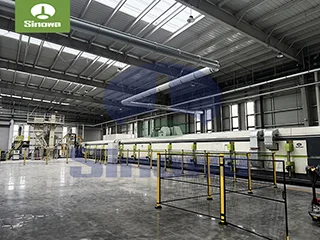
The overall structural design of the composite sandwich panel production line follows the logic of sequential production flow, with all functional modules arranged in a scientific linear layout to ensure smooth material circulation and seamless connection between each processing link. The entire system can be divided into three core functional sections including front-end raw material preprocessing section, middle composite molding and curing section, and back-end finishing and sorting section, supplemented by a unified central control system that coordinates the operation of all equipment units. Each functional section undertakes independent processing tasks while maintaining precise linkage with adjacent modules, forming a closed-loop production system with high synchronization and coordination. This modular integrated design not only simplifies the overall production process but also improves the flexibility of equipment operation, allowing the production line to adapt to different core materials and panel specification adjustments within a reasonable range.
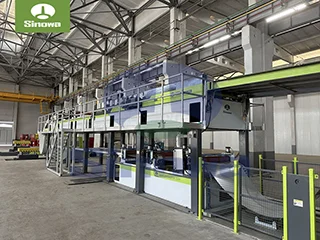
The front-end raw material preprocessing section is the initial link that determines the basic quality of finished panels, mainly responsible for the feeding, leveling, shaping, and pretreatment of surface covering materials and core insulation materials. For common metal surface materials such as color-coated steel sheets and aluminum sheets, the composite sandwich panel line is equipped with automatic unwinding devices that support stable and continuous discharge of coiled materials. Equipped with intelligent deviation correction structures, the unwinding system can dynamically adjust the feeding position in real time during operation, effectively avoiding lateral deviation of sheet materials and ensuring the straightness and uniformity of subsequent processing. After unwinding, the coiled sheets enter the roll forming system composed of multiple groups of precision forming rollers, which gradually press the flat sheets into customized contour structures such as flat plates, corrugated plates, and special-shaped edge structures through multi-stage rolling and shaping. This gradual cold forming process avoids structural damage to the surface materials, maintains the smoothness and structural strength of the sheet surface, and meets the assembly and connection requirements of different building and industrial scenarios.
In parallel with the surface material processing, the core material pretreatment and conveying system operates synchronously to complete the arrangement and laying of lightweight core materials. The composite sandwich panel machine is compatible with a variety of common insulation and filling core materials, including polystyrene foam, polyurethane foam, rock wool, glass magnesium board, and other lightweight composite materials, and can realize rapid switching of core material types through adjustable feeding structures. For bulk flexible core materials, the system adopts automatic quantitative feeding and uniform spreading technology to ensure consistent thickness and density of the core material layer; for rigid and semi-rigid core materials such as rock wool strips, it is equipped with precise cutting and positioning laying devices to cut core materials into standard sizes and arrange them neatly in the middle of the upper and lower surface sheets. Before composite molding, the system is also equipped with surface preheating and cleaning devices to remove dust and impurities on the surface of materials, and adjust the material temperature to the optimal bonding range, which significantly enhances the adhesion between the surface sheet and the core material, and improves the overall structural tightness and durability of the composite panel.
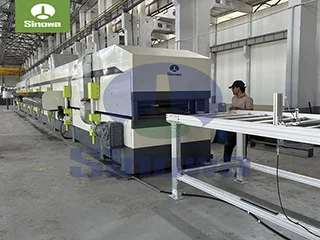
The middle composite molding and curing section is the core functional area of the entire composite sandwich panel production machine, which directly determines the bonding strength, structural stability and comprehensive performance of the finished sandwich panels. This section mainly includes high-precision glue coating system, synchronous lamination pressing system and constant temperature curing system. The glue coating system adopts uniform spraying and roller coating integrated technology, which can quantitatively and evenly coat environmental adhesive materials on the bonding surfaces of upper and lower sheets and core materials according to set parameters. The intelligent glue supply control unit can adjust the glue amount and coating uniformity in real time according to different material characteristics and panel thickness specifications, avoiding quality problems such as local glue shortage, glue accumulation and uneven bonding, and ensuring that the bonding interface forms a dense and uniform adhesive layer.
After the completion of glue coating, the surface materials and core materials enter the lamination pressing area for integral composite molding. The lamination system adopts multi-group balanced pressure structure, which can apply stable and uniform pressing force on the entire surface of the composite material layer. The constant pressure molding mode ensures that the upper and lower sheets and the middle core material are closely fitted without gaps, and effectively avoids panel deformation, hollowing and layering defects caused by uneven pressure. Meanwhile, the matching constant temperature curing device creates a stable temperature environment for the curing reaction of the adhesive and the foaming molding of foam core materials. By precisely controlling the curing temperature and residence time, the system accelerates the solidification and bonding reaction of the adhesive, promotes the full integration of the composite structure, and significantly improves the overall structural strength, peeling resistance and shear resistance of the sandwich panel. For foam-type core materials, the constant temperature environment can also ensure uniform foaming density and stable pore structure, so that the finished panels have consistent thermal insulation and sound insulation performance.
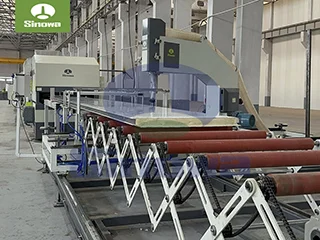
The back-end finishing and sorting section undertakes the final processing and standardized collection of the initially cured composite panels, including fixed-length cutting, edge trimming, surface finishing, automatic stacking and auxiliary conveying functions. After continuous composite molding and primary curing, the long strip composite panels are transported to the fixed-length cutting device through the synchronous conveying system. The high-precision cutting mechanism can automatically identify and adjust the cutting position according to the preset panel length specifications, realizing flat and smooth cutting sections without burrs or deformation. The edge trimming device further trims the edges of the panels to ensure consistent overall dimensions and neat edge structures, which facilitates subsequent on-site assembly and installation of the panels.
After finishing processing, the qualified panels are automatically transported to the stacking area, where the intelligent stacking device completes orderly stacking and arrangement according to set quantities and specifications. The entire stacking process is stable and orderly, avoiding surface scratches, extrusion deformation and other quality problems caused by manual handling. In addition, this section is equipped with real-time quality monitoring components, which conduct online detection of panel dimensional accuracy, surface flatness, and bonding integrity during the conveying process, and automatically screen out unqualified products, realizing real-time quality control in the production process.
The central control system runs through the entire composite sandwich panel production machinery and serves as the intelligent core to coordinate the operation of all functional modules. The system adopts integrated programmable control logic to realize unified scheduling and synchronous control of feeding, forming, gluing, pressing, curing, cutting and stacking processes. Operators can set production parameters such as panel thickness, width, length, core material type and processing speed through the centralized operation interface. The control system can automatically adjust the operating parameters of each equipment unit in real time according to the set standards, ensuring the synchronization and coordination of each link. In the actual production process, the system can also monitor the operating status, operating parameters and equipment load of each module in real time, and automatically alarm and locate faults when abnormal conditions such as equipment stalling, parameter deviation and material shortage occur, which greatly reduces the failure rate of the production line and improves the stability and continuity of production operation.
Compared with traditional intermittent production equipment, the sandwich panel composite production line has prominent advantages in production efficiency, product quality stability, resource utilization and production cost control. In terms of production efficiency, the fully automated continuous production mode realizes uninterrupted operation of the entire process from raw material input to finished product output, avoiding frequent start-stop and debugging operations of discrete equipment, and greatly improving the unit time output. In terms of product quality, the standardized parameter control and integrated processing mode eliminate human operation errors, making the dimensional accuracy, bonding performance and surface quality of each batch of products highly consistent, and effectively reducing the defective rate of products.
In terms of resource utilization, the precise quantitative control of the glue coating system and the intelligent feeding structure avoid waste of adhesive materials and core materials. The optimized transmission and processing structure reduces energy consumption in the production process, realizing energy-saving and efficient production. In terms of production management, the highly automated operation mode reduces the demand for manual operators, simplifies the production management process, and enables manufacturers to complete large-scale standardized production with fewer human resources, effectively reducing comprehensive production costs. In addition, the modular structural design of the composite sandwich panel manufacturing line gives it strong scalability and adaptability. By replacing individual functional modules and adjusting operating parameters, the same production line can produce sandwich panels with different core materials, different thickness specifications and different structural types, covering wall panels, roof panels, purification panels and other diversified product types, meeting the differentiated production needs of multiple industries.
With the continuous upgrading of industrial manufacturing technology and the increasing market demand for high-performance energy-saving building materials, the technical iteration of composite sandwich panel making machine is also accelerating. Modern production lines are gradually developing towards higher automation, intelligent precision control, green environmental protection and multi-functional integration. The upgraded intelligent sensing technology can realize more accurate real-time monitoring of material bonding status, curing degree and panel performance indicators; the optimized energy-saving structure further reduces the energy consumption of unit products; the improved sealing and dust-proof design optimizes the production environment and reduces the discharge of process waste. At the same time, the flexible production capacity of the equipment is continuously improved, which can adapt to the personalized and customized production needs of small batches and multiple specifications, breaking through the limitation that traditional equipment is only suitable for large-scale single-variety production.
As a key equipment for the production of new composite building materials, the sandwich panel composite production line plays an important supporting role in the development of modern construction industry and energy-saving environmental protection industry. The high-quality composite panels produced by the line have the advantages of light weight, high strength, good thermal insulation, sound insulation, fire resistance and weather resistance, and are widely used in industrial factory buildings, logistics cold storage, purification workshops, temporary buildings, municipal engineering and other fields. The stable and efficient production capacity of the production line ensures the sufficient market supply of high-performance composite panels, and its standardized production level promotes the overall upgrading of the composite panel manufacturing industry, driving the development of the building material industry towards high efficiency, energy saving, environmental protection and standardization. In the future, with the continuous innovation of material technology and intelligent manufacturing technology, the composite sandwich panel production equipment will further realize intelligent unattended operation, precise quality traceability and green low-carbon production, and provide more powerful technical support for the popularization and application of new energy-saving composite building materials.
https://www.cnsinowa.com/sandwich-panel-machines/sandwich-panel-composite-production-line.html