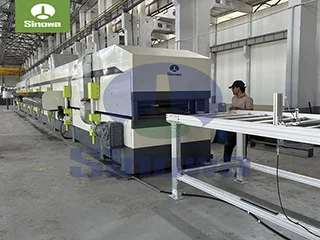
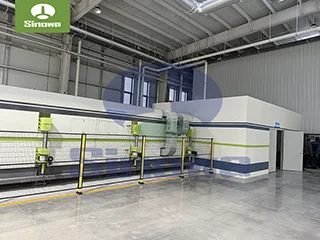
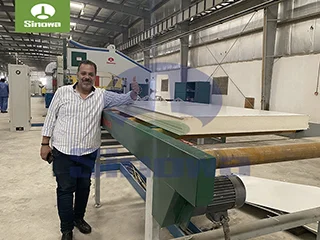
sandwich panel line
The fundamental strength of PIR sandwich panels as roofing materials lies in their composite structure, typically consisting of a rigid PIR foam core bonded between two outer facings, most commonly metal sheets. PIR foam, a modified polyurethane material with enhanced isocyanurate structures, offers exceptional thermal insulation properties, high-temperature stability, and fire resistance, making it ideal for roofing applications where temperature regulation and safety are paramount. Unlike traditional roofing materials, PIR sandwich panels combine lightweight characteristics with impressive load-bearing capacity, allowing for reduced structural support requirements while maintaining long-term durability. The full-automatic production line is engineered to capitalize on these material advantages, ensuring that each panel is manufactured with precise core thickness, uniform foam distribution, and strong adhesion between facings and core—critical factors that directly impact the performance and lifespan of the final roofing product.
A fully automatic PIR sandwich panel production line for roof panels operates as a seamless, integrated system, encompassing a series of interconnected stages that transform raw materials into finished panels with minimal manual intervention. The production process begins with the handling and preparation of facing materials, which typically arrive in large coils. These coils are fed into uncoiling machines, which unwind the material smoothly and consistently to prevent wrinkling or damage. Following uncoiling, the facing sheets pass through leveling units to correct any imperfections or distortions, ensuring a flat, uniform surface that will facilitate proper bonding with the PIR core. In some configurations, the facing sheets may also undergo surface treatment processes, such as corona treatment, to enhance the adhesion properties of the material, ensuring a strong and durable bond with the foam core.
After preparation, the facing sheets are guided into the roll forming section, a critical stage for roof panel production. Roll forming machines shape the facing sheets into specific profiles tailored to roofing requirements—common profiles include trapezoidal, corrugated, or ribbed designs, which enhance the panel’s structural strength, water drainage capabilities, and resistance to wind uplift. The roll forming process is fully automated, with precision-engineered rollers that gradually shape the metal sheets without compromising their structural integrity. The ability to produce custom profiles is a key advantage of modern production lines, allowing manufacturers to adapt to the specific design needs of different roofing projects, from flat concrete roofs to sloping industrial roofs and photovoltaic (PV) integrated roofing systems.
Concurrent with the preparation of facing sheets, the production line handles the formulation and application of the PIR foam core—a process that demands strict precision to ensure consistent quality. High-pressure foaming machines are the heart of this stage, responsible for accurately dosing, mixing, and pressurizing the chemical components required to produce PIR foam. These components, typically polyol and isocyanate, are heated to optimal temperatures and mixed in precise ratios to initiate the foaming reaction. Advanced foaming systems may also incorporate nucleators to control the cell structure of the foam, enhancing its thermal insulation properties and mechanical strength. The foaming machine dispenses the reactive mixture onto the lower facing sheet as it moves along the production line, ensuring uniform coverage across the entire width of the panel.
Once the foam mixture is applied, the upper facing sheet—previously prepared and roll-formed—is brought into contact with the foam layer, forming a sandwich structure. This assembly then enters the double belt press, a critical component that controls the foaming process and ensures the final panel’s flatness and thickness. The double belt press consists of two parallel, continuously moving belts that apply uniform pressure to the sandwich structure while maintaining precise temperature control. The controlled temperature and pressure conditions within the press facilitate the optimal expansion and curing of the PIR foam, ensuring that the core achieves its full structural and thermal properties. The belts are also insulated to minimize energy loss, contributing to the production line’s overall energy efficiency. The length of the double belt press is designed to provide sufficient curing time for the foam, which is essential for achieving the desired strength and stability of the final panel.
After exiting the double belt press, the cured sandwich panel moves to the cutting section, where it is trimmed to the required lengths. Modern production lines utilize flying saw cutting machines, which operate in synchronization with the moving panel to perform precise, on-the-fly cuts without interrupting the production flow. These cutting machines are equipped with sharp, durable blades—either band saws or disk blades—and may feature 180-degree rotating mechanisms to allow for cutting in both directions, enabling the production of short panel lengths even at high line speeds. The cutting process is fully automated, with dimensions controlled by the production line’s central control system, ensuring high precision and minimizing material waste. Following cutting, the panels undergo a cooling stage to stabilize the foam core and ensure dimensional accuracy, particularly important for maintaining consistent quality in varying environmental temperatures.
The final stages of the production process include handling, stacking, and wrapping the finished panels. Automated handling systems, including conveyors, turning stations, and stacking machines, move the panels efficiently without causing damage. Stacking machines arrange the panels in neat, stable piles, ready for wrapping. Wrapping units apply protective film or packaging material to the stacked panels, safeguarding them from moisture, dust, and scratches during storage and transportation. These final stages are fully integrated into the automatic system, reducing the need for manual handling and minimizing the risk of product damage, further enhancing production efficiency and product quality.
A defining feature of modern full-automatic PIR sandwich panel production lines is their advanced control systems, which centralize all production processes and enable seamless coordination between different stages. The central control system, often equipped with a user-friendly human-machine interface (HMI), allows operators to monitor and adjust key production parameters—such as line speed, foam mixing ratios, press temperature and pressure, and cutting dimensions—with precision. Advanced systems may also incorporate bus control technology and remote communication capabilities, enabling real-time monitoring and troubleshooting from off-site locations. Fault self-diagnosis functions are another critical feature, automatically detecting issues such as material shortages, equipment malfunctions, or parameter deviations and alerting operators to minimize downtime. This high level of control not only ensures consistent product quality but also enhances operational efficiency by reducing the risk of errors and minimizing production interruptions.
Modular design is another key advantage of contemporary full-automatic production lines, offering flexibility and scalability to meet changing production needs. Modular components—such as uncoilers, roll formers, foaming units, and cutting machines—can be easily integrated, reconfigured, or expanded, allowing manufacturers to adapt the line to produce different panel types (including wall panels and cold storage panels) or adjust production capacity as demand grows. This modularity also simplifies maintenance and repair, as individual components can be serviced or replaced without disrupting the entire production line. Additionally, modular design facilitates standardized production processes, ensuring that components are interchangeable and reducing the need for custom manufacturing, which can lower operational costs and shorten lead times.
The efficiency of full-automatic PIR sandwich panel production lines is evident in their ability to minimize labor requirements, reduce material waste, and maximize production output. By automating all key processes—from raw material handling to finished product packaging—the lines significantly reduce the need for manual intervention, lowering labor costs and minimizing the risk of human error. Precise control over foam mixing, application, and curing ensures that each panel has a uniform core thickness and consistent foam density, reducing material waste and improving product yield. High line speeds, combined with continuous production capabilities, enable manufacturers to produce large volumes of panels in a short period, meeting the demands of large-scale construction projects. Energy-efficient design features—such as insulated press belts, low-energy foaming systems, and efficient heating and cooling units—further enhance the lines’ sustainability, reducing energy consumption and operational costs over time.
The PIR roof panels produced by these automatic lines offer a wide range of performance benefits that make them suitable for diverse roofing applications. Their exceptional thermal insulation properties, characterized by low thermal conductivity (typically between 0.022 and 0.024 W/m·K), make them ideal for energy-efficient buildings, reducing heating and cooling costs and minimizing carbon footprints. This thermal efficiency is particularly valuable for cold storage facilities, where precise temperature control is critical, and for industrial and commercial buildings seeking to meet strict energy efficiency standards. The panels’ high compressive strength and load-bearing capacity enable them to support heavy loads, including snow, wind, and solar panels, making them suitable for PV-integrated roofing systems—a growing segment of the construction industry driven by renewable energy goals.
Fire resistance is another key performance attribute of PIR roof panels, thanks to the inherent properties of PIR foam. Unlike many other insulation materials, PIR foam exhibits a unique carbonization behavior when exposed to fire, forming a protective char layer that limits flame spread and reduces heat release. This fire resistance enhances the safety of buildings, making PIR roof panels a preferred choice for industrial and commercial applications where fire safety is a priority. Additionally, the panels’ durable metal facings provide excellent resistance to corrosion, moisture, and UV damage, ensuring long-term performance even in harsh environmental conditions. Their low water absorption rate (typically less than 1%) further enhances their durability, preventing moisture-related damage and extending the lifespan of the roofing system.
The versatility of PIR roof panels produced by full-automatic lines is reflected in their wide range of applications across various sectors. In the industrial sector, they are commonly used for roofing in manufacturing facilities, warehouses, and logistics centers, where large spans, rapid installation, and energy efficiency are essential. Agricultural buildings, such as greenhouses, barns, and livestock facilities, also benefit from PIR roof panels, as their thermal insulation properties help maintain optimal internal temperatures for crop growth and animal welfare. Commercial applications include shopping malls, office buildings, and retail outlets, where the panels’ aesthetic flexibility (available in various profiles and finishes) and performance benefits make them a practical choice. Additionally, their compatibility with PV systems has made them a key component in renewable energy projects, enabling the integration of solar power generation into roofing designs.
The use of full-automatic production lines also contributes to the sustainability of PIR roof panel manufacturing. By minimizing material waste through precise production processes, the lines reduce the environmental impact of manufacturing. Energy-efficient design features lower energy consumption, reducing greenhouse gas emissions. Furthermore, the long lifespan of PIR roof panels—often exceeding 50 years—reduces the need for frequent replacement, minimizing the environmental impact associated with the production and disposal of roofing materials. The lightweight nature of the panels also reduces transportation costs and carbon emissions during delivery, further enhancing their sustainability profile.
Looking to the future, the development of full-automatic PIR sandwich panel production lines is likely to focus on further enhancing efficiency, sustainability, and technological integration. Advances in foaming technology may lead to the development of low-VOC (volatile organic compound) PIR foam formulations, reducing the environmental impact of the production process. Improvements in control systems, including the integration of artificial intelligence (AI) and machine learning, could enable predictive maintenance, optimizing production schedules and minimizing downtime. Additionally, the integration of digital twin technology may allow manufacturers to simulate production processes, identify potential issues, and optimize parameters before full-scale production, further improving product quality and efficiency.
Another area of potential advancement is the expansion of material compatibility, enabling production lines to handle a wider range of facing materials and core insulations. This could include the integration of recycled materials into facing sheets or the production of hybrid panels with enhanced performance properties. Additionally, the development of more compact and flexible production lines may enable manufacturers to serve smaller markets or on-site production needs, further expanding the applications of PIR roof panels.
In conclusion, the full-automatic PIR sandwich panel production line for roof panels represents a significant advancement in construction material manufacturing, combining precision engineering, automation, and sustainability to produce high-performance roofing solutions. Its integrated, modular design ensures efficiency, flexibility, and consistent quality, while the PIR roof panels it produces offer exceptional thermal insulation, structural strength, and durability. As the construction industry continues to prioritize energy efficiency, safety, and sustainability, the role of these production lines will only grow, driving innovation and meeting the evolving needs of diverse roofing applications. From industrial warehouses to renewable energy projects, the full-automatic PIR sandwich panel production line is shaping the future of roofing, providing reliable, efficient, and sustainable solutions that stand the test of time.
https://www.cnsinowa.com/sandwich-panel-machines/full-automatic-pir-sandwich-panel-production-line-for-roof-panels.html