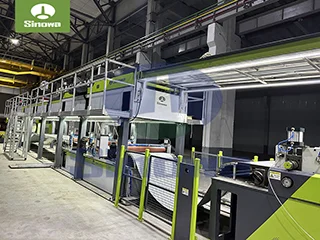
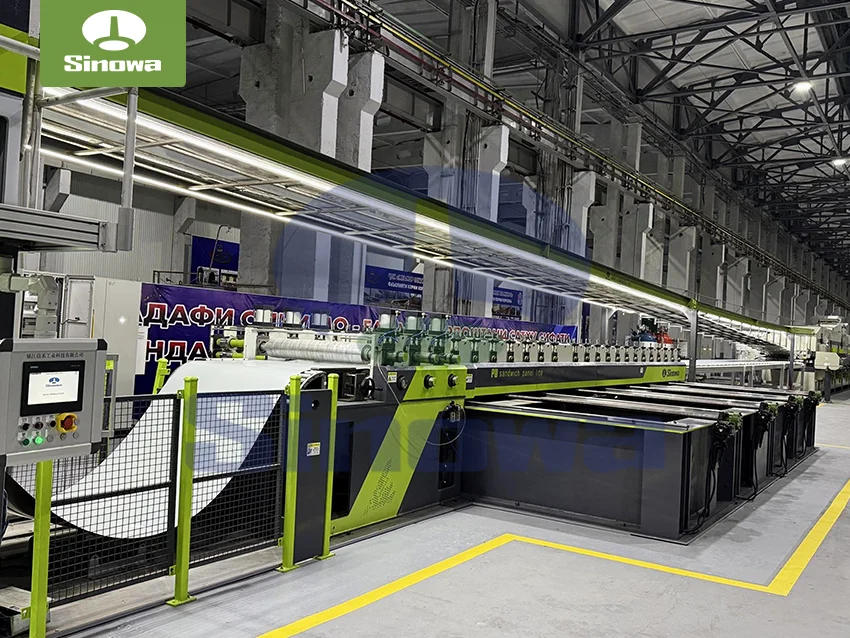
 sandwich panel line
The overall structural design of the sandwich panel production line is centered on practicality and maintainability, with all core functional components arranged in a logical and accessible layout. Every functional unit is independent yet closely coordinated in operation, realizing seamless connection of each production link without redundant mechanical structures. The raw material feeding section adopts a stable unwinding and leveling structure, which can steadily release and flatten surface materials for sandwich panels. The structural optimization of this part focuses on reducing material friction and residue accumulation, fundamentally lowering the frequency of daily cleaning and component replacement. The transmission system connecting each production section uses standardized chain and gear combinations with high wear resistance and stable transmission performance. These standardized components feature universal specifications and simple disassembly steps, enabling ordinary operators to complete daily inspection and replacement without professional technical training, which greatly reduces the threshold of equipment maintenance.
In the gluing and core material compounding section that determines panel bonding quality, the sandwich panel line is equipped with an optimized quantitative gluing system. The pipeline and nozzle structures of the gluing system are designed with anti-blocking and easy-cleaning concepts, effectively solving the common problems of adhesive residue accumulation and pipeline blockage in traditional equipment. During continuous production, the system can maintain uniform and stable adhesive coating, and the residual adhesive inside the pipeline can be quickly removed through simple flushing and wiping after daily shutdown, avoiding long-term solidification of adhesive that affects subsequent production accuracy. The core material laying and positioning auxiliary structures are simplified and optimized, with fewer precision vulnerable parts, reducing daily wear and failure probability, and further cutting down the workload of routine maintenance and component replacement.
The laminating and pressing section is the core link for forming integrated sandwich panels, and its structural stability directly determines the flatness and bonding firmness of finished panels. The simple maintenance sandwich panel machine adopts constant-pressure laminating structure with adjustable pressure parameters, and the internal pressure balance components are sealed and protected scientifically to prevent dust, debris and moisture in the production environment from invading the mechanical moving parts. This protective design greatly reduces the occurrence of mechanical jamming and pressure deviation caused by environmental pollution. The surface of the pressing roller is treated with anti-stick and wear-resistant process, which can effectively resist the adhesion of residual core materials and adhesives during production. Daily cleaning only requires simple surface wiping to keep the roller surface smooth and flat, ensuring consistent pressing quality for each batch of panels without frequent precision calibration of roller gaps.
The curing and shaping area of the sandwich panel manufacturing line relies on stable environmental temperature and air circulation design to complete the natural curing and shaping of composite panels. Compared with high-energy-consuming and complex constant-temperature curing equipment, the optimized curing structure of this line has no precise and fragile temperature-sensing components that are easy to damage. It maintains a stable curing environment through reasonable spatial layout and air convection design, reducing the failure rate of electrical and induction components. The internal support frame of the curing area adopts integrated welding structure with strong structural stability, which is not easy to deform or loose after long-term operation, eliminating the need for regular structural reinforcement and calibration work. This not only ensures the consistent molding quality of sandwich panels but also greatly simplifies the daily inspection and maintenance work of the curing link.
The final cutting and finishing section of the sandwich panel making machine focuses on operational simplicity and maintenance convenience. The precision cutting tool is equipped with a protective isolation structure, which can isolate most production dust and debris, slowing down tool wear and avoiding cutting precision deviation caused by residue accumulation. The cutting positioning system adopts mechanical limit and parameter memory design, which can maintain stable cutting size accuracy for a long time after one-time calibration. Operators only need to check the tightness of fixed parts and the sharpness of cutting tools regularly, without repeated debugging of positioning parameters. The trimmed waste recycling structure is simple and smooth, which can automatically collect production waste and reduce residue accumulation on the equipment surface, further reducing the cleaning range and workload of daily maintenance.
The simple maintenance advantage of the sandwich panel production machine is fully reflected in the standardized hierarchical maintenance system, which divides daily upkeep into daily routine inspection, weekly partial maintenance and monthly comprehensive calibration, forming a complete and low-cost maintenance cycle. Daily maintenance work is mainly concentrated on surface cleaning and basic operation inspection. After each daily production, operators only need to wipe the surface of transmission rollers, conveyor belts and cutting tools to remove accumulated dust, residual core materials and adhesive debris, and check whether there is abnormal noise or vibration during equipment no-load operation. Meanwhile, it is necessary to confirm the lubricating oil level of each transmission friction part and supplement lubricating oil in time to ensure the flexibility of mechanical operation. These simple operations can effectively avoid hard residue scratching raw materials and affecting processing accuracy, and eliminate potential operational hazards caused by insufficient lubrication.
Weekly maintenance focuses on partial component inspection and targeted cleaning and maintenance. It is necessary to conduct a comprehensive inspection of all transmission chains, gears and bearing parts to check for wear, looseness and abnormal friction, and fasten loose connecting parts in time. For the gluing system, thorough cleaning of internal pipelines and nozzles is required to remove residual solidified adhesive and prevent pipeline blockage that may affect gluing uniformity in the next production cycle. In addition, operators need to check the flatness of the feeding platform and the flexibility of material positioning components to ensure stable material conveying and accurate positioning, avoiding panel deviation and dimensional errors caused by material conveying abnormalities.
Monthly comprehensive maintenance covers precision calibration and overall equipment condition assessment. The key work includes verifying the dimensional accuracy of the cutting system to ensure that the cutting length and edge finishing of finished panels meet production standards, and calibrating the pressure parameters of the laminating system to maintain consistent bonding strength of composite panels. It is also necessary to comprehensively check the line connection of the control system, clean the dust on the surface of electrical components, and confirm the sensitivity of emergency stop and protection devices. For parts with slight wear found during inspection, targeted replacement and maintenance can be carried out in a timely manner to avoid minor faults evolving into large-scale equipment failures, ensuring the long-term stable operation of the entire sandwich panel manufacturing line.
The modular design of the production line brings unique advantages for fault maintenance and component replacement. Each functional module is relatively independent, and when a single component or local module fails, maintenance personnel can directly disassemble and replace the faulty part without dismantling the entire production line or affecting the normal operation of other functional areas. This structural feature greatly shortens equipment maintenance time, minimizes production interruption caused by equipment failure, and effectively improves the overall operation rate of the production line. At the same time, the standardized component specifications of the sandwich panel production machinery make spare parts procurement more convenient, avoiding the problem of difficult matching of special parts in traditional equipment, and further reducing the time cost and economic cost of equipment maintenance.
Reasonable daily maintenance not only prolongs the service life of the sandwich panel production line but also ensures the stability and consistency of finished product quality. Long-term standardized cleaning and lubrication can reduce mechanical wear and friction loss of equipment, avoid precision deviation of key components caused by long-term high-load operation, and thus ensure the flatness, bonding firmness and dimensional accuracy of each batch of sandwich panels. Regular inspection and calibration can eliminate potential faults in advance, avoid product quality problems such as uneven gluing, insufficient pressing strength and inaccurate cutting size caused by equipment abnormalities, and reduce the rate of defective products in the production process.
In actual production and application scenarios, the simple maintenance design of the sandwich panel line also reduces the enterprise’s dependence on professional maintenance technicians. ordinary production operators can master all maintenance processes through simple operational training, realizing self-inspection and self-maintenance of daily equipment. This not only optimizes the enterprise’s human resource allocation and reduces the daily operation and maintenance cost of the production line but also improves the timeliness of equipment fault handling. On-site operators can find and solve minor equipment abnormalities in the first time, avoiding fault expansion and ensuring the continuity and stability of production work.
In terms of environmental adaptability, the sandwich panel production equipment has strong tolerance to conventional production environments, and its maintenance design fully considers the dust and temperature changes in building material production workshops. The key mechanical and electrical parts are equipped with targeted dust-proof and anti-corrosion protection measures, which can resist the influence of conventional workshop dust, humidity and temperature changes on equipment performance. Even in long-term continuous production and complex environmental conditions, the equipment can maintain stable operational performance, and the daily maintenance difficulty will not increase due to environmental changes, realizing low-maintenance and high-efficiency long-term operation.
With the continuous development of the building material industry, the market has put forward higher requirements for the economical efficiency and operational stability of production equipment. The simple maintenance sandwich panel production line perfectly conforms to the market development trend by virtue of its simple structure, convenient maintenance, stable performance and low operational cost. It not only meets the mass production demand of various specification sandwich panels for building thermal insulation, enclosure and decoration but also solves the pain points of complex maintenance, high failure rate and high operational cost of traditional production equipment. Through scientific and reasonable structural design and standardized maintenance system, the sandwich panel equipment realizes the organic unity of high production efficiency, stable product quality and low maintenance cost, providing reliable equipment support for the efficient and sustainable operation of building material production enterprises.
In the long-term equipment operation management, adhering to standardized simple maintenance procedures is the key to maintaining the best performance of the sandwich panel making line. The lightweight maintenance mode of the equipment does not mean neglecting daily management, but simplifies redundant maintenance links on the premise of ensuring comprehensive equipment protection. Every standardized cleaning, inspection, lubrication and calibration work can accumulate to form a good operational state of the equipment, effectively delay equipment aging, reduce failure frequency, and create greater economic benefits for production enterprises. For building material manufacturers, choosing a simple maintenance sandwich panel machinery is not only a choice of production equipment, but also a scientific operational management mode, which can help enterprises reduce operational costs, stabilize product quality, and enhance market competitiveness in the fierce industry competition.
https://www.cnsinowa.com/sandwich-panel-machines/simple-maintenance-sandwich-panel-line.html