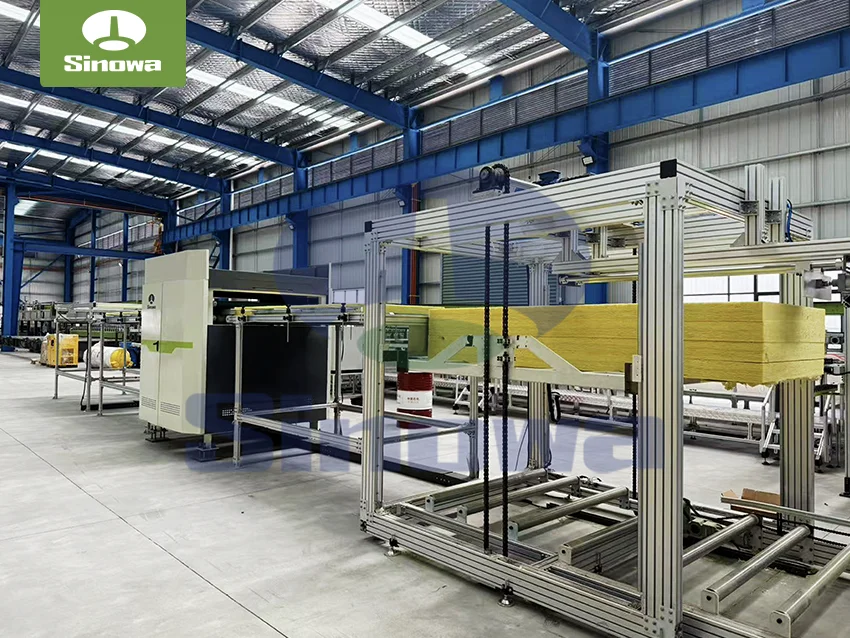
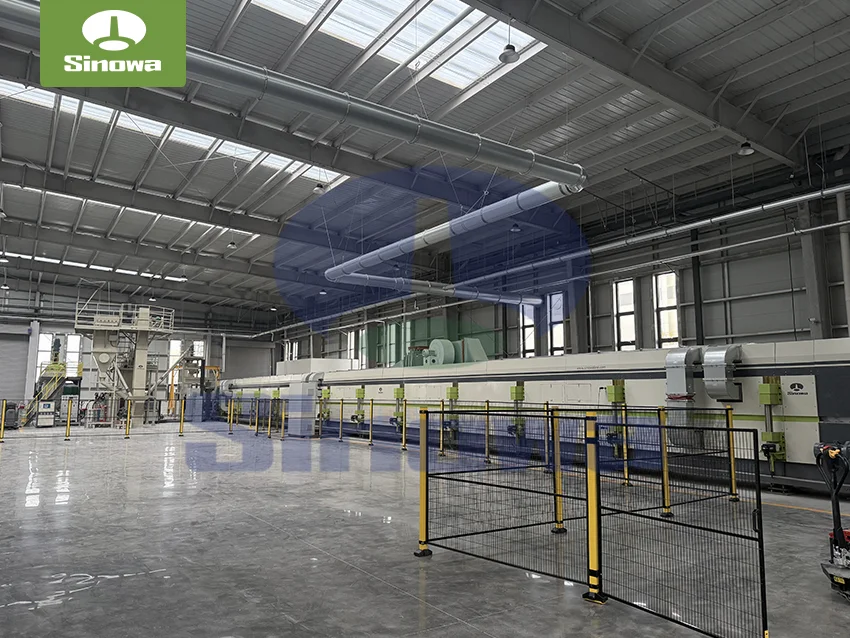
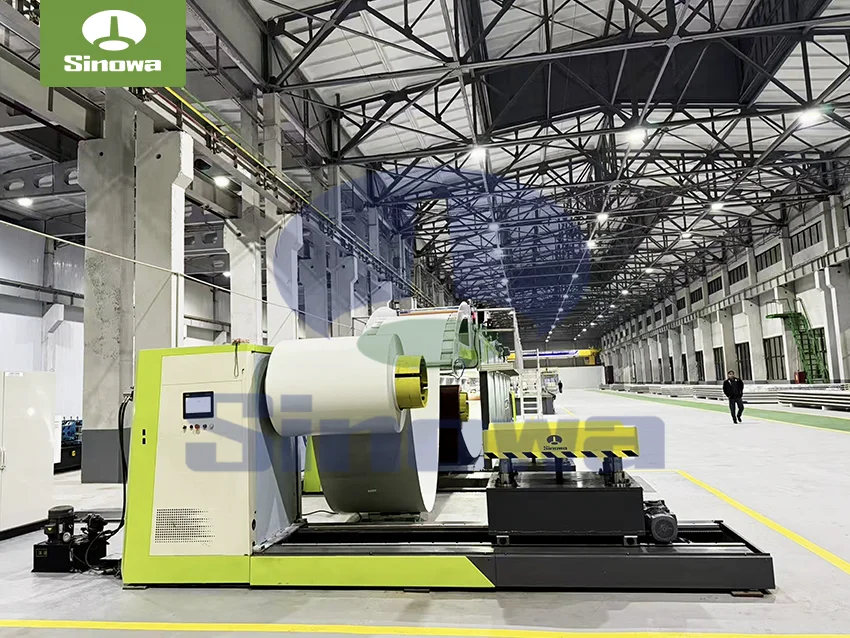
 sandwich panel machine
The entire operating system of the polyurethane color steel sandwich panel machine adopts a modular integrated design, with all functional units coordinated and operated synchronously through a unified intelligent control logic, ensuring the continuity and stability of the production process. The complete production system covers raw material pretreatment, surface plate rolling forming, polyurethane raw material precise mixing and pouring, composite lamination pressing, constant-temperature curing, fixed-length cutting, and finished product conveying and stacking, forming a fully closed-loop production chain. Each functional module is designed with highly targeted mechanical structures and control programs, which can adapt to the production requirements of different panel specifications, thicknesses, and usage scenarios, and maintain excellent production consistency in long-term continuous operation.
The initial stage of the production process centers on the feeding and pretreatment of color steel coil materials, which lays a foundational guarantee for the flatness and bonding performance of finished panels. The polyurethane sandwich panel machine is equipped with a stable unwinding structure that can carry large-capacity color steel coils, realizing automatic and stable discharging of upper and lower color steel plates. In the feeding process, the built-in correction device continuously monitors the running track of the steel plates in real time, automatically adjusting the offset of the coil materials to avoid lateral deviation during transmission, which effectively prevents uneven edge trimming and inconsistent plate thickness in subsequent processing. Meanwhile, the professional cleaning and drying unit removes surface dust, oil stains, and moisture on the color steel plates through multi-stage physical treatment, eliminating the interference of surface impurities on the subsequent bonding of polyurethane foam and steel plates, and greatly improving the composite firmness and durability of the sandwich structure.
After completing pretreatment, the color steel plates enter the rolling forming unit for precise shape calibration and structural shaping. The rolling system consists of multiple groups of precision rollers arranged in an orderly manner, which gradually presses the flat color steel plates into the required structural profiles according to the preset panel processing standards. This gradual rolling forming mode avoids structural damage and stress concentration caused by one-time strong pressing, ensuring the uniform thickness, flat surface, and stable structural performance of the formed steel plates. The gap between each group of rollers can be fine-tuned according to different production needs, enabling the equipment to process color steel plates of different thicknesses and produce sandwich panels with diverse surface structural designs, meeting the personalized construction needs of different engineering projects.
The polyurethane foaming and pouring link is the core process that determines the thermal insulation performance and structural strength of the finished sandwich panel, and also the most technically sophisticated part of the entire production line. The polyurethane sandwich panel line is equipped with a high-precision metering and mixing system for polyurethane raw materials, which can accurately proportion two-component polyurethane raw materials according to fixed process parameters. The fully enclosed high-pressure mixing structure ensures the full and uniform fusion of raw materials without dead angles, avoiding uneven foaming, local hollowing, or inconsistent density caused by insufficient mixing. The uniformly mixed polyurethane solution is evenly poured on the surface of the lower color steel plate through a precise pouring port, with the pouring flow rate and range strictly controlled by the system to ensure the uniformity of the polyurethane core material in the whole plate width and length range.
Immediately after the pouring operation, the upper and lower color steel plates and the intermediate polyurethane raw material enter the lamination and pressing unit for composite forming. The constant-pressure lamination structure applies uniform and stable pressure to the composite plate body, making the liquid polyurethane raw material fully spread and filled between the two layers of steel plates, forming a tight composite structure. The pressure value of the lamination system is kept stable during the whole process, avoiding excessive pressure leading to excessive thinning of the core material or insufficient pressure resulting in loose bonding between layers. This synchronous pressing and shaping process enables the steel plates and polyurethane core material to form an integrated structure initially, laying a solid foundation for subsequent curing and final forming.
The constant-temperature curing zone is a key area for the chemical forming and performance stabilization of the polyurethane core material. The cured area adopts a fully insulated closed structural design, which can maintain a stable temperature environment required for polyurethane foaming and curing. In the process of slow transmission of the composite plate body in the curing zone, the polyurethane raw material completes foaming, cross-linking, and solidification reactions under constant temperature conditions, gradually forming a continuous, uniform, and high-density foam core layer. The length of the curing zone and the running speed of the conveyor system are matched with the curing cycle of polyurethane materials, ensuring that each batch of plates can complete sufficient chemical reaction, achieve the designed mechanical strength and thermal insulation performance, and avoid quality problems such as incomplete curing, soft core material, and poor structural stability caused by insufficient reaction time.
After completing curing and forming, the integrated sandwich panel enters the precise cutting stage. The automatic cutting system supports arbitrary setting of cutting length according to production requirements, and realizes fixed-length cutting of continuous plate bodies through high-precision sensing and positioning technology. The cutting tool adopts a high-hardness structural design, which can complete smooth cutting of composite plates with steel surface and foam core without burrs, plate deformation, or core material peeling. The cutting action is highly synchronized with the transmission speed of the polyurethane sandwich panel production line, realizing non-stop continuous cutting, which effectively improves the overall production efficiency while ensuring the dimensional accuracy of finished plates. The edge trimming function matched with cutting can further optimize the flatness of the plate edge, making the size and appearance of each finished panel highly unified.
The final stage of production is automatic conveying, sorting, and stacking of finished products. The qualified sandwich panels after cutting are stably transmitted to the stacking station through the conveyor system, and the automatic stacking device neatly arranges the finished plates according to fixed specifications. The whole process realizes unmanned automatic operation, which not only reduces the labor investment in the production link, but also avoids the surface scratches, plate deformation, and stacking disorder problems easily caused by manual handling. The neatly stacked finished panels have uniform specifications and stable stacking quality, which is convenient for subsequent packaging, transportation, and warehouse storage, and improves the overall standardization level of product delivery.
The outstanding advantages of the polyurethane color steel sandwich panel line in industrial production are mainly reflected in its high integration, stable operation, and strong adaptability. The whole production line adopts an integrated mechanical structure and intelligent control system, which realizes the full-process automation from raw material input to finished product output, greatly reducing manual intervention links. The centralized control system can monitor the operating parameters of each unit in real time, including transmission speed, mixing ratio, lamination pressure, curing temperature, and cutting size, and automatically adjust the operating state of the equipment according to real-time data, ensuring that the production process is always in a stable and controllable state. This intelligent control mode effectively reduces the error rate caused by manual operation and significantly improves the yield rate and consistency of finished products.
In terms of product performance guarantee, the equipment's precise process control capability endows the produced color steel polyurethane sandwich panels with excellent comprehensive performance. The uniformly foamed polyurethane core material has fine and closed-cell structure, which brings excellent thermal insulation, heat preservation, and sound insulation effects, effectively reducing the energy consumption of building temperature regulation and improving the indoor sound environment. The tight composite structure between the color steel plate and the polyurethane core material ensures the overall structural stability of the panel, with good compression resistance, bending resistance, and impact resistance. Meanwhile, the color steel surface has good weather resistance and corrosion resistance, enabling the panels to maintain stable performance in different complex natural environments such as high temperature, low temperature, and humid rain, with a long service life.
In terms of production efficiency and cost control, the continuous circulating production mode of the sandwich panel equipment breaks through the bottleneck of low efficiency of traditional intermittent production equipment. The synchronous operation of each functional module realizes seamless connection of all production links, without waiting and stagnation in the production process, and the unit time output is far higher than that of traditional processing equipment. The precise raw material metering system avoids raw material waste caused by inaccurate proportioning, and the high yield rate reduces the loss of raw materials and subsequent reprocessing costs. In addition, the highly automated production mode greatly reduces the number of on-site operators, lowers the long-term labor cost input for enterprises, and brings good economic benefits for large-scale and batch production of building panels.
The color steel sandwich panel production equipment also has strong production flexibility and scene adaptability, which can meet the diversified production needs of the construction industry. By adjusting the operating parameters of each module, the equipment can produce sandwich panels of different thicknesses, widths, and structural types, covering the production requirements of roof panels, wall panels, and partition panels used in industrial plants, public buildings, temporary construction facilities, and cold storage insulation projects. Whether it is conventional standard panel production or special-specification customized panel processing, the equipment can complete stable production, with strong product compatibility, which can well adapt to the diverse and personalized development trend of modern building engineering.
In terms of color steel sandwich panel machinery operation and maintenance, the modular structural design brings great convenience for daily management. Each functional unit is relatively independent, which is convenient for daily inspection, fault detection, and partial maintenance and replacement. The equipment is equipped with a perfect operation protection mechanism, which can automatically alarm and stop operation in case of abnormal parameters such as equipment jamming, raw material shortage, and temperature deviation, effectively avoiding equipment failure expansion and production safety accidents. The simplified mechanical transmission structure reduces the wear and failure rate of parts in long-term operation, lowers the difficulty and cost of daily maintenance, and ensures the long-term stable and continuous operation of the production line.
With the continuous advancement of prefabricated building technology and the increasing improvement of building energy-saving standards, the market application prospect of polyurethane color steel sandwich panels is becoming increasingly broad, and the supporting production equipment is also constantly optimized and upgraded. Modern polyurethane color steel sandwich panel production machinery is gradually developing in the direction of higher automation, more precise control, lower energy consumption, and stronger intelligence. The continuous optimization of the curing system, foaming mixing technology, and intelligent monitoring function further improves product quality stability and production efficiency, and reduces the energy consumption and resource waste in the production process.
As a key equipment in the field of prefabricated energy-saving building materials, the polyurethane color steel sandwich panel production machine not only provides efficient and reliable production support for the manufacturing of high-performance building panels, but also promotes the standardized and industrialized development of the entire building material industry. Its efficient production capacity, stable product quality, and flexible production adaptability make it widely used in various construction fields, providing solid technical and equipment support for the construction of energy-saving, environmentally friendly, and high-efficiency modern buildings. In the future, with the continuous innovation of material technology and mechanical manufacturing technology, this type of equipment will further release its application value and become an important driving force for the iterative upgrading of the construction and building material industries.
https://www.cnsinowa.com/sandwich-panel-machines/polyurethane-color-steel-sandwich-panel-machine.html