sandwich panel line
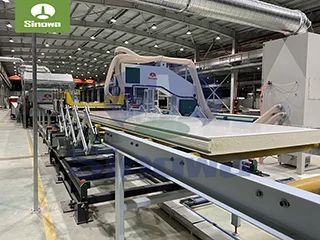
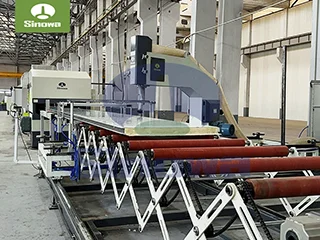
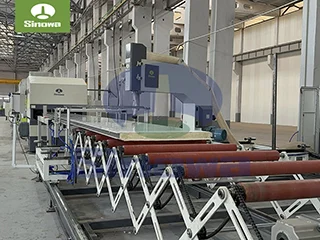
A complete custom PUR sandwich panel line is a highly integrated automated production system that combines raw material processing, precise batching and mixing, continuous laminating forming, constant-temperature curing, fixed-length cutting, and post-forming trimming. Every functional module of the production line supports flexible parameter adjustment, which constitutes the core advantage of customized production. The entire production workflow starts with raw material preparation and pretreatment, where metal coil materials used for panel surface layers are uncoiled, leveled, and precision-shaped through automated feeding systems. The leveling and shaping processes are fine-tuned based on the thickness, hardness, and surface coating characteristics of different metal materials, ensuring that the surface substrates maintain flatness and uniform structural tension throughout the production process. This adjustable pretreatment mechanism effectively avoids surface wrinkles, uneven stress distribution, and dimensional deviations that often occur in standardized production, laying a solid foundation for the subsequent composite forming of sandwich panels.
The core technological advantage of the custom PUR sandwich panel production line lies in its adjustable polyurethane foaming and gluing composite system. PUR foam materials rely on two-component chemical raw materials that achieve foaming, expansion, and solidification through precise proportional mixing. The customized production line is equipped with an intelligent metering and mixing system that can dynamically adjust the mixing ratio, material output volume, and injection speed of raw materials according to the required thermal insulation performance, core layer density, and structural strength of finished panels. In practical production, different application scenarios require distinct core layer performances: building exterior wall panels need moderate density and high thermal insulation to reduce building energy consumption, while industrial equipment enclosure panels require higher core layer compactness and structural toughness to withstand external impact and mechanical pressure. The adjustable batching system of the custom production line can accurately match the optimal foaming parameters for different product positioning, enabling the PUR core layer to form a uniform and fine cellular structure after foaming and curing, which delivers excellent thermal insulation, sound insulation, and pressure resistance.
The laminating and pressing process is a key link that determines the overall bonding strength and flatness of PUR sandwich panels, and the custom sandwich panel production line realizes flexible control of pressing parameters that traditional equipment cannot achieve. After the uniform injection of PUR mixed materials between the upper and lower surface substrates, the composite materials enter the continuous laminating conveyor system. The customized pressing structure can adjust pressing pressure, running speed, and fitting clearance in real time according to the panel thickness, substrate material hardness, and foaming expansion rate. For thin-specification decorative insulation panels, low-pressure and high-speed pressing parameters are adopted to prevent core layer compression deformation and maintain lightweight characteristics; for thick industrial load-bearing insulation panels, graded high-pressure pressing and low-speed forming processes are applied to ensure full bonding between the core layer and surface layers, eliminating hollow layers and delamination problems. The entire pressing process maintains stable and balanced force distribution across the panel surface, ensuring consistent thickness uniformity and overall flatness of each batch of customized products.
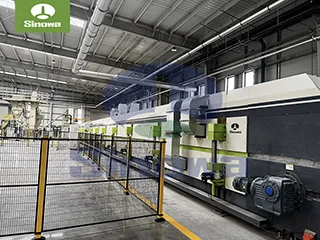
Constant-temperature curing is an indispensable stage to stabilize the structural performance of PUR sandwich panels, and the custom sandwich panel line is equipped with an intelligent temperature control curing system with adjustable temperature zones. The curing quality directly affects the bonding firmness, dimensional stability, and service life of finished panels. Traditional fixed-mode production lines often adopt single temperature and fixed-time curing procedures, which cannot adapt to the curing requirements of panels with different thicknesses and different raw material ratios. In contrast, the custom line can set independent curing temperatures and holding times for products of different specifications. Thicker panels require longer low-temperature slow curing to ensure thorough solidification of deep foam structures, while thin panels adopt rapid constant-temperature curing to improve production efficiency. The closed temperature-controlled curing channel maintains a stable internal temperature environment, avoiding product deformation, shrinkage, or performance attenuation caused by uneven temperature or excessive temperature fluctuation, and maximizes the structural stability of customized panels.
The post-forming processing module of the custom PUR sandwich panel machine also reflects strong personalized adaptability. After curing and forming, the continuous panel blanks are transported to the cutting and trimming system, which supports free setting of fixed-length cutting dimensions and edge trimming ranges. Whether producing short-size special-shaped panels for special engineering or long-size continuous panels for large-area building envelopes, the system can complete high-precision fixed-length cutting through automatic positioning and tracking technology. The cutting tool parameters and operating speed can be adjusted according to the hardness and thickness of the surface substrate, ensuring smooth and burr-free cutting sections and neat and regular panel edges. In addition, the production line can be expanded with personalized functional modules according to customer production needs, including surface groove processing, edge sealing treatment, and special-shaped bending functions, enabling one-time integrated forming of customized panels with complex structural requirements and avoiding secondary processing errors and cost increases.
The popularization and application of custom PUR sandwich panel machinery has greatly enriched the product diversity of the lightweight building material industry and improved the matching degree between building materials and engineering scenarios. In the field of civil building energy conservation, customized low-density and high-insulation PUR sandwich panels can be produced for residential exterior walls, roof insulation, and interior partition systems, effectively reducing building heating and cooling energy consumption and improving indoor thermal comfort. For public buildings such as exhibition halls, stadiums, and large shopping malls with high requirements for building appearance and space span, the production line can produce ultra-flat, high-decoration surface sandwich panels with customized width and length specifications, meeting the dual needs of architectural aesthetics and structural insulation.
In industrial production and cold chain logistics fields, the customized performance advantages of PUR sandwich panels are more prominent. Industrial plants, chemical workshops, and mechanical equipment enclosures require building materials with good sound insulation, heat insulation, and corrosion resistance. The custom production line can adjust the formula of PUR core materials and select different surface coating materials to produce anti-corrosion, noise-reducing, and high-temperature-resistant customized panels, adapting to harsh industrial production environments. Cold storage and fresh-keeping logistics facilities have extremely strict requirements for low-temperature thermal insulation performance, and the production line can produce high-density low-thermal-conductivity PUR sandwich panels through precise parameter adjustment, effectively reducing cold air loss in cold storage, maintaining stable internal low-temperature environment, and lowering long-term operation energy consumption of cold chain equipment.
In addition to performance and specification customization, the custom PUR sandwich panel manufacturing line also realizes flexible adjustment of production efficiency and production mode, bringing higher economic benefits to manufacturing enterprises. Small and medium-sized material manufacturers with diversified order needs can adjust the production line operating speed and switch product specifications quickly to meet small-batch and multi-variable customized order demands, avoiding the overcapacity and inventory backlog problems caused by single-specification mass production. Large-scale building material enterprises can optimize the production line configuration according to large-scale engineering project needs, set fixed high-efficiency production parameters for bulk customized products, and realize stable and efficient mass production while ensuring product consistency. This flexible production mode enables enterprises to accurately respond to market changes and personalized customer needs and enhance market competitiveness in the increasingly segmented building material market.
From the perspective of product performance and service life, panels produced by custom PUR sandwich panel production machine has more stable comprehensive quality than ordinary standardized products. The precisely matched raw material ratio, adaptive pressing process, and targeted curing mode make the internal cellular structure of the PUR core layer more uniform, with lower thermal conductivity and better thermal insulation sustainability. The tight composite structure between the core layer and surface layers effectively resists the influence of external temperature changes, humidity erosion, and mechanical vibration, avoiding common problems such as core layer powdering, delamination, and thermal insulation performance decline after long-term use. Meanwhile, customized production can optimize the product structure according to the stress characteristics of the application environment, enhancing the wind resistance, pressure resistance, and structural stability of the panel in specific usage scenarios, thus extending the overall service life of building and industrial facilities.
With the continuous advancement of industrial intelligence and green building concepts, the technical level of custom PUR sandwich panel production line is also constantly upgrading. Modern customized production lines have realized intelligent linkage of the whole process, with real-time monitoring and automatic adjustment of key parameters such as raw material batching, foaming temperature, pressing pressure, and cutting size. The system can automatically record production data of each customized product, form standardized production files, and facilitate product quality tracking and subsequent process optimization. At the same time, the optimized foaming process and raw material utilization technology effectively reduce raw material waste in the production process, improve material utilization efficiency, and reduce production energy consumption, which is in line with the development trend of green and low-carbon manufacturing in the building material industry.
In the future, as the construction industry continues to develop towards modularization, prefabrication, and personalized customization, the market demand for custom PUR sandwich panel line will continue to grow. Prefabricated buildings require a large number of personalized composite wall panels, roof panels, and enclosure components adapted to different building structures and spatial layouts, which cannot be fully met by traditional standardized production equipment. The flexible customization capability of PUR sandwich panel production lines can perfectly match the production needs of prefabricated building components, promote the rapid development of assembly construction technology, and improve the construction efficiency and standardization level of modern buildings. In addition, with the continuous expansion of special engineering fields such as environmental protection equipment, new energy facilities, and special isolation spaces, the application scenarios of customized PUR sandwich panels will be further enriched, driving the continuous technological innovation and functional upgrading of supporting production lines.
In summary, the custom PUR sandwich panel line as a flexible, efficient, and high-precision intelligent production system, breaks through the limitations of traditional fixed-mode production equipment and provides strong technical support for the personalized customization and high-quality production of lightweight composite building materials. Through adjustable raw material batching, adaptive composite pressing, targeted constant-temperature curing, and flexible post-processing technology, it can produce sandwich panel products with diverse specifications, stable performance, and strong scenario adaptability, covering the application needs of civil construction, industrial manufacturing, cold chain logistics, and special engineering fields. With the dual driving forces of market demand upgrading and manufacturing technology progress, custom PUR sandwich panel production technology will continue to mature, playing a more important role in promoting the high-quality development of the building material industry and the innovation and upgrading of modern construction engineering.
https://www.cnsinowa.com/sandwich-panel-machines/custom-pur-sandwich-panel-line.html