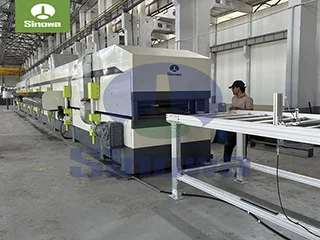
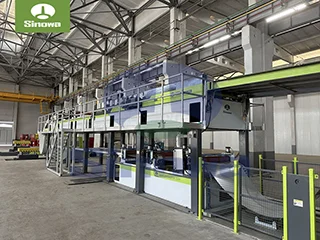
sandwich panel machine
The basic structural composition of a foam sandwich panel machine follows the logic of streamlined industrial production, and each functional module is closely connected to ensure the continuity and stability of the entire production process. The whole set of equipment is mainly composed of raw material conveying system, stirring and metering system, foaming forming system, composite pressing system, constant temperature curing system, fixed-length cutting system and intelligent control system. Every component is designed based on mechanical stability and production rationality, adapting to the physical and chemical changes of raw materials during panel processing. The main frame of the machine adopts high-strength welded profiles, which can maintain structural stability under long-term continuous operation, effectively avoiding mechanical deformation caused by long-time load-bearing and vibration, and laying a solid foundation for consistent product dimensional accuracy.
The raw material conveying system is the starting link of the entire sandwich panel production line, responsible for the automatic and quantitative delivery of surface layer raw materials and foam core layer raw materials. For the surface materials commonly used in sandwich panels, including metal sheets, fiber cement boards and other flat sheet materials, the conveying module is equipped with precision roller sets. These rollers are arranged in an orderly manner with adjustable spacing and rotating speed, which can smoothly transport flat raw materials to the processing station without scratching or extruding the surface of the materials. For granular and liquid raw materials required for foam core layer foaming, the conveying system adopts closed conveying pipelines and quantitative feeding devices. This design can effectively control the feeding amount of each raw material, avoid raw material waste caused by manual feeding errors, and ensure the proportion coordination between different raw materials, which is a key prerequisite for forming uniform and dense foam structures.
The stirring and metering system acts as the core pretreatment unit of foam raw materials, determining the uniformity and foaming activity of the mixed materials. Inside the sealed stirring cabin, high-speed rotating stirring blades carry out three-dimensional mixing of various foam raw materials. During the mixing process, the system can accurately adjust the stirring speed and stirring time according to the preset production parameters, so that different raw materials can fully fuse at the molecular level. The built-in metering components monitor the feeding flow of each raw material in real time, and automatically fine-tune the feeding rate to keep the raw material ratio within the optimal foaming range. Reasonable mixing treatment can eliminate particle agglomeration inside the raw materials, make the foam pores formed in the later stage fine and uniform, and significantly improve the thermal insulation and compression resistance of the finished sandwich panels. In addition, the sealed stirring structure can reduce the volatilization of raw materials and avoid the impact of dust and volatile substances on the production environment.
The foaming forming system is the key functional module that distinguishes the foam sandwich panel making machine from ordinary composite board processing equipment. After the uniformly mixed foam raw materials are transported to the forming station, the physical foaming and chemical curing reactions proceed simultaneously in a relatively closed space. The equipment is equipped with an adjustable foaming mold cavity, which can limit the expansion range of the foam raw materials to ensure that the thickness and width of the foam core layer maintain a unified standard. With the gradual expansion of foam materials, tiny and independent bubble structures are formed inside the core layer. These dense bubble structures endow the sandwich panel with excellent heat insulation and sound insulation performance. The internal temperature and pressure sensing elements of the foaming system monitor the foaming state in real time, and automatically adjust the internal environment parameters of the mold cavity according to the foaming progress, so as to prevent quality defects such as hollow cavities and uneven density caused by excessive foaming or insufficient expansion.
The composite pressing system undertakes the bonding work of the surface layer materials and the foam core layer. After the foam raw materials complete the initial foaming and have preliminary structural strength, the upper and lower surface materials are accurately covered on both sides of the foam core layer through the roller conveying device. The pressing unit adopts multi-group layered pressing rollers, which can apply uniform and stable pressure to the composite board. The pressure value can be adjusted according to the hardness and thickness of different surface materials to ensure that the surface layer and the core layer are closely bonded without gaps. In the pressing process, the vacuum auxiliary structure inside the system can extract the residual air between the contact surfaces of the materials, effectively avoiding bubbles and wrinkles at the bonding interface. This precise pressing treatment greatly improves the bonding firmness between layers, prevents the finished panels from delaminating during long-term use, and enhances the overall structural stability of the panels.
The constant temperature curing system is an indispensable post-processing unit for the forming of foam sandwich panels. The initially compounded panels are transported to the closed curing channel with the operation of the conveyor belt. The interior of the curing channel maintains a stable constant temperature environment through a circulating temperature control device, providing a suitable reaction condition for the complete curing of the foam core layer and the bonding adhesive. During the curing process, the internal molecular structure of the foam material is further stabilized, and the bonding force between the surface layer and the core layer is continuously enhanced. The length of the curing channel and the running speed of the conveyor belt can be adjusted according to the material characteristics and production cycle requirements, which can meet the curing demands of different types of foam sandwich panels. The heat energy generated during the operation of the curing system is recycled through the circulating pipeline, reducing energy consumption while maintaining a constant temperature state, realizing energy-saving production to a certain extent.
The fixed-length cutting system realizes the final shaping of finished panels. After curing, the continuous long-strip composite panels are transported to the cutting station, and the high-precision sensing components identify the conveying length of the panels in real time. When the panels reach the preset cutting size, the cutting tool automatically starts to complete vertical and horizontal cutting operations. The cutting tool is made of wear-resistant high-hardness materials, which can keep the cutting edge smooth without burrs during long-term reciprocating cutting. At the same time, the cutting system is equipped with a dust collection device, which can collect the foam debris generated during the cutting process to keep the production environment clean. After cutting, the specifications of each batch of finished panels remain consistent, which is convenient for subsequent stacking, transportation and standardized installation.
The intelligent control system is the brain of the entire foam sandwich panel production machine, responsible for the coordinated operation of all functional modules. The system adopts an integrated control mode, and operators can set production parameters such as raw material feeding speed, foaming temperature, pressing pressure, curing time and cutting size through the human-computer interaction interface. The built-in data processing chip can collect the operating data of each component in real time, including equipment operating temperature, operating speed and raw material consumption. When abnormal conditions such as material blockage and parameter deviation occur during production, the system will automatically trigger an early warning prompt and perform slight parameter correction to ensure the continuity of production. The highly automated control mode reduces manual intervention links, lowers the requirement for operator proficiency, and effectively reduces human operation errors in the production process.
Compared with traditional manual semi-automatic panel making equipment, modern foam sandwich panel machines have prominent advantages in production efficiency, product quality and operation cost. In terms of production efficiency, the integrated assembly line design realizes uninterrupted continuous production from raw material feeding to finished product blanking. The mechanical automatic conveying and processing mode greatly shortens the single-panel forming cycle, and the daily production capacity is far higher than that of decentralized processing equipment. In terms of product quality stability, the unified parameter setting and precise sensing control system eliminate the quality fluctuation caused by artificial factors. The finished panels produced have uniform thickness, flat surface, stable internal density and consistent physical properties.
In terms of operation economy, the foam sandwich panel manufacturing machine optimizes the raw material feeding and mixing process, which can maximize the utilization rate of foam raw materials and reduce unnecessary raw material loss. The closed production structure reduces the volatilization and waste of chemical raw materials, and the circulating energy-saving design of the curing system cuts down the long-term energy consumption cost of the equipment. In addition, the integrated mechanical structure reduces the manual configuration required for production. A single production line can be operated by a small number of operators, effectively saving labor costs for manufacturing enterprises. From the perspective of use durability, the key load-bearing and processing parts of the equipment are treated with anti-corrosion and wear resistance, which can adapt to long-term continuous industrial production and extend the service life of the equipment.
Foam sandwich panel machinery is widely used in multiple industrial production fields, and the produced panels cover construction, cold chain logistics, agricultural breeding and industrial plant decoration industries. In the construction industry, the equipment can produce thermal insulation wall panels and roof panels for temporary buildings, low-rise buildings and public facilities. These panels are lightweight and easy to install, which can shorten the construction cycle, and their excellent thermal insulation performance can reduce the energy consumption of building temperature regulation. In the cold chain storage industry, the high-density foam core panels produced by the equipment have low thermal conductivity, which can build a stable low-temperature storage environment and reduce the operating energy consumption of refrigeration equipment.
In the agricultural field, the anti-corrosion and heat-preservation sandwich panels are applied to the construction of greenhouses and breeding houses. The panels can isolate external temperature changes, maintain a stable internal breeding and planting environment, and resist the erosion of humid and corrosive agricultural environments. In the industrial production field, the panels are used for the partition decoration of factory workshops and purification workshops. The sound insulation and fire-resistant properties of the panels can optimize the internal production environment and meet the clean and quiet production requirements of special industries. With the diversification of market demand, the sandwich panel production equipment can also adjust production parameters to manufacture customized panels with different thicknesses, surface materials and functional characteristics to meet the differentiated usage demands of various industries.
To maintain the long-term stable operation of the foam sandwich panel line and ensure continuous production quality, standardized daily maintenance and scientific operation management are essential. In daily operation, operators need to regularly clean the residual foam debris and raw material attachments on the surface of conveying rollers, mixing cabins and cutting tools to avoid material accumulation affecting the processing accuracy. The transmission parts such as gears and bearings should be regularly coated with lubricating oil to reduce mechanical friction loss and prevent abnormal noise and jamming during equipment operation. It is necessary to regularly calibrate the metering components and sensing elements of the equipment to ensure the accuracy of raw material ratio and temperature and pressure monitoring data.
In addition, the production environment of the equipment should be kept dry and ventilated to avoid moisture corrosion of the metal frame and circuit components. After the daily production work is completed, the operator needs to cut off the power supply in an orderly manner, sort out the production data, and check the tightness of each connecting part of the equipment. Regular comprehensive maintenance shall be carried out every fixed cycle, including circuit detection, pipeline dredging and aging part replacement. Scientific maintenance measures can not only reduce the failure rate of the equipment and avoid production interruption caused by mechanical faults, but also keep the production accuracy of the equipment for a long time, ensuring that the produced foam sandwich panels always meet the industrial use standards.
With the continuous progress of industrial manufacturing technology and the improvement of environmental protection production requirements, the development direction of foam sandwich panel production machinery is gradually moving towards intelligent upgrading, energy conservation and environmental protection, and multi-functional integration. In terms of intelligent optimization, the equipment will be combined with digital monitoring technology to realize real-time uploading and cloud storage of production data. Manufacturers can remotely view the equipment operating status and production progress, and carry out data analysis to optimize production parameters. In terms of energy saving and emission reduction, the equipment will further optimize the heating and circulating heat preservation structure, adopt more efficient heat energy recovery technology, reduce energy consumption, and optimize the closed raw material conveying system to reduce the volatilization of harmful substances.
In terms of functional expansion, the improved foam core sandwich panel production line will be compatible with more types of surface and core layer raw materials, and can produce composite panels with fire resistance, waterproofing, anti-corrosion and high-strength impact resistance to adapt to more extreme application scenarios. At the same time, the equipment will adopt a more compact integrated structural design, reducing the occupied production space and improving the space utilization rate of the production plant. In the future, with the continuous expansion of the application market of foam sandwich panels, the technological iteration speed of supporting production equipment will continue to accelerate, and the comprehensive performance of the equipment will be further improved to meet the higher production requirements of the composite material industry.
In conclusion, the foam sandwich panel machine as professional and efficient composite material processing equipment, completes the standardized production of foam sandwich panels through the coordination of multiple functional modules. Its reasonable mechanical structure, automated production process and diverse production capabilities make it occupy an important position in the modern building material manufacturing industry. The excellent performance of the equipment not only improves the production efficiency of sandwich panels and stabilizes product quality, but also reduces the comprehensive production cost for manufacturing enterprises. With the continuous development of downstream application industries and the progress of mechanical manufacturing technology, the foam sandwich panel manufacturing plant will continue to realize technological innovation and performance optimization, provide more reliable production support for the composite building material industry, and make important contributions to the high-quality development of the global construction and manufacturing industries.
https://www.cnsinowa.com/sandwich-panel-machines/foam-sandwich-panel-machine.html