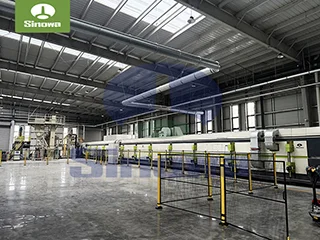
sandwich panel line
The overall structural composition of a complete composite sandwich panel production line follows the sequential logic of raw material input, pretreatment, composite forming, curing and post-processing, and each functional unit is closely connected to form an integrated continuous production chain. From the perspective of mechanical layout, the production line can be divided into raw material unwinding system, surface layer pretreatment module, glue coating system, core material feeding and shaping unit, laminating pressing system, constant temperature curing channel, traction conveying mechanism, fixed-length cutting device and finished product stacking system. Every single unit has independent mechanical adjustment components and linkage control modules, which can realize synchronous operation under the unified scheduling of the central control system. The spatial layout of the production line strictly conforms to the material flow direction, effectively reducing the material transfer distance between processes and avoiding product deformation or surface damage caused by multiple handling. In addition, the internal structure of the production line reserves adjustable gaps and movable installation positions, which can complete the specification switching of panels with different thicknesses and widths through simple parameter setting and mechanical debugging, meeting the flexible production requirements of diversified products.
The raw material unwinding system is the starting link of the entire production line, undertaking the task of stably conveying the surface layer substrates required for composite panels. The common surface layer raw materials include metal plates with smooth surface and uniform thickness, fiber-reinforced composite sheets and polymer decorative plates. These raw materials are usually stored in the form of coiled materials to adapt to continuous feeding requirements. The unwinding unit is equipped with hydraulic tension control components and deviation correction sensing devices. In the process of coil material unfolding, the tension sensor monitors the material stretching state in real time, and the hydraulic execution component dynamically adjusts the unwinding speed and damping force to prevent the surface layer material from generating tensile deformation, wrinkles and edge warping. The automatic deviation correction system can capture the lateral offset of the coil material through optical sensing elements, and feed back the offset data to the transmission mechanism to complete the fine adjustment of the material conveying track, ensuring that the upper and lower surface layers can maintain precise alignment in the subsequent composite process. For raw materials with high surface flatness requirements, the unwinding system is also matched with a preliminary leveling mechanism, which uses multi-group parallel pressure rollers to eliminate the tiny bending stress generated during coil storage, laying a foundation for the flat forming of subsequent composite panels.
After completing stable unwinding, the surface layer materials will enter the pretreatment module to finish surface purification and physical modification treatment. In the production process of composite sandwich panels, the bonding firmness between the surface layer and the core layer depends heavily on the surface cleanliness and roughness of the substrate. The pretreatment unit first adopts high-pressure air flow and static removal equipment to remove floating dust, fine particles and static attachments on the material surface, avoiding the formation of impurity isolation layers in the subsequent gluing process. For materials with oil stains and oxide layers on the surface, the production line is equipped with roller brush cleaning components and low-temperature degreasing structures. The rotating soft brush rolls evenly along the material conveying direction to polish the surface mildly, and the constant-temperature hot air flow accelerates the volatilization of greasy attachments. After cleaning, the surface layer materials will pass through the infrared preheating area. The moderate temperature can improve the surface activity of the substrate, enhance the wettability of the adhesive, and make the glue liquid spread more evenly on the material surface. The whole pretreatment process is carried out in a closed dust-proof space to prevent external environmental pollutants from secondary contamination of the treated materials, ensuring the stability of the subsequent bonding process.
The glue coating system is the core functional module to realize the composite bonding of sandwich panels, and its coating uniformity and glue amount control accuracy directly determine the structural durability of finished products. The production line is equipped with two sets of symmetric glue spreading mechanisms, which coat the inner surfaces of the upper and lower surface layers respectively. According to different production processes, the glue coating system supports two working modes: roller transfer coating and spray permeation coating. The roller coating structure uses precision grooved rollers to quantitatively extract glue liquid from the storage tank, and transfers the glue to the material surface through rolling contact. This mode is suitable for medium and high viscosity adhesives, with the advantages of uniform glue layer thickness and low material waste. The spray coating mode relies on high-pressure atomization components to disperse the glue liquid into fine mist particles, which can penetrate into the tiny pores on the surface of porous substrates and improve the bonding tightness between heterogeneous materials. In order to ensure the stability of glue performance, the glue storage tank is equipped with constant temperature stirring components. The stirring blades rotate at a low speed to avoid adhesive precipitation and stratification, and the constant temperature system maintains the glue liquid within the optimal activity temperature range, preventing the viscosity change caused by temperature fluctuation from affecting the coating effect. Meanwhile, the intelligent flow control valve dynamically adjusts the glue output according to the material conveying speed, realizing the dynamic matching between coating amount and production rhythm.
While the surface layer completes pretreatment and glue coating, the core material feeding and shaping unit synchronously carries out the processing and conveying of the sandwich core layer. The core materials commonly used in composite sandwich panels include porous foam materials, inorganic fiber cotton and honeycomb structural materials. Different from the dense surface layer, the core layer materials have the characteristics of low density, high porosity and weak mechanical rigidity, so the feeding mechanism adopts flexible conveying and anti-extrusion structural design. For block porous core materials, the feeding unit is equipped with a quantitative cutting mechanism to cut the continuous core material strips into standard fixed-width raw materials, and the vibration sorting device arranges the cut core materials neatly to avoid overlapping and tilting during feeding. For honeycomb core materials with regular hollow structures, the system is matched with a stretching shaping assembly to expand the compressed honeycomb blank to a standard pore structure and fix the spatial shape through temporary positioning components. In the feeding process, the core material will pass through the dust removal and drying area to remove the residual processing debris and moisture inside the pores, reducing the internal defect rate of composite panels. After pretreatment, the core material is accurately transported to the middle position of the two glued surface layers through the synchronous conveying track, realizing the initial assembly of the three-layer composite structure.
The laminating pressing system is the key equipment to realize the permanent bonding of the sandwich panel structure, which completes the tight fitting and preliminary curing of the surface layer and the core layer through constant pressure and uniform extrusion. The pressing unit is composed of upper and lower parallel pressure plate groups and hydraulic power components, and the internal space of the pressure plates can be adjusted according to the thickness of the finished panel. Before lamination, the positioning sensor detects the overall thickness of the assembled three-layer material, and the hydraulic system automatically adjusts the opening distance of the pressure plates to ensure uniform pressure distribution on the entire plate surface. In the pressing process, the pressure value is maintained within a stable constant range, which can not only eliminate the tiny gaps between layers and discharge the residual air in the bonding interface, but also avoid the permanent deformation of the core layer structure caused by excessive pressure. The inner wall of the pressure plate is embedded with thermal conduction components, which can appropriately increase the ambient temperature in the pressing cavity, accelerate the wetting reaction between the adhesive and the substrate, and shorten the initial bonding curing time. In order to ensure the flatness of the plate surface, the pressure plate is processed with high-precision grinding, and the parallelism error of the upper and lower plates is controlled within a tiny range, effectively avoiding the warping and bending of the finished panel.
The constant temperature curing channel undertakes the task of deep curing and structural stabilization of composite panels, and it is an indispensable link to improve the bonding strength and service durability of products. After preliminary lamination and pressing, the semi-finished panels enter the long closed curing channel at a constant conveying speed. The interior of the channel is divided into multiple independent temperature control areas, and each area is equipped with circulating hot air circulation equipment and temperature sensing elements. According to the curing characteristics of different adhesives, the system sets gradient temperature parameters. The low-temperature preheating area accelerates the internal molecular movement of the adhesive, the constant-temperature curing area promotes the cross-linking reaction of the adhesive molecules, and the slow cooling area eliminates the internal thermal stress of the panel. The circulating hot air forms a uniform temperature field inside the channel, realizing three-dimensional surrounding heating of the panels and avoiding the inconsistent curing degree caused by local temperature difference. The conveying speed of the traction mechanism is matched with the curing cycle of the adhesive to ensure that each section of the panel can obtain sufficient curing time. After the curing treatment, the bonding interface between the surface layer and the core layer forms a stable molecular composite structure, and the overall mechanical strength and structural stability of the panel are significantly improved.
The traction conveying mechanism runs through the entire production line, undertaking the synchronous transmission task of materials in each processing link. The traction unit adopts multi-group roller combination structure, and the driving rollers are driven by servo motors to realize stepless speed regulation. The surface of the traction roller is wrapped with wear-resistant anti-slip materials, which can increase the friction with the panel surface without damaging the treated outer layer. In order to ensure the synchronization of material transmission in each link, the traction system is equipped with a linkage sensing module. When the material accumulation or conveying delay occurs in a single processing unit, the system automatically adjusts the operating speed of the front and rear traction rollers to maintain the continuity of the production process. For large-size thick plates, the traction mechanism adds auxiliary pressing rollers to avoid material sliding and position deviation in the high-temperature curing section. The traction speed can be accurately adjusted according to the production specifications and curing requirements, realizing the flexible switching between high-efficiency mass production and low-speed high-precision processing modes.
The fixed-length cutting device is responsible for cutting the continuously molded long-strip composite panels into finished products that meet the dimensional specifications. The cutting unit is installed at the tail end of the curing channel, and it adopts non-contact induction positioning and mechanical synchronous cutting technology. Before cutting, the high-precision ranging sensor measures the real-time conveying length of the panel, and sends a cutting instruction when the material reaches the preset size. The cutting tool adopts high-hardness alloy blades, and the cutting mechanism is equipped with a shock absorption structure to reduce the vibration amplitude during cutting. The vertical downward cutting mode ensures that the cutting section is flat and smooth without burrs and layer warping. In order to adapt to different plate widths, the cutting device can horizontally adjust the cutting range, and the intelligent control system automatically records the cutting quantity and dimensional error data. After cutting, the edge trimming mechanism polishes the four sides of the panel to remove tiny burrs and sharp edges, improving the appearance quality and use safety of finished products.
The finished product stacking system is the terminal link of the production line, completing the automatic collection, arrangement and temporary storage of cut composite panels. The stacking unit is composed of a turning conveyor belt, a mechanical grabbing arm and a layered storage rack. The qualified panels are transported to the stacking area through the conveyor belt, and the mechanical arm with flexible clamping components stably grabs the plates from the side to avoid surface scratch damage caused by direct extrusion on the outer layer. The grabbing arm can adjust the clamping force and lifting height according to the weight and thickness of the panels, and arrange the finished products in an orderly manner according to the fixed stacking spacing. The interior of the storage rack is equipped with a buffer protection pad to reduce the collision friction between the bottom plate and the rack body. At the same time, the stacking system is connected with the counting and sorting module, which can classify and store products according to dimensional specifications and surface quality, providing convenient conditions for subsequent packaging and transportation.
In the actual industrial production process, the operation stability of composite sandwich panel line is affected by multiple internal and external factors, among which raw material performance matching and process parameter setting are the core influencing elements. The compatibility between the surface layer substrate, core layer material and adhesive directly determines the bonding effect of the composite structure. For metal surface layers, adhesives with strong oxidation resistance and mechanical adhesion should be selected; for porous non-metal substrates, permeable adhesives with good ductility are more suitable. The matching of material thermal expansion coefficient is also crucial. If the thermal deformation parameters of the surface layer and the core layer are quite different, the finished panel is prone to internal stress accumulation under alternating temperature environments, resulting in layer separation and surface cracking. In terms of process parameters, the curing temperature, pressing pressure and conveying speed need to be dynamically adjusted according to the material characteristics. Excessively high curing temperature will cause the core layer to shrink and deform, while too low pressure will lead to insufficient bonding compactness between layers.
The daily maintenance and intelligent optimization of composite sandwich panel line are important guarantees to extend the service life of equipment and maintain stable production capacity. The daily maintenance work focuses on the cleaning of transmission components, the inspection of sealing structures and the lubrication of moving parts. The residual adhesive and material debris on the traction roller and pressure plate need to be cleaned regularly to prevent hard attachments from scratching the plate surface; the sealing strips of the curing channel and dust-proof shell should be inspected periodically to avoid heat loss and dust infiltration; the rotating bearings and transmission gears are filled with high-temperature resistant lubricants to reduce mechanical wear and running noise. With the development of intelligent manufacturing technology, modern production lines are equipped with data monitoring and fault early warning systems. The sensors arranged in each unit collect operating parameters such as equipment temperature, running speed and pressure in real time, and upload the data to the central control platform for big data analysis. When abnormal parameter fluctuation occurs, the system automatically triggers the early warning prompt and locks the faulty operation link, which is convenient for maintenance personnel to quickly locate and eliminate faults.
Composite sandwich panel line has a wide range of industrial application scenarios, covering many fields such as industrial construction, special transportation and environmental protection engineering. In the building construction industry, the production line manufactures lightweight thermal insulation sandwich panels, which are used for the enclosure walls and roof structures of temporary workshops and constant-temperature warehouses. The excellent heat preservation performance of the panels can reduce the energy consumption of building temperature regulation, and the lightweight characteristics simplify the building assembly process. In the cold chain transportation industry, the composite panels produced by the optimized production line have low thermal conductivity and good moisture resistance, which are suitable for manufacturing the carriage plates of refrigerated transport vehicles, realizing the constant-temperature storage of perishable goods. In addition, the corrosion-resistant composite panels processed by special process parameters can be applied to chemical plants and coastal humid environments, resisting the erosion of corrosive gases and salt fog.
From the perspective of industrial development trend, composite sandwich panel line is evolving towards intelligent integration, energy conservation and environmental protection, and multi-functional customization. In terms of intelligent upgrading, the production line will realize fully automated unmanned operation, and the artificial intelligence system can independently complete raw material identification, parameter debugging and product quality detection, reducing the dependence on manual operation. In terms of energy consumption optimization, the thermal circulation system of the curing channel will be further optimized to improve the utilization rate of heat energy and reduce the energy consumption of unit products. The glue coating system will adopt low-carbon environmental protection adhesive supply technology to reduce the volatilization of harmful substances in the production process. In terms of functional expansion, the production line will reserve more adjustable functional modules, which can realize composite processing such as surface anti-corrosion coating and flame retardant modification in one molding process, meeting the customized production requirements of high-performance composite panels in special industrial fields.
In conclusion, composite sandwich panel line, as a systematic and automated production equipment for composite materials, realizes the efficient and standardized manufacturing of sandwich panels through the coordinated operation of multiple functional units. From raw material pretreatment to finished product stacking, each processing link has precise mechanical logic and process control standards, ensuring the stable mechanical performance and reliable structural quality of finished products. With the continuous progress of material science and mechanical manufacturing technology, the structural design and process control level of composite sandwich panel line will be further improved. In the future, this kind of production line will play a more important role in the lightweight upgrading of the manufacturing industry, and continuously promote the innovative application of composite sandwich panels in more emerging industrial fields, providing solid equipment support for the high-quality development of the composite material industry.
https://www.cnsinowa.com/sandwich-panel-machines/composite-sandwich-panel-line.html