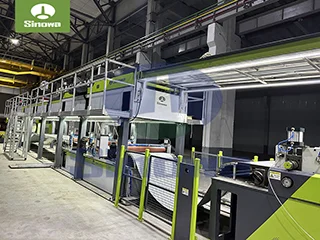
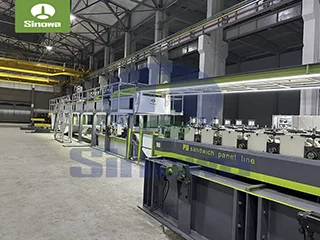
sandwich panel machine
The overall structural design of PU sandwich panel machine follows the logic of continuous assembly line production, and the entire production line consists of multiple interconnected functional units with clear division of labor and coordinated operation. Each functional unit undertakes an independent production link, and the mechanical transmission system realizes the synchronous operation of all units, avoiding production stagnation caused by mismatched operating speeds of individual equipment. From the perspective of production sequence, the complete production line mainly includes substrate unwinding equipment, surface pretreatment devices, polyurethane foaming and metering equipment, continuous laminating and pressing mechanisms, constant temperature curing channels, traction transmission equipment, fixed-length cutting devices, and finished product stacking systems. In addition, auxiliary supporting components such as hydraulic power systems, electrical control systems, and deviation correction sensing devices are installed throughout the production line to monitor and adjust the operating state of the equipment in real time. The layout of the production line adopts a linear horizontal arrangement, which not only saves factory space but also simplifies the material transmission path, effectively reducing the resistance of substrate transportation and improving the overall production fluency. The main frame of the machinery is made of high-strength metal profiles processed by anti-rust and anti-corrosion treatment, which can withstand long-term continuous operation and external mechanical vibration, ensuring structural rigidity and service life in complex industrial production environments. All transmission parts are equipped with wear-resistant buffer components to reduce mechanical friction loss during operation and lower the frequency of daily maintenance.
As the starting unit of the entire production line, the substrate unwinding equipment undertakes the task of continuously and stably releasing coil-shaped surface substrates. Common substrates applicable to this machinery include metal color plates, non-metal fiber plates, and composite waterproof plates, and the unwinding structure can be adaptively adjusted according to the hardness and thickness of different substrates. The unwinding unit is composed of a fixed support frame, a rotating winding shaft, a tension adjustment assembly, and an initial deviation correction structure. The winding shaft adopts a hollow integrated structure, which can firmly fix the substrate coil and avoid lateral shaking during the unwinding process. The tension adjustment assembly uses elastic buffer structures combined with mechanical sensing components to identify the tightness of the substrate in real time. When the substrate is too loose or over-tensioned, the system will automatically adjust the rotating speed of the winding shaft to keep the substrate in a flat and straight state without wrinkles or stretching deformation. The built-in deviation correction device can capture the lateral offset signal of the substrate through infrared sensing elements, and drive the hydraulic push rod to fine-tune the position of the winding shaft, ensuring that the substrate always advances along the predetermined central trajectory. For production lines that need to lay double-sided substrates, two sets of symmetrically arranged unwinding equipment are configured to complete the synchronous feeding of upper and lower substrates, laying a foundation for the subsequent uniform compounding of polyurethane foam materials. The operating speed of the unwinding equipment is synchronously linked with the subsequent processing units to avoid material accumulation or substrate fracture caused by speed difference.
After completing the unwinding operation, the substrate will be sent to the surface pretreatment device for necessary processing to enhance the bonding firmness between the substrate and polyurethane foam. The pretreatment process mainly includes surface cleaning, flattening correction, and edge trimming. The cleaning component is equipped with high-density soft brush rollers and static removal structures, which can sweep away dust, metal debris, and oil stains attached to the substrate surface. At the same time, it eliminates static electricity generated by friction during substrate transportation, preventing fine impurities from adhering to the substrate again due to electrostatic adsorption. The flattening correction mechanism adopts multi-group staggered pressing rollers. The smooth and wear-resistant roller surfaces apply uniform pressure to the bent or uneven substrate to eliminate tiny bending deformation generated during coil storage and transportation. The edge trimming structure is installed on both sides of the transmission track, using precision rotating cutting tools to trim the uneven edges of the substrate, ensuring that the width of the substrate meets the production standard and avoiding edge warping or material overflow in the subsequent foaming process. All pretreatment components are installed in a closed protective cover, which can isolate dust and sundries in the external production environment, maintain the cleanliness of the substrate surface, and further optimize the bonding effect between the substrate and the foam interlayer.
Polyurethane foaming and metering equipment is the core functional unit of the entire manufacturing machinery, which directly determines the foaming density, pore uniformity, and thermal insulation performance of the sandwich panel interlayer. The foaming system is mainly composed of raw material storage tanks, independent metering pumps, mixing chambers, and mobile material distribution structures. Two sealed storage tanks are used to separately store polyurethane combined materials, and each storage tank is equipped with a constant temperature heating component and a stirring device. The low-speed continuous stirring operation can prevent raw material precipitation and viscosity stratification, while the constant temperature system keeps the raw material within the optimal reaction temperature range, ensuring the stability of chemical reaction activity during foaming. The metering pump group is driven by independent variable frequency drive motors, and the rotating speed of the pump body can be accurately adjusted according to production parameters to control the output flow of different raw materials. The precise flow matching ensures that the raw materials are mixed in the optimal proportion, which is the key to avoiding uneven foaming, local hollowing, or excessive hardness of the interlayer. After the raw materials are transported to the mixing chamber, the high-speed turbulence structure inside the chamber fully stirs the combined materials to form a homogeneous liquid mixture without particle agglomeration. The mixed liquid is evenly sprayed between the upper and lower substrates through the mobile material distribution mechanism. The material distribution mechanism can reciprocate horizontally along the width direction of the substrate to ensure that the liquid raw material covers every area of the substrate uniformly, forming a flat liquid material layer with consistent thickness.
The continuous laminating and pressing mechanism undertakes the compound molding task of the substrate and polyurethane foaming material, which is an essential link to shape the overall structure of the sandwich panel. This mechanism is composed of upper and lower pressing roller groups, hydraulic pressure adjustment assemblies, and synchronous transmission chains. The pressing rollers are arranged in multiple groups in a linear sequence, and the gap between the upper and lower rollers corresponds to the preset thickness of the finished panel. The hydraulic system provides stable and adjustable pressing pressure, and different pressure values can be set according to the softness of the substrate and the foaming viscosity. For rigid metal substrates, medium and high pressure is applied to eliminate tiny bubbles generated during foaming and squeeze the raw materials to fill every gap between the substrates; for soft non-metal substrates, low-pressure slow pressing is adopted to prevent irreversible deformation of the substrate structure. The surface of the pressing roller is treated with high-temperature and anti-sticking coating to avoid the adhesion of uncured polyurethane raw materials, which simplifies the daily cleaning work of the equipment. All pressing rollers keep synchronous rotating speed through the transmission chain, ensuring that the substrate and the internal foam materials do not undergo relative displacement during the pressing process, preventing layer separation and offset defects. During the pressing process, the auxiliary heating structure inside the pressing rollers can appropriately increase the material temperature, accelerate the preliminary foaming reaction of polyurethane, and shorten the curing molding cycle.
The constant temperature curing channel is a closed long-strip thermal insulation space specially set for the complete foaming and curing of polyurethane materials. After preliminary pressing and compounding, the semi-finished panels enter the curing channel at a constant speed to complete the subsequent chemical cross-linking reaction and structural shaping. The interior of the curing channel is divided into multiple independent temperature control sections, and each section is equipped with heating elements and temperature sensing probes. The electrical control system can independently adjust the temperature of each section to form a gradient temperature field, which adapts to the different reaction heat release stages of polyurethane materials. In the early stage of entering the channel, the medium-temperature environment promotes the continuous expansion of foam pores to form a uniform and fine porous structure; in the middle stage, the constant temperature state maintains the stability of the cross-linking reaction to avoid pore collapse caused by excessive temperature; in the later stage, the temperature is appropriately reduced to realize slow cooling and shaping, reducing the internal stress of the panel. The circulating air system is installed inside the channel to make the internal temperature distribution more uniform, eliminating local temperature difference and preventing inconsistent curing degree of panels in different areas. The sealed structural design of the curing channel can isolate external cold air and dust, maintain the stability of the internal reaction environment, and effectively improve the flatness and structural compactness of the finished panels. The length of the curing channel can be customized according to the production speed and panel thickness to ensure that the polyurethane materials are completely cured before leaving the channel.
The traction transmission equipment is responsible for stably conveying the cured semi-finished panels to the subsequent cutting process, and its operating stability directly affects the dimensional accuracy of the finished products. The traction unit adopts multi-group high-strength rubber traction rollers, which are arranged symmetrically up and down to clamp the panel body through moderate friction. The rubber material with high friction coefficient can ensure that no relative sliding occurs between the rollers and the panel during the transmission process, avoiding length deviation caused by slipping. The traction power is provided by servo drive motors, which can realize stepless speed regulation and keep the transmission speed consistent with the operating rhythm of the previous curing channel. The built-in pressure sensing element can monitor the clamping force of the traction rollers in real time. When the panel thickness has tiny errors, the system will automatically fine-tune the roller gap to prevent excessive pressure from crushing the panel surface or insufficient clamping force leading to transmission jitter. In addition, the traction equipment is equipped with a vibration damping base, which can weaken the mechanical vibration generated during high-speed operation and maintain the horizontal stability of the panel in the transmission process. The surface of the traction roller is smooth and wear-resistant, which will not leave indentations or scratches on the outer surface of the substrate, ensuring the appearance quality of the finished panel.
The fixed-length cutting device is used to cut the continuously transmitted long-strip panels into finished products with specified dimensions. This device integrates intelligent length measurement, automatic positioning, and high-speed cutting functions. The precision ranging sensor installed at the front end of the cutting area records the moving distance of the panel in real time and transmits the length data to the electrical control system. When the panel reaches the preset cutting length, the system automatically triggers the positioning and locking structure to fix the panel body to prevent displacement during cutting. The cutting mechanism adopts high-speed rotating alloy cutting tools, which have high hardness and wear resistance, and can complete smooth cutting of composite panels with metal or non-metal substrates. The cutting speed is matched with the panel transmission speed to realize dynamic cutting without stopping the machine, ensuring the continuity of the production process. The edge pressing structure is arranged around the cutting tool to compress the cutting edge of the panel, avoiding edge warping, cracking, and foam shedding caused by cutting force. The cutting gap is equipped with a dust collection and debris cleaning device to collect the cut leftover materials and tiny foam particles, maintaining the cleanliness of the production environment. After cutting, the edge of the panel is smooth and flat without burrs, eliminating the need for secondary trimming processing.
The finished product stacking system is the terminal unit of the entire production line, which realizes automatic collection, arrangement, and stacking of cut qualified panels. This system consists of a material transfer conveyor, a mechanical clamping arm, and a stacking platform. The cut panels are horizontally transported to the stacking area through the conveyor, and the infrared sensing element identifies the position and posture of the panels. The mechanical clamping arm made of lightweight high-strength materials uses flexible contact components to clamp the panel body, avoiding surface damage caused by rigid extrusion. According to the preset stacking sequence, the clamping arm places the panels neatly on the stacking platform and adjusts the spacing between layers to prevent mutual friction and collision between panels. The stacking platform has a height adjustment function. With the increase of stacking layers, the platform automatically descends to keep the clamping stroke of the mechanical arm stable, optimizing the stacking efficiency. After the stacking height reaches the standard, the system sends a reminder signal to the staff to facilitate the subsequent transfer and packaging of finished products. The entire stacking process is automated without manual intervention, which reduces labor input and avoids panel pollution and damage caused by manual contact.
The electrical control system is the intelligent command center of PU sandwich panel machinery, which realizes centralized monitoring and automatic regulation of all functional units. The core of the control system is an integrated logic controller, which receives real-time data signals from temperature sensors, pressure sensors, speed sensors, and deviation correction sensors distributed in various positions of the production line. The system converts the collected analog signals into digital data and displays the operating parameters of each equipment unit on the human-computer interaction interface. Staff can set production parameters such as panel thickness, cutting length, transmission speed, and foaming ratio through the touch operation interface. The control system has an automatic matching function, which can synchronously adjust the operating parameters of each linkage unit to ensure the coordinated operation of the entire production line. In terms of safety control, the system is equipped with overload protection, material breakage alarm, and abnormal temperature monitoring functions. When equipment overload operation, substrate fracture, or local overheating occurs, the system will automatically trigger an alarm and execute emergency shutdown procedures to avoid equipment damage and production safety accidents. In addition, the control system has a data storage function, which can record daily production output, parameter adjustment records, and equipment operation status, providing data support for production management and equipment maintenance.
In the actual production and application process, the operational performance of PU sandwich panel manufacturing machinery is affected by multiple environmental and mechanical factors, so reasonable parameter adjustment and daily maintenance are essential to ensure production efficiency and product quality. In terms of environmental adaptation, the production line should be placed in a closed workshop with stable temperature and low humidity. Excessively low ambient temperature will increase the viscosity of polyurethane raw materials, reduce the mixing uniformity, and easily lead to poor foaming effect; excessively high humidity will make the raw materials absorb moisture and produce bubbles during the reaction, affecting the compactness of the panel interlayer. During the operation of the equipment, staff need to regularly check the tightness of connecting bolts, the flexibility of transmission chains, and the sensitivity of sensing components. The residual raw materials on the surface of pressing rollers and mixing chambers should be cleaned regularly to prevent material carbonization and adhesion from affecting subsequent production. The hydraulic oil and lubricating grease inside the equipment need to be replaced periodically according to the operating cycle to ensure the smooth operation of the transmission and hydraulic systems. For the wearing parts such as cutting tools and traction rubber rollers, regular wear detection should be carried out, and damaged parts should be replaced in a timely manner to avoid affecting the processing accuracy.
With the continuous progress of industrial manufacturing technology, the development trend of PU sandwich panel manufacturing machinery presents obvious characteristics of intelligence, energy saving, and high integration. In terms of intelligent upgrading, more advanced sensing and identification technologies are applied to the production line. The visual detection system can automatically identify surface scratches, bubble defects, and edge irregularities of panels, and classify qualified and unqualified products without manual inspection. The remote monitoring module enables staff to view the equipment operation status in real time through terminal devices and remotely adjust production parameters, realizing unattended auxiliary production. In terms of energy-saving optimization, the improved heating and circulation system reduces heat loss in the curing process, and the frequency conversion drive technology lowers the idle power consumption of the motor. The optimized structural design reduces the friction resistance between mechanical components, effectively cutting down comprehensive energy consumption. In terms of integrated design, the production line integrates feeding, processing, detection, and stacking functions into a compact space, simplifying the equipment layout and reducing the occupation of factory land. At the same time, the modular assembly structure is adopted, which facilitates the disassembly, transportation, and later transformation of the equipment, improving the flexibility of equipment application.
In the industrial chain of polyurethane sandwich panel production, manufacturing machinery plays a decisive foundational role. The structural rationality, operational stability, and technological advancement of the machinery directly determine the physical properties, appearance quality, and production cost of the finished panels. High-quality manufacturing machinery can produce sandwich panels with uniform foaming structure, stable thermal insulation performance, and strong bonding strength, which can adapt to complex application environments such as low-temperature cold storage, humid workshops, and windy outdoor buildings. With the continuous improvement of global energy-saving and environmental protection requirements, the market demand for lightweight, heat-insulating, and low-carbon composite panels will continue to grow, which also puts forward higher technical requirements for PU sandwich panel manufacturing machinery. In the future, the machinery manufacturing industry will continue to carry out technological innovation in raw material utilization efficiency, intelligent detection level, energy consumption reduction, and environmental protection performance, continuously optimizing the production process and equipment structure. Through the iterative upgrading of manufacturing machinery, the production quality of polyurethane sandwich panels will be further improved, and the application scope in construction, logistics, industrial manufacturing and other fields will be continuously expanded, bringing more stable and efficient production solutions for the composite panel industry. In the long-term industrial development, the continuous progress of PU sandwich panel manufacturing machinery will also promote the standardized and high-quality development of the entire energy-saving building material industry, creating greater economic and social value for modern industrial construction and urban infrastructure construction.
https://www.cnsinowa.com/sandwich-panel-machines/pu-sandwich-panel-manufacturing-machinery.html