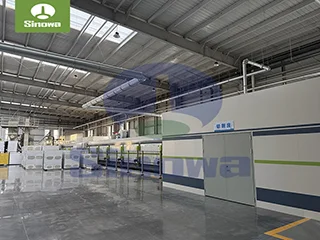
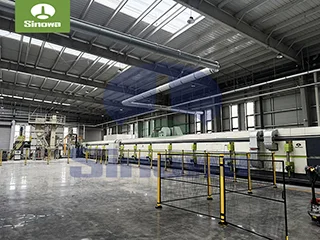
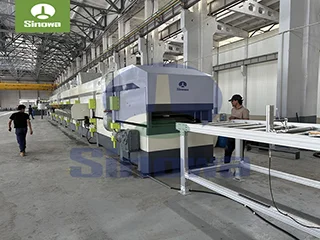
sandwich panel machine
The overall design of modern wall sandwich panel machine adopts a modular integrated structure, which scientifically divides the complete production flow into multiple functional and interconnected units. This modular design not only simplifies the overall equipment structure and facilitates daily maintenance and later functional upgrading but also enables flexible adjustment of production parameters according to different raw material types and panel design requirements. The entire production line operates in a fully automated cyclic manner, requiring only a small number of on-site operators to monitor the equipment status and adjust parameters, effectively reducing the interference of manual operation errors on product quality and greatly improving the consistency and stability of finished wall panels. Compared with traditional intermittent production equipment, continuous sandwich panel production line achieve seamless connection of each production link, eliminating idle time between processes and significantly enhancing overall production efficiency.
The complete production workflow of the wall sandwich panel line starts with the raw material feeding and unwinding stage, which is the initial link that determines the flatness and feeding accuracy of subsequent panels. This functional unit is mainly responsible for bearing and unfolding coiled surface materials, including metal sheets, composite fiber boards, and other common surface layer raw materials used for wall panels. Equipped with precision deviation correction and flattening devices, the system can dynamically monitor the feeding track of raw materials in real time during the operation process. Once material offset or uneven spreading is detected, the device will automatically fine-tune the feeding position and tension to ensure that the surface materials are always conveyed in a flat, straight, and stable state. Stable feeding accuracy is crucial for subsequent roll forming and composite lamination processes, as any slight deviation in the early feeding stage will be amplified in the subsequent processing links, leading to problems such as uneven panel edges, inconsistent thickness, and poor composite tightness, which affect the overall quality and service performance of finished wall panels.
After the completion of unwinding and flattening, the surface materials enter the roll forming and profiling unit, which shapes the flat raw material sheets into the specific cross-sectional profiles required for wall panel installation and assembly. This unit is composed of multiple groups of precision arranged rolling rollers, and the number and arrangement mode of roller sets are designed according to the diverse profile requirements of different wall panels. Through gradual and orderly rolling extrusion, the flat surface materials undergo continuous plastic deformation to form standard flat plates, corrugated plates, or special-shaped edge structures. All roller gaps and pressing angles are adjustable, allowing the equipment to adapt to the production of wall panels with different widths, thicknesses, and edge profiles without large-scale equipment transformation or part replacement. The gradual forming process avoids the problem of local stress concentration caused by one-time stamping forming, effectively preventing surface cracking, deformation, and indentation of the surface materials, ensuring the smooth and flat surface of the formed panels and uniform structural stress distribution.
Subsequent to roll forming, the surface materials will pass through the preheating and surface treatment module, a key link that directly affects the bonding strength between the surface layer and the core material of the sandwich panel. During the long-term storage and transportation of raw materials, the surface is prone to produce tiny dust, moisture, and oxide layers, which will hinder the tight combination of the adhesive and the base material, reducing the bonding firmness of the composite panel. The preheating device can accurately adjust the surface temperature of the formed sheets within the optimal range required for bonding, which not only volatilizes the residual moisture on the material surface and removes tiny impurities but also activates the surface molecular activity of the materials, greatly enhancing the adhesion between the surface layer and the core material. The whole surface treatment process is carried out in a closed and stable environment, avoiding the influence of external temperature and humidity changes on the surface treatment effect, laying a solid foundation for the high-strength composite forming of subsequent sandwich panels.
The core material laying and gluing composite system is the core functional component of the entire wall sandwich panel production line, determining the structural performance and service life of the finished wall panel. Different from single-layer plate processing equipment, the sandwich panel production process requires the tight compounding of upper and lower surface layers with the middle thermal insulation and filling core material. The equipment is compatible with a variety of common core materials used for building wall panels, including rigid foam materials, rock wool materials, and other environmentally friendly thermal insulation and fireproof core materials. For different types of core materials, the equipment adopts corresponding automatic laying and filling technologies. For foam core materials, the high-precision metering and mixing system delivers the raw material components to the mixing head according to a set proportion, and evenly sprays and distributes the mixed foam raw materials on the surface of the lower layer sheet. The foam materials undergo foaming, expansion, and solidification reactions in the closed composite space to form a uniform and dense core layer structure. For rock wool and other plate-shaped core materials, the automatic conveying and positioning device accurately arranges the core material strips between the upper and lower surface sheets to ensure neat arrangement and no gaps or offsets between core materials.
The high-precision gluing system matched with the composite unit can evenly spray environmentally friendly adhesive on the contact surfaces of the upper and lower surface layers and the core material. The glue output and spraying range can be precisely adjusted through the intelligent control system, which not only ensures that the adhesive covers the entire composite interface without dead angles and guarantees sufficient bonding strength but also avoids excessive glue spraying leading to material waste and panel surface contamination. In the double-belt laminating and pressing area, the upper and lower conveyor belts maintain constant and uniform pressure and conveying speed, so that the surface layers and the core material are tightly laminated into an integrated structure. In the continuous pressing state, the core material completes solidification and shaping, and the adhesive fully reacts and cures, realizing seamless integration between layers. The constant-pressure laminating technology effectively avoids common quality problems such as local hollowing, delamination, and uneven thickness of traditional sandwich panels, making the overall structure of the wall panel more stable and the bearing capacity and structural uniformity significantly improved.
After the composite lamination and preliminary solidification molding, the continuous integral panel enters the trimming and fixed-length cutting unit. In the continuous production state, the wall sandwich panel equipment first completes the edge trimming treatment of the two sides of the panel to remove the irregular edge materials generated in the forming and composite process, ensuring that the two sides of the wall panel are flat, neat, and consistent in width. The fixed-length cutting system adopts high-precision automatic cutting technology, which can set arbitrary cutting lengths according to customer production requirements. The most prominent advantage of this cutting unit is that it can realize non-stop dynamic cutting in the continuous production process, avoiding production pause caused by cutting operation, effectively improving the continuity and efficiency of the entire production line. The cutting tool has high hardness and wear resistance, which can ensure smooth and neat cutting sections without burrs, cracks, or deformation, ensuring that the dimensional accuracy of each finished wall panel meets the unified production standards.
The cooled and cut finished wall panels will be automatically conveyed to the post-processing and stacking unit. This unit is responsible for sorting, arranging, and stacking the finished panels, and can complete automatic counting and orderly stacking according to the set quantity specifications. The automatic stacking method replaces the traditional manual handling and stacking mode, not only greatly reducing the labor intensity of operators and reducing the risk of panel surface damage and panel body deformation caused by manual handling but also making the stacking of finished products more standardized and orderly, convenient for subsequent packaging, storage, and transportation. Some optimized equipment configurations are also equipped with surface protection film covering devices, which can automatically paste protective films on the surface of finished panels after cutting, effectively preventing surface scratches, dust pollution, and friction damage during storage and transportation, further improving the finished product yield and appearance quality of wall panels.
The intelligent control system runs through all functional units of the entire wall sandwich panel manufacturing line and is the central brain to ensure the coordinated and stable operation of each link. The system adopts integrated programmable control technology, which can uniformly adjust and monitor all parameters in the production process, including feeding speed, rolling pressure, preheating temperature, glue spraying volume, laminating pressure, cutting length, and production operation speed. All production parameters can be set and stored through the human-machine operation interface, and common production specifications can be preset into the system in advance, realizing one-key switching of different product production modes. During the continuous operation of the equipment, the control system can monitor the operating status of each component in real time. Once abnormal conditions such as material jamming, parameter deviation, and equipment overload occur, the system will automatically trigger early warning prompts and perform self-protection shutdown operations to avoid equipment failure expansion and mass production of defective products.
In terms of operational performance, modern wall sandwich panel making machine has obvious advantages in production continuity and stability. The optimized mechanical structure and electrical control system enable the equipment to support long-term uninterrupted cyclic operation, with stable daily production output and excellent product consistency. All mechanical transmission components adopt precision processing and matching technology, which reduces mechanical friction loss and operational vibration during equipment operation, not only extending the service life of the equipment but also ensuring the smooth operation of the production process and avoiding panel quality fluctuations caused by equipment vibration. At the same time, the equipment has good parameter adjustment flexibility, which can quickly adapt to the production needs of wall panels with different thicknesses, widths, core material types, and surface layer materials, meeting the diversified product iteration and personalized production needs of manufacturing enterprises.
In terms of production quality control, the whole-process closed-loop production mode of the wall sandwich panel production machine effectively guarantees the comprehensive performance of finished wall panels. The precise temperature control in the preheating link ensures the activation effect of the material surface, the uniform gluing and constant-pressure lamination ensure the bonding tightness between layers, and the gradual forming technology ensures the structural stability of the panel surface. The wall panels produced by this equipment have excellent overall performance, including uniform overall thickness, flat and smooth surface, stable internal structure, and no delamination or hollowing phenomena. In terms of functional performance, the composite structure of surface layer and lightweight core material endows the wall panels with light self-weight, which can effectively reduce the overall load of the building structure and reduce the construction difficulty and structural engineering cost. At the same time, the core material with thermal insulation and sound insulation properties makes the wall panels have excellent heat preservation, heat insulation, and noise reduction effects, which can effectively reduce building energy consumption and improve the comfort of the building interior space.
In addition, different core material configurations can give the wall panels good fire resistance, moisture resistance, and corrosion resistance, enabling the products to adapt to various complex building use environments, including high-humidity, high-temperature, and corrosive industrial environments, as well as outdoor wall decoration and thermal insulation scenes. The standardized and integrated production mode of the equipment makes the structural size and performance parameters of each batch of finished panels highly unified, which is convenient for modular assembly and rapid construction on the construction site, greatly shortening the construction cycle of building projects and realizing the rapid delivery of engineering projects.
In terms of production cost and energy consumption control, the optimized structural design of the wall sandwich panel manufacturing machine achieves effective savings in raw materials and energy. The precise glue spraying control system avoids the waste of adhesive raw materials, the accurate material positioning and cutting technology reduce the generation of leftover materials, and the efficient transmission and heating system reduces invalid energy consumption in the production process. Compared with traditional manual-assisted semi-automatic production equipment, the fully automated production mode greatly reduces labor input, lowers the labor management cost and manual error loss in the production process, and improves the overall economic benefits of enterprise production. At the same time, the closed production environment reduces the overflow of dust and harmful gases in the production process, which is more in line with the modern industrial production requirements of environmental protection and low carbon, and reduces the environmental pressure of production workshops.
With the continuous development of prefabricated building technology and the continuous upgrading of market demand, the technical level of wall sandwich panel machinery is also constantly improving and iterating. The new generation of equipment is developing in the direction of higher automation intelligence, more flexible production adaptation, higher production precision, and lower energy consumption. The intelligent monitoring function is gradually improved, which can realize real-time statistics of production data, automatic analysis of production efficiency, and intelligent diagnosis of equipment operation faults, helping production enterprises realize refined production management. The modular functional design enables the equipment to expand production functions according to market demand, such as adding special-shaped edge processing, surface embossing, and other functional modules, enriching the product types of wall panels and improving the market competitiveness of enterprise products.
In the field of practical industrial application, wall sandwich panel manufacturing machinery has become the core production equipment for prefabricated building material manufacturers, covering the production needs of various building wall panels such as industrial workshop walls, warehouse enclosure walls, office building thermal insulation walls, residential exterior wall thermal insulation decoration, and temporary building walls. The efficient and standardized production capacity of the equipment solves the pain points of low production efficiency, uneven product quality, and single product type in the traditional wall panel production process, and provides high-quality and standardized basic materials for the popularization and application of prefabricated buildings. With the global emphasis on energy-saving building construction and green environmental protection industry, the market demand for high-performance thermal insulation and energy-saving wall panels will continue to grow, which also provides a broad market development space for the technological innovation and equipment upgrading of wall sandwich panel machines.
In terms of equipment operation and maintenance, the integrated modular structure design simplifies the daily maintenance work of the equipment. Each functional unit is relatively independent, which is convenient for operators to carry out daily cleaning, component inspection, and fault maintenance. The wearing parts of the equipment are designed with standardization and generalization, which reduces the difficulty and cost of later parts replacement and equipment maintenance. The intuitive human-machine operation interface reduces the operation threshold of the equipment, and operators can quickly master the parameter setting, equipment start-stop, and daily operation management methods through simple training, realizing efficient and standardized operation of the production line.
In conclusion, the wall sandwich panel production machinery as a special automated production equipment integrating mechanical forming, composite processing, and intelligent control, plays an irreplaceable important role in the field of prefabricated building material production. Its continuous and efficient production mode, standardized product output quality, flexible production adaptation capability, and good energy-saving and environmental protection performance effectively meet the market demand for high-quality, low-cost, and diversified building wall panels. With the continuous progress of construction industrialization and intelligent manufacturing technology, wall sandwich panel machines will continue to complete technological innovation and performance upgrading, further improve production efficiency and product quality, expand the application scope of products, and provide more solid technical and equipment support for the high-quality development of the global prefabricated construction industry and green energy-saving buildings.
https://www.cnsinowa.com/sandwich-panel-machines/wall-sandwich-panel-machines.html