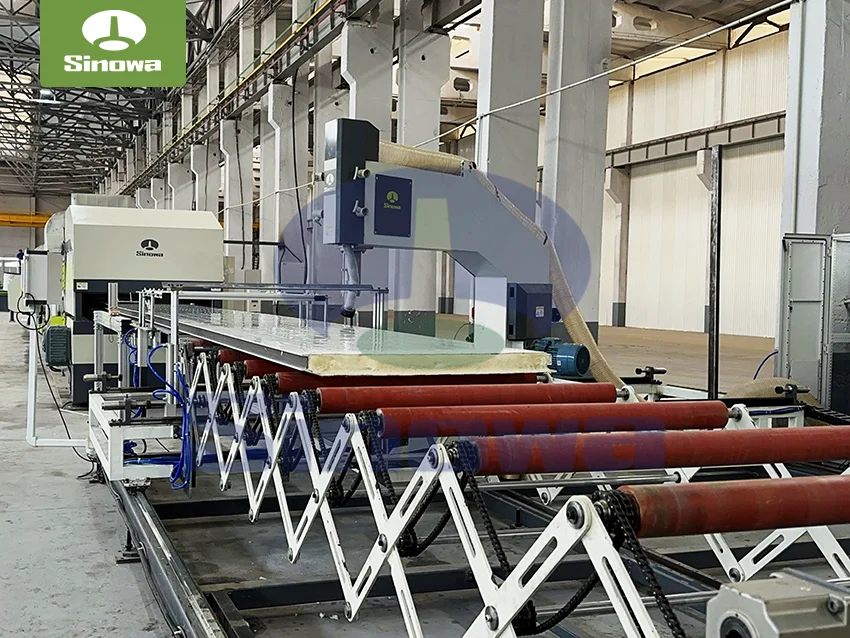
 sandwich panel machine
A fully automatic sandwich panel machine typically consists of multiple functional modules, including an automatic feeding system, panel pre-processing unit, core material filling device, hot pressing forming system, automatic cutting machine, and finished product stacking device. These modules are seamlessly connected through an intelligent control system, forming a complete assembly line that can operate 24 hours a day without interruption, with a daily production capacity of 5000-10000 square meters.
Core technology composition and working principle
Automatic feeding system
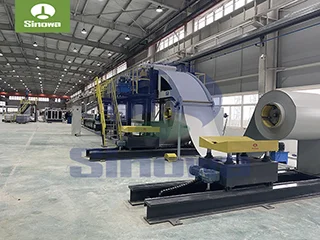
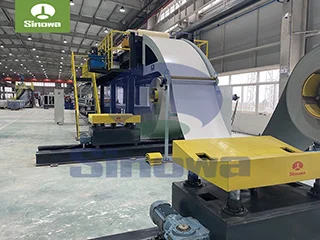
The starting point of a fully automatic sandwich panel machine is an efficient feeding system. Metal coils (usually color steel plates, stainless steel or aluminum plates) are unfolded by an automatic unwinding machine, and after the internal stress is eliminated by a leveling machine, they enter the cleaning and drying process. This process is completely controlled by PLC to ensure a clean and pollution-free surface of the panel, providing ideal conditions for subsequent bonding processes.
Core material processing unit
According to product requirements, the system can automatically switch between different core materials, such as polyurethane (PU), rock wool, glass wool, or EPS. The core material is quantitatively dispensed through precise measuring devices, and some high-end models are also equipped with core material online foaming technology to achieve on-site foaming and filling of polyurethane, ensuring that the core material is evenly distributed without voids.
Composite and Forming System
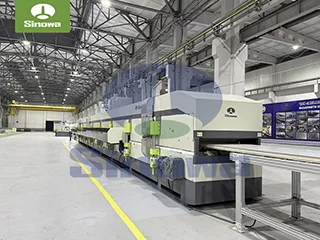
This is the core part of the production line, including the glue coating machine, pre press machine, and hot press machine. The specially designed double-sided adhesive coating device ensures even distribution of adhesive. The pre press machine preliminarily fixes the position relationship between the panel and the core material, and then enters the hot pressing forming section. The hot press adopts zone temperature control technology, with a temperature accuracy of ± 1 ℃ and a pressure uniformity error of no more than 2%, ensuring the bonding strength and flatness of the product.
Fixed length cutting system
Equipped with high-precision servo controlled flying saws or laser cutting devices, the cutting accuracy can reach ± 0.5mm. The advanced visual recognition system can automatically identify and mark defects in the board, and some high-end models also have automatic trimming and chamfering functions.
Intelligent stacking and packaging
Finished boards are stacked by robots or automatic stackers according to preset programs, equipped with automatic counting and coding systems. Some production lines also integrate automatic packaging machines to package finished products with protective film or cardboard, reducing transportation damage.
Technological innovation and advantageous characteristics
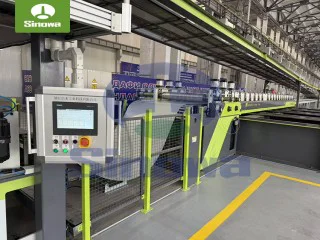
Intelligent control system
Modern fully automatic sandwich panel machines adopt industrial design concepts to achieve the following functions:
Real time monitoring and recording of production data
Adaptive adjustment of process parameters
Equipment status warning and remote diagnosis
Energy consumption optimization management
Energy saving and environmentally friendly design
The new generation of devices has significant improvements in energy consumption:
The hot pressing system adopts an efficient insulation design, which increases the thermal energy utilization rate by 40%
The waste recycling device can process scrap materials with a recovery rate of over 95%
The exhaust gas treatment system complies with international environmental standards
Multi functional adaptability
One device can produce multiple types of sandwich panels:
Thickness range: 30-200mm (customizable)
Panel material: metal PVC、 Fiber cement, etc
Core material types: PU, PIR, rock wool, phenolic resin, etc
Board type changes: flat board, corrugated board, customized irregular board
The products produced by automatic sandwich panel machines are widely used in:
Industrial plants and storage facilities
Cold storage and temperature controlled warehouse
Cleanrooms and medical facilities
Prefabricated buildings and temporary houses
Ship cabins and vehicle interiors
The fully automatic sandwich panel making machine is leading the development of building material manufacturing towards intelligence, efficiency, and environmental protection, providing strong equipment support for the global construction industrialization process. With the advancement of technology, such equipment will continue to break through production capacity limits, reduce production costs, and promote the application of sandwich panels in a wider range of fields.
Automatic sandwich panel machines represent a cornerstone of modern industrial manufacturing, integrating mechanical engineering, electrical automation, material processing, and precision control technologies to streamline the production of composite sandwich panels. These panels, consisting of two rigid outer face sheets bonded to a lightweight core material, have become indispensable across multiple sectors due to their unique combination of strength, insulation, durability, and versatility, and the machines that produce them are engineered to deliver consistent, high-volume output with minimal manual intervention. Unlike basic manual or semi-automatic production setups, fully automatic sandwich panel machines are designed as integrated production lines, where every stage of material handling, forming, bonding, curing, and finishing operates in a synchronized, continuous flow, eliminating bottlenecks and ensuring uniform product quality across large production batches. To fully understand the value and functionality of these machines, it is essential to examine their internal structural composition, key performance attributes, diverse classification systems, and wide-ranging practical applications, each element working in tandem to define their efficiency and adaptability in global manufacturing markets.
At the core of every automatic sandwich panel machine lies a well-engineered structural framework that supports seamless production from raw material input to finished panel output, with each modular component serving a specialized purpose while maintaining full compatibility with the entire line. The foundational structure begins with the material feeding and uncoiling system, which is tasked with holding and dispensing large rolls of outer face sheet materials, most commonly metal sheets such as steel or aluminum, though non-metallic options like fiber cement boards or decorative composite panels are also accommodated. This system is equipped with automatic tension control and deviation correction mechanisms to prevent misalignment, wrinkling, or uneven feeding of the face sheets, a critical detail that directly impacts the flatness and structural integrity of the final panels. Following the uncoiling station, the material moves through a roll forming unit, which gradually shapes the flat raw sheets into the desired profile, whether that involves simple flat panels, corrugated designs, or custom edge formations for seamless on-site assembly. The roll forming section features precision-machined rollers and adjustable spacing, allowing operators to modify panel dimensions and profiles without extensive retooling, enhancing the machine’s flexibility for diverse production orders.
Moving deeper into the machine’s structure, the core material processing and bonding zone stands as the heart of the entire production line, where the outer face sheets are permanently bonded to the insulating or structural core. This zone includes a pre-heating and surface treatment module that optimizes the temperature and surface texture of the face sheets to promote strong, long-lasting adhesion with the core material, removing surface contaminants and ensuring the adhesive or foaming agent activates effectively. For foam-core panels, this section houses a high-precision mixing and dispensing system that combines raw chemical components to create the foam core in real-time, with controlled pressure and flow rates to guarantee uniform density across the entire panel surface. For rigid core materials such as rock wool, expanded polystyrene (EPS), or phenolic foam, the machine includes a core feeding and positioning system that cuts and places pre-formed core blocks or rolls with exact alignment between the two face sheets. Surrounding this bonding area is a double-belt conveyor system, a key structural component that applies consistent, even pressure to the sandwich panel as it moves through the curing stage, preventing gaps between the face sheets and core and maintaining precise panel thickness. The double belt system is constructed with high-strength, heat-resistant materials to withstand prolonged operation and temperature fluctuations, with a box-shaped main frame that undergoes stress annealing treatment to enhance structural stability and prevent deformation over time.
The final structural segments of the automatic sandwich panel machine include the curing and cooling system, precision cutting unit, and panel stacking and output module. The curing system uses controlled heating, often through hot air circulation or surface heating elements, to accelerate the bonding and hardening process without compromising the material properties of the core or face sheets, with temperature sensors and regulators to maintain a consistent thermal environment throughout the line. Once the panel is fully cured, it passes through a cooling section that brings it to room temperature safely, preventing warping or shrinkage that could occur with rapid temperature changes. The precision cutting system is equipped with high-speed cutting tools that trim panels to exact length specifications, with automatic length measurement and adjustment capabilities to accommodate custom orders and minimize material waste. Finally, the stacking system gently collects finished panels, arranges them in neat stacks, and prepares them for packaging or direct transport, completing the fully automated production cycle without the need for manual handling at any stage. Every structural component is connected via a centralized control system, typically featuring a programmable logic controller (PLC) and human-machine interface (HMI) that allows operators to monitor production parameters, adjust settings, and troubleshoot issues in real time, creating a fully integrated and user-friendly operational structure.
The performance of an automatic sandwich panel machine is defined by a set of core attributes that distinguish it from lower-efficiency production equipment, with a primary focus on precision, efficiency, durability, consistency, and adaptability to varying production demands. One of the most prominent performance features is its high production efficiency, as these machines operate continuously with minimal downtime, capable of producing hundreds of meters of sandwich panels per hour depending on the model and panel specifications. This continuous operation eliminates the start-stop cycles common in manual production, significantly boosting output volume and reducing per-unit production time, making them ideal for large-scale manufacturing facilities with high demand. Precision is another critical performance metric, with the machine delivering consistent panel thickness, width, and length across every production run, with tolerance levels kept to a minimum to ensure panels fit perfectly during installation. The automatic deviation correction, tension control, and pressure regulation systems work together to eliminate uneven surfaces, core gaps, or bonding failures, resulting in panels with uniform quality that meet strict industrial and construction standards.
Durability and long-term operational stability are also key performance hallmarks, as the machine’s structural components are built from heavy-duty, wear-resistant materials designed to withstand continuous use in industrial environments. The roller systems, conveyor belts, and cutting tools are engineered for extended service life with minimal maintenance, reducing the need for frequent repairs and replacement parts. The machine’s control system is designed for stable operation, with built-in safety features to prevent overload, overheating, or mechanical jams, protecting both the equipment and operating personnel. Energy efficiency is another important performance aspect, with modern designs incorporating targeted heating systems that focus heat only on the panel surface rather than the entire machine, reducing energy consumption and lowering operational costs over time. Additionally, these machines offer strong adaptability, able to process a wide range of face sheet materials and core types without major structural modifications, allowing manufacturers to switch between product lines quickly to meet changing market needs. The automated control system also simplifies operation, reducing the need for highly skilled manual labor and minimizing human error, further enhancing overall production performance and product consistency.
Automatic sandwich panel machines are classified into several distinct types based on multiple criteria, including production process, core material compatibility, operational mode, and structural orientation, each type tailored to specific production requirements, facility constraints, and end-product applications. The most common classification is based on the production process, dividing machines into continuous production lines and discontinuous (batch) production machines. Continuous automatic sandwich panel lines are designed for large-scale, high-volume production, operating non-stop to produce long panels that are cut to length on demand, ideal for manufacturers serving large construction projects or mass market demand. These lines offer the highest efficiency and output, with a fully integrated flow from material feeding to finished panel stacking, and are typically used in large industrial facilities with sufficient floor space. Discontinuous sandwich panel machines, by contrast, operate in batch mode, producing individual panels or small batches at a time, making them suitable for smaller manufacturing facilities, custom panel production, or facilities with limited space. While their output volume is lower than continuous lines, they offer greater flexibility for small-batch, custom orders and require less initial installation space, making them a practical choice for niche or specialized production.
Another major classification system is based on the type of core material the machine is designed to process, with each variant optimized for the unique properties of different core materials to ensure optimal bonding and panel quality. EPS core sandwich panel machines are engineered to handle expanded polystyrene cores, a lightweight and cost-effective insulation material, with specialized core feeding and molding systems that shape EPS beads or blocks into uniform core layers. Polyurethane (PU) and polyisocyanurate (PIR) foam core machines feature advanced chemical mixing and foaming systems that generate the foam core in-line, with precise control over foaming pressure, temperature, and density to create high-insulation, fire-resistant panels. Rock wool core machines are built to handle rigid, fire-resistant mineral wool cores, with sturdy handling systems to prevent core breakage during production and strong bonding mechanisms to secure the dense core between face sheets. Phenolic foam core machines are designed for temperature-resistant and fire-retardant phenolic cores, with controlled curing systems to maintain the core’s structural integrity. Additionally, there are multi-core compatible machines that can be adjusted to process multiple core types, offering maximum versatility for manufacturers with diverse product portfolios.
Machines are also categorized by their structural orientation, specifically horizontal and vertical models, each suited to different facility layouts and production needs. Horizontal automatic sandwich panel machines feature a flat, horizontal production layout, with materials moving along a horizontal conveyor from input to output. This design allows for the production of wider, thicker, and longer panels, making it the preferred choice for large-scale construction and industrial panel production, though it requires a larger horizontal footprint. Vertical sandwich panel machines have a compact, upright structural design, with the production process occurring in a vertical space to minimize floor space usage, making them ideal for small to mid-sized facilities with limited horizontal space. While vertical models may have limitations on maximum panel size compared to horizontal variants, their compact design makes them highly practical for urban manufacturing facilities or operations where space is at a premium. Beyond these primary classifications, machines can also be grouped by panel application, such as wall panel machines, roof panel machines, cold storage panel machines, and decorative panel machines, each with slight structural modifications to optimize for the specific performance requirements of the end product.
The applications of automatic sandwich panel machines and the panels they produce span a vast range of industries, driven by the unique combination of properties offered by sandwich panels, including thermal insulation, sound absorption, structural strength, fire resistance, weather resistance, and ease of installation. The construction industry is the largest and most prominent application sector, where sandwich panels are widely used for both residential and commercial building projects. In commercial construction, they are utilized for exterior wall cladding, roof systems, partition walls, and facade elements for office buildings, shopping malls, and public facilities, offering fast installation times and excellent thermal efficiency to reduce building energy consumption. For industrial construction, the panels are ideal for manufacturing plants, warehouses, workshops, and logistics centers, as they provide durable, low-maintenance structural solutions that can withstand heavy industrial use and harsh environmental conditions. The modular and prefabricated building sector relies heavily on panels produced by these automatic machines, as the consistent dimensions and high quality of the panels enable quick on-site assembly, reducing construction timelines and labor costs significantly.
The cold chain and refrigeration industry is another major application area, where high-insulation sandwich panels are essential for constructing cold storage warehouses, refrigerated transport containers, cold rooms, food processing facilities, and pharmaceutical storage units. The panels produced by automatic machines offer exceptional thermal resistance, preventing heat transfer and maintaining stable low temperatures, which is critical for preserving perishable goods, food products, and temperature-sensitive medical supplies. The fire-resistant and durable properties of rock wool and PIR core panels make them suitable for cold storage facilities that also require strict fire safety compliance, a common requirement in the food and pharmaceutical sectors. In the agricultural industry, sandwich panels are used to build climate-controlled greenhouses, livestock barns, and agricultural storage facilities, where thermal insulation helps regulate internal temperatures and protect crops and livestock from extreme weather conditions. The lightweight yet sturdy nature of the panels reduces the structural load on agricultural buildings while providing long-lasting protection against moisture, corrosion, and pests.
Beyond construction and cold chain applications, automatic sandwich panel machines support production for specialized industrial sectors, including transportation, marine engineering, and interior decoration. In transportation, the lightweight and high-strength panels are used to fabricate body parts for refrigerated trucks, trailers, vans, and shipping containers, reducing vehicle weight to improve fuel efficiency while maintaining structural integrity and insulation performance. Marine applications include interior wall panels, ceiling panels, and partition systems for ships and offshore structures, where moisture resistance and lightweight properties are essential. For interior decoration, the machines produce decorative sandwich panels with aesthetically pleasing surface finishes, used for wall coverings, ceiling tiles, and furniture components in residential and commercial spaces, combining visual appeal with functional insulation and soundproofing. Additionally, the panels are used in disaster relief and temporary construction projects, as they are easy to transport and assemble quickly to create temporary shelters, emergency facilities, and temporary commercial spaces, providing durable and safe structures in urgent situations.
As manufacturing and construction industries continue to evolve toward automation, efficiency, and sustainability, the role of automatic sandwich panel machines becomes increasingly vital, with ongoing advancements in structural design and control technology further enhancing their performance and versatility. The ability to produce high-quality, consistent composite panels at scale has transformed traditional construction methods, shifting the industry toward prefabrication and modular building practices that reduce waste, shorten project timelines, and improve overall building performance. Each structural component of these machines is carefully engineered to work in harmony, delivering reliable performance that meets the diverse needs of global markets, while the wide range of machine types ensures that manufacturers of all sizes can find a solution tailored to their production capacity and facility constraints. From large-scale industrial construction to specialized cold chain storage and decorative interior applications, the panels produced by these automatic machines continue to drive innovation across sectors, offering a sustainable, cost-effective, and high-performance building material solution. As demand for energy-efficient, durable, and versatile composite materials grows, automatic sandwich panel machines will remain a key asset in industrial manufacturing, adapting to new material technologies and production standards to meet the evolving needs of modern industry and infrastructure development.
https://www.cnsinowa.com/sandwich-panel-machines/automatic-sandwich-panel-machines.html