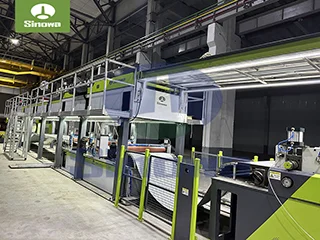
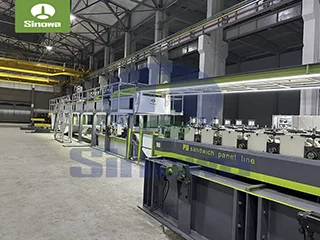
sandwich panel machine
The fundamental design logic of thermal insulation sandwich panel machine centers on precise material compounding, standardized molding, and stable performance curing, aiming to eliminate performance inconsistencies caused by manual operation and backward production processes. A complete set of production machinery covers the entire industrial chain from raw material pretreatment, automatic feeding, precise mixing, layered compounding, pressure molding, constant-temperature curing, fixed-size cutting to finished product output and stacking. Each functional unit operates in a coordinated and continuous manner, forming a closed-loop production system that ensures every produced sandwich panel maintains consistent thickness, density, bonding strength, and thermal insulation performance. Compared with discrete production equipment, integrated sandwich panel production machinery features higher operational continuity, lower manual intervention, and stronger product standardization, which are the key reasons for its wide application in modern construction engineering, cold chain logistics facilities, industrial plant construction, and commercial building renovation projects.
To fully understand the operational value and technical advantages of thermal insulation sandwich panel machinery, it is essential to analyze its overall structural composition and the functional positioning of each core module. The entire production system can be divided into multiple interconnected functional units, including raw material conveying and pretreatment systems, core material processing systems, surface panel feeding and positioning systems, automatic gluing and composite systems, pressure molding systems, constant-temperature curing systems, precision cutting systems, and finished product sorting and stacking systems. Every module is optimized for mechanical coordination and parameter matching, ensuring seamless connection between front and rear processes and avoiding production stagnation or product quality defects caused by process disconnection.
The raw material pretreatment and feeding system serves as the starting point of the entire production process, undertaking the task of standardized input of all production materials. For metal surface materials commonly used in sandwich panels, this system completes unwinding, leveling, surface dedusting, and preliminary shaping treatments. Metal coils often have surface tension unevenness and minor deformation after long-term storage and transportation; the leveling structure of the machinery can calibrate the flatness of the metal plate through multi-group roller pressure adjustment, ensuring the surface of the subsequent composite panel is smooth and free of warping. Meanwhile, the automatic dedusting device removes surface dust, oil stains, and impurities, laying a foundation for firm bonding between the surface panel and the core material. For lightweight thermal insulation core materials such as polyurethane, rock wool, and phenolic foam, the feeding system realizes quantitative and uniform conveying through intelligent speed regulation and material distribution structures, avoiding local material accumulation or sparse distribution that may affect the overall thermal insulation and structural uniformity of the panel.
The core material processing unit is a key module that determines the thermal insulation performance of finished panels, and its operational precision directly affects the core functional indicators of the products. For foam-type core materials, the machinery is equipped with professional mixing and foaming structures that realize precise proportioning of raw materials, high-speed uniform mixing, and controllable foaming and molding. During operation, the system accurately controls the mixing speed, mixing time, and material injection volume of different raw materials to ensure the internal pore structure of the foam core material is uniform and dense. A stable and consistent microporous structure can effectively block air convection and heat transfer, endowing the panel with excellent long-term thermal insulation performance. For inorganic core materials such as rock wool, the processing unit completes fixed-thickness cutting, fiber carding, and layer compaction of raw materials, eliminating loose fibers and thickness deviation of raw materials. This processing method ensures that the core material maintains stable structural density and thermal resistance in long-term use, avoiding thermal insulation attenuation caused by fiber looseness or material settlement.
The automatic gluing and composite system is the core functional component that realizes the integrated molding of sandwich panels, responsible for the firm combination of surface panels and thermal insulation core materials. Modern thermal insulation sandwich panel machine adopts full-automatic spraying and roller coating integrated gluing processes, which can uniformly coat high-performance adhesive materials on the bonding surfaces of upper and lower surface panels and core materials. The gluing thickness and gluing density are intelligently adjusted according to different material characteristics and panel specifications, ensuring no missing coating, no glue accumulation, and no uneven gluing. The precise gluing control technology effectively improves the bonding uniformity between layers, enhances the overall structural integrity of the panel, and prevents layer separation, bulging, and cracking in subsequent use. After the gluing operation is completed, the multi-layer materials are accurately aligned and compounded through the automatic positioning and guiding structure of the machinery, ensuring the upper and lower panels and the middle core material are completely overlapped with no offset, and the overall dimensional accuracy of the composite blank is strictly controlled.
The pressure molding system undertakes the task of shaping and preliminary curing of composite blanks, which is crucial for forming the stable structural morphology of sandwich panels. The machinery adopts multi-group symmetrical pressure roller structures or integral mold pressing structures, which apply uniform and stable pressure to the composite materials. The pressure value, pressing speed, and pressing time can be adaptively adjusted according to different core material types and panel thickness specifications. Moderate and stable pressure can make the adhesive fully infiltrate the material surface, enhance the bonding force between layers, and make the core material structure more compact and uniform. Excessive pressure will cause excessive compression of the lightweight core material, damage the internal thermal insulation pore structure, and reduce thermal insulation performance; insufficient pressure will lead to loose bonding between layers, poor panel flatness, and low overall structural strength. Therefore, the precise pressure control capability of the molding system is one of the core technical indicators of high-quality thermal insulation sandwich panel machinery. After pressure molding, the preliminary integrated semi-finished panel with stable shape and bonding state is formed.
The constant-temperature curing system is a key unit to realize the stable molding and performance solidification of semi-finished panels, and it is an indispensable link to ensure the long-term service stability of products. The curing system relies on closed constant-temperature space and uniform heat circulation technology to provide a stable temperature environment for the curing reaction of adhesives and the structural stabilization of core materials. During the curing process, the internal molecular structure of the adhesive undergoes complete cross-linking reaction, forming a high-strength and tough bonding layer, which permanently combines the surface panel and the core material into an integral structure. At the same time, the constant-temperature environment can eliminate internal stress generated during the pressing and compounding process of the panel, avoid subsequent warping deformation and size deviation of the product, and further optimize the compactness and uniformity of the core material structure. Different core materials and adhesive formulas correspond to matched curing temperature ranges and curing cycle parameters. Modern intelligent machinery can automatically adjust curing parameters according to production specifications, realizing accurate control of the curing process and ensuring that each batch of products reaches the optimal performance state.
The precision cutting and finishing system is responsible for shaping the size of cured semi-finished panels and removing edge excess materials to form standard finished products. The cutting unit adopts high-precision servo driving technology and fixed-length positioning system, which can complete fixed-size cutting according to different customized length and width requirements. Compared with traditional manual cutting and ordinary mechanical cutting, the cutting system of professional sandwich panel machinery has higher dimensional accuracy and cutting flatness, with smooth and burr-free cutting sections, which avoids secondary processing of finished products. At the same time, the equipment is equipped with an edge trimming and deburring structure, which can trim the irregular edges of the panel, optimize the overall appearance quality of the product, and ensure the fitting accuracy of the panel in subsequent construction and installation. The cutting speed and cutting interval can be intelligently adjusted according to production efficiency requirements, realizing seamless connection with the front-end curing process and ensuring the continuity and high efficiency of the entire production line.
The final finished product sorting and stacking system realizes automatic collection, arrangement, and stacking of cut standard panels, completing the last link of automated production. This unit replaces manual carrying and stacking, effectively reducing labor intensity, avoiding panel surface scratches, deformation, and stacking disorder caused by manual operation, and improving the neatness and consistency of finished product storage. The system can adjust the stacking height and arrangement mode according to panel specifications, and cooperate with subsequent handling equipment to realize streamlined docking of finished product warehousing and transportation, greatly improving the overall operational efficiency of the production line.
In terms of technical characteristics, modern thermal insulation sandwich panel production machine presents prominent advantages of high automation, intelligent control, stable operation, and strong adaptability. The entire production line adopts integrated programmable control technology, which centrally manages and regulates all links from raw material feeding to finished product output. Operators only need to set parameter values such as panel thickness, length, width, and material type through the operation interface, and the equipment can automatically complete the whole production process. The system has real-time monitoring functions for key production parameters such as operating speed, pressing pressure, curing temperature, and gluing volume. Once parameter deviation or equipment abnormal operation occurs, the system will trigger automatic adjustment and early warning prompts, effectively reducing the probability of defective products and equipment failures. This intelligent control mode greatly reduces the dependence on skilled operators, simplifies the production operation process, and improves the stability and consistency of batch production quality.
The structural stability and durability of thermal insulation sandwich panel production machine are also important guarantees for long-term efficient production. The main frame of the equipment adopts high-strength structural materials and integrated welding and processing technology, which has strong compression resistance, vibration resistance, and deformation resistance. It can maintain stable operating accuracy under long-term continuous high-load production conditions and avoid equipment vibration and frame deformation that affect product precision. The transmission parts and moving parts of the equipment are equipped with wear-resistant and lubricating structures, which reduce mechanical friction loss, extend the service life of the equipment, and reduce the frequency of maintenance and parts replacement. In addition, the equipment is designed with a modular disassembly and assembly structure, which facilitates daily maintenance, fault inspection, and component replacement, effectively improving the operational stability and service cycle of the entire production line.
The technological adaptability of thermal insulation sandwich panel making machine enables it to meet the diversified production needs of multiple types of thermal insulation sandwich panels. By adjusting equipment parameters and replacing individual functional components, the same production line can produce sandwich panels with different core materials, different thickness specifications, and different surface layer types, covering polyurethane foam sandwich panels, rock wool sandwich panels, phenolic foam sandwich panels, and other mainstream product types. The produced panels can meet the thermal insulation, fire resistance, structural strength, and weather resistance requirements of different application scenarios. For thin-type decorative thermal insulation panels used in building exterior walls, the equipment can realize ultra-thin uniform compounding and precise size shaping; for thick-type thermal insulation and fireproof panels used in industrial plants and cold storage buildings, the equipment can complete high-thickness core material molding and high-strength layered bonding, realizing multi-scene and multi-specification flexible production.
In terms of production efficiency, automated thermal insulation sandwich panel manufacturing machine has completely subverted the low-efficiency production mode of traditional discrete equipment. The integrated assembly line operation realizes uninterrupted continuous production from raw material input to finished product output, with short production cycle and large single-batch output. The coordinated operation of each functional module avoids waiting time and process gap in traditional segmented production, greatly improves the overall production efficiency, and can meet the large-scale and centralized procurement demand of modern construction projects. At the same time, the standardized production mode effectively reduces the material waste rate. The precise quantitative feeding and gluing control of the equipment avoids excessive consumption of raw materials caused by manual operation, realizing efficient utilization of production materials and reducing comprehensive production costs.
The product quality advantages brought by professional thermal insulation sandwich panel production line is extremely prominent, which are difficult to achieve in traditional production modes. The mechanically produced sandwich panels have uniform overall thickness, consistent internal density, and tight bonding between layers, with no hollowing, bulging, or cracking problems. The internal thermal insulation core material has a complete and stable pore structure or fiber structure, ensuring long-term stable thermal insulation performance and avoiding heat transfer efficiency attenuation caused by structural damage. The surface of the finished panel is flat and smooth, with accurate overall dimensions and good assembly consistency, which can realize rapid assembly and construction on the construction site, shorten the construction cycle, and improve the overall construction quality of the project. In terms of environmental adaptability, mechanically molded panels have stronger weather resistance, can resist temperature difference changes, humid environment erosion, and external slight impact in long-term outdoor and indoor use, and maintain stable structural and thermal insulation performance.
With the global construction industry accelerating the transformation to energy saving, emission reduction, and green low carbon, the application scope of thermal insulation sandwich panels continues to expand, which further drives the technical upgrading and market expansion of supporting production machinery. In industrial construction scenarios such as factory buildings, warehouses, and workshops, thermal insulation sandwich panels produced by professional machinery are widely used in roof and wall enclosure structures, relying on their excellent thermal insulation performance to reduce building heating and cooling energy consumption and realize energy-saving operation of industrial buildings. In cold chain logistics facilities such as cold storage and constant-temperature warehouses, the high-precision composite structure and low thermal conductivity of mechanically produced panels can effectively isolate internal and external heat exchange, maintain stable internal low-temperature environment, and reduce the operational energy consumption of refrigeration equipment.
In commercial buildings, residential exterior wall thermal insulation, and indoor partition projects, the standardized and high-precision production characteristics of mechanical equipment ensure the excellent decorative effect and stable service performance of sandwich panels. The diversified production capacity of the equipment can meet the personalized design needs of different buildings for panel color, thickness, and surface texture, realizing the integration of building thermal insulation and decorative functions. In addition, in special engineering fields such as clean workshops, temporary construction facilities, and scenic prefabricated buildings, the high efficiency and high quality of mechanical production provide reliable material support for rapid construction and long-term stable operation of engineering projects.
In terms of green production and environmental protection performance, modern thermal insulation sandwich panel line also has significant optimization compared with traditional equipment. The equipment adopts closed production design in the foaming, gluing, and mixing links, which effectively reduces the volatilization and diffusion of harmful substances in the production process and reduces production pollution. The precise material ratio control technology avoids excessive raw material consumption and waste residue generation, realizing energy-saving and material-saving production. At the same time, the high-efficiency production mode of the equipment shortens the production cycle, reduces the energy consumption of unit product production, and conforms to the development trend of green manufacturing in the modern building materials industry. The panels produced by this machinery are energy-saving and environmentally friendly building materials, which can reduce the overall energy consumption of buildings and help the construction industry achieve the goal of low-carbon development.
In the actual production and application process, the standardized operation and scientific maintenance of thermal insulation sandwich panel manufacturing line is crucial to ensuring production efficiency and product quality. Daily equipment maintenance includes regular inspection of transmission components, cleaning of feeding and gluing systems, calibration of cutting and positioning systems, and detection of curing system temperature control accuracy. Timely maintenance can effectively avoid equipment aging failure and parameter deviation, ensure the long-term stable operation of the equipment, and maintain the consistency of product quality. In addition, according to different production tasks and material characteristics, reasonably adjusting the operating parameters of the equipment and optimizing the production process flow can further improve production efficiency and product performance, and give full play to the technical advantages of automated production machinery.
Looking at the future development trend, thermal insulation sandwich panel machine will develop in the direction of higher intelligence, higher precision, stronger integration, and greener production. With the continuous progress of industrial intelligent technology, the equipment will realize more autonomous production functions, including automatic material identification, intelligent parameter matching, real-time quality self-inspection, and fault self-diagnosis, further reducing manual intervention and improving production automation and intelligence. In terms of precision manufacturing, the equipment will optimize the mechanical transmission and control system, realize higher-precision material compounding and size shaping, and meet the higher-standard product requirements of high-end construction engineering. In terms of functional integration, the production line will integrate more process links such as surface decoration and anti-corrosion treatment to realize one-stop integrated production of finished panels and further improve production efficiency. In terms of environmental protection and energy saving, the equipment will further optimize the production process, reduce production energy consumption and pollutant emissions, and adapt to the increasingly strict green production standards of the global building materials industry.
As the core equipment for the production of energy-saving thermal insulation building materials, thermal insulation sandwich panel machinery undertakes the important task of promoting the industrialization and standardized development of thermal insulation sandwich panels. Its technical level and production performance directly determine the quality level and application effect of thermal insulation sandwich panel products, and indirectly affect the energy-saving efficiency and construction quality of modern buildings. In the context of the global construction industry's vigorous promotion of prefabricated construction and green energy-saving buildings, thermal insulation sandwich panel machinery will continue to exert important industrial value. Through continuous technological innovation and structural optimization, it will provide more efficient, stable, and environmentally friendly production solutions for the building materials industry, promote the iterative upgrading of energy-saving building materials, and contribute to the high-quality development of the modern construction industry.
https://www.cnsinowa.com/sandwich-panel-machines/thermal-insulation-sandwich-panel-machinery.html