sandwich panel machine
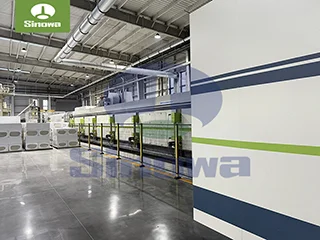
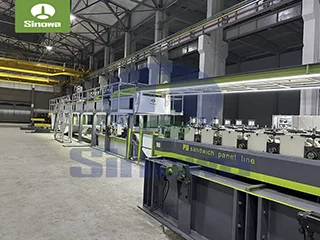
The overall structural design of the steel structure sandwich panel production line follows the principles of continuous production and modular combination, with each functional unit closely connected and coordinated to complete the whole production process from raw material feeding to finished product stacking. The complete production system covers multiple core functional modules including raw material unwinding and leveling, roll forming, core material conveying and distribution, adhesive coating, high-pressure composite lamination, constant-temperature curing, fixed-length cutting, edge trimming, and automatic stacking. Each module operates under unified system scheduling, ensuring the continuity and stability of the production line and avoiding production discontinuity and quality fluctuations caused by manual operation intervention. The mechanical framework of the equipment adopts high-rigidity steel welding structures, which can withstand long-term continuous operation and maintain stable operating accuracy under different working conditions, effectively reducing equipment vibration and deformation during high-speed production.
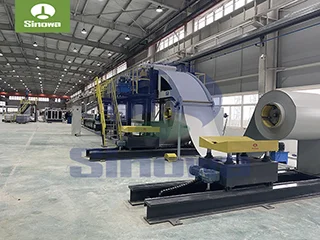
The front-end working area of the steel structure sandwich panel line is mainly responsible for the pretreatment of metal surface materials, which is the foundation for ensuring the flatness and molding accuracy of finished panels. The metal coil raw materials used for the upper and lower surfaces of the sandwich panel are stably loaded into the hydraulic unwinding mechanism, which realizes automatic, smooth and tension-controllable material feeding. Different from simple manual feeding equipment, the hydraulic unwinding structure can adapt to metal coils of different specifications and weights, avoiding material deviation and stretching deformation during the feeding process. After unwinding, the metal sheets will pass through a multi-group leveling system, which eliminates the internal stress and surface wrinkles of the metal sheets through repeated rolling and pressing, ensuring that the surface flatness of the sheets meets the subsequent composite molding standards. The leveled metal sheets then enter the roll forming station, where multiple groups of precision forming rollers perform gradual profile pressing and molding. By adjusting the gap and angle of the rollers, the equipment can process metal sheets into various groove and edge structures required for on-site assembly, laying a foundation for the later seamless splicing of sandwich panels in engineering applications.
While the metal surface materials are being pretreated and molded, the core material conveying and distribution system operates synchronously to realize the precise matching of surface materials and core materials. Common core materials processed by the equipment include lightweight thermal insulation materials such as polyurethane, polyisocyanurate, expanded polystyrene, and mineral wool, all of which have excellent thermal insulation, sound insulation and fire-resistant properties. The core material conveying device adopts automatic quantitative feeding technology, which can stably and evenly transport the core material raw materials to the composite lamination area according to the preset thickness and density parameters. For foam core materials that require chemical reaction molding, the equipment is equipped with an accurate raw material mixing and foaming system, which mixes different raw material components in a fixed proportion and conducts uniform spraying and pouring. This online foaming and laying mode enables the core material to form a continuous and uniform integral structure between the upper and lower metal sheets, avoiding the hollowing, uneven thickness and local gaps that are prone to occur in traditional manual paving processes.
The adhesive coating and composite lamination module is the core functional part of the entire steel structure sandwich panel production machine, directly determining the bonding strength and overall structural stability of the finished sandwich panel. The high-precision adhesive spraying system installed on the equipment can evenly coat environmental protection adhesive materials on the inner surfaces of the upper and lower metal sheets and the upper and lower sides of the core material. The spraying volume and spraying range can be intelligently adjusted according to different material characteristics and production process requirements, ensuring that the adhesive layer is thin and uniform without excess accumulation or missing coating. After the adhesive coating is completed, the metal sheets and core material immediately enter the constant-pressure lamination mechanism. The double-layer circulating pressing structure applies uniform and stable mechanical pressure to the composite materials, so that the surface materials and core materials are closely fitted and bonded as a whole. The lamination process maintains a stable pressure environment throughout, which can effectively eliminate internal gaps, improve the compactness of the composite structure, and enhance the overall compression resistance and bending resistance of the panel.
The constant-temperature curing system matched with the lamination unit further optimizes the bonding effect and structural stability of the sandwich panel. After composite pressing, the preliminary bonded panel semi-finished products pass through the constant-temperature curing channel, where a reasonable temperature environment accelerates the curing reaction of the adhesive and the molding and solidification of the foam core material. The intelligent temperature control system can dynamically adjust the internal temperature of the curing channel according to the ambient temperature, production speed and material types, ensuring that the adhesive fully reacts and the core material forms a stable three-dimensional structure. This curing process not only significantly improves the bonding firmness between layers and avoids delamination and peeling during long-term use, but also standardizes the physical properties of the core material, making the thermal insulation, sound insulation and mechanical properties of each batch of panels highly consistent.
The post-processing unit of the steel structure sandwich panel equipment realizes the precise shaping and standardized collection of finished panels, completing the final link of automated production. After curing and shaping, the integrated sandwich panel enters the fixed-length cutting and edge trimming area. The high-precision cutting system performs fixed-size cutting according to customized production parameters, with extremely strict dimensional tolerance control, ensuring that the length, width and edge flatness of each panel meet engineering application standards. The edge trimming mechanism can trim the burrs and irregular edges generated during cutting and molding, making the panel edges smooth and neat, which is convenient for subsequent on-site assembly and sealing construction. Some optimized equipment configurations are also equipped with automatic grooving and punching functions, which can complete the pre-processing of assembly structures in one step during the production process, further improving the convenience of later construction.
The final automatic stacking and discharging system realizes unmanned collection and sorting of finished products. The processed qualified sandwich panels are stably transported to the terminal stacking platform through the conveying mechanism, and the mechanical stacking device automatically completes orderly stacking and arrangement according to the set number and specification standards. The entire stacking process is stable and efficient, avoiding surface scratches, deformation and messy stacking problems caused by manual carrying and stacking. The stacked finished panels have regular shapes and uniform specifications, which is convenient for subsequent packaging, transportation and storage, and also improves the overall standardization of product delivery.
Compared with traditional manual and semi-automatic panel production equipment, the integrated steel structure sandwich panel making machine has outstanding advantages in production efficiency, product quality stability and production cost control. In terms of production efficiency, the continuous assembly line production mode completely breaks the limitations of intermittent production of traditional equipment. The whole process from raw material feeding to finished product discharging is carried out continuously, which greatly shortens the single-panel production cycle and can realize large-scale and batch production. The highly automated operation mode only requires personnel to complete raw material replacement, parameter setting and daily equipment inspection work, which greatly reduces the demand for on-site operators and effectively saves labor costs in the production process.
In terms of product quality, the full-mechanical and intelligent control mode avoids human operation errors that are inevitable in traditional production processes. All production parameters such as material thickness, adhesive coating volume, lamination pressure, curing temperature and cutting size are precisely controlled by the system, realizing unified standard production. The produced sandwich panels have uniform thickness, flat and smooth surfaces, firm internal bonding, and stable physical and chemical properties. The overall structural strength, thermal insulation performance and weather resistance of the products are significantly improved, which can adapt to complex and harsh use environments such as high temperature, low temperature and strong wind, and meet the long-term service requirements of various engineering projects.
In terms of production flexibility, modern steel structure sandwich panel manufacturing machine has strong adaptive adjustment capabilities. By simply adjusting the equipment operation parameters and replacing a small number of forming accessories, the equipment can produce sandwich panels with different thicknesses, different core materials and different surface specifications. This flexible production mode can meet the personalized customization needs of different customers for building enclosure materials, and can quickly respond to the differentiated material requirements of various projects such as industrial factory buildings, cold storage warehouses, public buildings and temporary construction facilities. At the same time, the equipment has good production compatibility, and can adapt to the processing and production of various metal sheet materials and environmentally friendly core materials, which is in line with the current development trend of green and low-carbon building materials.
The equipment also has excellent operational stability and energy-saving environmental protection performance in the actual production process. The optimized mechanical transmission structure reduces equipment friction loss and operation failure rate, realizing long-term stable continuous operation and reducing production downtime and maintenance costs caused by equipment failure. The intelligent energy-saving control system can automatically adjust the operating power of each functional module according to the production load, avoiding invalid energy consumption in the production process. In terms of environmental protection, the closed production structure effectively reduces the volatilization of adhesive raw materials and foam raw materials, and the matched waste recycling device can treat and recycle the residual materials generated in the cutting and trimming process, reducing production waste and environmental pollution, and meeting the environmental protection standards of modern industrial production.
With the continuous upgrading of modern building engineering standards and the rapid development of steel structure building technology, the market demand for high-performance standardized sandwich panels is increasing day by day, which also promotes the continuous technological iteration and performance optimization of steel structure sandwich panel manufacturing line. The future development direction of the equipment is mainly reflected in higher intelligent control level, more flexible production performance and more environmentally friendly production processes. The introduction of digital monitoring and remote debugging technology can realize real-time monitoring of equipment operating status, automatic early warning of faults and remote parameter adjustment, further improving the intelligent and unmanned level of production. The optimized modular structure design can realize faster function switching and specification adjustment, meet the small-batch and multi-variety customized production needs of the market, and improve the comprehensive utilization rate of equipment.
In the field of engineering application, the high-quality sandwich panels produced by steel structure sandwich panel machinery has become the core enclosure materials for modern steel structure buildings, widely used in industrial factory buildings, logistics warehouses, low-temperature cold storage facilities, clean workshops, urban public buildings and mobile temporary engineering facilities. Relying on the excellent thermal insulation, sound insulation, fire resistance, wind resistance and seismic performance of the finished panels, as well as the advantages of light weight, convenient installation and short construction period, these materials effectively reduce the overall construction cost of the project and improve the construction efficiency and service life of the building. The stable product quality brought by advanced production equipment also ensures the overall safety and durability of steel structure buildings, providing reliable material guarantee for the standardized and high-quality development of the construction industry.
In conclusion, the steel structure sandwich panel machine, as a key automated production equipment in the field of modern building materials, integrates advanced mechanical manufacturing and intelligent control technology, and realizes efficient, standardized and green production of composite sandwich panels through continuous process optimization and structural upgrading. Its excellent production performance and flexible application characteristics not only solve the pain points of low efficiency, unstable quality and high cost in traditional panel production, but also provide strong technical support for the popularization and application of steel structure buildings. With the continuous progress of industrial technology and the continuous improvement of building energy-saving standards, this type of sandwich panel production equipment will play a more important role in the field of modern construction engineering and building material manufacturing, and promote the whole industry to develop towards higher efficiency, higher quality and greener direction.
https://www.cnsinowa.com/sandwich-panel-machines/steel-structure-sandwich-panel-machine.html