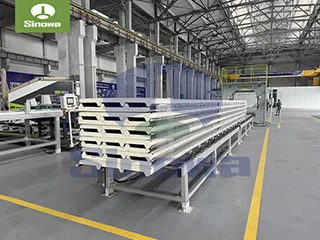
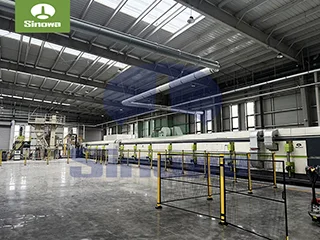
sandwich panel machine
The core value of PU sandwich panel production machine in sound insulation projects stems from their ability to accurately fabricate panels with optimized sound insulation structures. A typical PU sandwich panel consists of two outer facing materials and a middle core of polyurethane foam. The polyurethane foam core, with its unique closed-cell structure, is the key to the panel's sound insulation performance. It contains countless tiny sealed bubbles that effectively block the transmission of sound waves by reducing air flow and absorbing acoustic energy. However, the formation of this high-quality foam core and its reliable bonding with the facing materials rely entirely on the precise operation of the production machine. Unlike traditional manual or semi-automatic production methods, modern PU sandwich panel production machines can achieve strict control over every link of the production process, from the preparation of raw materials to the final forming of the panel, thus ensuring that each panel has uniform density, consistent thickness, and strong bonding between layers—all of which are critical factors affecting sound insulation effectiveness.
The working principle of PU sandwich panel production line involves a series of coordinated processes that seamlessly integrate material processing, foam injection, and forming. The production process typically starts with the uncoiling and leveling of the facing materials. Common facing materials include color-coated steel sheets, aluminum sheets, or non-woven fabrics, which not only provide structural support for the panel but also enhance its sound insulation and durability. The uncoiling system of the production machine gently unfolds the coiled facing materials, and the leveling device removes any wrinkles or deformations, ensuring that the surface of the facing materials is flat and smooth. This step is crucial because uneven facing materials can lead to gaps between the core and the facing during the bonding process, creating sound transmission channels that significantly reduce the sound insulation effect of the final panel.
After the facing materials are prepared, they are conveyed to the foam injection area through a precision conveyor system. Meanwhile, the production machine's material mixing system accurately measures and mixes polyurethane resin, curing agent, foaming agent, and other raw materials according to a preset ratio. The mixing process is carried out in a high-speed mixing head, which ensures that the raw materials are thoroughly and uniformly mixed. The uniformity of the mixture directly affects the quality of the polyurethane foam core—any uneven mixing can result in inconsistent foam density, leading to local weaknesses in sound insulation performance. The production machine's metering pump system plays a key role here, as it can control the flow rate of each raw material with an error margin of less than 1%, ensuring the stability of the foam formulation.
Once the mixture is ready, it is evenly sprayed onto the lower facing material through a movable pouring head. The pouring head moves back and forth along the width of the facing material, ensuring that the mixture is distributed uniformly without any accumulation or gaps.Then, the upper facing material is fed onto the mixture, and the combined structure enters a double-belt pressing and forming system. This system consists of two parallel, continuously moving belts that apply uniform pressure to the panel. At the same time, the heating device in the double-belt system maintains a specific temperature environment, which promotes the foaming and curing of the polyurethane mixture. The temperature and pressure control during this stage are particularly critical for the formation of the closed-cell structure of the foam. If the temperature is too low, the foam may not fully cure, resulting in poor bonding strength and reduced sound insulation performance. If the pressure is uneven, the foam density may vary across the panel, leading to inconsistent sound insulation effects. Modern PU sandwich panel production machines are equipped with advanced temperature and pressure sensors that continuously monitor and adjust these parameters in real-time, ensuring that the foam core forms a uniform and dense closed-cell structure.
After the foam is fully cured and formed, the continuous panel is conveyed to the trimming and cutting section. The trimming device removes the excess material from both sides of the panel to ensure that the width of the panel meets the design requirements. The cutting device, usually a flying saw that moves synchronously with the panel, cuts the continuous panel into lengths specified by the project. This synchronous cutting method avoids damage to the panel structure and ensures that the cut edges are flat and smooth. For sound insulation projects, the precision of the panel dimensions is crucial because irregular dimensions can lead to gaps during installation. These gaps, even if very small, can become major sound transmission paths, seriously affecting the overall sound insulation effect of the project. The production machine's ability to cut panels with high precision ensures that the panels can be tightly fitted during installation, minimizing sound leakage.
In addition to ensuring the basic quality of the panels, modern PU sandwich panel machine also have the flexibility to adapt to different sound insulation project requirements by adjusting production parameters. For example, in projects that require higher sound insulation performance, such as recording studios or hospitals, the production machine can be adjusted to increase the thickness of the polyurethane foam core or use a composite core structure (e.g., combining polyurethane foam with rock wool). The modular design of the production machine allows for easy switching of different production modules, enabling the production of panels with varying core thicknesses (ranging from 25mm to 150mm or more) and different facing materials. This flexibility makes PU sandwich panels suitable for a wide range of sound insulation scenarios, from light-duty residential sound insulation to heavy-duty industrial noise reduction.
Another important advantage of PU sandwich panel line in sound insulation projects is their high production efficiency, which can meet the large material demand of large-scale projects. Traditional sound insulation material production methods often have low efficiency and difficulty in ensuring consistent quality, making them unable to keep up with the construction progress of large projects. In contrast, modern continuous PU sandwich panel production machines can achieve a production speed of up to 30 meters per minute, with a daily output of thousands of square meters. This high efficiency not only shortens the production cycle but also reduces the construction period of the entire sound insulation project. Moreover, the automated production process of the machine reduces the dependence on manual operations, minimizing human errors and ensuring that each batch of panels has consistent quality. This consistency is particularly important for large-scale sound insulation projects, where the performance of the entire sound insulation system depends on the uniform quality of each panel.
The environmental friendliness of polyurethane sandwich panel production line also contributes to their wide application in modern sound insulation projects. With the increasing emphasis on environmental protection, sound insulation projects are not only required to have good sound insulation effects but also to be environmentally sustainable. Advanced production machines adopt environmentally friendly foaming systems, such as pentane foaming technology, which replaces traditional ozone-depleting foaming agents, reducing environmental pollution. In addition, the production machine's energy-saving design reduces energy consumption during the production process. For example, the lamination conveyor system of some advanced machines uses high-efficiency motors with power consumption only 50% of that of traditional motors, and the body of the conveyor is covered with thermal insulation materials to reduce heat loss. These energy-saving and environmental protection measures not only reduce the production cost but also align with the concept of green construction, making PU sandwich panels and their production machines more in line with the requirements of modern sustainable development.
In practical sound insulation projects, the performance of PU sandwich panels produced by advanced machines has been fully verified. For example, in industrial workshop sound insulation projects, where the noise level is often as high as 85 decibels or more, PU sandwich panels produced by these machines can reduce the noise level inside the workshop to below 60 decibels, meeting the national noise standard requirements. In airport terminal sound insulation projects, the panels effectively block the noise from aircraft takeoff and landing, creating a quiet waiting environment for passengers. The excellent sound insulation performance of these panels is largely attributed to the precise control of the production machine over the foam density and panel structure. Tests have shown that PU sandwich panels produced by advanced machines have a weighted sound insulation index (Rw) of 29-36 decibels, and when combined with a double-panel structure with an air layer, the sound insulation index can be further increased to 45-50 decibels, which is sufficient to meet the sound insulation requirements of most projects.
The role of polyurethane sandwich panel line in sound insulation projects is not limited to the production of panels; they also contribute to the optimization of the entire sound insulation system. By producing panels with precise dimensions and consistent quality, these machines ensure the tight fitting of panels during installation, reducing the need for on-site secondary processing. This not only shortens the installation cycle but also avoids the damage to the panel structure caused by secondary processing, which could otherwise affect sound insulation performance. In addition, some advanced production machines can produce panels with special edge-sealing structures, such as PU-sealed edges for rock wool core panels. This edge-sealing structure not only improves the water resistance and durability of the panels but also enhances their sound insulation performance by eliminating gaps at the edges.
Looking to the future, with the continuous advancement of sound insulation technology and the increasing demand for high-performance sound insulation materials, PU sandwich panel production machines will continue to evolve towards higher precision, higher efficiency, and greater intelligence. The integration of artificial intelligence and Internet of Things (IoT) technologies into production machines will enable real-time monitoring and predictive maintenance of the production process, further improving production efficiency and product quality. For example, AI-powered sensors can detect subtle changes in raw material properties and automatically adjust the mixing ratio to ensure the stability of the foam core. IoT technology can connect various components of the production machine to a central control system, allowing for remote monitoring and operation, which improves the flexibility and convenience of production management.
Moreover, the development of new materials and new processes will also drive the innovation of polyurethane sandwich panel machine. For instance, the emergence of environmentally friendly and high-performance polyurethane raw materials will require production machines to have more precise material control capabilities. The development of composite sandwich panel structures, such as combining PU foam with other sound-absorbing materials, will require production machines to have more flexible multi-layer material processing capabilities. These innovations will further enhance the sound insulation performance of PU sandwich panels and expand their application scope in sound insulation projects.
In conclusion, PU sandwich panel production machines play an indispensable role in sound insulation projects. Their ability to produce high-quality, consistent, and efficient PU sandwich panels provides a solid material foundation for effective noise control. From the precise control of raw material mixing to the accurate forming and cutting of panels, every link of the production process is designed to ensure the optimal sound insulation performance of the final product. As the demand for sound insulation continues to grow and technology advances, these production machines will continue to innovate, contributing more to the creation of quiet, comfortable, and sustainable living and working environments. Whether in large-scale industrial projects, public buildings, or residential constructions, PU sandwich panel production machines will remain a key force in the fight against noise pollution, safeguarding the quality of life and work for people around the world.
https://www.cnsinowa.com/sandwich-panel-machines/pu-sandwich-panel-production-machine-for-sound-insulation-project.html