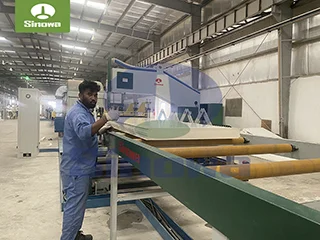
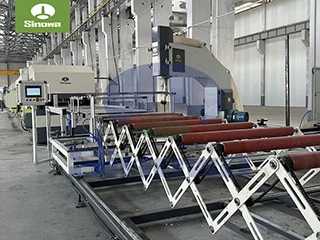
sandwich panel machine
Sandwich panel machinery refers to a complete set of interconnected mechanical devices specially designed for the integrated molding of sandwich composite plates. Its basic design logic is based on the structural characteristics of sandwich panels, which are composed of two layers of dense surface materials and a porous lightweight core material sandwiched in the middle. The overall mechanical system needs to realize the synchronous transportation of surface substrates, quantitative distribution of core materials, precise composite pressing, stable curing molding, and fixed-size cutting. Unlike single-function processing machinery, sandwich panel machinery adopts an integrated assembly structure, where each functional module maintains an independent mechanical operation logic while realizing interlocking linkage through transmission systems and intelligent control components. This integrated design effectively avoids production discontinuity caused by the independent operation of single equipment, reduces manual intervention links in the production process, and improves the overall continuity and stability of panel production. The applicable processing raw materials of this machinery cover a wide range of types. Common surface substrates include metal color plates, galvanized sheets, and non-metal inorganic plates, while core materials involve foam polymers, rock wool, glass wool, and other lightweight thermal insulation materials. Different material combinations require slight adjustments to mechanical parameters such as pressing pressure, heating temperature, and transmission speed, reflecting the strong adaptability of modern sandwich panel machine to diversified production demands.
The complete mechanical system of sandwich panel production consists of multiple interrelated functional modules, each undertaking unique production tasks and jointly constructing a closed-loop production flow. The raw material pretreatment and feeding module is the starting link of the sandwich panel production line, mainly responsible for the arrangement, leveling, and continuous conveying of surface substrates and the crushing, screening, and quantitative feeding of bulk core materials. For coiled metal substrates, this module is equipped with automatic unwinding devices and leveling mechanisms. The unwinding structure adopts a stable rotating support design to ensure that the coiled material is released at a uniform speed without tension fluctuation, avoiding surface wrinkling or deformation of the substrate caused by uneven pulling force. The leveling mechanism uses multi-group staggered pressing rollers to eliminate the inherent bending stress of the coiled material, so that the flatness of the substrate meets the composite processing standards. For granular and fibrous core materials, the pretreatment part is equipped with screening and stirring components to filter out impurity particles mixed in raw materials, break up agglomerated fiber materials, and ensure the uniformity of core material bulk density. Meanwhile, the quantitative feeding device can adjust the feeding rate according to the preset production parameters, realizing accurate matching between the feeding amount of core materials and the transmission speed of surface plates, which lays a foundation for the consistent thickness and uniform structure of finished panels.
Following the pretreatment link, the surface coating and gluing module undertakes the key task of enhancing the bonding performance between substrates and core materials. The stable bonding interface is the core guarantee for the overall structural strength of sandwich panels, so the gluing process needs to strictly control the coating thickness, uniformity, and adhesion of adhesives. This module is equipped with automatic gluing components that adopt rolling or spraying gluing modes according to different substrate characteristics. The rolling gluing structure is suitable for smooth metal plates, relying on the gap between precision rollers to control the adhesive coating thickness within a stable range, while the spraying gluing mode is applied to rough inorganic plates to ensure that adhesives can fully penetrate into tiny pores on the plate surface and improve bonding fastness. During the gluing process, the mechanical system is matched with constant temperature adjustment components to maintain the activity of adhesives within the optimal temperature range, avoiding the decline of bonding effect caused by excessive temperature fluctuation. In addition, the redundant adhesive recovery structure is designed inside the module to collect excess adhesive overflowing from the plate edge during the coating process, which not only reduces raw material waste but also prevents residual adhesive from polluting subsequent mechanical transmission components.
The composite pressing and heating curing module is the core functional section of sandwich panel production machinery, which directly determines the molding quality and structural stability of composite panels. After the surface substrate coated with adhesive and the quantitative filled core material enter this module synchronously, the mechanical pressing structure applies continuous and uniform vertical pressure to the composite raw materials. The pressing system adopts hydraulic or pneumatic power transmission modes, with pressure sensing components embedded inside to monitor the pressure value in real time and automatically adjust the pressure intensity according to the hardness and compression resistance of different core materials. For soft foam core materials, low-pressure slow pressing is adopted to prevent excessive compression from damaging the internal porous thermal insulation structure, while for rigid fiber core materials, medium and high pressure is applied to eliminate internal gaps and enhance the overall compactness of the panel. The heating and curing structure is distributed around the pressing channel, adopting cyclic heat conduction modes such as electric heating or hot air circulation to maintain a constant curing temperature in the composite cavity. The collaborative operation of pressure and temperature accelerates the curing reaction of adhesives, realizes the tight integration between substrates and core materials, and forms an integral composite structure. The internal cooling circulation pipeline is also arranged inside the pressing module to complete the gradual cooling of the molded panels, avoiding structural deformation caused by rapid temperature change after high-temperature curing.
The fixed-size cutting and edge trimming module is responsible for shaping the continuous long plates after composite molding to meet the dimensional specifications of finished products. After the composite cured panels are output from the pressing channel, they are transmitted to the cutting area through the constant-speed transmission roller group. The mechanical positioning system first completes the accurate calibration of the plate length and width, relying on infrared sensing components to identify the plate boundary and eliminate position deviation generated during transmission. The cutting structure adopts high-speed rotating cutting tools made of wear-resistant alloy materials, which can complete flat cutting of metal and non-metal composite plates without generating rough burrs on the cutting section. In addition to fixed-length cutting, this module is also equipped with edge trimming components to trim the uneven residual materials on both sides of the plates, ensuring that the edge flatness and width of each finished panel maintain a unified standard. The cutting speed maintains synchronous coordination with the transmission speed of the production line to realize uninterrupted cutting operation in the continuous production state, effectively improving production continuity. The waste generated during cutting and trimming is collected through the centralized waste discharge channel, which is convenient for subsequent centralized recycling and processing.
The final finished product sorting and stacking module completes the terminal sorting, conveying, and stacking of molded panels. The qualified panels after cutting and trimming are transported to the sorting platform through the transmission mechanism, and the mechanical detection components preliminarily screen the appearance quality of the panels, eliminating individual products with surface scratches, uneven thickness, and edge deformation. The qualified finished panels are automatically stacked by the mechanical stacking arm, which can adjust the stacking height and arrangement mode according to the storage and transportation requirements. The buffer protection structure is installed at the contact position between the stacking arm and the panels to avoid surface indentation or coating damage caused by rigid extrusion. The entire stacking process realizes unmanned automatic operation, which not only improves stacking neatness but also reduces the labor cost of manual handling and the risk of panel damage caused by human operation. Meanwhile, the counting device embedded in the module can record the number of finished products in real time, providing accurate data statistics for production management.
In terms of operational working principles, the entire production process of sandwich panel line follows the mechanical logic of synchronous transmission, graded processing, and integrated molding. The power system of the equipment takes the motor as the core power source, and transmits power to each functional module through gear sets, transmission chains, and hydraulic pipelines, realizing the synchronous operation of unwinding, feeding, gluing, pressing, cutting, and stacking. The transmission system adopts frequency conversion speed regulation technology, which can flexibly adjust the overall production line operating speed according to production tasks and raw material characteristics, realizing seamless switching between high-efficiency mass production and low-precision customized production. The internal control system of the machinery integrates intelligent sensing components and programmable control units. Temperature sensors, pressure sensors, and speed sensors are distributed in each processing link to collect real-time operating data of the equipment. The control unit analyzes and processes the collected data, automatically corrects parameter deviations such as pressing pressure and heating temperature, and maintains the stable operation of the equipment within the optimal parameter range. When abnormal conditions such as material blockage and pressure overload occur inside the equipment, the intelligent control system can trigger an automatic alarm and perform emergency shutdown protection to avoid mechanical structural damage caused by abnormal operation.
Different types of sandwich panel making machine have obvious pertinence in structural design and parameter setting due to the diverse types of sandwich panels. Metal surface sandwich panel machinery is optimized for the processing characteristics of metal substrates. The surface of the transmission roller is treated with anti-scratch coating to prevent damage to the metal coating during transportation. The pressing gap is equipped with an anti-deviation limiting structure to ensure the alignment of the upper and lower metal plates. The heating temperature is controlled at a medium and low level to avoid oxidation and discoloration of the metal surface caused by high temperature. Inorganic lightweight sandwich panel machinery strengthens the structural rigidity of the feeding and pressing modules, adopts anti-wear thickened mechanical components to cope with the abrasion of inorganic raw materials on mechanical parts, and is equipped with a dust removal structure to collect floating dust generated during raw material processing and reduce dust accumulation inside the equipment. Flexible core material sandwich panel machinery optimizes the feeding and pressing speed, adopts a slow feeding and graded pressing mode to prevent the elastic deformation of flexible core materials from affecting the molding effect, and adds a tension balancing device in the transmission link to maintain the flat state of flexible composite panels.
In actual industrial production applications, sandwich panel manufacturing machine has prominent application advantages in production efficiency, product consistency, and resource utilization. In terms of production efficiency, the integrated continuous production mode enables the equipment to realize uninterrupted processing for a long time. The intelligent linkage between modules eliminates the waiting interval between processes, and the single-line daily production capacity can meet the large-scale material supply demand of medium and large construction projects. In terms of product quality consistency, the unified mechanical parameter setting replaces manual operation errors. The thickness, density, bonding strength, and external dimensions of each batch of finished panels maintain high uniformity, which is convenient for standardized assembly and construction in the later stage. In terms of resource utilization, the equipment is equipped with multiple recovery structures to realize the recycling of excess adhesives, cutting waste, and residual raw materials. The precise quantitative feeding mode reduces the waste of raw materials, which conforms to the resource-saving production concept of modern manufacturing industry. In addition, the highly automated operation mode of the machinery reduces the number of on-site operators, simplifies the production management process, and lowers the comprehensive operation cost of the production line.
The daily maintenance and regular maintenance of sandwich panel manufacturing machinery are crucial to extend the service life of the equipment and maintain stable production performance. Daily maintenance work focuses on surface cleaning and running inspection. After the daily production task is completed, the residual raw materials, adhesives, and dust attached to the surface of mechanical components need to be cleaned to prevent long-term accumulation from causing component corrosion and transmission blockage. Operators need to check the tightness of transmission chains, the flexibility of rolling bearings, and the sensitivity of sensing components before equipment startup every day, and eliminate minor faults such as loose parts and slow sensor response in a timely manner. Regular maintenance includes lubrication treatment, component inspection, and parameter calibration. Lubricating oil is regularly injected into the friction moving parts such as transmission rollers and rotating bearings to reduce mechanical wear and noise during operation. Vulnerable parts such as cutting tools and sealing gaskets are regularly inspected for wear and aging, and damaged parts are replaced in a timely manner to avoid affecting production accuracy. The pressure, temperature, and speed parameters of the control system are calibrated regularly to ensure that the operating parameters are consistent with the preset production standards and avoid quality fluctuations of finished panels caused by parameter deviation.
With the continuous upgrading of global building energy conservation standards and industrial manufacturing technology, sandwich panel making machinery is evolving towards intelligent optimization, energy conservation and environmental protection, and multi-functional integration. In terms of intelligent upgrading, the equipment is gradually equipped with digital monitoring platforms, which can realize remote real-time viewing of equipment operating status, production data statistics, and fault early warning prompts. The automatic parameter matching function enables the equipment to independently identify raw material types and intelligently adjust processing parameters such as pressure and temperature, reducing the technical requirements for operators. In terms of energy conservation and environmental protection, the new generation of machinery optimizes the internal heating and power transmission structure, reduces energy consumption during equipment operation through heat circulation utilization and low-loss power transmission technology, and is equipped with efficient dust removal and waste gas treatment devices to reduce environmental pollution generated during production. In terms of multi-functional integration, the equipment expands the processing functions of surface embossing, anti-corrosion coating, and edge sealing integration, realizing one-time completion of panel molding and surface processing, further improving the comprehensive performance and added value of finished panels.
In the context of the booming global construction industry, the market demand for sandwich panels will continue to grow steadily, which brings broader application space and higher technical requirements for sandwich panel machinery. Construction fields such as industrial factory buildings, cold storage warehouses, and temporary construction facilities have rigid demand for high-efficiency thermal insulation and quick-assembly composite panels, which promotes the continuous iteration of mechanical production technology. In the future, sandwich panel machinery will further break through the limitations of single production mode, develop modular combined production structures, realize flexible switching of multiple panel production processes on one production line, and meet the personalized customized production needs of different industries. At the same time, with the popularization of green building concepts, the equipment will be more compatible with environmentally friendly and degradable raw materials, optimize the low-carbon production process, and reduce the energy consumption and carbon emission of the production link. The deep integration of mechanical manufacturing technology and digital intelligent technology will also make the production operation of sandwich panel manufacturing line more precise, efficient, and stable, providing strong technical support for the high-quality development of the modern building composite material industry.
https://www.cnsinowa.com/sandwich-panel-machines/sandwich-panel-machinery.html