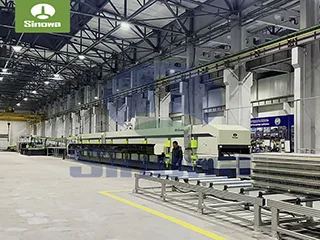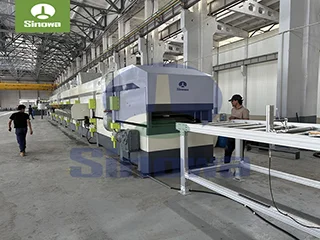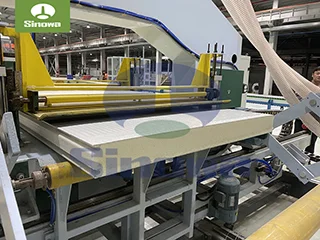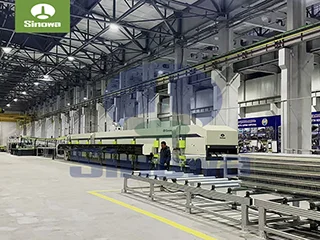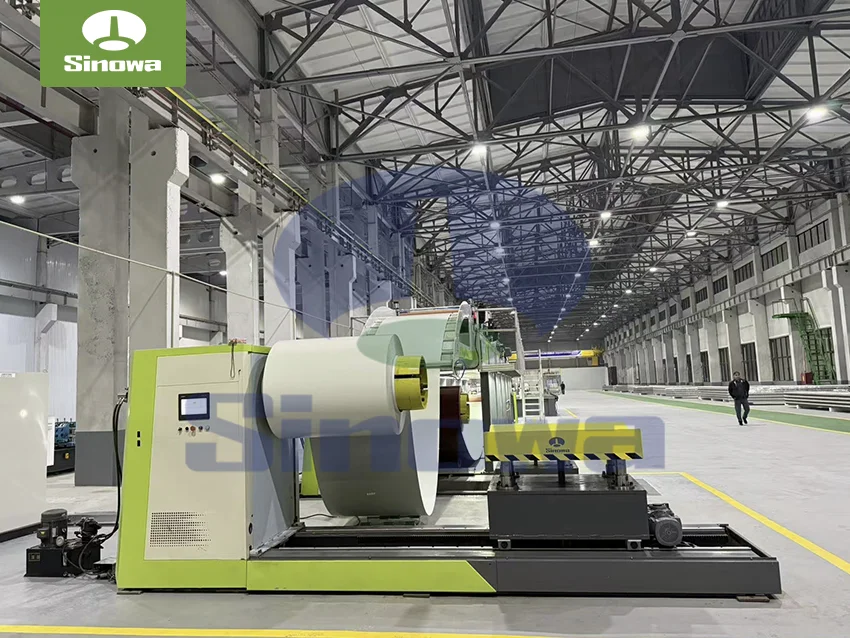
The integrated design of edge trimming and hole punching functions is a key upgrade of modern continuous PU sandwich panel production line, which integrates the preliminary panel molding, intermediate curing and shaping, and post-finishing precision processing into a seamless production flow. Different from ordinary production lines that only complete rolling, compounding and fixed-length cutting, this advanced production line takes the fine processing of panel edges and reserved mounting holes as core functional modules, organically embedding them into the continuous production rhythm, avoiding multiple turnover and positioning of semi-finished products, and ensuring the consistency and integrity of the whole production process. The entire production process is controlled by an intelligent numerical control system, which can automatically adjust processing parameters according to different panel specifications, material thicknesses and application requirements, realizing adaptive production of diversified products and meeting the personalized processing needs of various engineering scenarios.
Edge trimming, as the core finishing process of the sandwich panel production line, undertakes the task of correcting edge deformation, removing excess materials and optimizing edge flatness of molded PU sandwich panels. In the continuous lamination and compounding process of sandwich panels, affected by the tension difference of surface metal plates and the slight expansion and contraction of PU core materials during curing, the two sides of the panels are prone to irregular burrs, uneven edges and tiny dimensional deviations. If these defects are not processed in time, they will lead to poor fitting effect during on-site installation, easy gaps between panels, and even affect the overall thermal insulation and airtight performance of the building enclosure structure. The high-precision edge trimming module of the production line is equipped with symmetrically arranged longitudinal trimming structures and high-hardness alloy cutting components, which can complete synchronous trimming on both sides of the panel in the running state of the production line without stopping the machine, ensuring high continuity of production.
This edge trimming system supports multiple flexible processing modes to adapt to diverse construction and installation requirements. The standard right-angle trimming mode is applicable to most conventional wall and roof sandwich panels, which can control the edge verticality of the panel within the range of 89.5 degrees to 90.5 degrees, ensuring the vertical and flat edge of the panel and realizing seamless docking between adjacent panels. The adjustable chamfering trimming mode can adjust the cutting angle freely between 30 degrees and 60 degrees, which is suitable for special structural connections of building corners and inclined enclosure parts, effectively improving the fitting tightness of special-shaped installation positions. In addition, the step trimming function can form a waterproof step structure on the panel edge through precise cutting, which can enhance the waterproof and sealing performance of the panel lap joint and avoid rainwater penetration caused by flat lap joints in outdoor building applications. For complex engineering design requirements, the system can also realize special-shaped contour trimming according to preset processing parameters, completing personalized edge shaping for non-standard panels and expanding the application scope of finished products.
In terms of processing accuracy, the edge trimming module adopts laser scanning positioning technology and real-time dimensional monitoring components. Before trimming, the system automatically scans the edge contour and overall size of the running panel, calculates the optimal cutting path through the internal numerical control algorithm, and automatically corrects tiny position deviations, so as to ensure that the width size of each processed panel maintains high consistency. The high-wear-resistant alloy cutting tools can keep the cutting edge sharp for a long time, effectively avoiding core material peeling, metal plate deformation and burr residue during trimming. The processed panel edge is smooth and flat without secondary polishing, which not only optimizes the appearance quality of the product, but also eliminates the hidden danger of scratch damage during subsequent transportation and installation. Moreover, the edge trimming process can remove the residual uneven composite layer on the panel edge, make the combination of the surface metal layer and the internal PU core material more compact, and further enhance the overall structural stability and edge compression resistance of the sandwich panel.
The embedded hole punching function is another important functional advantage of the integrated sandwich panel line, which solves the problems of low efficiency, low precision and easy deformation of traditional manual or offline punching processing. In the actual application of PU sandwich panels, reserved mounting holes, fixing holes and connecting holes are essential structural parts for panel installation and fixation. Traditional post-processing punching requires workers to position and punch holes one by one according to the installation drawings, which is not only time-consuming and labor-intensive, but also prone to inaccurate hole position spacing, inconsistent hole diameter and local depression deformation of the panel caused by uneven punching force. The online punching module of the production line is perfectly connected with the front-end molding and trimming process, realizing one-time precise punching of the panel during the continuous production process, with no need for secondary processing after the finished product is off the line.
The punching process follows the scientific shear cutting principle, and the whole process is stable and efficient without damaging the internal structure of the panel. When the punching mechanism acts on the panel, the punch first makes slight contact with the surface metal plate to form uniform micro-deformation, then completes layered cutting of the metal plate and PU core material through stable downward pressure, and finally separates the hole waste material completely and ejects it downward automatically. The whole punching process will not cause cracking, hollowing or delamination of the PU core material, nor will it produce obvious deformation and wrinkles on the panel surface, ensuring the flatness and structural integrity of the panel while completing hole processing. The numerical control system can flexibly set the hole diameter, hole spacing, hole row number and punching position according to different panel specifications and installation standards, realizing uniform and standardized distribution of mounting holes on each panel surface.
In terms of functional matching, the punching module and edge trimming module realize linkage control through the central intelligent system, maintaining high synchronization and coordination in the production rhythm. After the edge trimming is completed and the panel dimensional calibration is finished, the system automatically triggers the punching procedure according to the preset program, and completes the fixed-point and fixed-size punching operation in the designated area of the panel. The positioning sensor of the punching module can monitor the running speed and position of the panel in real time, dynamically adjust the punching action rhythm, and ensure that the punching position error is controlled within a tiny range. This linkage processing mode avoids the position deviation caused by independent processing of the two processes, and greatly improves the overall processing precision and product uniformity of the sandwich panel.
The entire PU sandwich panel line realizes full-process automated production from raw material feeding, roller forming, PU foaming compounding, heating curing, fixed-length cutting, edge trimming to online hole punching and finished product output. The front-end raw material feeding system realizes automatic leveling and conveying of metal plates and automatic proportional feeding of PU foaming materials, ensuring stable raw material supply and consistent material ratio. The lamination and curing system adopts constant-temperature and constant-pressure control technology, which makes the foaming and curing reaction of PU core material more sufficient, and the composite bonding degree between the core material and the surface metal plate is more firm, laying a good structural foundation for subsequent trimming and punching processing. The fixed-length cutting module can accurately cut the continuously molded long panel according to the preset length specification, providing standard-sized semi-finished products for the post-finishing process.
Compared with the traditional separated production mode, the integrated polyurethane sandwich panel production line with edge trimming and punching functions has obvious advantages in production efficiency and product quality control. The one-stop processing mode eliminates multiple handling, positioning and clamping links of semi-finished products, reduces the intermediate waiting time of the production process, and the continuous production efficiency is significantly improved. The full-process numerical control automatic control avoids human intervention errors in manual positioning and processing, realizes standardized and standardized production of each panel, and the dimensional accuracy, edge quality and hole position accuracy of finished products are far higher than those of traditional processing products. At the same time, the reduction of secondary processing links effectively reduces the scrap rate caused by handling damage and processing errors, saves production and processing costs, and improves the economic benefits of enterprise production.
In terms of product application performance, the panels processed by integrated trimming and punching have better installation adaptability and engineering applicability. The smooth and regular edge structure enables the panels to form a tight lap joint structure during on-site assembly, effectively blocking the penetration of air and moisture, and ensuring the long-term stable thermal insulation, waterproof and airtight performance of the building enclosure. The accurately reserved mounting holes have uniform specifications and accurate positions, which can perfectly match the installation accessories and keel structures, make the on-site assembly operation more convenient and efficient, shorten the construction cycle of the project, and avoid the rework problem caused by inconsistent hole positions. In cold storage, clean room, industrial workshop and other engineering scenarios with high requirements for thermal insulation and airtightness, the high-precision processed panels can effectively reduce the energy consumption of building operation and improve the overall construction quality of the project.
The polyurethane sandwich panel line also has good flexibility and compatibility, which can adapt to the production and processing of PU sandwich panels with different thicknesses, different surface materials and different structural specifications. By simply adjusting the operating parameters of the numerical control system and the spacing of the processing components, the equipment can switch between different product specifications quickly, meeting the diversified production needs of enterprises for conventional panels and special-shaped panels. The edge trimming depth, angle range and punching parameters can be adjusted independently without mutual interference, which realizes flexible combination of processes and can customize exclusive processing schemes according to the special needs of different customers and different engineering projects.
In terms of equipment operation and maintenance, the modular design of the edge trimming and punching system makes the equipment structure more reasonable and the operation more convenient. The intelligent operation interface integrates all process parameter setting, equipment operation monitoring and fault alarm functions, and operators can complete the switching and parameter adjustment of various processing modes through simple operations. The key processing components are made of high-strength and wear-resistant materials, which have long service life and stable operation performance, and can adapt to long-term continuous high-load production. The modular structure is also convenient for daily maintenance and component replacement, reducing the difficulty and cost of equipment maintenance, and ensuring the long-term stable operation of the production line.
With the continuous upgrading of the construction industry's requirements for energy-saving, environmental protection and high-precision building materials, the market demand for high-quality standardized PU sandwich panels is increasing day by day. The PU sandwich panel machine integrating edge trimming and hole punching functions represents the advanced development direction of the current sandwich panel manufacturing industry. It not only realizes the intelligent and automated upgrade of the production process, but also greatly improves the comprehensive quality and application value of finished products, provides reliable equipment support for the production of high-standard building insulation materials, and helps the construction industry to realize the development goals of energy saving, emission reduction and high-quality construction. In the future, with the further innovation of processing technology and intelligent control technology, the integrated processing function of the production line will be further optimized, and the processing accuracy, production efficiency and product adaptability will be continuously improved, bringing broader development space for the PU sandwich panel manufacturing industry.


Any Questins About Continuous Sandwich Panel Production Lines or Other Products
Email us with inquiries or use our contact infomations