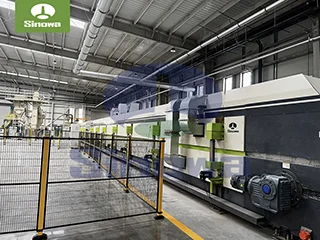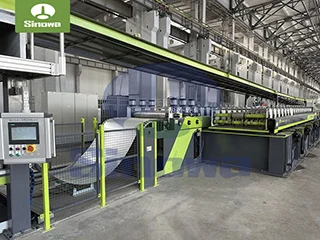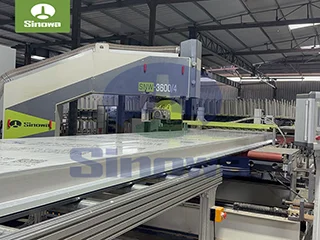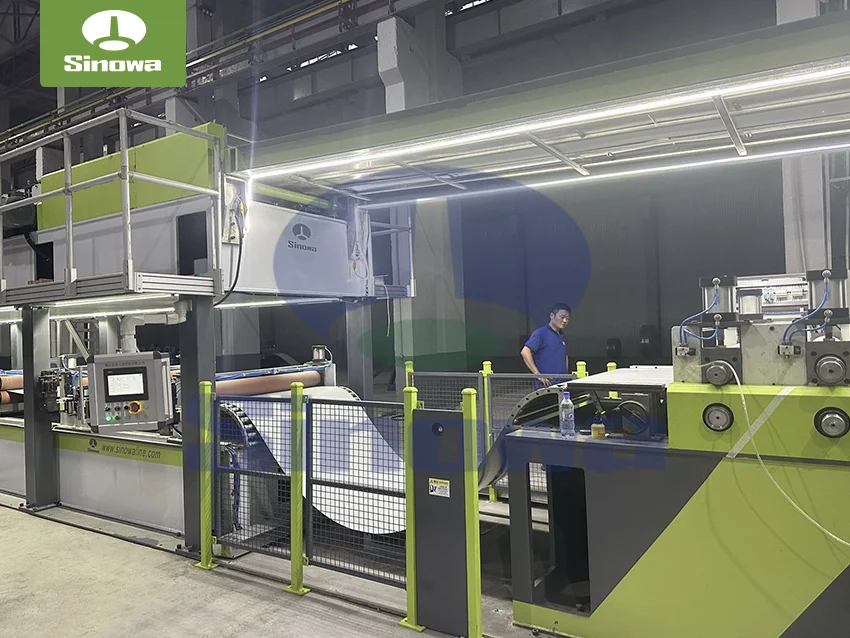
The overall operational logic of the PU sandwich panel production line relies on the precise synergy of mechanical transmission, automatic sensing control, chemical reaction regulation, and constant-temperature thermal forming technology, forming a fully continuous and closed-loop manufacturing process from raw material input to finished product output. Unlike traditional intermittent panel manufacturing equipment, this streamlined production model eliminates frequent manual intervention and process interruption, ensuring that every production link maintains consistent technological parameters and operational stability. The entire production workflow covers raw material pretreatment, surface material forming, precise PU material proportioning and foaming, composite lamination, constant-temperature curing, fixed-length cutting, and finished product sorting, enabling one-stop molding of integrated sandwich panels that integrate outer protective layers and thermal insulation core layers.
Raw material pretreatment and feeding constitute the initial and foundational stage of the entire production process, which directly lays the groundwork for the bonding quality and structural stability of finished panels. Prefab house factories usually adopt metal coil materials as the surface layers of sandwich panels, and the polyurethane sandwich panel production line is equipped with automatic unwinding and flattening modules to realize continuous and stable feeding of coiled materials. During this stage, the surface materials will undergo comprehensive flattening and surface cleaning treatment to remove surface dust, oil stains, and irregular burrs generated during coiling and transportation. This pretreatment process effectively enhances the adhesion between the surface material and the polyurethane foam core layer, fundamentally avoiding common quality defects such as hollowing, delamination, and incomplete bonding that often occur in inferior sandwich panels. Meanwhile, the production line supports adaptive feeding adjustment according to different surface material thicknesses and width specifications, meeting the diverse material matching requirements of wall panels, roof panels, and partition panels used in different parts of prefab houses.
Following the surface material pretreatment process is the roll forming stage, which shapes the flat surface coil materials into standardized structural profiles suitable for prefab house assembly. The PU sandwich panel line is equipped with multi-group precision roll forming units, which gradually bend and shape the flat metal plates through orderly arranged rolling wheels. The rolling gap and forming angle of each group of rollers can be fine-tuned according to the design standards of prefab building panels, ensuring that the formed panels have accurate dimensional accuracy, smooth surface lines, and consistent structural radian. For prefab house roof panels with special rib structures, the equipment can complete integrated filling and shaping of trapezoidal structural gaps in the online production process, optimizing the overall structural rigidity and wind resistance of the panels. All forming processes are completed through automated mechanical transmission, avoiding dimensional errors caused by manual operation and ensuring the complete consistency of each batch of panel profiles, which facilitates rapid assembly and seamless docking of prefab houses on the construction site.
The polyurethane foaming and uniform distribution system is the core functional module that determines the thermal insulation performance and internal structural uniformity of sandwich panels. The polyurethane sandwich panel line adopts a multi-component high-pressure metering and feeding structure, which can accurately proportion different PU raw materials according to fixed technological ratios. The precision metering system ensures that the chemical components of the foaming materials are fully matched, providing stable conditions for subsequent uniform foaming and dense pore forming. After full mixing through high-pressure equipment, the foaming liquid is evenly sprayed on the surface of the lower layer profile through a reciprocating oscillating gantry nozzle. The intelligent reciprocating spraying path covers the entire effective width of the surface material without dead angles or local material accumulation, enabling the PU foaming material to be evenly distributed on the substrate surface. This uniform spraying and distributing mode ensures that the core layer density of each position of the panel is consistent, so that the finished sandwich panels have balanced thermal insulation performance and structural bearing capacity in all parts.
Composite lamination and pressure shaping are key processes for forming the integrated structure of sandwich panels, directly affecting the overall flatness, thickness accuracy, and bonding firmness of finished products. After the PU foaming liquid is coated on the lower surface material, the upper and lower formed profiles are synchronously guided into the precision lamination pressing mechanism along with the initially foamed core material. The PU sandwich panel machine can automatically adjust the pressing gap and working pressure according to the preset panel thickness specifications, so that the upper and lower surface layers and the PU foam core layer are closely fitted under uniform pressure. The continuous pressing state effectively discharges excess air inside the foam layer, promotes full infiltration and bonding between the foaming material and the surface material, and shapes the overall thickness specification of the panel in one step. The entire lamination process maintains stable pressure and speed, avoiding panel surface unevenness, local thickness deviation, or core layer hollowing problems caused by pressure fluctuation, ensuring that each panel maintains high dimensional uniformity and structural integrity.
Constant-temperature curing treatment is an indispensable post-forming process to ensure the long-term stability of sandwich panel performance. Although the PU foam material completes preliminary shaping and bonding in the lamination stage, the internal chemical cross-linking reaction has not been fully completed, and the bonding strength between the core layer and the surface layer as well as the structural compactness of the foam layer need a certain period of constant temperature maintenance to reach the optimal state. The polyurethane sandwich panel machine is equipped with an integrated constant-temperature curing tunnel, which can form a stable and uniform temperature environment inside the equipment through circulating temperature control components. The semi-finished panels after lamination and forming slowly pass through the curing tunnel at a constant speed, realizing deep curing of the internal foam structure. This process optimizes the pore structure density of the PU core layer, improves the thermal insulation and sound insulation performance of the panel, and significantly enhances the peel resistance and compressive strength between layers. Panels treated by standardized constant-temperature curing will not experience delamination, deformation, or performance attenuation during long-term use in prefab buildings, greatly improving the service life and structural safety of prefab houses.
Fixed-length cutting and edge trimming processes endow the finished sandwich panels with accurate dimensional specifications and neat appearance quality, meeting the standardized assembly requirements of prefab houses. After completing curing and shaping, the continuous long-strip panel is transported to the cutting station through an automatic conveying system. The high-precision cutting mechanism can automatically identify and cut the panel according to the preset length and width parameters, realizing synchronous cutting and edge trimming. The cutting tool maintains high-speed and stable operation, ensuring that the cutting section of the panel is flat and smooth without burrs, cracks, or edge warping. For prefab house panels that need precise edge sealing and grooving, the equipment can complete integrated edge processing in the online state, making the subsequent on-site assembly and docking of panels more convenient and tight. The automated cutting system supports flexible switching of different size parameters, enabling factories to quickly respond to the dimensional requirements of different prefab house models and realize flexible production of diversified products.
The final stage of the production process includes cooling conveying, finished product sorting, and automatic stacking. The cut panels will pass through the cooling conveying area to complete natural heat dissipation and final structural stabilization, eliminating residual internal stress generated during the thermal forming process. The fully cooled finished panels have more stable structural performance and are not prone to post-production deformation. Subsequently, the automatic sorting and stacking system will classify and stack the panels according to different specifications, realizing neat arrangement and centralized collection of finished products. This automated post-processing mode reduces manual handling links, lowers the risk of panel surface scratches and structural damage caused by manual operation, and greatly improves the efficiency of finished product storage and transportation. The neatly stacked finished panels can be directly transported to the prefab house assembly workshop, realizing seamless connection between panel production and building assembly.
For prefab house factories, the application of fully automatic PU sandwich panel production machine brings comprehensive improvements in production efficiency, product quality, and production flexibility. In terms of production efficiency, the continuous streamlined production mode realizes uninterrupted operation of multiple processes, with a far higher single-unit output than traditional semi-automatic production equipment, effectively meeting the large-scale panel demand of batch prefab house projects. In terms of product quality, the full-process automatic parameter control avoids the instability of manual operation, making the thermal insulation, sound insulation, fire resistance, and structural strength of each batch of panels maintain a stable high level. The dense and uniform PU foam core layer can effectively block heat conduction, enabling prefab houses to have excellent energy-saving and thermal insulation effects, and adapt to the construction and use needs of different climatic regions.
In terms of production flexibility, the modular structural design of the sandwich panel machine enables it to adapt to the production of multi-specification and multi-type sandwich panels. By simply adjusting equipment parameters, factories can switch between the production of wall panels, roof panels, ceiling panels, and special-shaped panels for prefab houses, realizing one-line multi-purpose production and effectively reducing the equipment investment cost of enterprises. In addition, the equipment has good expandability and can be matched with subsequent auxiliary processing modules according to the upgrading needs of prefab building products, realizing iterative upgrading of production processes and product performance.
From the perspective of the development trend of the prefabricated construction industry, the integration of intelligent and automated PU sandwich panel manufacturing line with prefab house manufacturing systems has become an inevitable development direction. Modern production lines are equipped with intelligent sensing and linkage control systems, which can monitor key parameters such as material proportioning, foaming density, pressing pressure, and curing temperature in real time during the production process. Once slight parameter deviation is detected, the system will automatically adjust and correct it, realizing full-process intelligent quality control. Meanwhile, the equipment has stable operation performance, low failure rate, and simple daily maintenance, which can maintain long-term efficient and stable production operation, providing reliable equipment support for the continuous production and delivery of prefab house factories.
The excellent performance of PU sandwich panels produced by professional production lines also endows prefab houses with more comprehensive use advantages. The lightweight structural characteristics of the panels reduce the overall self-weight of prefab buildings, lower the requirements for building foundation bearing capacity, and shorten the foundation construction cycle. At the same time, the integrated composite structure of the panels has good seismic resistance, wind resistance, and structural stability, ensuring the safety and reliability of prefab houses in different use scenarios. In addition, the panels have good waterproof, moisture-proof, and corrosion-resistant properties, which can adapt to complex outdoor and construction site environments, reducing the later maintenance cost of prefab buildings.
In practical industrial production, standardized PU sandwich panel production line has effectively promoted the standardized and modular development of the prefab house manufacturing industry. The unified production process and quality standards make the panel products of different batches highly versatile, which is conducive to forming standardized component systems for prefab houses. This standardized production mode not only improves the production and assembly efficiency of prefab buildings, but also reduces the construction cycle and comprehensive cost of prefab houses, making prefabricated construction technology more popular and applied in temporary construction, residential accommodation, commercial facilities, and other fields. With the continuous improvement of energy-saving and environmental protection requirements in the construction industry, the efficient and green production characteristics of PU sandwich panel machinery will further highlight their industrial value, providing strong technical and equipment support for the high-quality development of the global prefab construction industry.


Any Questins About Continuous Sandwich Panel Production Lines or Other Products
Email us with inquiries or use our contact infomations