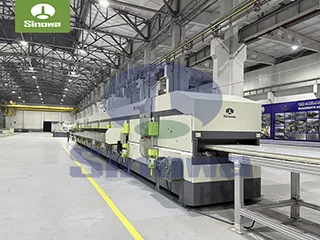
 sandwich panel line
The overall structural design of the full-auto PU sandwich panel line follows a modular and integrated layout, with all functional units closely connected and operating in a continuous cycle without intermittent shutdowns in normal production states. The entire production flow covers raw material unwinding and surface pretreatment, profile roll forming, raw material temperature regulation, high-precision PU raw material mixing and pouring, continuous composite lamination, constant-temperature curing and shaping, fixed-length cutting, surface finishing, and automatic stacking. Every production link is equipped with independent sensing and execution components, and all operational data and parameter adjustments are uniformly managed and scheduled by the PLC control system, forming a closed-loop intelligent production system with real-time monitoring, dynamic adjustment, and fault self-detection capabilities.
At the initial stage of production, the surface material feeding and pretreatment module undertakes the foundation work of the entire production process. Coiled surface materials, including metal and non-metal sheet materials applicable to different panel specifications, are stably and continuously unwound through automatic unwinding devices. The PLC system precisely controls the unwinding speed and tension matching according to the preset production parameters, effectively avoiding material deviation, wrinkling, and stretching deformation that often occur in manual or semi-automatic feeding processes. Subsequently, the surface materials pass through the precision roll forming unit, where multiple groups of rolling rollers gradually press and shape the flat sheet materials into the required three-dimensional profiles. The PLC system synchronizes the operating speed of the roll forming unit with the subsequent foaming and lamination units to ensure the continuous and stable transmission of surface materials, laying a solid foundation for the uniform compounding of the core foam material in the later stage. Before formal compounding, the surface materials will also undergo automatic preheating treatment. The system adjusts the preheating temperature in real time based on material characteristics and production speed, removing surface moisture and improving the bonding affinity between the surface layer and the PU foam core material, which significantly enhances the overall structural adhesion and durability of the finished panel.
The PU foaming and material pouring module is the core functional unit that determines the thermal insulation performance and structural compactness of sandwich panels, and it is also the key link controlled precisely by the PLC system. Polyurethane foam is formed by the chemical reaction between two main liquid raw materials and auxiliary additives, and the proportion, mixing uniformity, pouring flow rate, and reaction temperature of the raw materials directly affect the core density, pore structure, and thermal insulation effect of the panel. The polyurethane sandwich panel production line is equipped with sealed raw material storage and temperature regulation units, which maintain the activity and stability of chemical raw materials through constant-temperature control. The high-precision metering pumps collect real-time data of raw material flow and pressure and transmit the data to the PLC system. After intelligent calculation and analysis, the system automatically adjusts the operating frequency of the pumps to ensure the accurate proportion of different raw materials, avoiding quality defects such as uneven foam density, incomplete reaction, or excessive expansion caused by raw material ratio deviation. The mixed raw materials are transported to the high-pressure dynamic mixing chamber for full homogenization and then evenly poured into the gap between the upper and lower surface materials in continuous operation. The PLC system dynamically matches the pouring amount with the transmission speed of the surface materials, realizing uniform pouring without accumulation or missing areas across the entire panel width and length.
Following the pouring process, the composite lamination and constant-temperature curing module completes the integral molding of the sandwich panel structure. The surface materials carrying the liquid PU mixture enter the continuous double-belt pressing system, where stable pressing pressure and fixed operating speed are maintained throughout the process. The PLC system collects data from temperature sensors, pressure sensors, and speed sensors arranged in the pressing and curing area in real time, and dynamically adjusts the heating temperature, belt operating speed, and pressing pressure according to the set process parameters. In the constant-temperature closed curing environment, the PU liquid material undergoes continuous foaming, expansion, and curing reactions, gradually forming a dense and uniform porous core structure, and achieving tight composite bonding with the upper and lower surface layers. The intelligent adjustment function of the PLC system can adaptively optimize process parameters according to different production environments and panel specifications. For panels with different thicknesses and core density requirements, the system automatically matches the corresponding curing time, temperature gradient, and pressing pressure, ensuring that each batch of panels maintains consistent structural compactness and bonding strength. This closed-loop control mode effectively solves the problems of inconsistent curing degree, loose core structure, and debonding between layers that are common in traditional production processes.
The fixed-length cutting and post-processing module realizes the standardized finishing of finished panels, and the whole process is fully automated under PLC control without manual measurement and positioning. After the cured integrated sandwich panel is transmitted out of the molding area, the length detection sensor transmits real-time length data to the PLC system. When the panel reaches the preset fixed length, the system automatically triggers the cutting device to perform high-precision fixed-length cutting. The cutting speed and tool operating state are synchronously adjusted with the panel transmission speed to ensure flat and smooth cutting sections without burrs, deformation, or uneven incision. After cutting, the edge trimming unit automatically finishes the edges of the panels to remove tiny burrs and irregular edges generated during cutting, further improving the appearance flatness and specification accuracy of the products. The entire cutting and trimming process realizes intelligent linkage, and the PLC system can store multiple sets of production parameter programs corresponding to different panel lengths and widths, enabling one-click switching of production specifications and greatly improving the flexibility of PU sandwich panel production line operation.
The final automatic stacking and discharging module completes the orderly collection and arrangement of finished products. The finished panels after post-processing are automatically transported to the stacking platform through the conveying system. The PLC system controls the stacking device to perform regular stacking according to the preset stacking quantity and arrangement mode, realizing neat and standardized collection of finished products. The automatic stacking function replaces manual carrying and stacking, reduces labor investment, avoids surface scratches and panel damage caused by manual operation, and ensures the uniformity of finished product stacking, which is convenient for subsequent packaging, transportation, and storage. In addition, the system is equipped with an automatic counting function, which can record the real-time output and cumulative output of products, providing accurate production data support for production management and output statistics.
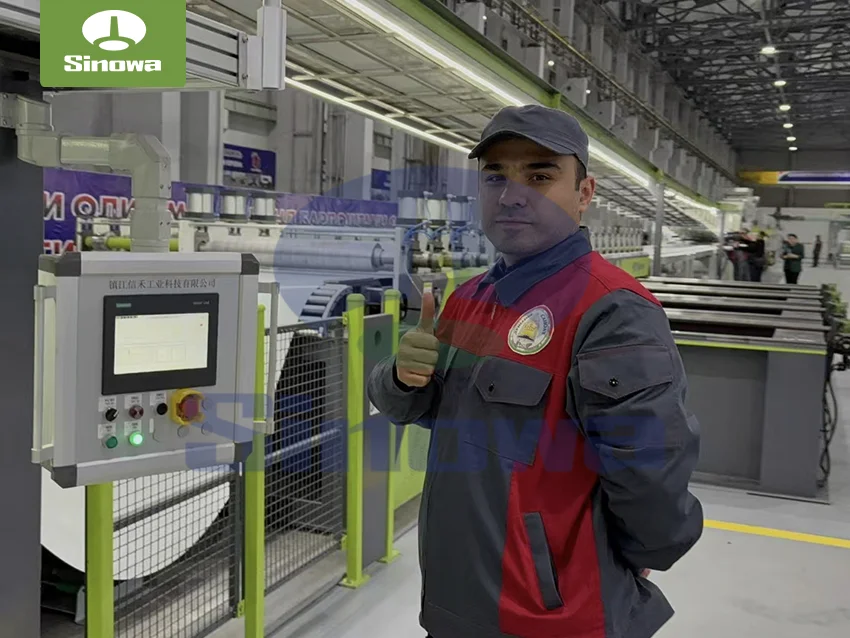
The core advantage of the full-auto polyurethane sandwich panel line lies in the intelligent scheduling and precise control of the PLC system, which endows the entire production line with excellent stability, flexibility, and fault tolerance. As the central control core of the entire equipment, the PLC system integrates all sensor signal acquisition, actuator control, and process parameter management functions. Through the supporting human-machine interaction interface, operators can view the real-time operating state of each unit, including production speed, operating temperature, working pressure, raw material consumption, and equipment operating parameters. All production parameters can be set, modified, and stored through the interface, and the system can automatically memorize the parameter formulas of different product specifications, realizing rapid switching of production modes and effectively shortening the parameter debugging time during product replacement.
In terms of operational stability, the PLC system has a real-time fault monitoring and early warning mechanism. During the continuous operation of the polyurethane sandwich panel machine, once abnormal conditions such as material jamming, parameter deviation, equipment overload, or raw material shortage occur in any link, the system will immediately capture the abnormal signal, trigger the early warning prompt, and automatically perform protective operations such as deceleration or shutdown according to the fault level, avoiding equipment damage and mass product quality problems caused by continuous operation under abnormal conditions. Meanwhile, the system can record fault information and operating logs, which is convenient for staff to quickly locate problems and complete daily maintenance and equipment debugging, greatly improving the operational reliability and service life of the production line.
In terms of production quality control, the full closed-loop intelligent control mode fundamentally optimizes the product quality consistency of PU sandwich panels. Traditional manual and semi-automatic production methods are restricted by operational experience and real-time judgment ability, and it is difficult to maintain the absolute stability of parameters such as raw material ratio, curing temperature, and pressing pressure in each production cycle, resulting in subtle differences in the density, thermal insulation performance, and bonding strength of different panels. The PLC-controlled full-automatic PU sandwich panel machine realizes digital and precise control of all core process parameters, with all production links executed according to fixed program parameters. The parameter error is controlled within an extremely low range, ensuring that the core structure density, surface flatness, interlayer bonding strength, and overall dimensional accuracy of each batch of panels remain highly consistent, effectively improving the overall qualification rate of products and reducing material waste caused by defective products.
In terms of production efficiency and cost control, the continuous and uninterrupted automatic production mode greatly improves the production capacity of PU sandwich panels. The coordinated operation of all modular units under PLC scheduling avoids waiting time and process conflicts between different processes, realizing seamless connection from feeding to finished product discharging. Compared with segmented semi-automatic sandwich panel production line, the full-automatic line saves a large amount of manual auxiliary operation time, significantly improves the hourly production capacity, and can maintain long-term stable high-speed operation. At the same time, the precise raw material ratio control and quantitative pouring function avoid excessive consumption of chemical raw materials, reducing the waste of production materials. The intelligent fault early warning and automatic protection functions reduce equipment failure downtime and maintenance costs, further optimizing the comprehensive production cost of products and bringing better economic benefits to industrial production.
In terms of product performance and application adaptability, the panels produced by this full-automatic line have excellent comprehensive performance. The uniformly foamed PU core material has a closed-cell structure, which endows the panels with low thermal conductivity, excellent thermal insulation and heat preservation performance, and good sound insulation and shock absorption effects. The tight composite structure between the core material and the surface layer ensures that the panels have high structural strength, strong compression resistance and bending resistance, and are not easy to delaminate or deform during long-term use. By adjusting the process parameters through the PLC system, the PU sandwich panel manufacturing line can manufacture panels with different thicknesses, core densities, and surface specifications, which can meet the diverse application needs of different scenarios such as building exterior wall thermal insulation, roof waterproof and thermal insulation, factory purification workshops, cold storage thermal insulation, and temporary building enclosure structures.
With the continuous upgrading of the building material industry towards intelligence, efficiency, and environmental protection, the full-auto PU sandwich panel line with PLC control system has become the mainstream equipment for the standardized production of polyurethane sandwich panels. Its integrated and intelligent production mode abandons the extensive production mode relying on manual experience in the past, realizes the digital and standardized management of the entire production process, and not only improves the production level and product quality of sandwich panels, but also promotes the intelligent transformation and upgrading of the entire thermal insulation building material manufacturing industry. In actual industrial production applications, this equipment can adapt to long-term continuous industrial production, has strong operational stability and production flexibility, and can continuously provide high-quality, high-consistency, and high-performance PU sandwich panel products for the construction industry, laying a solid equipment foundation for the development of modern energy-saving and environmentally friendly buildings.
https://www.cnsinowa.com/sandwich-panel-machines/full-auto-pu-sandwich-panel-line-with-plc-control-system.html