sinowa@sinowa.cn
+0086 151 0610 6366
PU Sandwich Panel Line Using Kraft Paper Backing For Temporary Building Panels

PU Sandwich Panel Line Using Kraft Paper Backing For Temporary Building Panels

Jun 30, 2026

The rapid development of modern modular construction has created a growing demand for lightweight, efficient, and adaptable building materials that can meet the fast-paced construction needs of temporary architectural spaces. PU sandwich panels with kraft paper backing have gradually become a core material in the field of temporary building construction by virtue of their unique structural design, stable physical properties and excellent comprehensive applicability, and the professional production lines dedicated to manufacturing such panels have further standardized the production process and optimized the product performance, providing reliable material support for the standardized construction of various temporary buildings. Different from traditional sandwich panels with metal backings, the integration of kraft paper backing endows PU sandwich panels with more prominent advantages in weight control, construction convenience and cost adaptability, making them highly compatible with temporary construction scenarios that pursue rapid assembly, short service cycle and flexible disassembly.

Home > Sandwich Panel Machines > PU Sandwich Panel Line Using Kraft Paper Backing For Temporary Building Panels

PU Sandwich Panel Line Using Kraft Paper Backing For Temporary Building Panelssandwich panel line

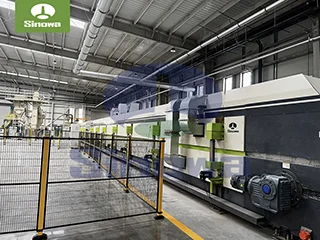
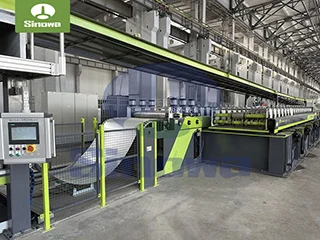
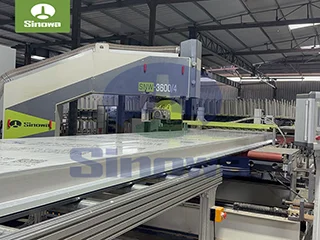
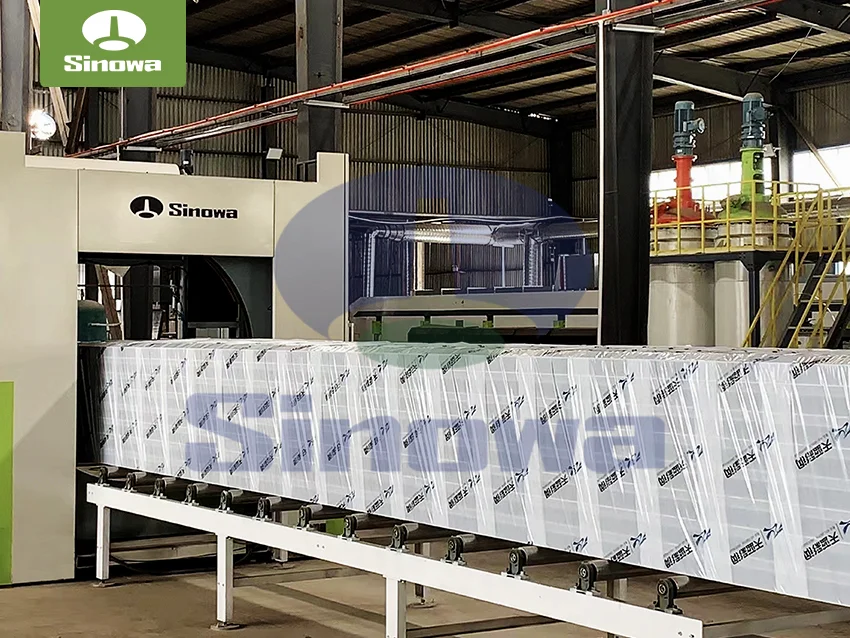
The production process of PU sandwich panels with kraft paper backing is completed through a continuous and integrated production system, which organically combines raw material pretreatment, core material foaming, composite bonding, shaping curing and fixed-length cutting to realize automated and streamlined manufacturing. In the initial stage of production, high-quality kraft paper with uniform texture and good tensile strength is selected as the backing layer material. This kind of kraft paper undergoes strict surface treatment to remove impurities and improve surface adhesion, ensuring that it can form a firm composite structure with the polyurethane foam core layer in the subsequent bonding process. The polyurethane raw materials are proportioned and fully mixed according to professional process parameters, and then injected into the composite interface of the surface layer and kraft paper backing layer through precise feeding equipment. Through high-pressure foaming and low-temperature curing, the polyurethane raw materials form a dense closed-cell foam structure, which is tightly bonded with the kraft paper backing without gaps or degumming, realizing the integrated molding of the sandwich panel.

The core structural advantage of this type of panel lies in the perfect combination of polyurethane foam core and kraft paper backing. The closed-cell structure of the polyurethane core layer gives the panel excellent thermal insulation and heat preservation performance. The tiny independent cell structure can effectively block the conduction and convection of air and heat, greatly reducing the heat exchange inside and outside the building space. This performance enables temporary buildings equipped with such panels to maintain a stable indoor temperature in different seasonal environments, effectively reducing the energy consumption of temporary temperature regulation equipment and improving the comfort of indoor space. At the same time, the polyurethane foam core has good sound insulation and noise reduction effects, which can weaken the transmission of external noise, create a quiet indoor environment for temporary office spaces, temporary accommodation and temporary activity venues, and meet the basic use functional requirements of temporary buildings.

The kraft paper backing plays an irreplaceable role in improving the overall applicability of the panel for temporary construction. Compared with metal backings that are heavy, easy to rust and inconvenient to process, kraft paper backing features ultra-light weight and flexible processing performance, which greatly reduces the overall self-weight of the sandwich panel. The lightweight feature significantly lowers the bearing load requirements of the temporary building’s supporting frame, allowing the use of simpler and lighter steel frame structures for temporary buildings, which not only simplifies the overall construction design but also reduces the difficulty of on-site assembly operation. In addition, kraft paper has good flexibility and tear resistance after special treatment, which can effectively resist minor external impact and friction during transportation and construction, avoiding local damage to the panel. Its excellent ductility also enables the panel to adapt to the slight deformation of the temporary building frame during use, preventing cracking and peeling of the panel structure and improving the overall stability of the building envelope.

In terms of environmental adaptability, PU sandwich panels with kraft paper backing show strong tolerance to various complex construction environments. The polyurethane core material has excellent moisture-proof and waterproof properties, and the closed-cell structure can prevent moisture and water vapor from penetrating into the panel interior, avoiding core material mildew, deformation and performance degradation caused by humid environment. The kraft paper backing also undergoes professional moisture-proof and anti-corrosion treatment, which can resist the erosion of humid air, dust and mild corrosive substances in the outdoor environment, ensuring that the panel can maintain stable structural performance in open-air temporary construction environments, rainy seasons and humid areas. Moreover, the integrated composite structure of the panel has good weather resistance, with low shrinkage and deformation rate in low-temperature and high-temperature environments, no brittle cracking in cold weather, and no softening and deformation in high-temperature environments, which can adapt to the diverse climatic conditions faced by temporary building construction in different regions.

The application advantages of PU sandwich panels with kraft paper backing in temporary building scenarios are extremely prominent, fully matching the core demands of temporary construction for rapid construction, flexible use and convenient recycling. Temporary buildings such as construction site temporary dormitories, on-site office rooms, emergency rescue shelters, temporary exhibition venues and mobile service stations all have the characteristics of short construction cycle, temporary use and possible later disassembly and transfer. This type of sandwich panel adopts a standardized modular design, with uniform specification and stable size, which can realize rapid on-site assembly through simple splicing and fixing processes. The assembly operation does not require complex construction equipment and professional high-threshold construction technology, and ordinary construction personnel can complete the installation efficiently, which can greatly shorten the overall construction cycle of temporary buildings and meet the urgent use needs of engineering construction and emergency scenarios.

The flexible disassembly and reusability of the panel further highlight its value in temporary construction. Different from traditional building materials that are difficult to disassemble and easy to produce a large amount of construction waste after use, the kraft paper backed PU sandwich panel has a simple assembly structure, which can be quickly disassembled without damaging the panel structure after the temporary building completes its service function. The disassembled panels can be transported and stored conveniently, and can be reused in subsequent temporary construction projects after simple cleaning and maintenance, effectively improving the recycling rate of building materials and reducing the waste of resources. This reusable feature not only conforms to the development concept of green and low-carbon construction but also brings better comprehensive benefits to temporary construction projects, which is incomparable to traditional one-time building materials.

In terms of structural safety, although the panel is lightweight, it has excellent overall structural strength and rigidity. The integrated composite structure formed by polyurethane foam and kraft paper backing can bear uniform external pressure and local impact force, maintaining the stable shape and structural integrity of the panel under normal wind load and external extrusion conditions. The optimized production process makes the bonding interface between the core material and the backing layer have high bonding strength, which will not produce delamination and peeling problems during long-term use and repeated disassembly and assembly. For temporary buildings with low load-bearing and safety reserve requirements, this stable structural performance can fully meet the daily use safety standards, ensuring the stable operation of temporary building spaces and the personal safety of indoor personnel.

The professional production line for kraft paper backed PU sandwich panels also realizes fine control over product performance and specifications, meeting the personalized construction needs of different temporary building scenarios. The production system can adjust the thickness of the polyurethane core layer and the specification parameters of the kraft paper backing according to different use environments and functional requirements, producing panels with different thermal insulation grades, structural strength and overall thickness. For temporary buildings in cold regions with high thermal insulation requirements, the PU sandwich panel production line can prepare panels with thicker core layers to enhance thermal insulation performance; for temporary venues that focus on rapid assembly and lightweight advantages, it can produce ultra-thin lightweight panels to further improve construction efficiency. This flexible production capability makes the panel applicable to almost all types of temporary building scenarios, with extremely wide market adaptability.

In addition to structural and performance advantages, the panel also has good construction compatibility and space adaptability. The flat and neat surface of the kraft paper backing is convenient for on-site finishing and decoration treatment. Construction personnel can carry out simple painting, pasting and other surface treatments according to the functional positioning of temporary buildings, realizing the differentiation and beautification of building exterior and interior surfaces, and improving the overall appearance of temporary buildings. At the same time, the panel can be perfectly matched with various light steel frame structures, connecting accessories and auxiliary building materials. The standardized interface design enables seamless splicing between panels and between panels and frame structures, effectively avoiding air leakage, water seepage and other problems at the building joints, ensuring the airtightness and integrity of the temporary building envelope, and further optimizing the indoor use environment.

From the perspective of industry development, the continuous upgrading and popularization of kraft paper backed PU sandwich panel line has promoted the standardized and industrialized development of temporary building materials. In the past, temporary building materials mostly had single performance, uneven quality and low reuse rate, which restricted the improvement of temporary construction efficiency and green level. The streamlined and automated production mode realizes stable quality control of each batch of panels, unifies product performance indicators and specification standards, and provides standardized material support for large-scale and modular temporary construction projects. With the continuous innovation of production technology, the performance of kraft paper backed PU sandwich panels is constantly optimized, and their advantages in energy saving, environmental protection, high efficiency and flexibility are further highlighted, gradually becoming the mainstream material for modern temporary building construction.

In practical engineering applications, kraft paper backed PU sandwich panels have shown excellent comprehensive performance in various temporary construction scenarios. In infrastructure construction projects, a large number of temporary office and living buildings need to be built quickly. The rapid assembly and stable thermal insulation performance of the panels can quickly build comfortable and functional temporary spaces for construction teams, and can be disassembled and reused after the project is completed, effectively saving project investment and reducing construction waste. In emergency disaster relief and temporary resettlement scenarios, the lightweight and easy-transport features of the panels enable rapid material deployment and on-site construction, quickly building safe and warm temporary resettlement houses to provide guarantee for disaster relief work. In temporary exhibition and commercial activity venues, the flexible assembly and beautiful decorative adaptability of the panels can meet the rapid construction and temporary use needs of different venue layouts, with low construction cost and short cycle, which is very suitable for short-term commercial and public activity scenarios.

Compared with other common temporary building materials, kraft paper backed PU sandwich panels have obvious comprehensive competitive advantages. Traditional color steel sandwich panels have high self-weight, are prone to rust and corrosion after long-term outdoor use, and have poor reusability; ordinary foam boards have low structural strength, poor wind and impact resistance, and cannot independently form building envelope structures. In contrast, kraft paper backed PU sandwich panels balance lightweight, strength, thermal insulation, weather resistance and reusability, with more comprehensive performance and wider applicability. It avoids the performance defects of single traditional materials, and perfectly fits the special use characteristics of temporary buildings that require rapid construction, temporary use, easy disassembly and green recycling.

With the continuous advancement of urban construction, infrastructure development and emergency guarantee system construction, the market demand for high-efficiency, green and reusable temporary building materials will continue to rise. The professional production line of kraft paper backed PU sandwich panels will further optimize the production process, improve product performance and enrich product specifications in the future, so as to adapt to more diversified temporary construction scenarios. As a high-quality temporary building material, kraft paper backed PU sandwich panels will continue to play an important role in modular temporary construction, helping the construction industry realize more efficient, environmentally friendly and economical temporary building construction modes, and injecting continuous power into the standardized and green development of the temporary construction field.

https://www.cnsinowa.com/sandwich-panel-machines/pu-sandwich-panel-line-using-kraft-paper-backing-for-temporary-building-panels.html

Main Products

Any Questins About Continuous Sandwich Panel Production Lines or Other Products

Email us with inquiries or use our contact infomations

Get In Touch