Continuous PU Sandwich Panel Production Line Speed Adjustment Synchronization Method
Sep 23, 2026
Practical speed adjustment synchronization methods for continuous PU sandwich panel production lines. It analyzes core synchronization pain points in multi-process linkage, proposes targeted adjustment strategies, and elaborates on implementation logic to stabilize production operation and improve product consistency effectively.
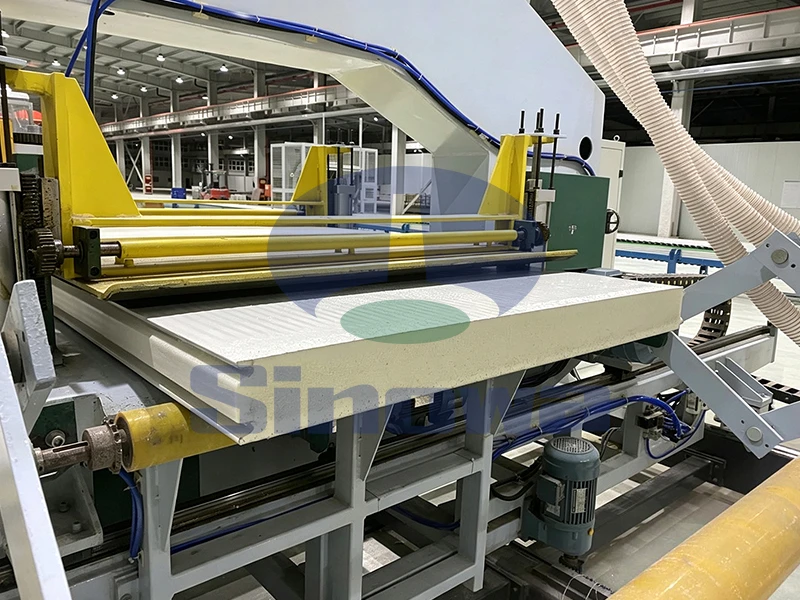
Continuous PU sandwich panel production involves a series of interconnected sequential processes, including raw material unwinding, surface layer leveling, PU foam injection, high-pressure laminating, curing, trimming, and fixed-length cutting, where the operating speed of each equipment unit directly determines the overall production stability and product quality uniformity. The most prominent challenge in actual production lies in the asynchronous speed deviation between front-end feeding equipment and back-end molding and cutting equipment. Minor speed mismatches can cause subtle problems such as surface layer wrinkling, foam uneven density, and panel thickness deviation, while severe synchronization failures will lead to material accumulation, stretching deformation, and even production line shutdown and material waste. Unlike intermittent production equipment, continuous production lines require real-time dynamic speed matching throughout the entire operation process, as static speed setting cannot adapt to tiny fluctuations in raw material tension, equipment operation resistance, and environmental temperature changes during long-term continuous operation. Therefore, establishing a scientific and real-time speed adjustment synchronization mechanism is the core prerequisite to ensure the continuous and stable operation of the PU sandwich panel production line and eliminate batch product quality defects. This synchronization mechanism needs to cover all key processing links, realize collaborative speed matching between independent equipment modules, and form a closed-loop adjustment system from real-time monitoring to dynamic correction.
The core principle of speed synchronization adjustment for continuous PU sandwich panel production lines is based on collaborative linkage of tension feedback and frequency conversion speed regulation, taking the main running speed of the laminating and curing section as the benchmark master speed to unify the speed logic of all auxiliary equipment. The laminating section is defined as the master control unit because it is the core molding link of PU sandwich panels; the running speed here determines the foaming time, curing state, and final molding size of the PU material, and any speed change in this link will directly affect the final product quality. All upstream equipment, including steel coil unwinding machines, leveling machines, and PU material metering and injection devices, as well as downstream trimming and cutting equipment, are set as slave units that follow the master speed for dynamic adjustment. In the traditional production mode, most production lines adopt fixed single-speed operation, which cannot respond to real-time changes in production status. The optimized synchronization method breaks the fixed-speed limitation by installing high-precision tension sensors and speed encoders on each equipment unit to collect real-time operating data. The system compares the speed difference and tension deviation between each slave unit and the master unit in real time, converts the deviation data into frequency regulation signals, and feeds them back to the frequency conversion drive system of each equipment to realize automatic speed fine-tuning, ensuring that the material transmission speed of each link maintains a consistent dynamic balance.
Real-time tension monitoring and dynamic speed correction are key technical means to realize efficient synchronization of the production line. In the feeding link of the upper and lower surface layers of the sandwich panel, the tension of metal or non-metal surface materials is extremely sensitive to speed changes. If the unwinding speed is slightly higher than the laminating speed, redundant materials will accumulate to form folds, and if the unwinding speed is lower than the laminating speed, the surface layer will be stretched, resulting in thin plate deformation and inconsistent flatness. To solve this problem, the synchronization system sets real-time tension threshold values for each feeding unit. When the sensor detects that the material tension exceeds the preset stable range, the system immediately triggers the speed adjustment program: it appropriately reduces the unwinding speed of the front-end material or fine-tunes the operating frequency of the leveling equipment to eliminate tension deviation, and the whole adjustment process is completed in milliseconds without affecting continuous production. For the PU foam injection link, the synchronization system links the material injection flow with the line operating speed. When the main line speed increases or decreases dynamically, the PU material metering pump automatically adjusts the injection volume synchronously, avoiding insufficient foaming caused by fast line speed and excessive foam overflow caused by slow line speed, so as to ensure the uniformity of the core material density of each batch of sandwich panels.
Multi-equipment linkage delay calibration is an indispensable part of the speed synchronization adjustment method, which effectively solves the asynchronous problem caused by mechanical response delay and signal transmission delay in long-distance production lines. The continuous PU sandwich panel production line has a long equipment layout, and there is a certain time interval for material transmission from the feeding end to the cutting end. In addition, different types of equipment have different mechanical response speeds when receiving speed adjustment signals, which will lead to temporary speed disorder if not calibrated uniformly. The synchronization adjustment method adopts staged delay calibration logic, dividing the production line into feeding area, foaming and laminating area, curing area and post-processing area. Through repeated production debugging, the signal delay time and mechanical response time of each area are recorded and stored in the system control program. When the main line speed is adjusted in real time, the system automatically delays the transmission of adjustment signals according to the regional calibration data, ensuring that the speed change actions of all equipment are completed synchronously with the material transmission rhythm. At the same time, the system adds a gradual speed adjustment mechanism to avoid quality fluctuations caused by sudden speed increase or decrease. All speed changes are completed through smooth gradient transition, which protects the mechanical structure of the equipment and stabilizes the production state.
Intelligent closed-loop feedback optimization further improves the accuracy and stability of production line speed synchronization adjustment. In the long-term continuous production process, mechanical wear of equipment, aging of transmission parts and subtle changes in operating environment will cause slow deviation of speed synchronization accuracy, and one-time static calibration cannot meet the long-term stable production requirements. The optimized synchronization method builds a real-time closed-loop feedback system based on production data big data collection. The system continuously collects operating speed data, tension data, and product quality detection data during production operation, and automatically analyzes the correlation between speed deviation and product quality defects. When minor synchronization errors that cannot be identified by conventional monitoring occur, the system can realize self-learning and adaptive correction, automatically update the speed adjustment parameters and delay calibration values, and optimize the synchronization operation logic in real time. This intelligent adjustment mode effectively reduces the manual intervention frequency in production, avoids synchronization errors caused by human operation differences, and greatly improves the consistency and yield of finished sandwich panels.
The application of this speed adjustment synchronization method can significantly optimize the overall operating state of the continuous PU sandwich panel production line and solve various quality and production problems caused by speed asynchrony. Through master-speed-based linkage control, real-time tension correction, delay calibration and intelligent closed-loop optimization, all production links maintain highly coordinated operating speed, effectively eliminating common defects such as panel thickness deviation, core material uneven density and surface wrinkling. In actual production operation, this synchronization method can adapt to different production speeds and different raw material characteristics, with strong universality and stability. It not only reduces material waste and equipment failure rates caused by asynchronous speed, but also improves the continuous production efficiency and finished product quality level of the production line, providing a reliable technical guarantee for the stable and high-efficiency operation of PU sandwich panel continuous production.
Main Products
-

Continuous PU Sandwich Panel Production Line
This continuous PU sandwich panel production line is an integrated automatic equipment. It covers uncoiling, forming, foaming, curing and cutting processes. With automatic raw material proportioning and precise temperature & pressure control, PIR sandwich panel production line continuously composites panels with double skins. Polyurethane sandwich panel production line stably produces steel and aluminum sandwich panels. Featuring high automation, the line makes fireproof and thermal-insulation panels for building enclosure and cold storage. -

Rock Wool Sandwich Panel Production Line
Continuous rockwool sandwich panel production line is an automatic integrated production equipment, consisting of uncoiling, forming, gluing and compounding, heating curing, fixed-length cutting, automatic stacking and other modules. The mineral wool sandwich panel production line continuously conveys color steel plates and rock wool core materials to automatically complete lamination and curing, which can produce fireproof and thermal insulation sandwich panels. Featuring high automation degree and stable operation, this production line is suitable for mass production of panels used for building walls, roofs and other scenarios. -

Phenolic Insulation Board Production Line
This integrated automatic production line continuously manufactures PU and phenolic insulation boards. The insulation board production line covers raw material proportioning, high-pressure foaming, laminating, curing and fixed-length cutting. Featuring high automation and stable molding, the insulation panel production line supports various surface materials. PU boards offer excellent thermal insulation, while phenolic boards have superior fire resistance. These products are widely used in construction, cold chain, ventilation ducts and other thermal insulation fields.
Other FAQs
- Polyurethane Sandwich Panel Production Line Idle Period Maintenance Management Scheme
- Polyurethane Sandwich Panel Production Line Start-up Pre-inspection Complete Items
- Noise Reduction Measures For PU Sandwich Panel Production Equipment
- Difference Between PUR And PIR Sandwich Panel Production Lines
- Compressed Air Supply Requirement For PU Sandwich Panel Line Operation