Why Does The PUR Sandwich Panel Production Line Have Inaccurate Cutting Length
Sep 29, 2026
Inaccurate cutting length is a common and troublesome issue in PUR sandwich panel production, undermining product consistency and raising production waste.
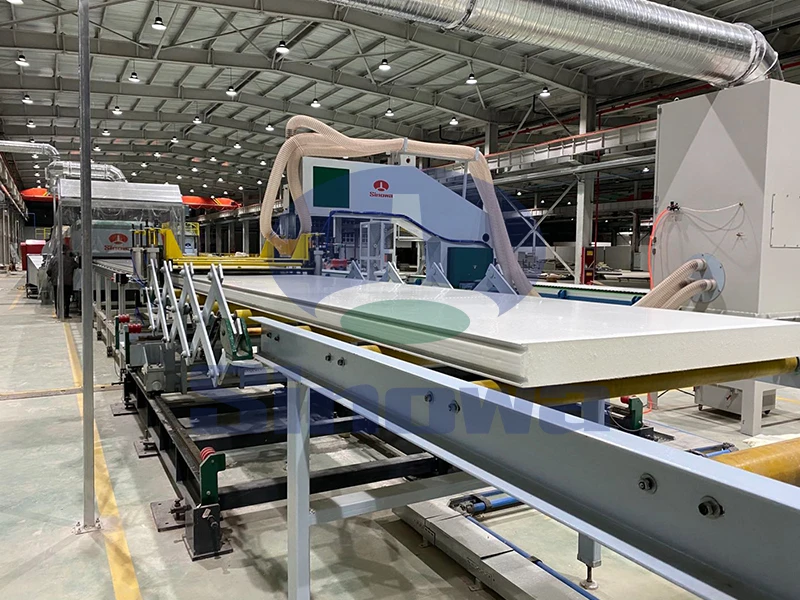
Mechanical transmission system failures are the most fundamental cause of inaccurate cutting length in PUR sandwich panel lines. The feeding and traction mechanism, which relies on rollers, chains and transmission shafts to transport panel materials steadily, directly determines the accuracy of material feeding length. Long-term continuous operation will lead to gradual wear of traction rollers, surface abrasion and reduced friction coefficient. When the roller surface is contaminated with dust, residual PUR foam or oil stains, the friction between the roller and the panel material becomes uneven, causing intermittent slippage during material conveying. In this case, the detection system records normal feeding displacement, while the actual movement of the sandwich panel lags behind, resulting in finished panels shorter than the preset size. Besides, loose transmission chains and misaligned guide rollers will aggravate conveying instability. Loose chains produce idle rotation during operation, failing to convert motor power into stable material feeding force, and offset guide rollers cause lateral deviation of materials. These subtle mechanical abnormalities will accumulate into obvious length errors after long-distance conveying, and the error range will expand with the extension of production operation time, forming irregular cutting length deviations.
Encoder and sensor detection abnormalities are key factors leading to cutting length errors, as these components undertake the core task of real-time monitoring of material feeding displacement. The encoder acts as the core measuring component of the production line, calculating feeding length by recording the pulse number of roller rotation. Long-term vibration of the equipment will loosen the encoder fixing bracket, causing slight displacement or shaking of the component during operation. This makes the encoder unable to accurately capture the rotation pulse signal, missing or misrecording partial pulse data. When the pulse count is lower than the actual rotation value, the system misjudges the feeding distance and cuts the panel longer than the standard size. Meanwhile, aging and dust coverage of proximity sensors and material detection sensors will delay signal transmission or cause false triggering. If the sensor fails to timely detect the material in place signal, the cutting system will delay the cutting action; abnormal signal triggering will lead to premature cutting. Unlike mechanical faults that produce cumulative errors, sensor and encoder failures often cause random length deviations, making product size inconsistency more irregular and difficult to troubleshoot in daily production.
Unreasonable parameter setting and control system operation errors are important human and program-induced causes of cutting length inaccuracy. The entire cutting process of the PUR sandwich panel production line is controlled by PLC programs, and the matching parameters of feeding speed and cutting timing directly affect cutting accuracy. Many production lines have unreasonable speed matching settings in actual operation. Excessively fast feeding speed will make the cutting tool fail to complete the cutting action in a stable state, and the material will continue to advance during the tool’s descending and cutting process, resulting in oversized panel length. In contrast, overly low feeding speed will cause slight compression and deformation of PUR foam materials, leading to dimensional shrinkage after cutting and molding. In addition, incorrect scale factor setting in the control system and integer rounding errors in program operation will produce subtle cumulative deviations. After multiple cycles of continuous production, these small program errors will be amplified, forming obvious length differences of finished products. Irregular parameter modification by operators and failure to calibrate the control system regularly will further exacerbate this problem, making the cutting accuracy unable to maintain a stable state for a long time.
Cutting system synchronization and hydraulic mechanical delay problems cannot be ignored in triggering length inaccuracy. The production line’s feeding system and cutting execution system need to maintain precise synchronous operation to ensure accurate cutting at the preset position. In actual operation, servo motor synchronization deviation often occurs due to long-term equipment operation and parameter drift. The operating speed of the cutting servo motor cannot completely follow the real-time feeding speed of materials, resulting in dislocation between cutting action and material position. For hydraulic cutting systems widely used in sandwich panel production, hydraulic valve response delay and hydraulic pressure fluctuation are common hidden troubles. When the hydraulic system has insufficient pressure or slow valve body response, the cutting tool will start the cutting action later than the system’s scheduled time, and the continuously moving materials will cause the cut panel to be longer than the standard size. Moreover, the blade’s aging and abrasion will increase cutting resistance, leading to slight material displacement during cutting. This subtle displacement will not affect the appearance of the incision but will directly cause deviation in the final cutting length, bringing hidden dangers to product size qualification rate.
Environmental changes and material self-performance differences will indirectly affect the cutting length accuracy of PUR sandwich panels. Production workshop temperature and humidity changes will cause tiny deformation of both equipment components and sandwich panel materials. In high-temperature environments, metal transmission components of the production line will produce slight thermal expansion, changing the actual rotation perimeter of traction rollers and leading to inaccurate conversion between rotation turns and feeding length. Meanwhile, the PUR foam core material and metal skin of sandwich panels have different thermal expansion and contraction coefficients. Temperature fluctuations will cause tiny stretching or shrinking of materials before cutting, resulting in inconsistent actual length of materials to be cut. In addition, differences in material surface flatness and hardness will also affect feeding stability. Partial uneven thickness of raw materials will lead to uneven stress during roller compression conveying, causing occasional material slippage. These environmental and material factors do not produce fixed regular errors, but they will cause random fluctuations in cutting length, increasing the difficulty of precision control in mass production and affecting the overall dimensional consistency of batch products.
Long-term equipment aging and lack of daily maintenance will continuously amplify various cutting length errors and turn occasional deviations into persistent production problems. Production lines that have been running for a long time will have comprehensive aging problems such as reduced motor operating accuracy, worn bearing gaps and decreased transmission component stability. These aging faults will not only reduce the overall operation stability of the equipment but also weaken the anti-interference ability of the production line during operation. Many production workshops lack standardized daily maintenance mechanisms, failing to regularly clean roller surface dirt, calibrate encoder parameters, check transmission chain tightness and debug hydraulic system pressure. Long-term accumulation of minor faults will make the superposition of mechanical deviation, detection error and synchronization error more serious. Eventually, the cutting length inaccuracy problem becomes frequent and difficult to eliminate, not only reducing product qualification rate and increasing raw material waste, but also affecting production efficiency and stable product quality of the entire production line.
Gallery
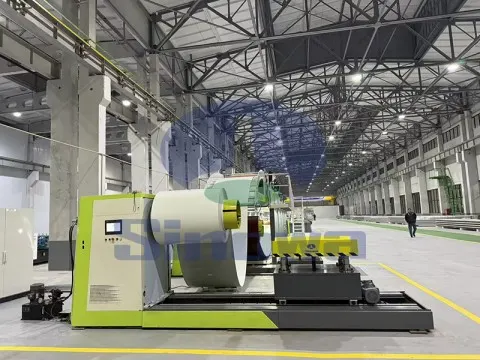
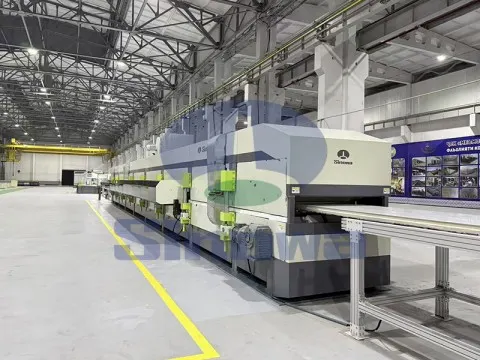
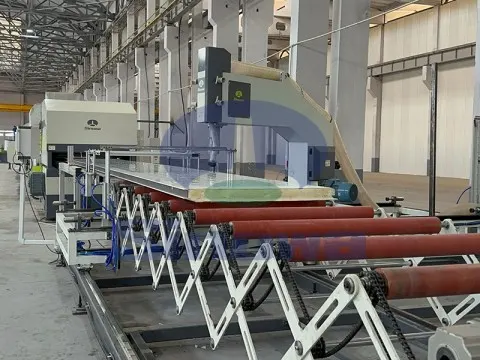
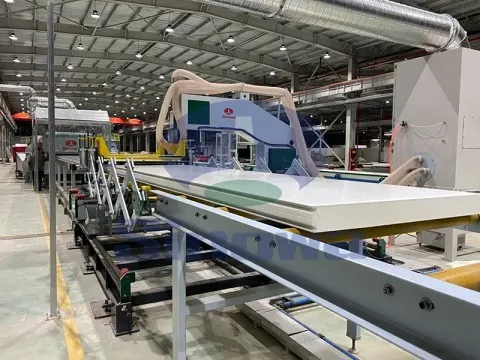
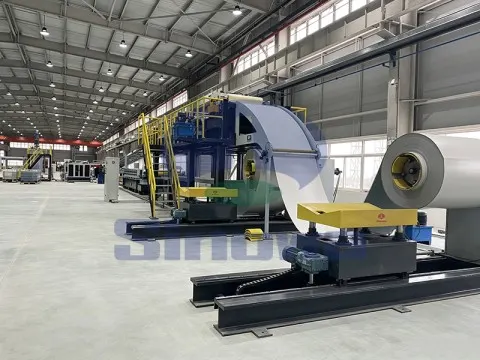
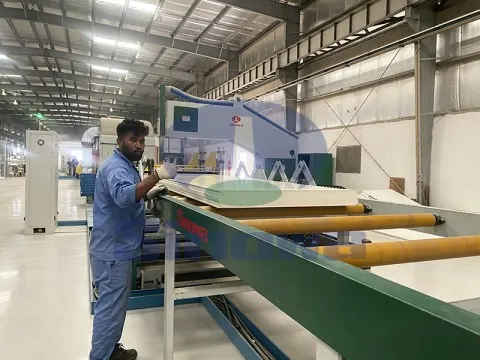
Sinowa is a professional manufacturer of sandwich panel machine in china, we provide diversified and high-performance sandwich panel production lines, including fully automatic continuous PU sandwich panel line and customized special lines to meet mass production and personalized order demands. These sandwich panel lines support processing multiple foam core materials, such as PU, PIR, mineral wool, rock wool and glass wool, covering different insulation and fireproof standards.
Featuring stable operation, high efficiency, energy saving and easy maintenance, our PU sandwich panel line deliver sandwich panels with excellent thermal insulation, fire resistance, sound insulation and lightweight durability. The finished panels are widely applied in industrial workshops, warehouse roofing and wall cladding, cold storage insulation, serving global construction and industrial insulation markets.
Main Products
-

Continuous PU Sandwich Panel Production Line
This continuous PU sandwich panel production line is an integrated automatic equipment. It covers uncoiling, forming, foaming, curing and cutting processes. With automatic raw material proportioning and precise temperature & pressure control, PIR sandwich panel production line continuously composites panels with double skins. Polyurethane sandwich panel production line stably produces steel and aluminum sandwich panels. Featuring high automation, the line makes fireproof and thermal-insulation panels for building enclosure and cold storage. -

Rock Wool Sandwich Panel Production Line
Continuous rockwool sandwich panel production line is an automatic integrated production equipment, consisting of uncoiling, forming, gluing and compounding, heating curing, fixed-length cutting, automatic stacking and other modules. The mineral wool sandwich panel production line continuously conveys color steel plates and rock wool core materials to automatically complete lamination and curing, which can produce fireproof and thermal insulation sandwich panels. Featuring high automation degree and stable operation, this production line is suitable for mass production of panels used for building walls, roofs and other scenarios. -

Phenolic Insulation Board Production Line
This integrated automatic production line continuously manufactures PU and phenolic insulation boards. The insulation board production line covers raw material proportioning, high-pressure foaming, laminating, curing and fixed-length cutting. Featuring high automation and stable molding, the insulation panel production line supports various surface materials. PU boards offer excellent thermal insulation, while phenolic boards have superior fire resistance. These products are widely used in construction, cold chain, ventilation ducts and other thermal insulation fields.
Other FAQs
- What Are The Common Faults Of A Polyurethane Sandwich Panel Machine
- How To Optimize Cutting Sequence Of PIR Sandwich Panel Production Line Batch Panels
- How To Adjust The Feeding Speed Of Insulation Panel Production Line For Stable Output
- Can A Continuous PU Sandwich Panel Production Line Be Customized For Special Panel Profiles
- Working Principle of PU Sandwich Panel Production Line
- PU Sandwich Panel Production Line Vibration Reduction And Noise Control Scheme
- Production Efficiency Improvement Measures Of Sandwich Panel Production Line
- Production Line Operation Steps For Continuous PU Sandwich Panel Molding
- How To Maintain A Polyurethane Sandwich Panel Machine Daily
- How To Adjust Foaming Density Gradient Of PIR Sandwich Panel Production Line Core Layer
Related Articles
- High-end Continuous PU Sandwich Panel Production Line Made In China
- PU Sandwich Panel Line For Pre-Insulated Duct
- High Efficiency PU Sandwich Panel Machine On Sales
- PU Sandwich Panel Manufacturing Machine With Servo Control System
- Metal Insulated Sandwich Panel Production Line
- PU Sandwich Panel Manufacturing Machine With Cooling System
- Custom PIR Sandwich Panel Line
- Fireproof Insulation Board Production Line
- PUR Sandwich Panel Machine
- Composite Insulation Board Production Line