sandwich panel line
The core function of a PU sandwich panel manufacturing line with a material feeding conveyor is to produce composite panels consisting of two outer facing materials and a middle PU foam core, all bonded together through a precise, automated process. The material feeding conveyor serves as the backbone of this system, responsible for the seamless and consistent delivery of raw materials to each stage of production, ensuring that the entire line operates in harmony without unnecessary delays or interruptions. Unlike traditional manufacturing methods that rely on manual material transport, which is prone to inconsistencies, fatigue, and errors, the material feeding conveyor automates the movement of facing materials, PU raw components, and intermediate products, creating a smooth, uninterrupted workflow that enhances productivity and reduces operational costs.
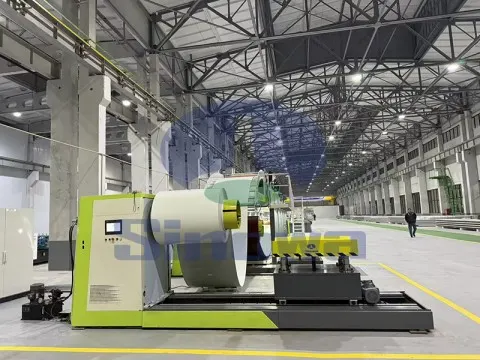
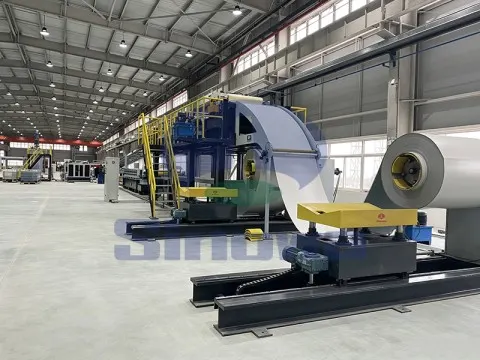
To understand the operation of this manufacturing line, it is essential to break down its key components and their respective roles, starting with the material feeding conveyor system. The conveyor is typically a modular belt or roller system, designed to handle different types of raw materials with varying weights, sizes, and properties. For the outer facing materials, which are commonly galvanized steel, galvalume, aluminum sheets, or pre-painted metal sheets, the feeding conveyor must provide stable and controlled movement to prevent damage or deformation during transport. These facing materials are usually supplied in coil form, and the conveyor works in tandem with uncoiling machines to feed the coils into the next stage of processing, ensuring a constant supply without tension fluctuations that could affect the quality of the final product. The conveyor’s speed is adjustable, allowing it to synchronize with other components of the line, such as the roll forming machine and the PU foaming unit, to maintain a consistent production rhythm.
In addition to transporting facing materials, the material feeding conveyor also handles the delivery of raw materials for the PU foam core, which includes polyol, isocyanate, foaming agents, catalysts, and other additives. These materials are stored in separate tanks and are fed into a high-pressure metering system via dedicated conveyor lines or hoses, which are integrated into the main feeding conveyor system. The precision of the material feeding process is critical here, as the ratio of each component directly impacts the density, thermal conductivity, and mechanical properties of the PU foam. The conveyor ensures that these raw materials are delivered in the correct proportions and at the right speed, preventing waste and ensuring that the chemical reaction that forms the PU foam is consistent and reliable. This level of precision is difficult to achieve with manual feeding, making the conveyor an essential component for maintaining product quality.
The production process of PU sandwich panels using this integrated line begins with the preparation of the facing materials. The coil-shaped facing materials are loaded onto uncoiling machines, which use tension control devices to ensure stable uncoiling. The material feeding conveyor then transports the uncoiled sheets to a leveling station, where any wrinkles or deformations caused during storage or transportation are eliminated. This leveling process is crucial for ensuring a flat surface that will bond effectively with the PU foam core. In some cases, the facing materials may also undergo preheating treatment, which is facilitated by the conveyor moving the sheets through a preheating chamber. Preheating ensures that the facing materials reach an optimal temperature for bonding with the PU foam, enhancing adhesion and improving the overall structural integrity of the sandwich panel.
After pretreatment, the facing materials are transported via the material feeding conveyor to the roll forming machine, which shapes the sheets into the desired profile. The roll forming process involves passing the sheets through a series of rollers arranged in tandem, each gradually bending the material into the specified shape. The conveyor maintains a consistent speed during this process, ensuring that the forming is uniform and precise. The profiles can be customized according to the application requirements, such as corrugated for roofing panels or flat for wall panels, and the conveyor system adapts to these variations by adjusting its speed and alignment.
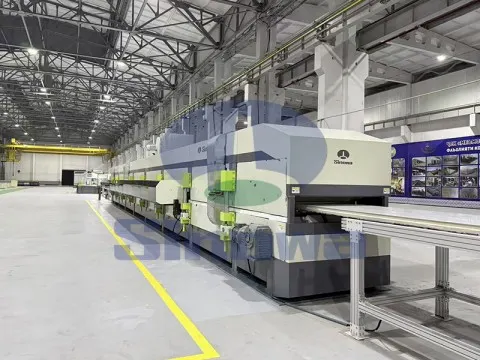
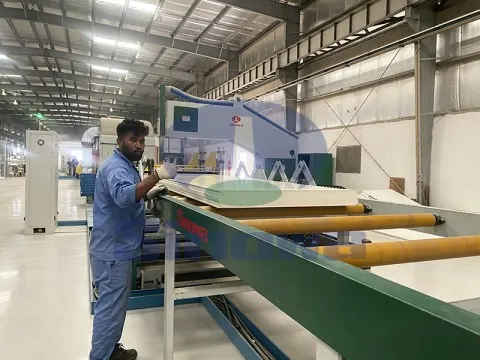
Once the facing materials are formed, the material feeding conveyor moves them to the foaming and lamination station, which is the core of the production process. Here, the high-pressure metering system injects the mixed PU raw materials between the two facing sheets. The conveyor then transports the combined structure through a double-belt pressing machine, which applies uniform pressure and temperature to ensure that the PU foam expands and bonds firmly with the facing materials. The double-belt press is equipped with temperature control systems to maintain the optimal curing temperature for the PU foam, which typically ranges between 40 and 60 degrees Celsius. The conveyor’s speed is carefully synchronized with the foaming and curing process, allowing the PU foam to expand and solidify fully before moving to the next stage.
During the foaming process, the PU foam undergoes a chemical reaction that causes it to expand and fill the space between the two facing materials, creating a closed-cell structure that provides excellent thermal insulation and soundproofing properties. The material feeding conveyor plays a critical role here by ensuring that the facing materials remain aligned and stable during the expansion process, preventing any shifting that could result in uneven foam distribution or weak bonding. The conveyor’s design minimizes vibration, which is essential for maintaining the integrity of the foam core as it cures.
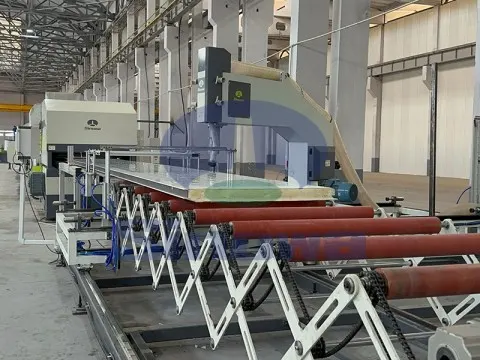
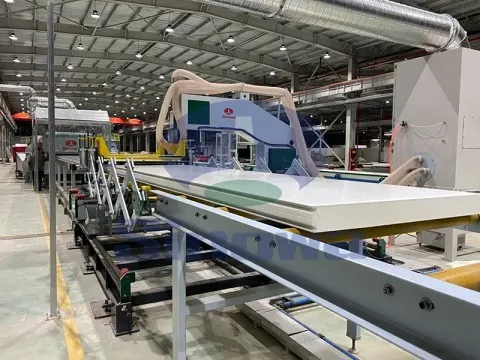
After the foaming and lamination process, the conveyor transports the semi-finished panels to a cooling station, where the PU foam is allowed to cure completely. The cooling process is typically achieved using forced air or water-cooled rollers, and the conveyor moves the panels through this station at a controlled speed to ensure uniform cooling. Once cooled, the panels are transported to a cutting station, where a flying saw or reciprocating saw cuts them to the desired length. The material feeding conveyor ensures that the panels are positioned accurately during cutting, preventing errors and ensuring that each panel meets the specified dimensions.
Following cutting, the conveyor moves the finished panels to a stacking and packaging station. Here, the panels are automatically stacked in neat piles, which are then wrapped for protection during storage and transportation. The material feeding conveyor continues to operate seamlessly, moving the stacked panels to the packaging area and ensuring that the entire production process is continuous and efficient. This automation reduces the need for manual labor, lowers the risk of damage to the finished panels, and increases the overall throughput of the manufacturing line.
One of the key advantages of a PU sandwich panel manufacturing line with a material feeding conveyor is its high level of automation, which significantly improves production efficiency. By automating the material handling process, manufacturers can reduce the time required to produce each panel, increase the volume of production, and minimize labor costs. The conveyor system also ensures that the production process is consistent, reducing the number of defective products and improving overall product quality. This consistency is particularly important for industries such as construction, where the performance and durability of building materials are critical.
Another advantage of this integrated system is its flexibility. The material feeding conveyor can be adjusted to handle different types of facing materials, including steel, aluminum, and composite sheets, as well as various thicknesses and widths. This flexibility allows manufacturers to produce a wide range of PU sandwich panels to meet the specific needs of different applications, such as industrial warehouses, logistics centers, commercial buildings, cold storage facilities, and residential construction. The conveyor system can also be adapted to accommodate changes in production volume, making it suitable for both small-scale and large-scale manufacturing operations.
In addition to efficiency and flexibility, the material feeding conveyor also contributes to a safer working environment. By automating the movement of heavy materials, the risk of workplace injuries associated with manual lifting and transport is significantly reduced. The conveyor system is designed with safety features such as emergency stop buttons, safety guards, and sensors to prevent accidents, ensuring that workers can operate the line safely. This focus on safety not only protects employees but also reduces downtime caused by accidents, further enhancing productivity.
The environmental benefits of this manufacturing line should also be noted. The precise metering of raw materials by the conveyor system reduces waste, as it ensures that only the required amount of each component is used in the foaming process. Additionally, many modern PU sandwich panel manufacturing lines use environmentally friendly foaming agents, such as pentane, which have a lower impact on the ozone layer compared to traditional foaming agents. The conveyor system also helps to reduce energy consumption by optimizing the production process, as the automated workflow minimizes idle time and ensures that each component of the line operates at peak efficiency.
The application of PU sandwich panels produced by this line is widespread, spanning multiple industries. In the construction industry, they are used for roofing, walls, and partitions, providing excellent thermal insulation that reduces energy consumption for heating and cooling. In industrial settings, such as warehouses and factories, the panels are valued for their structural strength and durability, as well as their ability to withstand harsh environmental conditions. Cold storage facilities benefit from the superior thermal insulation properties of PU sandwich panels, which help to maintain consistent temperatures and reduce energy costs. Additionally, the panels are used in modular buildings, portable cabins, and temporary structures, thanks to their lightweight and easy installation properties.
To ensure the long-term performance and reliability of the PU sandwich panel manufacturing line with a material feeding conveyor, regular maintenance is essential. The conveyor system, in particular, requires periodic inspection and maintenance to keep it operating smoothly. This includes checking the conveyor belts or rollers for wear and tear, lubricating moving parts, adjusting tension, and ensuring that the sensors and control systems are functioning correctly. Regular maintenance not only extends the lifespan of the equipment but also prevents unexpected breakdowns that could disrupt production. Manufacturers should also train their operators to use the equipment properly, as proper operation is key to maximizing efficiency and minimizing damage.
As technology continues to advance, the PU sandwich panel manufacturing line with a material feeding conveyor is expected to become even more efficient and versatile. Innovations in automation, such as the integration of artificial intelligence and machine learning, could further optimize the production process, allowing for real-time monitoring and adjustment of the conveyor speed, material flow, and other parameters. This would enable manufacturers to achieve even higher levels of productivity and product quality, while also reducing operational costs. Additionally, advancements in material science could lead to the development of new, more sustainable raw materials for PU foam, further enhancing the environmental benefits of the manufacturing process.
In conclusion, the PU sandwich panel line with a material feeding conveyor is a sophisticated and essential piece of equipment for modern manufacturing. Its integration of automation, precision, and flexibility makes it ideal for producing high-quality PU sandwich panels that meet the diverse needs of the construction, industrial, and cold storage industries. The material feeding conveyor serves as the backbone of this system, ensuring seamless material transport, consistent production, and improved efficiency. By automating the material handling process, this line reduces labor costs, minimizes errors, enhances safety, and reduces environmental impact, making it a valuable investment for manufacturers looking to stay competitive in today’s market. As technology continues to evolve, this manufacturing line will undoubtedly play an even more important role in the production of sustainable, high-performance building materials.
Sinowa is a professional manufacturer of sandwich panel machine in china, we provide diversified and high-performance sandwich panel production lines, including fully automatic continuous PU sandwich panel line and customized special lines to meet mass production and personalized order demands. These sandwich panel lines support processing multiple foam core materials, such as PU, PIR, mineral wool, rock wool and glass wool, covering different insulation and fireproof standards.
Featuring stable operation, high efficiency, energy saving and easy maintenance, our PU sandwich panel line deliver sandwich panels with excellent thermal insulation, fire resistance, sound insulation and lightweight durability. The finished panels are widely applied in industrial workshops, warehouse roofing and wall cladding, cold storage insulation, serving global construction and industrial insulation markets.
https://www.cnsinowa.com/sandwich-panel-machines/pu-sandwich-panel-manufacturing-line-with-material-feeding-conveyor.html