Production Line Operation Steps For Continuous PU Sandwich Panel Molding
Sep 17, 2026
Continuous PU sandwich panel molding is a streamlined industrial production process for making lightweight, high-insulation building panels.
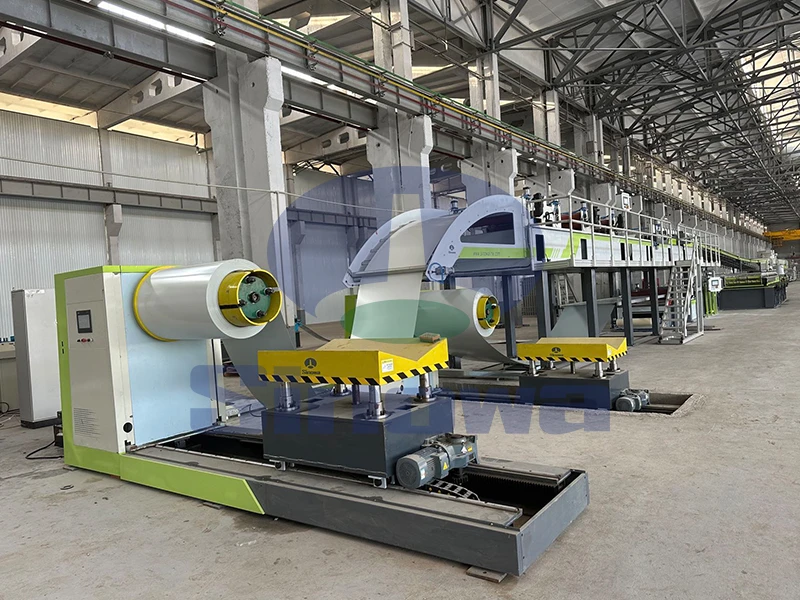
The first core operation step of continuous PU sandwich panel molding production is comprehensive pre-production line preparation and equipment debugging, which lays a solid foundation for smooth and standardized subsequent production. Before starting the entire production system, operators need to conduct a full-range visual and functional inspection of all production line equipment, including raw material delivery devices, PU foaming reaction systems, roller pressing units, conveying tracks and cutting mechanisms. It is essential to check the tightness of all connecting parts of the equipment to avoid material leakage and equipment jitter during high-speed continuous operation, and verify the normal operation of power, ventilation and temperature control systems. Meanwhile, operators need to clean the entire production pipeline thoroughly to remove residual raw materials, dust and debris from previous production batches, as foreign impurities will directly affect the bonding performance and surface flatness of finished panels. In addition, parameter pre-adjustment is a key part of this step. Operators need to set and debug core production parameters such as equipment operating speed, reaction temperature of PU materials and initial pressing spacing according to the preset production specifications of sandwich panels. After all inspections and parameter settings are completed, a no-load test run of the production line is required to confirm that all equipment runs stably without abnormal noise, stagnation or parameter deviation, and formal production can only be launched after the test run meets the operating requirements.
The second operational step is standardized raw material preparation and automatic feeding, which determines the uniformity and stability of panel raw material composition. The main raw materials for PU sandwich panels include upper and lower metal surface materials and polyurethane foaming raw materials, and all materials need to be inspected for basic appearance and state before feeding. For metal surface materials, operators need to check the surface flatness, integrity and uniformity of the coiled materials to exclude materials with scratches, wrinkles, deformation and uneven coating, ensuring the surface quality of subsequent finished products. For PU foaming materials, it is necessary to confirm the activity and uniformity of the two-component raw materials, and conduct low-speed stirring treatment to avoid material stratification that may affect the foaming effect. After material inspection, the coiled metal materials are installed on the automatic unwinding device of the production line, and the tension of the unwinding system is adjusted to ensure constant-speed and stable discharging without tension fluctuation. Meanwhile, the PU raw material delivery pipeline is connected and checked for patency, and the automatic feeding system is started to realize quantitative and continuous conveying of foaming materials. During the feeding process, operators need to monitor the feeding speed and material dosage in real time to ensure the proportion of raw materials is kept in a stable state at all times, avoiding quality problems such as insufficient foaming or excessive foam density caused by inaccurate material proportioning.
The third key step is in-line PU foaming and composite bonding treatment, which is the core link that forms the sandwich structure of the panel. After the upper and lower metal sheets are stably conveyed along the production line track, the quantitative mixed PU foaming raw materials are evenly sprayed between the two layers of metal sheets through the automatic spraying device. The spraying operation needs to maintain uniform distribution in the transverse and longitudinal directions of the metal sheet surface to ensure consistent foaming thickness everywhere. Immediately after spraying, the preliminary composite assembly of the upper and lower metal sheets and PU raw materials is completed with the assistance of the guiding roller device. In the closed constant-temperature reaction area of the production line, the PU materials start a rapid chemical foaming and curing reaction. With the gradual expansion and solidification of the foaming materials, the two layers of metal sheets are closely bonded to form an integrated sandwich structure. During the foaming reaction process, the production line’s constant-temperature system maintains a stable reaction environment to prevent local overheating or low temperature from causing inconsistent foaming speed and incomplete curing. Operators need to observe the real-time foaming state through the equipment observation window, timely adjust local material spraying volume and conveying speed according to the foaming effect, and eliminate abnormal phenomena such as bubble voids and uneven bonding in the initial composite stage in time to ensure the structural compactness of the panel core layer.
The fourth operational procedure is continuous pressing and shaping treatment, which calibrates the overall dimension and flatness of the preliminary molded sandwich panel. After preliminary foaming and composite bonding, the semi-finished panel enters the multi-group roller pressing system of the production line for continuous pressing and shaping. The pressing system adopts segmented pressure control, and the pressing force of each group of rollers is accurately adjusted according to the preset panel thickness specifications, so that the foaming core layer is further compacted and the bonding between the core layer and metal sheets is tighter. The upper and lower roller groups operate synchronously at a constant speed, which can effectively correct the minor deformation and uneven thickness of the semi-finished panel generated in the foaming stage, ensuring the overall flatness and uniform thickness of the panel. In the pressing process, the equipment keeps continuous and stable operation to avoid intermittent pressing marks on the panel surface. At the same time, the temperature of the pressing rollers is maintained within a reasonable range to assist the secondary curing of the PU core layer, enhance the structural stability of the panel, and prevent the finished panel from deformation and warping in the later stage. Operators regularly detect the thickness and flatness of the panel in the pressing section with professional testing tools, and fine-tune the pressing parameters in real time to ensure the molded panel meets the dimensional uniformity requirements.
The fifth step is fixed-length cutting and edge trimming processing, which realizes the standardized sizing of continuous molded panels. After continuous pressing and complete curing shaping, the long-strip integrated sandwich panel is stably conveyed to the automatic cutting unit of the production line. According to the preset product length specifications, the intelligent cutting system automatically locates and performs fixed-length cutting, and the high-speed cutting tool ensures smooth and neat cutting sections without burrs, cracks and material delamination. After the cutting operation is completed, the panel enters the edge trimming process, where the irregular residual edges on both sides of the panel are trimmed by the edge trimming device to ensure consistent width of the whole panel and regular and flat edge outlines. In the cutting and trimming process, the production line maintains synchronous conveying and processing speed to avoid position deviation caused by speed mismatch, which may affect cutting accuracy. Operators need to regularly check the sharpness of the cutting tool and the calibration accuracy of the positioning system, and replace and debug the tool in time if there is tool wear or positioning deviation, so as to ensure the dimensional accuracy of each batch of sized panels and avoid size deviation affecting subsequent application and installation.
The final operational step is post-processing and finished product quality inspection and stacking, which is the last guarantee of product quality before warehousing. After cutting and edge trimming, the surface of the panel is finely cleaned to remove residual foam scraps, dust and tiny impurities generated during processing, so as to keep the surface of the metal sheet smooth and clean. Then, operators conduct comprehensive manual and equipment auxiliary inspection on the finished panels, focusing on checking the surface flatness of the panels, the compactness of the internal core layer, the firmness of bonding between the core layer and metal sheets, and the accuracy of overall dimensions. Panels with surface scratches, unqualified thickness, hollow core layers and loose bonding are screened out as defective products and recorded uniformly. Qualified finished panels are automatically conveyed to the stacking area, and the mechanical stacking device performs neat and orderly stacking according to standardized specifications to avoid extrusion deformation between panels. After stacking, the product batches are marked with basic production information for subsequent warehousing, transportation and use. This step effectively controls the final quality of products, ensures that all delivered finished panels have stable performance and qualified appearance, and completes the whole continuous molding operation process of PU sandwich panels.
Main Products
-

Continuous PU Sandwich Panel Production Line
This continuous PU sandwich panel production line is an integrated automatic equipment. It covers uncoiling, forming, foaming, curing and cutting processes. With automatic raw material proportioning and precise temperature & pressure control, PIR sandwich panel production line continuously composites panels with double skins. Polyurethane sandwich panel production line stably produces steel and aluminum sandwich panels. Featuring high automation, the line makes fireproof and thermal-insulation panels for building enclosure and cold storage. -

Rock Wool Sandwich Panel Production Line
Continuous rockwool sandwich panel production line is an automatic integrated production equipment, consisting of uncoiling, forming, gluing and compounding, heating curing, fixed-length cutting, automatic stacking and other modules. The mineral wool sandwich panel production line continuously conveys color steel plates and rock wool core materials to automatically complete lamination and curing, which can produce fireproof and thermal insulation sandwich panels. Featuring high automation degree and stable operation, this production line is suitable for mass production of panels used for building walls, roofs and other scenarios. -

Phenolic Insulation Board Production Line
This integrated automatic production line continuously manufactures PU and phenolic insulation boards. The insulation board production line covers raw material proportioning, high-pressure foaming, laminating, curing and fixed-length cutting. Featuring high automation and stable molding, the insulation panel production line supports various surface materials. PU boards offer excellent thermal insulation, while phenolic boards have superior fire resistance. These products are widely used in construction, cold chain, ventilation ducts and other thermal insulation fields.
Other FAQs
- Difference Between Continuous And Discontinuous PU Sandwich Panel Production Lines
- Daily Maintenance Items Of Polyurethane Sandwich Panel Production Line
- Production Efficiency Improvement Measures Of Sandwich Panel Production Line
- Price Composition Of Complete PU Sandwich Panel Production Line
- Energy Consumption Standard Of Automatic PU Sandwich Panel Production Equipment