Can PIR Sandwich Panel Production Line Produce Prefabricated Container House Roof Panels
Sep 29, 2026
Yes, the PIR sandwich panel production line can fully produce prefabricated container house roof panels. This automated line fabricates high-strength, thermally insulated PIR panels with stable structures, which perfectly fit the structural and functional requirements of container house roofs for modular building applications.
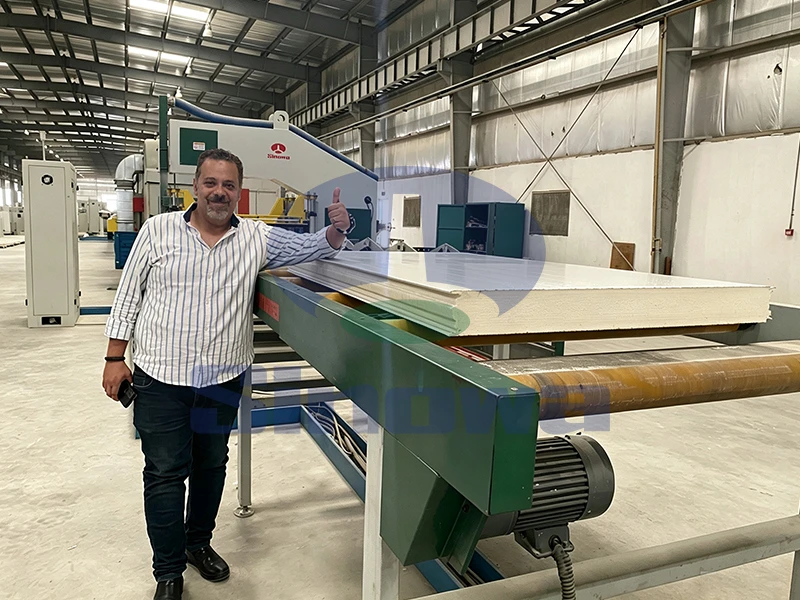
Prefabricated container houses have emerged as a mainstream modular building solution for temporary construction sites, emergency shelters, commercial temporary spaces and residential expansion projects, thanks to their lightweight structure, fast installation and excellent environmental adaptability. As a core component of container houses, roof panels bear multiple functional responsibilities including rainproof protection, thermal insulation, load bearing and weather resistance, putting forward strict requirements on material performance and manufacturing precision. The PIR sandwich panel production line is a professional automated production system dedicated to the manufacturing of high-performance composite insulation panels, which integrates continuous feeding, roll forming, core material compounding, high-temperature curing and fixed-length cutting processes. Many industry practitioners wonder whether this professional production line can be applied to the customized production of container house roof panels. In fact, the structural design and functional configuration of the PIR sandwich panel production line are highly compatible with the production demands of container roof panels, laying a solid equipment foundation for large-scale and standardized manufacturing of prefabricated container roof components. Different from ordinary building wall panels, container roof panels need to adapt to the box-type modular structure, requiring accurate dimensional matching, good bending resistance and overall waterproof continuity, all of which can be realized through parameter adjustment and process optimization of the PIR sandwich panel production line.
The core structural advantages of the PIR sandwich panel line determine its capability to produce qualified prefabricated container house roof panels. This automated production line adopts an integrated continuous processing mode, which effectively avoids the dimensional deviation and performance inconsistency caused by traditional manual or semi-automatic intermittent production. The production line is equipped with a flexible roll forming system that can adjust the pressing radian, plate thickness and edge sealing structure of metal surface layers according to the structural characteristics of container roof panels. Container roof panels usually need special edge crimping and lap joint structures to ensure tight assembly between adjacent panels and seamless connection with container wall panels, and the programmable forming parameters of the PIR sandwich panel production line can fully meet such personalized processing needs. In addition, the core material compounding and curing system of the production line can realize uniform pouring and solidification of PIR foam core materials, ensuring that the roof panels have consistent density and stable internal structure. This avoids local hollowing or insufficient strength that often occur in irregularly produced panels, effectively improving the overall structural stability of container roofs in long-term outdoor use.
In terms of functional performance matching, panels manufactured by the PIR sandwich panel making machine fully meet the comprehensive usage requirements of prefabricated container house roof panels. PIR foam core material has inherent excellent thermal insulation and heat preservation performance, which can effectively block external heat conduction, reduce the temperature difference inside and outside the container house, and improve the indoor comfort of modular buildings. For container houses exposed to outdoor environments all year round, roof panels need to resist extreme weather such as strong sunlight, rain erosion and temperature alternation. The composite panels produced by the PIR sandwich panel production line have low water absorption and excellent dimensional stability, and will not deform, expand or age significantly under long-term humid and high-temperature conditions. Meanwhile, the integrated composite process of the production line enables tight bonding between the metal surface layer and the PIR core layer, with no peeling or layering after long-term use. This reliable bonding performance ensures the structural integrity of the container roof, prevents rainwater penetration caused by panel layering, and greatly extends the service life of prefabricated container houses in various application scenarios.
The PIR sandwich panel production line shows outstanding advantages in batch production and customized adaptation for prefabricated container house roof panels. Modern prefabricated building projects often require large-scale standardized supporting components, and the continuous operation mode of the PIR sandwich panel production line can realize uninterrupted mass production of roof panels, greatly improving production efficiency and shortening the component supply cycle compared with traditional customized processing methods. The production line supports flexible adjustment of panel specifications, including customizable panel thickness, width and surface coating types, which can adapt to different types of prefabricated container houses, from simple temporary storage containers to multi-layer combined residential container buildings. Moreover, the finished panels produced by the PIR sandwich panel production line have precise dimensional accuracy and uniform surface flatness, which can perfectly match the standardized assembly process of container houses. The high consistency of finished products reduces the on-site trimming and modification work during container assembly, significantly improving the overall installation efficiency of prefabricated container buildings and reducing on-site construction costs.
Compared with other types of panel production equipment, the PIR sandwich panel manufacturing line has unique advantages in manufacturing prefabricated container house roof panels. Ordinary PU sandwich panel production lines have insufficient fire resistance and structural stability of finished panels, while rock wool sandwich panel production lines have relatively heavy finished products and poor thermal insulation uniformity, which are not suitable for lightweight and high-efficiency container building requirements. In contrast, the PIR sandwich panel production line combines the advantages of automated continuous production and high-performance core material processing. The produced roof panels have the dual advantages of light weight and high strength, which can reduce the overall self-weight of container houses without affecting load-bearing safety. In addition, the production line has a high degree of process integration, which can complete surface layer forming, core material compounding, edge trimming and surface finishing in one go, simplifying the production process of container roof panels. This integrated production mode not only improves product qualification rate but also reduces material waste in the production process, realizing more economical and environmentally friendly production of prefabricated container roof components.
In practical industrial production, the PIR sandwich panel production line has been widely applied in the supporting manufacturing of prefabricated container house components, fully verifying its production feasibility and practical value. A large number of practical production cases prove that after simple process parameter debugging and mold adjustment, the PIR sandwich panel production line can stably produce high-quality container house roof panels that meet the actual use standards of modular buildings. The finished roof panels have stable comprehensive performance, strong environmental adaptability and good assembly compatibility, which can fully meet the construction needs of various temporary and semi-permanent prefabricated container projects. With the continuous development of the prefabricated building industry towards high efficiency and high performance, the application scope of the PIR sandwich panel production line in the field of container building component manufacturing will continue to expand, becoming one of the core equipment for standardized and large-scale production of prefabricated container house roof panels.
Gallery
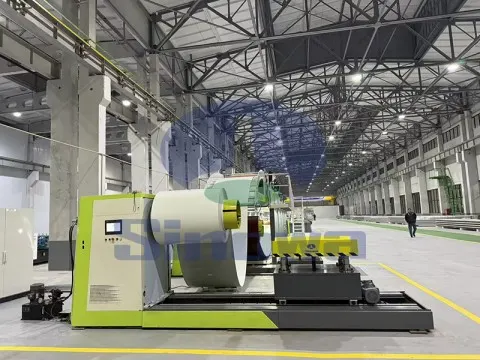
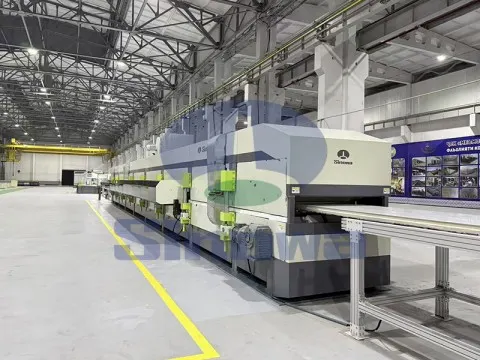
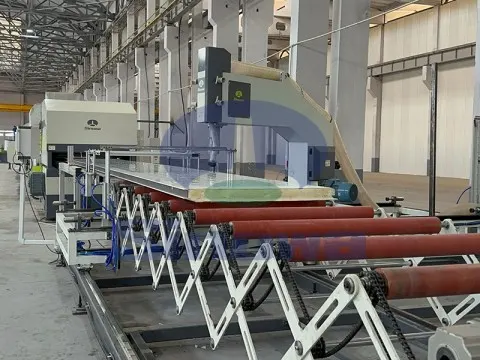
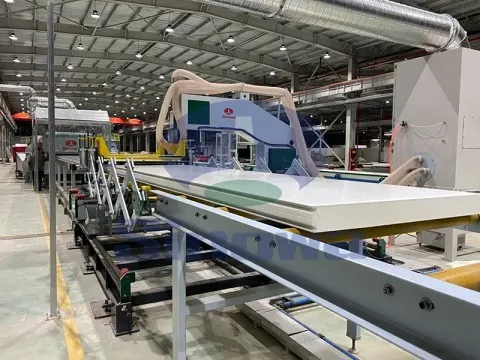
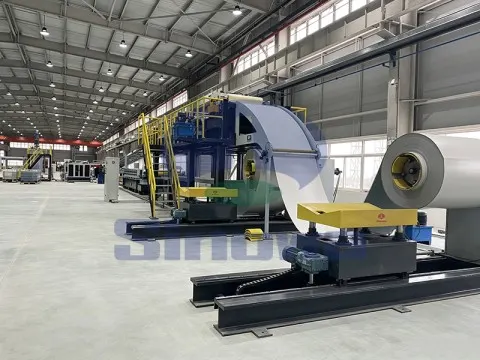
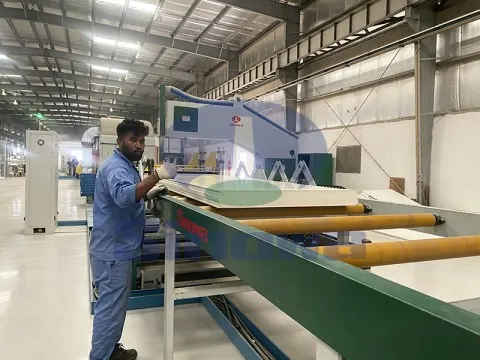
Sinowa is a professional manufacturer of sandwich panel machine in china, we provide diversified and high-performance sandwich panel production lines, including fully automatic continuous PU sandwich panel line and customized special lines to meet mass production and personalized order demands. These sandwich panel lines support processing multiple foam core materials, such as PU, PIR, mineral wool, rock wool and glass wool, covering different insulation and fireproof standards.
Featuring stable operation, high efficiency, energy saving and easy maintenance, our PU sandwich panel line deliver sandwich panels with excellent thermal insulation, fire resistance, sound insulation and lightweight durability. The finished panels are widely applied in industrial workshops, warehouse roofing and wall cladding, cold storage insulation, serving global construction and industrial insulation markets.
Main Products
-

Continuous PU Sandwich Panel Production Line
This continuous PU sandwich panel production line is an integrated automatic equipment. It covers uncoiling, forming, foaming, curing and cutting processes. With automatic raw material proportioning and precise temperature & pressure control, PIR sandwich panel production line continuously composites panels with double skins. Polyurethane sandwich panel production line stably produces steel and aluminum sandwich panels. Featuring high automation, the line makes fireproof and thermal-insulation panels for building enclosure and cold storage. -

Rock Wool Sandwich Panel Production Line
Continuous rockwool sandwich panel production line is an automatic integrated production equipment, consisting of uncoiling, forming, gluing and compounding, heating curing, fixed-length cutting, automatic stacking and other modules. The mineral wool sandwich panel production line continuously conveys color steel plates and rock wool core materials to automatically complete lamination and curing, which can produce fireproof and thermal insulation sandwich panels. Featuring high automation degree and stable operation, this production line is suitable for mass production of panels used for building walls, roofs and other scenarios. -

Phenolic Insulation Board Production Line
This integrated automatic production line continuously manufactures PU and phenolic insulation boards. The insulation board production line covers raw material proportioning, high-pressure foaming, laminating, curing and fixed-length cutting. Featuring high automation and stable molding, the insulation panel production line supports various surface materials. PU boards offer excellent thermal insulation, while phenolic boards have superior fire resistance. These products are widely used in construction, cold chain, ventilation ducts and other thermal insulation fields.
Other FAQs
- What Are The Common Faults Of A Polyurethane Sandwich Panel Machine
- How To Optimize Cutting Sequence Of PIR Sandwich Panel Production Line Batch Panels
- How To Adjust The Feeding Speed Of Insulation Panel Production Line For Stable Output
- Can A Continuous PU Sandwich Panel Production Line Be Customized For Special Panel Profiles
- Why Does The PUR Sandwich Panel Production Line Have Inaccurate Cutting Length
- Working Principle of PU Sandwich Panel Production Line
- PU Sandwich Panel Production Line Vibration Reduction And Noise Control Scheme
- Production Efficiency Improvement Measures Of Sandwich Panel Production Line
- Production Line Operation Steps For Continuous PU Sandwich Panel Molding
- How To Maintain A Polyurethane Sandwich Panel Machine Daily
Related Articles
- High-quality Sandwich Panel Production Machinery
- Multi-functional PU Sandwich Panel Line For Wall And Roofing Panels
- Intelligent PU Foaming Line
- Continuous PU Sandwich Panel Line With Remote Monitoring System
- PU Sandwich Panel Line For Sound-Proof Wall
- PU Sandwich Panel Line For Thermal Insulation Panels
- Automatic Sandwich Panel Production Line
- PU Sandwich Panel Machine For Soundproof Board Production
- Polyurethane Foam Sandwich Panel Production Line
- Partition PU Sandwich Panel Machine