Polyurethane Sandwich Panel Production Line Energy Saving Transformation Effect
Sep 22, 2026
Energy-saving transformation of polyurethane sandwich panel production lines effectively cuts energy consumption, reduces production costs and lowers carbon emissions. It optimizes traditional outdated production processes and equipment operation modes, bringing stable economic and environmental benefits for panel manufacturing industries.
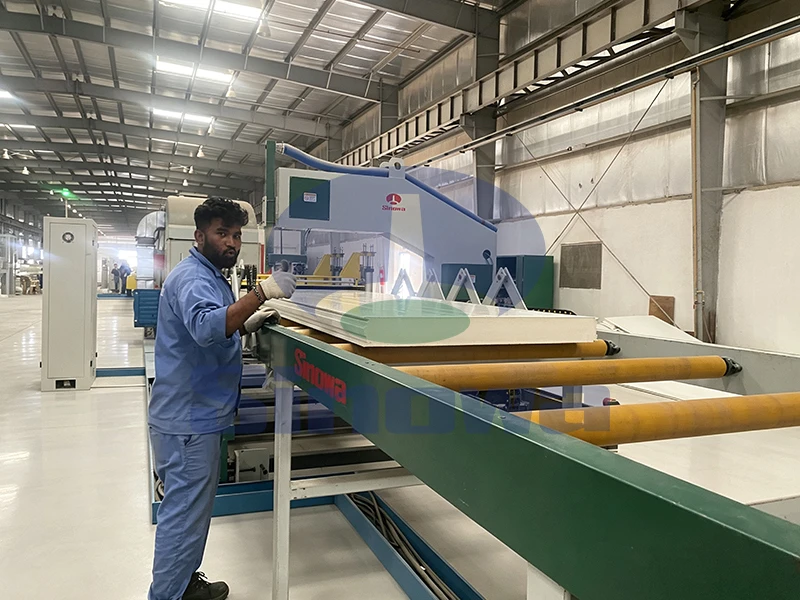
Traditional polyurethane sandwich panel production lines have long been plagued by extensive energy consumption modes in daily operation, which restrict the green and efficient development of the manufacturing process. Most conventional production equipment adopts fixed-frequency operation modes and outdated heating and foaming systems, leading to serious energy waste in multiple production links. In the raw material preheating stage, traditional heating devices cannot accurately control temperature according to production demands, resulting in long-term overheating and repeated heating of polyurethane raw materials. This not only consumes a large amount of electric energy and thermal energy but also causes uneven raw material activity, affecting the preliminary forming quality of sandwich panels. Meanwhile, the foaming and curing links of traditional production lines lack intelligent regulation mechanisms. The equipment maintains a constant power output regardless of production speed, panel thickness and raw material dosage, leading to massive invalid energy consumption during low-load operation and equipment idling. In addition, the old transmission and cooling systems have low operational efficiency, with large mechanical friction loss and unreasonable cold air circulation, further increasing the overall energy consumption level of the production line. These long-standing problems not only raise the comprehensive production cost of enterprises but also generate excessive energy waste and carbon emissions, failing to meet the current industry’s demand for low-carbon and high-efficiency production.
The core of the energy-saving transformation for polyurethane sandwich panel production lines lies in the systematic optimization and upgrading of key production links and core equipment. The transformation mainly focuses on three key modules including heating system optimization, intelligent power regulation and circulation system upgrading to achieve precise energy control and efficient resource utilization. For the heating system, the original single fixed heating equipment is replaced with segmented intelligent constant-temperature heating devices, which can automatically adjust heating power and temperature according to real-time production parameters such as raw material types, panel specifications and production rhythm. This avoids the energy waste caused by blind heating and ensures the stable activity of polyurethane raw materials. In terms of power operation optimization, variable-frequency speed regulation technology is introduced into all power equipment of the production line. The system can intelligently identify the operation load of each process link, dynamically adjust the operating frequency and power of motors and transmission equipment, and eliminate the high-energy consumption problem caused by fixed-frequency operation and no-load operation of traditional equipment. Moreover, the original open-type cooling and heat dissipation structure is upgraded to a closed circulating heat dissipation system, which realizes the recycling of waste heat and cooling air. The recovered waste heat can be reused for raw material preheating, effectively reducing the additional energy required for preheating links and forming a cyclic energy-saving production mode.
The energy-saving transformation brings remarkable energy consumption reduction effects to the entire polyurethane sandwich panel production process. After the systematic upgrading of production equipment and processes, the invalid energy consumption in key links such as raw material heating, foaming curing, equipment transmission and product cooling is greatly reduced. The intelligent segmented heating technology effectively improves the thermal utilization rate of the production line, avoiding the heat loss and energy waste of traditional integral heating. The application of variable-frequency regulation technology solves the long-term problem of high power consumption of equipment under low-load and idle conditions, realizing precise matching between power output and production demand. Meanwhile, the closed waste heat circulation system maximizes the reuse of residual heat generated during production, turning the originally wasted heat energy into reusable production energy. In actual production operation, the overall energy consumption per unit product of the transformed production line is significantly reduced compared with the traditional production mode. The continuous and stable operation data shows that the optimized production line can effectively reduce comprehensive energy loss in the whole production cycle, and the energy-saving effect is continuous and stable without affecting the production efficiency and product qualification rate, completely changing the extensive energy consumption state of traditional production lines.
In addition to prominent energy-saving effects, the transformation also brings comprehensive improvements in production efficiency and product quality stability. The traditional production line’s fixed operation mode often leads to unstable process parameters due to manual adjustment errors and equipment hysteresis, resulting in inconsistent foaming density, uneven bonding strength and unstable dimensional accuracy of polyurethane sandwich panels. After the energy-saving and intelligent transformation, all production process parameters are automatically controlled and adjusted by the intelligent system, realizing precise control of temperature, pressure, speed and raw material ratio in each production link. The accurate and stable production environment effectively optimizes the foaming and forming effect of polyurethane materials, making the internal structure of sandwich panels more uniform, the bonding between core materials and surface materials firmer, and the overall product quality more stable. At the same time, the optimized equipment operation mode reduces mechanical failure rates and shutdown maintenance frequency caused by long-term high-load and unreasonable operation. The continuous and stable operation of the production line effectively improves the overall production efficiency, shortens the single-piece production cycle, and enables enterprises to complete more production tasks under the same energy consumption and time cost, realizing the dual improvement of energy saving and efficiency increase.
The energy-saving transformation of the production line also brings significant long-term economic and environmental benefits for manufacturing enterprises. Economically, the continuous reduction of unit energy consumption directly lowers the daily operation and production costs of enterprises. The reduction of equipment failure rate and maintenance frequency saves a large amount of equipment maintenance costs and downtime loss. The improved product quality stability also reduces the defective rate and rework cost, further optimizing the enterprise’s production cost structure and improving the overall profit margin of product production. Environmentally, the reduction of comprehensive energy consumption directly cuts down the consumption of primary energy and the generation of carbon pollutants in the production process. The optimized production process reduces the waste of raw materials and energy resources, realizing the efficient and green utilization of production resources. This low-carbon and efficient production mode not only conforms to the general development trend of green manufacturing in the industry but also helps enterprises establish a good green production image, enhancing the core competitiveness of enterprises in the increasingly competitive market and laying a solid foundation for long-term sustainable development.
The popularization and application of energy-saving transformation technology for polyurethane sandwich panel production lines has important guiding significance for the overall upgrading of the industry. Most traditional sandwich panel manufacturing lines have the problems of backward technology, high energy consumption and low resource utilization rate. The systematic energy-saving transformation mode summarizes a mature and replicable green production optimization scheme through the upgrading of core processes, intelligent equipment and cyclic energy utilization. It breaks through the technical bottleneck of high energy consumption in the traditional production process of polyurethane sandwich panels, provides a feasible transformation path for most manufacturing enterprises to realize energy conservation, emission reduction and efficiency improvement. With the continuous promotion of green manufacturing concepts, this energy-saving transformation technology will be further optimized and popularized, driving the entire polyurethane sandwich panel manufacturing industry to transform from extensive energy consumption to intensive and efficient green development, and promoting the high-quality and sustainable development of the whole industrial chain.
Main Products
-

Continuous PU Sandwich Panel Production Line
This continuous PU sandwich panel production line is an integrated automatic equipment. It covers uncoiling, forming, foaming, curing and cutting processes. With automatic raw material proportioning and precise temperature & pressure control, PIR sandwich panel production line continuously composites panels with double skins. Polyurethane sandwich panel production line stably produces steel and aluminum sandwich panels. Featuring high automation, the line makes fireproof and thermal-insulation panels for building enclosure and cold storage. -

Rock Wool Sandwich Panel Production Line
Continuous rockwool sandwich panel production line is an automatic integrated production equipment, consisting of uncoiling, forming, gluing and compounding, heating curing, fixed-length cutting, automatic stacking and other modules. The mineral wool sandwich panel production line continuously conveys color steel plates and rock wool core materials to automatically complete lamination and curing, which can produce fireproof and thermal insulation sandwich panels. Featuring high automation degree and stable operation, this production line is suitable for mass production of panels used for building walls, roofs and other scenarios. -

Phenolic Insulation Board Production Line
This integrated automatic production line continuously manufactures PU and phenolic insulation boards. The insulation board production line covers raw material proportioning, high-pressure foaming, laminating, curing and fixed-length cutting. Featuring high automation and stable molding, the insulation panel production line supports various surface materials. PU boards offer excellent thermal insulation, while phenolic boards have superior fire resistance. These products are widely used in construction, cold chain, ventilation ducts and other thermal insulation fields.
Other FAQs
- Workshop Space Layout Requirement For PU Sandwich Panel Production Line
- Operator Professional Training Content For PU Sandwich Panel Line
- Energy Consumption Standard Of Automatic PU Sandwich Panel Production Equipment
- Polyurethane Sandwich Panel Production Equipment Lubrication Maintenance Standard
- Troubleshooting For Sandwich Panel Production Line Frequent Shutdown Failure