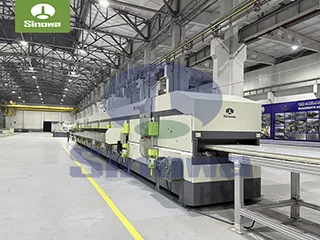
sandwich panel machine
PU sandwich panels are composite materials consisting of three layers: two outer facings (typically galvanized steel, galvalume, or aluminum) and a rigid polyurethane (PU) foam core sandwiched between them. The unique structure endows the panels with a combination of superior thermal insulation, high load-bearing capacity, weather resistance, and soundproofing performance, making them ideal for a variety of applications. However, the one-size-fits-all approach is no longer viable in today's market, where projects often require panels of specific dimensions to fit unique architectural designs, spatial constraints, or functional requirements. This is where custom size production comes into play, and the PU sandwich panel making machine designed for this purpose becomes a critical asset for manufacturers.
The PU sandwich panel machine for custom size production is a sophisticated integrated system that encompasses multiple functional modules, each working in harmony to ensure the precision and efficiency of the manufacturing process. Unlike standard production lines that are optimized for fixed dimensions, custom-oriented machinery features adjustable components and flexible control systems that allow for seamless changes in panel width, length, and thickness. The core components of such machinery include the uncoiling system, panel pretreatment module, PU foaming system, composite lamination unit, cooling and shaping section, precision cutting equipment, and post-processing and stacking systems. Each of these modules is designed with adaptability in mind, enabling manufacturers to produce panels that meet the exact specifications of their clients.
The uncoiling system is the starting point of the production process, responsible for feeding the outer facing materials (usually in the form of coiled metal sheets) into the PU sandwich panel production line. For custom size production, the uncoiling system is equipped with adjustable tension control devices that ensure the smooth and stable feeding of materials of different widths. This is crucial because variations in tension can lead to uneven panel surfaces or dimensional inaccuracies. The system typically includes multiple uncoilers to accommodate the simultaneous feeding of upper and lower facing sheets, and each uncoiler is equipped with automatic centering mechanisms to align the sheets precisely, laying the foundation for accurate composite formation.
Following the uncoiling process, the metal sheets undergo pretreatment in the panel pretreatment module. This module plays a vital role in enhancing the adhesion between the metal facings and the PU foam core, thereby improving the overall structural integrity of the sandwich panels. The pretreatment process may include degreasing, surface activation (such as corona treatment), and pressing or profiling. For custom production, the pressing and profiling components are adjustable, allowing for the creation of different surface textures or profiles (such as corrugated, trapezoidal, or flat) according to client requirements. These profiles not only enhance the aesthetic appeal of the panels but also improve their structural rigidity, making them suitable for specific applications such as roof panels or wall cladding. The pretreatment module also includes heating devices that preheat the metal sheets to an optimal temperature, which facilitates the subsequent foaming and bonding process.
The PU foaming system is the heart of the continuous sandwich panel production line, responsible for generating the rigid PU foam core that gives the panels their insulating and structural properties. For custom size production, the foaming system must be capable of adjusting the amount and distribution of foam to accommodate different panel thicknesses and dimensions. The system consists of a material storage and delivery unit, a high-pressure mixing head, and a foaming control system. The material storage unit holds the two main components of PU foam (polyol and isocyanate) along with additives such as blowing agents, catalysts, and flame retardants. These materials are delivered to the high-pressure mixing head in precise proportions, which is critical for ensuring the consistent quality of the foam. The mixing head rapidly mixes the materials, and the resulting foam is uniformly sprayed or poured onto the lower metal facing. The foaming control system uses advanced sensors and programmable logic controllers (PLC) to adjust the foaming rate and amount in real-time, ensuring that the foam fills the entire space between the upper and lower facings evenly, regardless of the panel's custom dimensions.
Once the foam is applied, the composite lamination unit brings the upper and lower metal facings together with the foam core, applying the necessary pressure and temperature to facilitate the bonding and curing process. The lamination unit typically consists of a continuous double-belt press, which uses two endless steel belts to apply uniform pressure across the entire surface of the panel. For custom size production, the press is equipped with adjustable width guides that can be quickly modified to match the desired panel width. The temperature and pressure within the press are precisely controlled, as these parameters directly affect the curing time and quality of the PU foam. The double-belt press ensures that the three layers are firmly bonded together, creating a sandwich panel with consistent thickness and flatness. The continuous nature of the press also ensures high production efficiency, even when switching between different custom sizes.
After lamination, the composite panel moves into the cooling and shaping section. The freshly laminated panel is still at an elevated temperature, and rapid cooling is necessary to stabilize its dimensions and ensure the complete curing of the PU foam. The cooling section uses air or water cooling systems to lower the temperature of the panel gradually. For custom size production, the cooling section is designed with adjustable cooling zones that can be tailored to different panel thicknesses, ensuring that the panel cools uniformly without warping or deformation. The shaping components within this section also help to maintain the panel's dimensional accuracy, ensuring that it meets the custom specifications.
Precision cutting is a critical step in custom size production, as it ensures that the panels are cut to the exact length and width required by the client. The precision cutting equipment is typically equipped with high-speed circular saws or band saws that are controlled by advanced CNC (Computer Numerical Control) systems. The CNC system allows operators to input the desired dimensions, and the cutting equipment automatically adjusts to make precise cuts. This eliminates the need for manual measurement and cutting, reducing the risk of human error and ensuring consistent dimensional accuracy across all panels. The cutting equipment is also capable of making clean, smooth cuts, minimizing edge burrs and reducing the need for additional post-processing.
Following the cutting process, the panels undergo post-processing, which may include edge trimming, grooving, or punching. These post-processing steps are often required to prepare the panels for installation, such as creating grooves for easy lap joint or punching holes for fasteners. For custom production, the post-processing equipment is adjustable, allowing for different edge profiles or hole positions to be created according to client requirements. Once the post-processing is complete, the panels are transferred to the stacking system, which automatically stacks the panels in an orderly manner, ready for packaging and delivery. The stacking system is also designed to handle different panel sizes, ensuring that the panels are not damaged during stacking.
The ability to produce custom-sized PU sandwich panels using this advanced machinery offers numerous advantages for both manufacturers and end-users. For manufacturers, custom production allows them to expand their market reach by catering to the diverse needs of different industries and projects. It also enables them to respond quickly to changing market demands, giving them a competitive edge in a fast-paced industry. The flexible nature of the machinery reduces the need for expensive retooling when switching between different sizes, lowering production costs and increasing operational efficiency. Additionally, the precision and automation of the machinery ensure consistent product quality, reducing the risk of rejects and improving customer satisfaction.
For end-users, custom-sized PU sandwich panels provide a high degree of design flexibility, allowing them to create structures that are tailored to their specific needs. Whether it's a cold storage facility that requires panels of exact dimensions to fit the refrigeration units, an industrial warehouse with unique roof slopes that demand custom-length panels, or a commercial building with intricate architectural details that require specialized panel sizes, custom production ensures that the panels integrate seamlessly into the project. This not only improves the aesthetic appeal of the structure but also enhances its functional performance. Custom-sized panels also reduce material waste during installation, as they fit perfectly into the designated spaces, minimizing the need for on-site cutting and adjustments. This, in turn, reduces installation time and labor costs, making the project more cost-effective overall.
The custom-sized PU sandwich panels produced by this machinery find applications in a wide range of industries. In the construction industry, they are used for wall cladding, roof panels, partition walls, and modular buildings. The ability to customize dimensions makes them ideal for both new construction and renovation projects, where existing structures may have non-standard dimensions. In the cold storage and refrigeration industry, custom-sized panels are essential for creating airtight and thermally efficient enclosures that fit the specific layout of the facility. The superior thermal insulation properties of PU foam ensure that the internal temperature is maintained at the required level, reducing energy consumption.
In the industrial and manufacturing sector, custom-sized PU sandwich panels are used for the construction of warehouses, production facilities, and equipment enclosures. The high load-bearing capacity and durability of the panels make them suitable for withstanding the harsh conditions of industrial environments, while their soundproofing properties help to reduce noise pollution within the facility. In the agricultural industry, the panels are used for livestock barns, greenhouses, and storage sheds. Custom dimensions allow for the creation of structures that fit the specific needs of different agricultural operations, such as accommodating large farming equipment or optimizing the layout of livestock pens.
Another important application area is the transportation industry, where custom-sized PU sandwich panels are used for the interior lining of trucks, trailers, and shipping containers. The lightweight nature of the panels helps to reduce the overall weight of the vehicles, improving fuel efficiency, while their thermal insulation properties are beneficial for transporting temperature-sensitive goods. Additionally, the panels' resistance to corrosion and moisture makes them suitable for use in marine environments, such as the interior partitioning of ships.
The performance of the PU sandwich panel line for custom size production is influenced by several key factors, including the precision of the components, the efficiency of the control system, and the quality of the raw materials. Manufacturers of such machinery continuously invest in research and development to improve the adaptability, efficiency, and reliability of their equipment. For example, the integration of advanced sensors and AI-based control systems allows for real-time monitoring and adjustment of the production process, ensuring even higher levels of precision and consistency. The development of more energy-efficient foaming systems and heating/cooling units also helps to reduce the environmental impact of the production process, aligning with the global trend towards sustainability.
In addition to technological advancements, the operation and maintenance of the machinery also play a crucial role in ensuring its long-term performance and productivity. Proper training of operators is essential to ensure that they can effectively use the flexible features of the machinery and make quick adjustments when switching between different custom sizes. Regular maintenance, including cleaning, lubrication, and inspection of components, helps to prevent breakdowns and extend the lifespan of the equipment. Manufacturers often provide comprehensive maintenance guidelines and technical support to help their clients maximize the efficiency and reliability of their production lines.
Looking ahead, the demand for custom-sized PU sandwich panels is expected to continue growing, driven by the increasing complexity of architectural designs, the expansion of end-user industries, and the growing emphasis on sustainability and energy efficiency. This will likely fuel further innovation in polyurethane sandwich panel production line, with a focus on enhancing flexibility, improving production speed, and reducing energy consumption. The integration of digital technologies, such as IoT (Internet of Things) and big data analytics, will enable more intelligent and connected production lines, allowing manufacturers to optimize their operations and respond more quickly to market demands.
In conclusion, PU sandwich panel machinery designed for custom size composite panel production is a sophisticated and essential tool in the modern composite material manufacturing industry. Its flexible and precise design allows manufacturers to meet the diverse needs of end-users across a wide range of industries, providing custom-sized panels that offer superior performance and design flexibility. The integration of advanced components and control systems ensures the efficiency, consistency, and reliability of the production process, while ongoing technological advancements continue to enhance the capabilities of the machinery. As the demand for custom solutions grows, this machinery will play an increasingly important role in driving the growth and development of the PU sandwich panel industry, contributing to the creation of more sustainable, efficient, and innovative built environments.
https://www.cnsinowa.com/sandwich-panel-machines/pu-sandwich-panel-making-machinery-for-custom-size-composite-panel-production.html