sandwich panel line
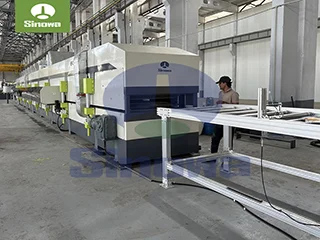
The basic structural composition of a continuous sandwich panel production line follows a streamlined production logic, with each functional module closely connected and mutually coordinated to ensure the continuity and stability of material transmission and processing. The front-end part of the entire production system is dominated by raw material unwinding and pretreatment units, which are responsible for releasing and preliminary treating the upper and lower surface materials of sandwich panels. Metal coils and non-metal sheet materials are fixed on unwinding racks, and the tension control devices inside the racks maintain constant material tension during the unwinding process to avoid surface wrinkles, stretching deformation, and positional deviation of surface materials. After unwinding, the surface materials pass through multi-stage leveling and trimming mechanisms; the leveling rollers eliminate subtle bending and irregular warping generated during coil storage and transportation, while the trimming devices cut off uneven edges on both sides of the sheet to ensure consistent width of the surface materials, laying a foundation for subsequent composite molding. In addition, the pretreatment unit is equipped with surface cleaning structures to remove dust, oil stains, and oxide layers attached to the material surface. A clean and flat bonding surface can significantly enhance the adhesion between surface materials and core materials, improving the overall structural compactness and service durability of finished panels.
Following the surface material pretreatment unit is the core batching and mixing system for core layer raw materials, which determines the foaming quality, density uniformity, and thermal insulation performance of the sandwich panel core. This system is mainly composed of raw material storage tanks, precision metering pumps, circulating conveying pipelines, and high-speed mixing chambers. Different types of core layer raw materials, including liquid chemical raw materials for foam formation and granular inorganic thermal insulation fillers, are separately stored in sealed storage tanks to prevent external environmental factors such as temperature and humidity from affecting raw material activity. During operation, the metering pumps accurately control the feeding ratio and flow rate of various raw materials according to preset process parameters. All raw materials are transported to the closed mixing chamber and undergo high-speed stirring and turbulent mixing through internal stirring components. The mixing process strictly controls stirring speed, mixing time, and material temperature to ensure uniform fusion of different raw material components without localized segregation or uneven concentration. Well-mixed composite materials are transported to the material distribution mechanism at a constant flow rate, achieving uniform spreading on the surface of the lower layer sheet. The rational design of the batching and mixing system effectively avoids quality defects such as inconsistent core density, local hollowing, and uneven pore structure, ensuring stable physical performance of each section of the continuously produced panels.
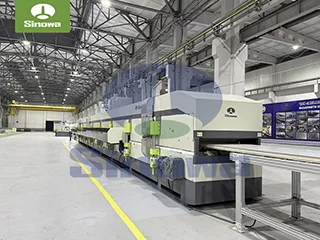
The composite molding unit serves as the central functional section of the entire production line, undertaking the key process of combining upper and lower surface materials with foamed core materials into an integrated panel structure. After the mixed core raw materials are evenly laid on the lower surface material, the sheet is steadily transported to the closed molding tunnel by the transmission roller group. In the front section of the molding tunnel, the upper surface material is automatically covered on the uncured core material through the flipping and pressing mechanism. The internal structure of the molding tunnel is equipped with multi-group pressure regulating rollers and temperature control components. The pressure rollers apply continuous and uniform vertical pressure to the composite plate body to eliminate gaps between the surface materials and the core layer, promoting sufficient bonding between materials. Meanwhile, the independent constant-temperature heating system inside the tunnel maintains a stable thermal environment, providing necessary temperature conditions for chemical foaming and curing reactions of core materials. The internal pressure and temperature parameters of the molding tunnel can be dynamically adjusted according to different material characteristics and panel thickness specifications. For panels with thicker core layers, appropriately extended constant-temperature holding time and moderate pressure increase are required to ensure complete foaming and sufficient curing of internal raw materials; for thin-specification lightweight panels, the production line accelerates the transmission speed and reduces heating energy consumption to balance production efficiency and molding quality. The overall structure of the molding tunnel adopts an integrated thermal insulation design to reduce internal temperature loss, lower energy waste, and maintain the stability of the internal reaction environment during continuous production.
The curing and heat preservation unit is arranged at the rear end of the molding tunnel, undertaking the task of secondary shaping and performance stabilization of initially composite panels. Although the core materials complete the primary foaming and bonding process in the molding tunnel, the internal molecular structure of the panel is not completely stable, and residual chemical reactions still exist inside the core layer. The curing unit extends the constant-temperature environment to prolong the material curing time, enabling the internal foaming structure to gradually stabilize and enhancing the bonding firmness between layers. The interior of the curing area is divided into multiple temperature gradient zones; the temperature of the front zone is consistent with the molding tunnel to avoid structural cracks caused by instantaneous temperature drop, while the temperature of the rear zone decreases slowly to realize natural cooling and shaping of the panel. The circulating air supply system inside the curing unit ensures uniform heat distribution in all areas of the equipment, preventing local overheating or excessive cooling that leads to inconsistent panel hardness and uneven internal stress. After continuous curing treatment, the sandwich panel forms a complete integrated structure, with significantly improved compression resistance, bending resistance, and overall structural stability, eliminating the risk of layer separation during subsequent use.
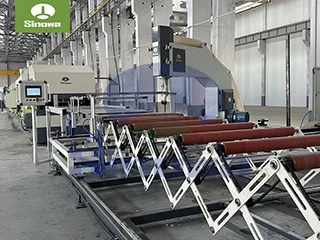
The precision cutting and sizing unit is responsible for cutting continuously produced long strip panels into finished products of standard specifications, which is a key link to realize the commercial application of panels. Driven by high-precision servo motors, the cutting system can real-time detect the transmission speed and length of panels through intelligent sensing components. The cutting tool adopts high-hardness alloy blades with smooth cutting edges to avoid burrs, collapses, and deformation at panel cuts. The entire cutting process follows non-stop dynamic cutting logic; the cutting mechanism moves synchronously with the panel transmission direction during operation to ensure flat and vertical cuts without affecting the continuous production rhythm of the assembly line. Before cutting, the edge trimming mechanism accurately polishes the two sides of the panel to ensure consistent panel width and neat edge structures. According to different usage scenarios, the cutting system can flexibly adjust cutting length parameters to produce panels of diversified specifications, meeting the customized production needs of different industries. In addition, the cutting unit is equipped with a waste recycling structure to collect edge leftover materials generated during trimming, which are centrally processed and recycled to reduce raw material waste and improve resource utilization efficiency.
The post-processing and automatic stacking unit is the terminal functional module of the production line, completing surface inspection, auxiliary processing, and orderly stacking of finished panels. After cutting, the panels are transported to the inspection platform through the conveyor belt, where built-in visual detection components conduct comprehensive non-destructive inspection on panel surfaces. The detection system can identify tiny defects such as surface scratches, depressions, bubbles, and uneven coatings, marking unqualified products in real time to realize automatic sorting of qualified and defective products. Qualified panels enter the surface finishing process; the dust removal device cleans residual debris and dust on the panel surface, and the edge sealing mechanism carries out anti-corrosion and sealing treatment on panel cuts to prevent moisture and corrosive substances from invading the internal core layer and extending panel service life. Subsequently, the automatic stacking mechanism neatly stacks flat panels in batches through mechanical arms. The stacking system adopts a dual-station alternating operation mode; while one station completes stacking, the other station receives conveyed panels, realizing uninterrupted stacking and effectively matching the high-speed production rhythm of the front-end production line. The stacked panel groups have regular shapes and uniform spacing, facilitating subsequent packaging, transportation, and warehousing management.
In terms of working performance and technical advantages, the continuous sandwich panel production line has obvious competitive superiority compared with traditional intermittent production equipment. First of all, it achieves ultra-high continuous production efficiency. The whole production process from raw material unwinding to finished product stacking is automated and interconnected, with no manual intervention required in the intermediate links. The uninterrupted production mode eliminates time loss caused by equipment shutdown, mold replacement, and parameter debugging, greatly improving daily production capacity. Secondly, the product quality consistency is excellent. The production line adopts closed-loop automatic control technology, with all key parameters such as raw material ratio, heating temperature, molding pressure, and transmission speed precisely regulated by the control system. The fluctuation range of production parameters is controlled within a tiny interval, ensuring that the thickness, density, flatness, and bonding strength of each finished panel remain highly consistent, effectively avoiding quality differences between batches of products. In addition, the production line has strong material compatibility. By adjusting process parameters and replacing individual functional components, it can produce sandwich panels with different surface materials and different core layer fillers, covering metal surface panels, non-metal inorganic panels, and various foam and inorganic thermal insulation core materials, adapting to diverse application scenarios in the construction industry.
From the perspective of production cost and energy consumption control, the optimized structural design of the continuous sandwich panel production line effectively reduces the comprehensive operating cost of the production system. In terms of raw material utilization, the closed batching system accurately controls the feeding amount of raw materials, avoiding excessive raw material addition and material deterioration caused by long-term exposure. The edge waste generated during trimming is recycled and reused, minimizing raw material loss in the production process. In terms of labor cost, the highly automated operation mode reduces the number of on-site operators; only a small number of employees are required to complete equipment parameter setting, operational monitoring, and routine maintenance work, greatly lowering labor input in the production link. In terms of energy consumption control, the overall equipment adopts thermal insulation and energy-saving structural design. The heating system uses circulating heat conduction to reduce heat loss, and the transmission components adopt low-friction mechanical structures to reduce power consumption during equipment operation. The intelligent energy regulation system automatically adjusts the operating power of heating and transmission components according to production load, realizing energy conservation and consumption reduction under the premise of ensuring production quality.
The application scope of products manufactured by the continuous sandwich panel production line covers multiple downstream industries, showing high market applicability and industrial value. In the field of industrial construction, such composite panels are widely used in the construction of factory workshops, cold storage, and temporary engineering buildings. The panels have excellent thermal insulation and heat preservation performance, which can effectively reduce the energy consumption of building temperature regulation; their lightweight characteristics reduce the bearing load of building structures, and their convenient assembly performance shortens the construction cycle of buildings. In the field of public buildings, the panels are applied to the interior and exterior enclosure structures of exhibition halls, stadiums, and medical purification workshops, relying on their smooth surface, easy cleaning, and good fire resistance to meet the high environmental requirements of public places. In addition, customized panels produced by adjusting production parameters can also be used in special scenarios such as transportation equipment enclosure structures and agricultural breeding greenhouses, providing reliable composite material support for the upgrading and development of various industries.
In actual industrial production, the stable operation of the continuous sandwich panel production line is inseparable from standardized daily maintenance and parameter optimization management. The transmission parts such as transmission rollers and chains need regular lubrication and wear detection to avoid transmission jitter and material deviation caused by component wear. The raw material conveying pipeline and mixing chamber should be cleaned periodically to prevent residual raw materials from solidifying and blocking the pipeline, ensuring the accuracy of raw material conveying ratio. The temperature and pressure sensors inside the molding tunnel and curing area need regular calibration to maintain the precision of production parameter monitoring. In addition, production technicians need to dynamically adjust process parameters according to changes in ambient temperature and humidity in the production workshop. Under high-humidity environmental conditions, appropriately extend the curing time to ensure complete reaction of core materials; under low-temperature conditions, preheat the raw material storage area to maintain the activity of chemical raw materials. Scientific maintenance and parameter optimization can effectively extend the service life of the production line, reduce equipment failure rates, and maintain long-term stable production capacity of the system.
With the continuous progress of industrial manufacturing technology and the improvement of global environmental protection production standards, the continuous sandwich panel production line is evolving towards higher intelligence, greener production, and broader material adaptability. In terms of intelligent upgrading, more intelligent sensing modules and digital control systems are being integrated into the production line. The production system can automatically collect and analyze production data such as material consumption, equipment operating status, and product qualification rate, realize intelligent early warning of equipment faults and automatic optimization of process parameters, and further reduce manual intervention in the production process. In terms of environmental protection optimization, the production line is equipped with improved waste gas and waste residue collection devices to centrally treat harmful gases and residual materials generated in the production process, reducing environmental pollution during production. At the same time, the production line is compatible with more environmentally friendly and recyclable raw materials, conforming to the sustainable development trend of the building material industry. In terms of structural optimization, the modular design of the production line is continuously improved; each functional module is independently assembled and connected by quick connectors, facilitating equipment transportation, installation, and later transformation and upgrading, and enhancing the flexibility of production line layout.
In conclusion, the continuous sandwich panel production line, as a mature and efficient composite material manufacturing system, integrates multiple advanced mechanical manufacturing and chemical processing technologies. Its streamlined production process, precise parameter control, and automated operation mode lay a solid foundation for large-scale, high-quality, and low-cost production of sandwich panels. Driven by the booming development of the global construction industry and the continuous upgrading of composite material performance requirements, this type of production line will further expand its application coverage in the building material manufacturing market. Through continuous technological iteration and structural optimization, the continuous sandwich panel production line will keep pace with the times in terms of intelligent level, environmental protection performance, and production efficiency, continuously outputting high-quality composite building materials for various industries, and making important contributions to the standardized, efficient, and green development of the global building composite material manufacturing industry. The profound industrial value and broad market development prospects of the production line also determine that it will remain a key core device in the field of composite panel manufacturing for a long time in the future.
https://www.cnsinowa.com/sandwich-panel-machines/continuous-sandwich-panel-production-line.html