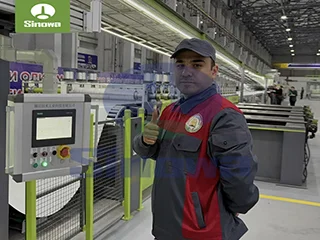
sandwich panel line
The overall structural design of the polyurethane sandwich panel production line follows modular integration logic, with each functional unit operating in synchronous coordination to form a closed-loop and uninterrupted production workflow. The entire system is composed of multiple core functional modules, including surface material unwinding and pretreatment unit, roller forming unit, high-precision raw material metering and mixing unit, foam pouring and composite pressing unit, constant temperature curing and cooling unit, fixed-length cutting and trimming unit, as well as finished product conveying and stacking unit. All modules are connected through synchronous transmission systems, ensuring that the operating speed, process parameters and material feeding rhythm of each link maintain precise matching, which lays a solid foundation for standardized and large-scale production of polyurethane composite panels.
The initial stage of production focuses on the pretreatment of surface facer materials, which is a key link determining the flatness, appearance quality and bonding performance of finished panels. Common surface materials applicable to the polyurethane sandwich panel line include metal sheets, aluminum substrates and various non-metal decorative materials, all of which are supplied in coiled forms to adapt to continuous feeding requirements. The coiled raw materials are fixed on automatic unwinding devices, which adopt tension control systems to release materials stably at a set constant speed. This tension regulation function effectively avoids material stretching, wrinkling and uneven feeding problems caused by unstable traction force, ensuring the flatness of surface materials in the whole production process. After unwinding, the materials pass through multi-group leveling and straightening mechanisms to eliminate tiny deformations and surface irregularities generated during coiling and storage, making the surface substrates smooth and uniform for subsequent forming and composite bonding processes.
Following the leveling treatment, the surface materials enter the roller forming unit for continuous shape calibration and structural molding. This unit is equipped with multiple groups of precision roller sets with orderly arranged geometric profiles. Through gradual rolling and extrusion, the flat surface substrates are processed into specific cross-sectional shapes that meet the design requirements of composite panels, including edge folding, groove pressing and shaping of installation structures. The graded rolling process avoids sudden stress deformation of materials, ensuring the dimensional accuracy of panel edges and structural parts. Meanwhile, the PU sandwich panel production line is equipped with preheating devices in the front section of the composite process, which heat the formed upper and lower surface materials to a stable temperature range. Appropriate preheating treatment can activate the surface activity of substrates, enhance the interfacial adhesion between surface materials and polyurethane foam core, and effectively prevent the problem of poor bonding and local separation between layers in long-term use.
The raw material metering, mixing and pouring process is the core technological link of the entire PU sandwich panel line, which directly determines the foaming quality, internal structure and thermal insulation performance of polyurethane foam core. Polyurethane foam is formed by the chemical reaction between two main raw materials, polyols and isocyanates, with auxiliary additives participating in the reaction to adjust foaming speed, pore structure and curing performance. The composite sandwich panel line adopts a fully automatic high-pressure metering and mixing system, which can accurately control the proportion of various raw materials within a stable range through precision metering pumps. The raw materials are transported to the high-speed mixing head through closed pipelines, and complete instantaneous uniform mixing under high-pressure impact and strong turbulence. This high-precision mixing mode ensures the uniformity of raw material components, avoids local uneven reaction caused by inconsistent proportioning, and lays a foundation for forming fine and uniform foam pore structure.
After full mixing, the polyurethane composite liquid materials are evenly poured and sprayed on the surface of the lower preformed substrate through the adjustable pouring mechanism. The pouring width, thickness and material distribution density can be dynamically adjusted according to the production specifications of different panels, realizing full and coverage-type feeding without dead angles. Immediately after pouring, the upper surface substrate is accurately aligned and covered with the lower substrate through the synchronous positioning device, forming a closed cavity structure for polyurethane foaming. The double-layer composite materials then enter the double-belt pressing unit, which is responsible for providing stable and continuous pressure environment for foam foaming and composite bonding. The double-belt structure runs synchronously with the production speed, maintaining uniform pressure on the upper and lower surfaces of the composite board, so that the polyurethane liquid can fully flow and fill the entire cavity between the two layers of substrates during the foaming expansion process.
The foaming and curing reaction of polyurethane materials is a complex process combining physical expansion and chemical cross-linking. In the constant temperature pressing cavity of the PU sandwich panel machine, the mixed raw materials undergo rapid chemical reaction, accompanied by gas generation and volume expansion, forming a dense and uniform closed-cell foam structure. With the progress of the reaction, polymer chains continue to cross-link and solidify, gradually forming a rigid foam core with stable mechanical properties. The production line is equipped with a precise constant temperature control system in the curing section, which maintains a stable reaction temperature environment. Reasonable temperature control can effectively adjust the reaction speed of polyurethane materials, avoid insufficient curing caused by low temperature or foam scorching and pore coarsening caused by overheating, and ensure that the foam core has consistent density, uniform pore structure and excellent overall compactness.
After completing the high-temperature curing and preliminary shaping, the composite panels enter the natural cooling and shaping stage. The continuous transmission structure of the polyurethane sandwich panel machine extends the cooling stroke sufficiently, allowing the internal stress of the panels to be released gradually and the foam structure to be completely stabilized. Slow and uniform cooling can prevent structural deformation, warping and cracking of panels caused by rapid temperature change, further improving the dimensional stability and structural firmness of finished products. After full cooling and shaping, the continuous long-strip composite panels are sent to the fixed-length cutting unit for precision processing. The cutting system adopts automatic numerical control positioning, which can set different cutting lengths according to production requirements. The high-speed cutting equipment realizes flat and smooth cutting sections without burrs and cracks, ensuring the dimensional accuracy of single finished panel.
In addition to fixed-length cutting, the trimming and finishing unit of the composite sandwich panel production line completes edge trimming, corner finishing and surface flaw inspection of the panels. This process removes redundant edge materials generated in the composite and forming process, standardizes the overall outline size of the panels, and ensures the consistency of the appearance and structure of each batch of products. The finished panels after finishing are transported to the automatic stacking unit through the conveying system. The stacking device can realize orderly arrangement and layered stacking of finished products according to the set specifications, with stable stacking posture and neat arrangement, which is convenient for subsequent centralized handling and storage. The whole process from feeding, forming, composite foaming, curing and cutting to stacking is completed automatically, with minimal manual intervention, effectively reducing the impact of human operation errors on product quality.
The operational advantages of polyurethane composite board production line are mainly reflected in continuous production stability and product performance consistency. The synchronous linkage design of all functional units realizes seamless connection of each production link, avoiding production interruption and parameter fluctuation caused by manual docking. The precise metering system of raw materials ensures the stability of foam core formula ratio in the whole production process, making the thermal insulation performance, compressive strength and bonding strength of each panel maintain a high consistent level. The closed-loop constant temperature curing environment optimizes the foaming reaction condition of polyurethane materials, making the internal closed-cell rate of foam core reach an ideal state, thus endowing the composite panels with excellent thermal insulation, sound insulation and pressure resistance.
In terms of production adaptability, the modular structural design of the sandwich panel production line enables it to meet the production requirements of composite panels with different thicknesses, widths and surface materials. By adjusting the operating parameters of the pressing system, metering system and cutting system, the equipment can quickly switch production specifications, realizing flexible production of diversified products. This flexible production characteristic makes the production line applicable to multiple application scenarios, including building exterior wall insulation, roof enclosure, industrial plant partition, cold storage thermal insulation and indoor decorative enclosure. The produced polyurethane composite panels have the advantages of light weight, high strength, good thermal insulation effect and convenient installation, which are widely recognized in the field of energy-saving building materials.
The daily operation and maintenance of polyurethane composite panel manufacturing line focuses on parameter stability control and regular equipment maintenance. In the production process, operators only need to set the basic process parameters according to product specifications, and the system can realize automatic stable operation. The real-time monitoring system can track the operating speed, raw material proportioning, curing temperature and pressing pressure of each link in real time, and feed back abnormal data timely to ensure that the production process is always in a standard state. Daily maintenance work includes cleaning the conveying and pressing mechanism, checking the tightness of raw material conveying pipelines, calibrating the precision of metering equipment, and lubricating the transmission parts. Regular maintenance can effectively prolong the service life of the equipment, maintain the precision and stability of long-term operation, and reduce the failure rate in the production process.
With the continuous upgrading of energy-saving and environmental protection requirements in the building industry, polyurethane sandwich panel machinery is also constantly optimized and upgraded in technological level. Modern production lines pay more attention to energy conservation and consumption reduction in the production process, optimizing the heating and pressing system structure to reduce energy loss while ensuring curing effect. At the same time, the closed raw material conveying and mixing system avoids the volatilization and waste of chemical materials in the production process, realizing cleaner production. The continuous technological optimization makes the production line not only improve production efficiency and product quality, but also meet the development requirements of green manufacturing, and provide reliable equipment support for the large-scale and high-quality development of energy-saving composite panel industry.
In summary, the polyurethane composite panel production line, as a highly integrated and automated professional manufacturing equipment, relies on scientific and reasonable process layout and precise mechanical control technology to realize efficient and standardized production of polyurethane composite panels. The perfect coordination of each functional module ensures the stability of the production process and the consistency of product performance, and its flexible production capacity and reliable operation performance make it the core equipment in the field of energy-saving building composite materials. With the continuous development of the construction industry's energy-saving and lightweight development trend, this sandwich panel production equipment will continue to play an important role, providing continuous and high-quality product supply for various engineering and industrial application scenarios, and promoting the iterative upgrading and innovative development of the entire composite panel manufacturing industry.
https://www.cnsinowa.com/sandwich-panel-machines/polyurethane-composite-panel-production-line.html