sandwich panel line
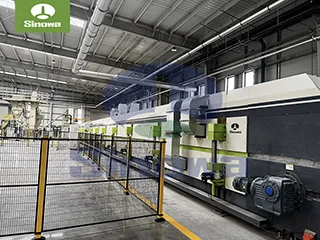
The overall structural layout of a complete PU insulated sandwich panel line follows a sequential production logic, arranging functional units in accordance with the material processing sequence to ensure the uninterrupted flow of raw materials from initial feeding to final finished product output. The entire insulated board production line can be divided into several core functional modules, including raw material conveying and pretreatment module, surface substrate processing module, polyurethane foaming and mixing module, continuous laminating and forming module, constant-temperature curing module, fixed-size cutting and trimming module, finished product conveying and stacking module, as well as the central intelligent control module. Each module maintains an independent operating logic while achieving precise collaborative linkage through unified control signals, eliminating redundant material transportation links and minimizing production interval gaps. The spatial layout of the production line fully considers the heat dissipation requirements of foaming reactions and the space occupation of mechanical movements, adopting a linear horizontal arrangement to simplify the material transmission path and reduce the mechanical energy consumption generated by frequent position changes of materials during processing.
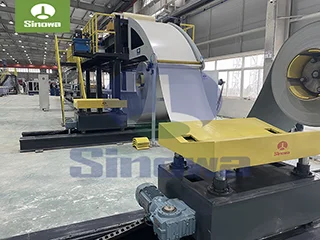
The raw material conveying and pretreatment module serves as the starting link of the entire production process, undertaking the task of screening, transporting and preliminary treatment of all production raw materials. The raw materials involved in PU insulated panel production mainly include polyurethane chemical raw materials and metal or non-metal surface substrates. For polyurethane chemical raw materials, this module is equipped with sealed storage tanks and quantitative conveying pipelines to store polyether polyol, isocyanate and other auxiliary raw materials required for foaming reactions. All storage containers are designed with thermal insulation layers to maintain a stable internal temperature, avoiding the change of raw material viscosity and chemical activity caused by ambient temperature fluctuation. Inside the conveying pipeline, high-precision flow control components are installed to adjust the conveying rate of different raw materials, ensuring that the proportion of various chemical components remains within the optimal reaction range during the subsequent mixing process. For surface substrates such as color steel plates and aluminum alloy plates, the pretreatment unit is equipped with automatic uncoiling equipment and surface flattening components. The uncoiling equipment realizes slow and uniform discharging of coiled substrates, while the multi-group roller flattening structure eliminates subtle bending and surface wrinkles generated during substrate coiling. In addition, a dust removal and oil removal device is arranged in this module to clean the surface of the substrates, removing floating dust, residual grease and other impurities that may affect the bonding tightness between the substrate and the foam core layer. Clean and flat substrates can effectively avoid hollowing and delamination defects inside the finished panels, laying a solid foundation for the stable quality of subsequent products.
The surface substrate processing module is an intermediate link connecting raw material pretreatment and foaming composite molding, focusing on surface modification and structural preprocessing of substrates to enhance the interfacial bonding force between the substrate and polyurethane foam. After completing dust removal and flattening, the substrates will pass through multi-group rolling units with different groove designs. These rolling units can press regular fine lines and shallow grooves on the inner surface of the substrates. The textured structure formed by rolling increases the contact area between the smooth substrate and the liquid polyurethane mixture. When the foaming raw materials are coated on the substrate surface, the liquid mixture can infiltrate into the tiny grooves, forming a physical occlusion structure after curing, which significantly improves the bonding durability between the substrate and the foam core layer. Meanwhile, this module is equipped with adjustable edge trimming components to carry out preliminary cutting on the two sides of the substrates, ensuring that the width of each substrate remains consistent and avoiding the problem of uneven panel edges in the subsequent composite molding process. The running speed of the substrate processing unit is synchronized with the operating frequency of the subsequent foaming unit through the central control system, so that the substrate conveying speed can match the foaming material coating rate, preventing material accumulation or supply interruption caused by inconsistent operating rhythms of different units.
The polyurethane foaming and mixing module is the core functional unit of the automatic sandwich panel production line, determining the foaming density, pore structure and thermal insulation performance of the panel core layer. This module is composed of a high-pressure mixing system, a material dispersion and coating system and an auxiliary temperature control system. The high-pressure mixing system adopts a collision mixing structure. Different polyurethane raw materials are transported to the mixing cavity through independent pipelines at a stable flow rate, and intense collision and stirring are completed in the tiny closed cavity in an instant. This rapid mixing method can make various chemical raw materials fully fused without dead angles, ensuring the uniformity of the mixed liquid material. Compared with traditional mechanical stirring and mixing, high-pressure collision mixing avoids the introduction of air bubbles caused by mechanical rotation, effectively reducing the number of large voids inside the foam core layer. The mixed liquid polyurethane material is evenly sprayed on the surface of the lower substrate through a movable coating head. The coating head is equipped with a fan-shaped discharge port, which can spread the liquid material in a uniform strip shape. The movement track and discharge volume of the coating head can be adjusted according to the preset panel thickness parameters. In order to maintain the stability of the foaming reaction, the external part of the mixing cavity and the coating pipeline is wrapped with constant-temperature heating components. The chemical reaction of polyurethane foaming is extremely sensitive to temperature, and a stable temperature environment can ensure that the foaming reaction rate is moderate, prevent excessive foaming and material expansion caused by high temperature, and avoid insufficient foaming and dense core layer structure caused by low temperature.
The continuous laminating and forming module is responsible for completing the composite assembly and thickness shaping of upper and lower substrates and foaming core materials, which is a key link to determine the external dimensional accuracy of insulated panels. This module mainly consists of an upper and lower crawler conveyor structure and an adjustable spacing pressing system. After the liquid polyurethane material is coated on the lower substrate, the upper substrate is automatically covered under the guidance of the conveying crawler, forming a three-layer composite structure of upper substrate, foaming material and lower substrate. The composite semi-finished panels enter the closed space between the upper and lower crawlers, and the vertical spacing between the two groups of crawlers is precisely adjusted according to the production parameters. The fixed spacing limits the expansion range of the foaming material, so that the foaming core layer can form a compact and uniform thickness structure under constant pressure. The crawler surface is made of high-temperature resistant and wear-resistant rubber materials with smooth surface treatment, which can reduce the friction resistance between the mechanical structure and the panel surface while maintaining uniform pressure on the panel, avoiding surface scratches and indentations on the substrates. The crawler conveying speed is matched with the foaming reaction cycle. The slow and stable conveying mode ensures that the foaming material can complete the primary expansion and bonding reaction in the limited forming space, realizing the preliminary integration of the three-layer structure.
The constant-temperature curing module undertakes the task of deep curing and structural stabilization of composite panels. After leaving the crawler forming unit, the semi-finished panels have completed preliminary bonding molding, but the internal polyurethane foaming reaction has not been completely terminated, and the molecular cross-linking structure is still in an unstable state. The curing module is designed as a fully enclosed thermal insulation curing channel with multi-stage temperature zoning control. The internal temperature of the channel is divided into low-temperature pre-curing area, medium-temperature stable reaction area and natural cooling shaping area. In the low-temperature pre-curing area, the residual heat generated by the foaming reaction is retained to promote the continuous cross-linking of polyurethane molecules and enhance the internal compactness of the foam core layer. In the medium-temperature stable reaction area, a constant temperature environment is maintained to eliminate the internal stress generated during the foaming and pressing process, preventing the finished panels from warping and deformation due to uneven stress distribution. In the natural cooling shaping area, the ambient temperature is gradually reduced to room temperature, so that the molecular structure of the foam core layer tends to be stable, and the bonding strength between the core layer and the substrates reaches the standard requirement. The interior of the curing channel is equipped with circulating air circulation components to make the internal temperature distribution uniform, avoiding local overheating or excessive cooling that leads to inconsistent curing degree of different parts of the panels. The length of the curing channel is matched with the production speed, ensuring that each panel can obtain sufficient curing time without causing material backlog.
The fixed-size cutting and trimming module realizes the standardized sizing and edge finishing of cured semi-finished panels. After curing, the continuous long-strip composite panels have stable structural performance and can withstand mechanical cutting without deformation. This module is equipped with high-speed rotating cutting tools and intelligent positioning and sensing components. The system sets the fixed length parameters of finished products in advance, and the sensing components monitor the conveying distance of panels in real time. When the panels reach the preset cutting position, the conveying structure automatically decelerates and positions, and the cutting tools complete vertical cross-cutting at a constant speed to separate the long-strip panels into independent single panels. In order to meet the flatness requirement of panel edges, double-side trimming devices are arranged on both sides of the cutting unit. The trimming tools can cut off the excess residual materials on the two sides of the panels, eliminating the uneven edge structure formed in the early coating and composite process. All cutting and trimming tools are made of high-hardness alloy materials, with wear resistance and high cutting smoothness, which can ensure that the cutting section of the panels is flat without burrs and cracks. The cutting and trimming process is carried out in a fully enclosed protective cover to avoid the splashing of tiny debris generated during cutting, which not only keeps the production environment clean but also reduces the potential safety hazards of mechanical operation.
The finished product conveying and stacking module is the terminal link of the continuous sandwich panel line, responsible for the transportation, temporary storage and automatic stacking of qualified finished panels. The cut single panels are transported to the sorting platform through the low-speed conveying roller table. The surface of the roller table is wrapped with flexible anti-collision materials to prevent hard contact and scratch damage between panels and mechanical components. The sorting platform is equipped with simple manual observation stations, allowing operators to visually inspect the surface flatness, edge integrity and color uniformity of the panels, and screen out individual defective products with obvious appearance defects. The qualified finished panels are automatically picked up by the mechanical stacking arm, and the stacking height and arrangement interval are controlled by the program. The mechanical stacking arm adopts a flexible clamping structure, which can adjust the clamping force according to the thickness and hardness of the panels to avoid indentation and deformation on the panel surface caused by excessive clamping force. The stacked finished products are neatly arranged in the designated storage area, which is convenient for subsequent centralized packaging and outbound transportation. Meanwhile, this module is equipped with a waste recycling channel to collect the leftover materials generated by cutting and trimming. These waste materials are uniformly transported to the crushing and recycling equipment for subsequent reprocessing, realizing the resource recycling of production materials.
The central intelligent control module runs through all functional units of the sandwich panel manufacturing line and is the core command center to coordinate the synchronous operation of all equipment. This module consists of an industrial control display screen, a programmable logic controller, a real-time data sensing system and an emergency protection mechanism. The industrial control display screen concentrates all adjustable production parameters, including raw material proportioning ratio, material conveying speed, crawler pressing spacing, curing channel temperature and cutting sizing length. Operators can complete parameter setting and mode switching through simple touch operations. The programmable logic controller converts the set parameters into electrical signals and transmits them to each functional unit to realize automatic adjustment of mechanical actions. The real-time data sensing system is equipped with temperature sensors, pressure sensors, flow sensors and speed sensors at key positions of the production line. These sensors continuously collect operating data such as raw material flow, reaction temperature, pressing pressure and conveying speed, and feed the data back to the control terminal in real time. When the operating data deviates from the preset standard range, the system will automatically trigger the fine-tuning program to correct the operating state of the equipment, ensuring the consistency of the production process. In addition, the emergency protection mechanism has functions such as overload power failure, material blockage alarm and high-temperature overheating protection. Once abnormal operating conditions occur, the system will quickly cut off the power supply of the faulty unit and send an alarm signal to avoid equipment damage and production safety accidents caused by faults.
Compared with intermittent manual production equipment, PU sandwich panel production line has obvious comprehensive technical advantages in production efficiency, product stability and production cost control. In terms of production efficiency, the continuous streamlined processing mode eliminates the intermediate handling and waiting links of semi-finished products. All functional units operate in a synchronous linkage state, and the uninterrupted production mode greatly improves the daily output of panels. The automated mechanical operation reduces the dependence on manual labor. A complete production line only needs a small number of operators to complete parameter monitoring and simple sorting work, which effectively reduces the labor cost in the production process. In terms of product quality stability, the intelligent quantitative control system accurately controls the proportion of chemical raw materials and the coating amount of foaming materials, avoiding the quality fluctuation caused by manual proportioning errors. The constant-pressure forming and multi-stage curing mode ensures that the internal pore structure of each batch of panels is uniform, the bonding strength between layers is consistent, and the external dimensional error is controlled within a tiny range. In terms of production flexibility, the production line can adjust processing parameters according to different production requirements, realizing the switching production of panels with different thicknesses, widths and surface materials. The simple parameter adjustment mode enables the production line to quickly respond to the diversified order demands of the market.
In the actual industrial production process, the standardized production control logic is adopted in PU sandwich panel line to minimize the impact of external environmental factors and human operation factors on product quality. First of all, in terms of raw material management, all chemical raw materials are stored in sealed constant-temperature tanks, and the raw material transportation pipeline is cleaned regularly to prevent residual raw materials from reacting and deteriorating in the pipeline and affecting the performance of mixed materials. Secondly, in terms of equipment operation maintenance, the system automatically records the operating time and working state of each mechanical unit, and regularly prompts operators to carry out lubrication, dust removal and component inspection on vulnerable parts such as transmission bearings and cutting tools. Regular maintenance can reduce equipment failure rate and extend the service life of the production line. In addition, the production line is equipped with a data storage function, which automatically stores the production parameter data of each batch of products. The stored data can be used for production quality traceability and subsequent process optimization, providing data support for the long-term stable operation of the production line. For the external production environment, the production workshop is equipped with ventilation and dehumidification equipment to maintain appropriate ambient humidity and temperature, preventing the polyurethane foaming reaction from being affected by excessive humidity and low temperature in the air.
PU insulated panel line has wide industrial adaptability and can meet the production demands of insulated panels for multiple application fields. In the building construction industry, the panels produced by such production lines are often used for the outer wall thermal insulation and roof waterproof thermal insulation of industrial plants, public buildings and civil residences. The integrated structure of metal substrate and polyurethane foam has both thermal insulation function and weather resistance, which can reduce the energy consumption of building temperature regulation and improve the service life of building enclosure structures. In the cold chain logistics industry, high-density PU insulated panels produced by optimized production parameters are applied to the manufacturing of cold storage walls, heat preservation carriages and fresh-keeping storage boxes. The fine and closed internal pore structure of the foam core layer gives the panels low thermal conductivity, which can effectively isolate internal and external heat exchange and maintain a stable low-temperature storage environment. In the industrial purification field, the smooth and flat surface of the panels is not easy to accumulate dust, and the compact internal structure can resist the erosion of common chemical reagents, which is suitable for the construction of purification workshops in pharmaceutical, food and electronic processing industries. In addition, through replacing different surface substrates and adjusting foaming density parameters, the production line can also produce special insulated panels for outdoor temporary buildings, agricultural breeding greenhouses and other scenarios, realizing the diversified expansion of product application scope.
With the continuous progress of industrial manufacturing technology, polyurethane sandwich panel production line is constantly optimized and upgraded in terms of energy conservation, environmental protection, intelligence and processing precision. In terms of energy saving optimization, the production line adopts waste heat recovery technology to collect the residual heat generated by the foaming reaction and curing heating, and reuse the recovered heat for the preheating treatment of raw material storage tanks, reducing the energy consumption of external heating equipment. The optimized crawler transmission structure reduces mechanical friction resistance, and the frequency conversion motor automatically adjusts the operating power according to the production load, realizing the efficient utilization of electric energy. In terms of environmental protection improvement, the production line is equipped with sealed waste gas collection pipelines to collect the trace volatile gas generated in the foaming reaction process. The collected waste gas is treated by purification equipment before being discharged, which reduces the impact of production waste gas on the surrounding environment. The recycled leftover materials are crushed and reprocessed to realize the cyclic utilization of raw materials and reduce the generation of production waste. In terms of intelligent upgrading, the production line introduces remote monitoring and fault diagnosis technology. Managers can view the real-time operating state of the production line through remote terminals, and the system can automatically analyze potential fault risks of mechanical components according to historical operating data, realizing predictive maintenance of equipment. In terms of precision improvement, the high-precision sensor components are upgraded to further narrow the error range of raw material proportioning and pressing pressure, making the internal structure of finished panels more compact and uniform.
In the future development of the building thermal insulation material industry, polyurethane sandwich panel line will develop towards higher automation integration, stronger personalized customization capability and lower comprehensive energy consumption. With the continuous improvement of market requirements for the fire resistance, sound insulation and compression resistance of insulated panels, the production line will be matched with more diversified raw material mixing processes to produce composite panels with multi-functional characteristics. The intelligent control system will realize the automatic matching of raw material formulas according to the product performance requirements, reducing the manual intervention links in the production process. At the same time, combined with the digital twin technology, the virtual simulation operation of the production line will be realized. Before the formal production of new products, the processing effect of different parameters can be simulated in the virtual system, shortening the product debugging cycle and reducing the material loss in the debugging process. In addition, under the background of the global green manufacturing concept, the production line will continuously optimize the environmental protection process, adopt more environmentally friendly foaming auxiliary materials, and further reduce the emission of harmful substances in the production process, so as to meet the higher environmental protection standards of the manufacturing industry.
In conclusion, PU insulated panel production lines are efficient and systematic production equipment integrating mechanical transmission, chemical reaction control and intelligent management technology. Each functional module of the production line has a clear division of labor and close cooperation, realizing the standardized and large-scale production of polyurethane insulated panels. From raw material pretreatment to finished product stacking, every production link is controlled by precise parameters, which ensures the excellent and stable comprehensive performance of finished panels. Relying on their high production efficiency, low operating cost and wide application adaptability, such production lines have become important supporting equipment in the thermal insulation material manufacturing industry. With the continuous innovation of industrial technology, the technical performance of PU insulated sandwich panel production line will be further optimized, providing more high-quality and diversified insulated panel products for construction, cold chain, purification and other industries, and making important contributions to the high-quality development of the modern building material manufacturing industry.
https://www.cnsinowa.com/sandwich-panel-machines/pu-insulated-panel-line.html