sandwich panel line
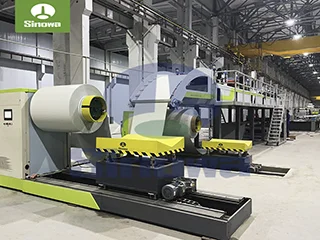
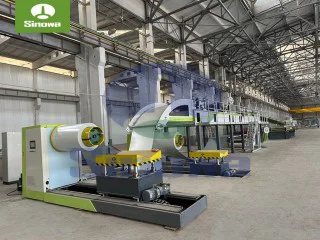
The entire production system consists of multiple interconnected functional units, each undertaking independent and collaborative processing tasks to form a closed-loop continuous production workflow. The front-end part of the PIR sandwich panel production line focuses on the pretreatment and forming of surface facing materials, which are usually high-quality metal sheets with smooth and uniform surface texture. The raw facing materials are transported to the production line through automatic unwinding equipment, which realizes steady and tension-controlled material release to avoid sheet deformation, wrinkling, or offset transmission during operation. This tension balancing design is essential for the subsequent composite molding process, as uniform flatness of the upper and lower facing materials directly determines the overall flatness and structural uniformity of the finished partition panels. After unwinding, the facing materials enter the preheating and surface treatment unit, where circulating hot air is used for uniform heating to remove surface moisture and activate the material surface. Meanwhile, micro dust and oil stains attached to the surface are eliminated through physical cleaning measures, effectively enhancing the bonding adhesion between the facing materials and the PIR foam core layer and preventing delamination or cracking of the composite structure in long-term use.
Following the surface pretreatment of facing materials is the core chemical foaming and pouring process, which is the most critical link that distinguishes PIR insulated sandwich panel production line from ordinary panel production equipment. The PIR foam core is formed by the chemical reaction of two main liquid raw materials supplemented by various functional additives. The production line is equipped with a precise raw material storage and conveying system, which independently stores different raw materials in sealed constant-temperature tanks to maintain the stability of raw material activity and chemical properties. All raw materials are transported to the high-pressure mixing device through quantitative conveying pipelines, and the system realizes accurate proportional metering of each component through automatic flow regulation. The high-pressure mixing unit adopts high-speed turbulent mixing technology to fully blend isocyanates, polyols, catalysts, blowing agents, and functional additives in an instant, ensuring uniform distribution of all components without local concentration difference. Sufficient and uniform mixing is the core premise for forming fine and closed-cell foam structures, which directly affects the thermal insulation performance, compressive strength, and dimensional stability of the panel core layer.
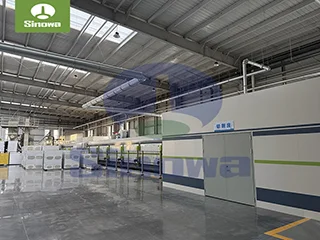
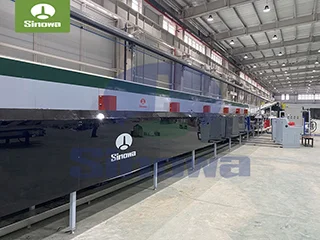
After full mixing, the homogeneous liquid foam material is evenly poured between the upper and lower preheated facing materials through a precision pouring head. The pouring speed, pouring range, and material output density are dynamically adjusted according to the set panel thickness and width parameters to ensure full coverage of the gap between the two layers of facing materials without material accumulation or missing pouring. With the continuous advancement of the conveyor device, the poured foam material begins to undergo foaming and expansion reactions under specific temperature conditions. The unique chemical reaction characteristics of PIR materials require strict control of the reaction temperature and curing speed in this stage. The PIR sandwich panel line is equipped with a fully enclosed constant-temperature curing channel, which creates a stable thermal environment through circulating heating and constant-temperature heat preservation measures to ensure that the foam expands stably and fills the entire composite space. During the foaming expansion process, the liquid material gradually transforms into a rigid closed-cell foam structure, and forms a firm integrated bonding state with the inner surface of the facing materials, realizing the composite molding of the metal surface layer and the PIR insulation core layer.
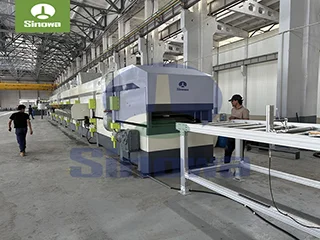
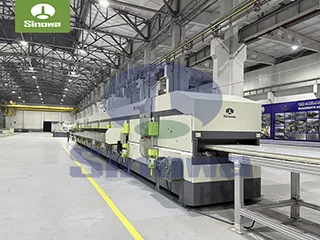
The composite semi-finished panels after primary foaming and bonding enter the double-belt continuous pressing and curing system for deep shaping and solidification. The double-belt pressing device adopts synchronous transmission up and down, applying uniform and stable pressure on the composite panel in the horizontal and vertical directions. This continuous pressure control can effectively limit the excessive expansion of foam, standardize the overall thickness of the panel, and eliminate internal gaps and structural defects inside the core layer. At the same time, with the cooperation of constant-temperature curing equipment, the PIR foam completes the final molecular cross-linking reaction in the pressing state, further improving the compactness, structural rigidity, and anti-deformation ability of the core material. The collaborative operation of pressing and curing processes ensures that the internal structure of the panel is uniform and stable, avoiding quality problems such as uneven thickness, hollow core, and inconsistent hardness that are prone to occur in intermittent production processes. The running speed of the double-belt system is intelligently matched with the front-end foaming and pouring speed to ensure the continuity and coordination of the entire production process and improve overall production efficiency.
After completing curing and shaping, the panels enter the gradual cooling and shaping stage. High-temperature cured panels cannot be directly cut and processed, as rapid temperature change will cause internal thermal stress, leading to panel deformation, warping, or structural cracking. The PIR sandwich panel machine is equipped with a segmented circulating cooling system, which adopts gradual temperature reduction treatment to slowly release the internal temperature of the panel and stabilize the internal molecular structure and overall dimensional accuracy. The cooling section is designed with a sufficient conveying stroke to ensure that panels of different thickness specifications can achieve comprehensive and uniform cooling. After cooling, the overall performance and shape of the panels tend to be stable, with reliable flatness and structural strength, meeting the basic conditions for fixed-length cutting and finished product processing.
The fixed-length cutting and edge trimming process is an important link to realize the standardized molding of finished panels. The PIR sandwich panel making machine is equipped with high-precision flying saw cutting equipment, which adopts servo synchronous control technology to complete fixed-length cutting in the moving state of panels. The system can preset multiple production specifications through the intelligent control terminal, realizing automatic switching of cutting lengths and ensuring high consistency of the dimensional accuracy of each batch of panels. The cutting tool maintains high flatness and sharpness during operation, which can realize smooth and burr-free cutting sections, avoiding edge collapse or deformation of the PIR core layer. In addition to fixed-length cutting, the edge trimming device on the production line can perform precise trimming on both sides of the panel to correct the tiny dimensional deviation generated in the continuous molding process, ensuring that the width of the finished panel is completely unified and the edges and corners are neat and regular. The whole cutting and trimming process is automated without manual intervention, which not only improves production efficiency but also effectively guarantees the dimensional standardization of finished products.
The final stage of the PIR insulation board production line is automatic conveying, turnover and stacking of finished panels. The cut and trimmed qualified panels are transported to the stacking area through the conveying platform, and the automatic turnover device adjusts the panel placement state to ensure uniform stacking direction. The intelligent stacking equipment realizes layered and orderly stacking according to the set stacking height and quantity, with stable stacking posture and neat arrangement, which is convenient for subsequent transportation and storage. The whole stacking process is highly automated, reducing manual handling errors and labor costs, and avoiding surface scratches or panel damage caused by manual operation. Meanwhile, the supporting sorting device can screen out unqualified products with obvious defects in appearance and size during the conveying process, realizing preliminary quality classification of finished products.
The core advantage of the PIR insulation panel production line lies in its professional adaptation to partition panel performance requirements. Different from ordinary thermal insulation panels that only focus on thermal insulation effects, partition panels need to take into account thermal insulation, structural stability, impact resistance, and space separation functionality. The production line optimizes the foam reaction formula control and pressing curing process parameters according to the use characteristics of partition products, making the PIR core layer have higher compactness and compressive strength. The closed-cell rate of the foam core layer produced by this continuous process is extremely high, which can effectively block heat conduction and air convection, providing excellent long-term thermal insulation performance. At the same time, the integrated composite structure formed by continuous pressing and bonding makes the metal surface layer and the foam core layer not easy to peel off, ensuring that the partition panel can maintain stable structural performance during long-term service, frequent disassembly and assembly, and external force impact.
In terms of production control, the PIR sandwich panel production line adopts centralized intelligent control mode, with all process links interconnected and synchronously controlled. The system can monitor key parameters in real time, including raw material mixing ratio, reaction temperature, pressing pressure, production speed, and cutting size. Once parameter deviation occurs, the system will automatically perform fine adjustment and correction to keep the production process in a stable state. This intelligent control method greatly reduces the impact of human operation factors on product quality and realizes standardized and standardized large-scale production. The continuous production mode breaks through the limitations of traditional intermittent production, realizes uninterrupted operation, and significantly improves production capacity while ensuring stable product quality of each batch.
In practical production applications, the PIR insulated partition panel manufacturing line has strong specification adaptability. By adjusting the operation parameters of foaming pouring, pressing thickness, and cutting length, it can produce partition panels of different thicknesses, widths, and lengths, meeting the partition and insulation needs of different application scenarios. The panels produced by the line have lightweight characteristics while maintaining high structural strength, which reduces the overall load of building structures and facilitates flexible installation and layout of indoor space. In addition, the fine closed-cell structure of PIR foam endows the panels with good moisture resistance and air tightness, which can effectively block moisture penetration, avoid mildew and corrosion inside the partition wall, and prolong the service life of the product.
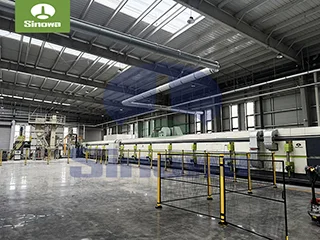
The overall structural design of the sandwich panel line focuses on operational stability and maintenance convenience. Each functional unit is arranged in a modular manner, with clear functional division and smooth material transmission, which is convenient for daily equipment inspection, maintenance, and fault troubleshooting. The transmission parts are equipped with stable damping and deviation correction devices to avoid material deviation and equipment vibration during long-term operation, ensuring the long-term stable operation of the equipment. The closed design of the foaming and curing unit reduces the impact of external environmental changes on the production reaction, ensures that the production quality is not affected by temperature and humidity fluctuations in the production environment, and improves the environmental adaptability of the production line.
With the continuous upgrading of building energy-saving and space partition requirements, the PIR insulated partition panel production line has become key core equipment in the field of modern prefabricated building supporting materials. Its automated, continuous, and standardized production mode not only improves the production efficiency of insulated partition panels but also fundamentally optimizes the comprehensive performance of products. The panels produced by the line integrate thermal insulation, energy saving, sound insulation, structural protection, and flexible partition functions, providing high-quality material support for the construction of efficient, energy-saving, and modular modern buildings. While meeting the diverse needs of the construction market, the advanced production technology and stable operation performance of the sandwich panel machinery also lay a solid foundation for the large-scale and high-quality development of the insulated partition panel industry.
https://www.cnsinowa.com/sandwich-panel-machines/pir-insulated-partition-panel-production-line.html