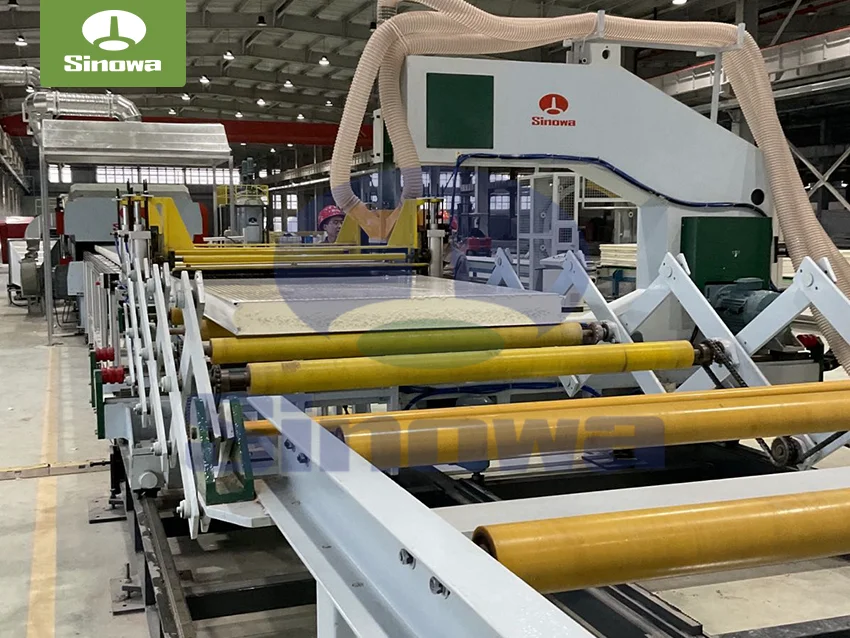
 sandwich panel machine
Polyurethane composite sandwich panel machinery is essentially a customized integrated production line tailored for the physical foaming and chemical composite reaction characteristics of polyurethane materials. Unlike ordinary single metal forming equipment or independent foam spraying equipment, this set of machinery realizes the organic integration of mechanical transmission, polymer chemical reaction control, constant temperature and pressure closed-loop adjustment, and automated logic control. The core design logic of the whole equipment is to solve three key pain points in panel production: uniform foaming density of polyurethane core layer, firm bonding strength between foam core and surface plates, and consistent overall dimensional accuracy of finished panels. Any deviation in temperature, material flow rate, laminating pressure or running speed during the production process will lead to defective products such as uneven internal pores of the foam layer, delamination between core material and surface plates, warpage and deformation of finished panels, and inconsistent panel thickness. Therefore, every functional module of polyurethane composite sandwich panel machine is designed with precise linkage parameters to match the irreversible foaming and curing reaction process of polyurethane two-component raw materials, ensuring that each production link maintains synchronous operation and parameter matching.
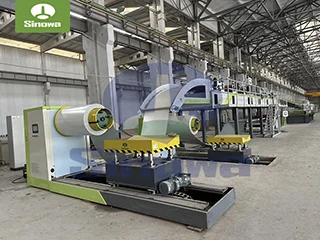
A complete set of polyurethane composite sandwich panel production machinery consists of multiple interconnected functional modules, each undertaking independent production tasks while maintaining synchronous linkage with the whole line. The front-end raw material feeding module is the starting part of the whole sandwich panel production line, mainly responsible for continuous unwinding and preliminary leveling of coiled surface materials. Common surface materials include color-coated steel sheets, galvanized steel sheets, aluminum alloy sheets and fiberglass-reinforced plastic plates, all of which are supplied in coiled forms to adapt to continuous automated production. This module eliminates internal stress generated during coil storage through multi-group leveling rollers, avoiding residual deformation of surface plates in subsequent forming and composite processes. Connected to the feeding module is the roll forming module, which shapes flat metal or non-metal sheets into customized profile structures according to the application scenarios of finished panels. For roof sandwich panels, the roll forming module will process raised wave structures on the surface plates to enhance rainwater drainage capacity and overall bending resistance; for wall panels and clean room panels, the module will produce flat or hidden button splicing structures to improve the tightness and aesthetics of panel assembly during on-site installation. The precision of roller sets in this module directly determines the splicing accuracy of finished panels in engineering application, so the equipment adopts integrated machined roller structures to avoid dimensional deviation caused by long-term mechanical wear.
The polyurethane high-pressure foaming and mixing module is the most core functional unit of the entire machinery, which determines the thermal insulation performance and structural stability of sandwich panel products. Polyurethane foam is formed by the cross-linking chemical reaction between isocyanate and polyether polyol, and the mixing ratio, mixing speed, injection flow rate and material temperature of the two raw materials are the key parameters affecting foam quality. This module adopts high-pressure impact mixing technology to realize instantaneous full mixing of two liquid raw materials without adding extra auxiliary solvents, which can avoid residual chemical substances inside the foam core layer and improve the environmental protection level of finished panels. Different from low-pressure foaming equipment, the high-pressure mixing structure can ensure uniform micro-pore distribution inside the foam after foaming, effectively reducing the thermal conductivity of the core layer and maintaining long-term stable thermal insulation effect. Meanwhile, the foaming module is equipped with independent material temperature preheating units, which keep liquid polyurethane raw materials within a constant temperature range before injection. Stable raw material temperature can avoid insufficient reaction or excessive rapid foaming caused by temperature difference, so as to ensure that the foam expands stably and fills the gap between upper and lower surface plates completely without hollow gaps or local dense foam areas.
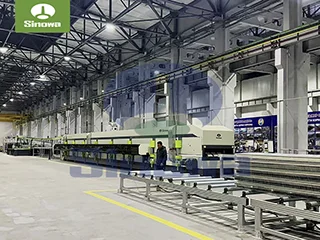
Following the foaming injection process is the continuous laminating and constant-temperature curing module, which undertakes the key composite bonding work of surface plates and foam core materials. After the mixed liquid polyurethane raw material is evenly sprayed on the lower formed surface plate, the upper formed surface plate is synchronously covered through the upper conveying mechanism, and the integrated plate body enters the closed laminating pressing section. The laminating module adopts segmented temperature control and pressure control design, matching the different reaction stages of polyurethane foaming. In the initial foaming stage, moderate pressure is applied to limit excessive free expansion of foam and ensure unified panel thickness; in the middle curing stage, constant temperature heating is maintained to accelerate polymer cross-linking reaction and enhance the bonding force between foam and surface plates; in the late shaping stage, slow cooling is carried out to release internal stress generated by foaming and pressing, preventing finished panels from warping after leaving the sandwich panel line. The running speed of the laminating conveyor chain keeps fully synchronous with the front feeding and foaming modules, realizing uninterrupted continuous composite production. The length of the laminating curing section is designed according to the foaming reaction cycle of polyurethane materials, reserving sufficient time for complete curing of the core layer, so that the finished panel can reach qualified structural strength without secondary curing treatment after production.
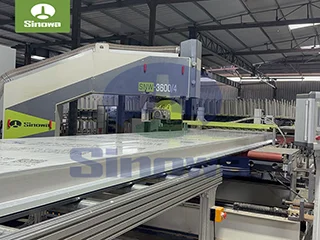
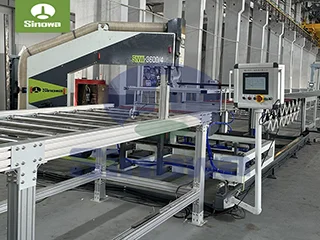
The rear-end processing modules include automatic fixed-length cutting, forced cooling, automatic stacking and conveying mechanisms. After complete composite curing, continuous long sandwich panels are cut into standard lengths according to preset parameter instructions by the non-dust automatic cutting unit. The cutting unit adopts flying cutting technology, which can complete fixed-length cutting without stopping the production line, avoiding production efficiency loss caused by frequent start and stop of mechanical equipment. The cut panels are then sent to the forced cooling channel to further stabilize the internal molecular structure of polyurethane foam and eliminate subtle residual stress inside the panel. Finally, the finished panels are automatically stacked by the stacking manipulator, realizing unmanned collection of finished products and reducing manual contact in the whole production process. According to different production modes, polyurethane composite sandwich panel machinery can be divided into continuous production lines and discontinuous batch production lines, which are applicable to different production scale and product customization demands.
Continuous PU sandwich panel machine is suitable for large-scale mass production of standardized panels with fixed specifications. The whole sandwich panel manufacturing line operates 24 hours uninterruptedly with high overall automation, requiring only a small number of operators to monitor operating parameters and conduct daily equipment inspection. All links from coil feeding to finished product stacking are connected seamlessly, with stable production efficiency and consistent product quality. This type of equipment is widely used in large building materials manufacturers that supply standardized wall and roof panels for industrial plants and logistics warehouses. Discontinuous batch production machinery is more suitable for small and medium-sized manufacturers and customized panel production with diversified specifications. It adopts intermittent feeding and pressing methods, with flexible parameter adjustment functions, which can quickly switch panel thickness, surface plate profiles and foam density according to personalized order demands. Although its single-hour production capacity is lower than that of continuous sandwich panel production line, it has outstanding advantages in flexible production and low early-stage site investment cost, making it more adaptable to scattered customized market orders.
The intelligent control system built into modern polyurethane composite sandwich panel line is the brain coordinating all mechanical actions and chemical reaction parameters. Early traditional equipment relied on manual knob adjustment to control speed, temperature and pressure, which had large parameter errors and required rich operating experience for workers. Current generation equipment adopts centralized integrated control system, which visualizes all operating parameters of the whole polyurethane sandwich panel production line on a human-machine interactive screen. Operators only need to input finished panel specifications including thickness, width, length and foam density, and the system will automatically match the running speed of each module, raw material mixing ratio, laminating pressure and curing temperature. In the actual production process, the system monitors real-time data of each key node through multiple sensors. Once abnormal parameters such as raw material flow deviation, laminating pressure fluctuation and temperature mutation are detected, the equipment will automatically trigger early warning and fine-tune relevant parameters in real time to avoid mass defective products. In addition, the control system supports production data storage and query, recording daily production output, parameter change records and equipment operation failure information, which facilitates subsequent production schedule arrangement and regular equipment maintenance.
Scientific daily operation and regular maintenance are critical to extending the service life of polyurethane composite sandwich panel making machine and maintaining long-term stable production accuracy. For the foaming system, regular cleaning of mixing heads and material conveying pipelines is required to prevent residual polyurethane raw materials from curing inside pipelines and blocking material channels, because cured polyurethane materials have strong adhesion and are difficult to remove after long-term accumulation. For mechanical transmission parts such as conveyor chains and forming rollers, regular lubrication and wear detection should be carried out to avoid vibration and running deviation caused by mechanical friction, which will affect panel dimensional accuracy. For the temperature and pressure sensing components of the control system, regular calibration is needed to ensure the authenticity and accuracy of feedback data, preventing production parameter mismatch caused by sensor drift. Meanwhile, standardized operation specifications should be followed in daily production: the equipment needs to run idle for a certain period before formal production to preheat each module and stabilize operating parameters; raw material feeding should be kept uniform to avoid sudden material shortage or overflow affecting foaming quality; after daily production, residual raw materials inside the foaming system need to be cleaned completely to protect core mixing components.
In terms of practical application value, the technological progress of polyurethane composite sandwich panel manufacturing machine directly promotes the iterative upgrading of downstream building materials industry. Compared with traditional insulation materials such as rock wool and polystyrene foam, polyurethane sandwich panels produced by advanced machinery have lower thermal conductivity, better air tightness and lighter overall weight, which can effectively reduce the energy consumption of building heating and cooling and realize building energy conservation. In cold chain warehouses and refrigerated transportation compartments, high-precision polyurethane sandwich panels produced by optimized machinery can reduce cold air loss and lower long-term operation energy consumption of refrigeration equipment. In addition, optimized mechanical production processes improve the bonding firmness between foam core and surface plates, solving the common industry problem of panel delamination and peeling in long-term use, and greatly improving the service life of composite panels in complex outdoor environments such as high temperature, low temperature and humid weather.
Looking at the future development trend of polyurethane sandwich panel machine, the whole industry will evolve towards higher intelligence, lower energy consumption, greener production and stronger multi-material compatibility. Firstly, intelligent unmanned production will be further popularized: combined with internet of things technology, the PU sandwich panel production line can realize remote parameter monitoring, automatic fault diagnosis and unattended automatic operation, reducing labor dependence and human error in production. Secondly, energy-saving optimization of core modules will become a key research direction: optimizing the heating structure of the curing section and the power matching of transmission motors to reduce overall power consumption of the whole line, and developing low-temperature foaming technology to reduce energy consumption required for raw material preheating. Thirdly, equipment will strengthen compatibility with environmentally friendly raw materials: with the global promotion of fluorine-free foaming agents and bio-based polyurethane raw materials, new generation machinery will be upgraded in foaming mixing structure and parameter adaptation to match green and low-carbon raw material formulas, meeting increasingly strict global environmental protection requirements.
Moreover, future polyurethane composite sandwich panel making machinery will break through the limitation of single composite structure and realize integrated compound production of multi-functional panels. Through modular functional expansion, the equipment can complete one-time composite production of panels with fire-resistant intermediate layers, sound-absorbing structures and anti-corrosion coating layers without changing core production units, further enriching product functions and adapting to higher-demand scenarios such as high-fire-risk industrial workshops, noise reduction workshops and coastal anti-corrosion buildings. Meanwhile, the equipment will adopt more compact overall structural design to reduce occupied plant space, meeting the site layout demands of small and medium-sized production enterprises.
In conclusion, polyurethane composite sandwich panel production machine is a comprehensive interdisciplinary equipment integrating mechanical engineering, polymer material chemistry, automatic control technology and thermal engineering. It is not only a production carrier for manufacturing high-performance polyurethane composite sandwich panels, but also an important technical support for the development of global green buildings, energy-saving insulation industry and cold chain infrastructure. With the continuous progress of automation technology and material science, this type of machinery will keep optimizing production accuracy, production efficiency and environmental-friendly performance, continuously solving existing production pain points such as energy consumption, product consistency and customized production flexibility. As the global demand for energy-saving building materials continues to grow, polyurethane composite sandwich panel plant will occupy a more important position in the advanced building materials manufacturing equipment industry, and continuously promote the high-quality and low-carbon transformation of the entire construction and insulation material manufacturing industry in the future.
https://www.cnsinowa.com/sandwich-panel-machines/polyurethane-composite-sandwich-panel-machinery.html