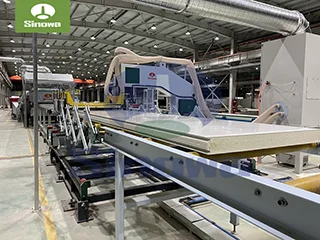
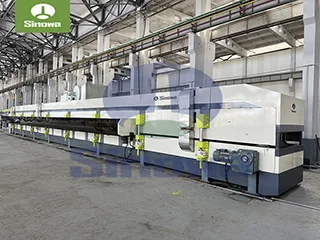
sandwich panel line
The overall operational logic of the polyurethane sandwich panel production line follows a sequential and continuous processing mode, starting from the feeding of base surface materials to the final stacking of finished panels. The entire manufacturing flow can be divided into multiple interconnected processing stages without intermittent manual intervention in the core production links. At the initial stage of production, the surface material feeding system undertakes the task of transporting upper and lower base materials for the sandwich panels. Common surface materials include various metal sheets and non-metal decorative plates, all of which need to maintain flat surface conditions and stable conveying tension during transportation. This feeding system is equipped with automatic tension adjustment components, which can dynamically correct the conveying deviation of coiled materials. By controlling the unwinding speed and stretching degree of the base materials, it effectively avoids wrinkles, distortions, and position offsets of the surface materials in the subsequent compounding process, laying a solid foundation for the flatness and dimensional accuracy of finished panels.
Following the surface material feeding process, the raw material metering and mixing system begins to operate, which is the core functional unit determining the foaming quality of the polyurethane interlayer. Polyurethane foaming relies on the chemical reaction between multiple raw materials, and the proportion of each raw material directly affects the foam density, cellular structure, and bonding strength of the finished interlayer. This system adopts precision metering power components to deliver polyurethane resin, curing agent, foaming agent, and auxiliary additives to the high-speed mixing device at a stable flow rate. During the mixing process, internal mechanical structures accelerate the fusion of various raw materials to form a homogeneous liquid mixture without granular agglomeration. The mixing speed and internal pressure of the mixing device are kept within a stable range to ensure that the chemical reaction activity of the raw material mixture remains consistent, preventing abnormal foaming phenomena such as uneven bubble distribution and excessive local expansion.
After completing raw material mixing, the liquid polyurethane mixture is transported to the reciprocating distributing mechanism, which evenly coats the mixed material on the surface of the lower base material in a regular trajectory. The moving speed and distributing range of the distributing mechanism can be adjusted according to the preset thickness and width parameters of the panels. Uniform coating is crucial to eliminate the density difference of the polyurethane interlayer in different areas, which further guarantees the uniformity of thermal insulation and mechanical bearing capacity of the panels. At this stage, the upper base material is gradually closed and laminated with the lower base material coated with polyurethane raw materials under the guidance of the conveying roller set. The closed composite structure is then sent to the double-belt pressing and curing device, where the core foaming and molding process of the sandwich panel is completed.
The double-belt pressing device serves as the key molding section of the continuous PU sandwich panel production line, providing a stable temperature and pressure environment for the foaming and curing of polyurethane materials. Inside the device, the upper and lower circulating caterpillar bands clamp the composite plate body and maintain a fixed spacing to control the final thickness of the panels. The internal heating system continuously adjusts the ambient temperature to meet the temperature requirements for the chemical cross-linking reaction of polyurethane raw materials. As the plate body moves forward at a constant speed, the liquid polyurethane mixture gradually expands and foams in the confined space, filling the gap between the two layers of surface materials completely. With the progress of the chemical reaction, the foam structure gradually solidifies and forms a compact three-dimensional cellular framework. The continuous pressure exerted by the caterpillar bands eliminates internal bubbles and interfacial gaps, achieving tight bonding between the polyurethane interlayer and the surface materials without delamination or separation.
Once the primary curing and molding are completed, the semi-finished panels flow into the trimming and shaping area to remove redundant edge materials generated during the compounding process. The trimming devices installed on both sides of the production line adopt synchronous cutting structures, which can accurately polish and cut the two side edges of the panels to ensure that the width of each panel meets the unified production standard. In addition to edge trimming, this link also includes surface finishing treatment to smooth the tiny burrs and uneven protrusions on the panel edges, optimizing the appearance flatness of the finished products. The trimmed waste materials are automatically collected and exported through the conveying pipeline, realizing centralized recycling and reducing raw material waste in the production process.
Subsequently, the continuously produced long strip panels enter the fixed-length cutting unit. According to the customized production specifications, the intelligent control system sets the cutting spacing and running rhythm, and the high-speed cutting tool performs vertical cutting on the horizontally moving panels. The cutting mechanism maintains stable vertical pressure during operation to ensure smooth and neat cutting sections without material tearing or edge warping. To avoid structural damage to the polyurethane interlayer caused by instantaneous cutting force, the cutting speed and blade angle are precisely calibrated, which effectively preserves the integrity of the internal cellular structure and maintains the thermal insulation performance and compressive resistance of the cut panels.
Cooling and shaping is an indispensable post-processing procedure after cutting. The newly cut panels still retain residual reaction heat, and the internal molecular structure has not been completely stabilized. The cooling system arranged at the rear of the production line adopts a circulating air cooling mode to evenly dissipate heat on the surface and interior of the panels. By controlling the cooling wind speed and heat dissipation time, the temperature drop rate of the panels is kept within a reasonable range, which prevents structural deformation and surface wrinkles caused by rapid temperature changes. After sufficient cooling, the hardness, toughness, and dimensional stability of the panels reach the qualified standard, and the internal stress generated during the foaming and compounding process is completely released.
The final stage of the production line is automatic inspection and stacking. The inspection components conduct comprehensive detection on the flatness, thickness uniformity, edge straightness, and surface integrity of the finished panels. Minor surface defects and dimensional deviations are marked through intelligent identification, providing a basis for subsequent classification processing. Qualified panels are transported to the stacking platform by the conveying mechanism, and the mechanical grabbing equipment automatically completes the stacking arrangement. The stacking height and placement angle are standardized to avoid extrusion deformation between stacked panels. The entire stacking process is completed by automated machinery, which improves the neatness of finished product storage and facilitates subsequent transportation and handling.
In terms of system control, the entire polyurethane sandwich panel line adopts an integrated intelligent control mode. The centralized control terminal uniformly manages the operating parameters of each functional unit, including raw material metering ratio, conveying speed, heating temperature, molding pressure, and cutting dimensions. The real-time operating data of each processing link is fed back to the control interface, and the system automatically adjusts the operating state of the equipment according to the preset production logic. When abnormal fluctuations such as raw material flow deviation and equipment operating resistance occur, the control system will trigger automatic adjustment instructions to ensure the continuity and stability of the production process. This highly integrated control mode reduces manual operation errors, simplifies the production management process, and improves the overall consistency of product quality.
From the perspective of production performance advantages, this continuous PU sandwich panel production line has prominent characteristics in production efficiency and product quality. Compared with intermittent single-mode production equipment, the continuous assembly line eliminates repeated mold opening, closing, and preheating processes, greatly shortening the single-panel production cycle. The closed foaming environment inside the double-belt device effectively isolates external temperature and humidity interference, making the density and thermal conductivity of the polyurethane interlayer more stable. In addition, the automated conveying and processing structure reduces manual contact with semi-finished products, lowering the risk of surface contamination and structural damage of panels during production. The panels manufactured by this production line have uniform bonding strength between layers, excellent thermal insulation performance, and good bending resistance, which can adapt to complex application environments such as low-temperature storage buildings, industrial factory enclosures, and exterior wall thermal insulation projects.
In terms of daily operation and maintenance, the structural design of the polyurethane sandwich panel machine takes operational convenience into full consideration. Each functional module is independently arranged with reserved maintenance spaces, which facilitates daily cleaning, component inspection, and wearing part replacement. The raw material conveying pipeline is equipped with anti-blocking and cleaning structures to avoid raw material residue from causing pipeline clogging and affecting subsequent production batches. The transmission parts of the equipment are treated with anti-corrosion and wear-resistant processes to adapt to the humid and chemical-containing production environment, extending the continuous service life of the equipment. Reasonable maintenance design reduces the failure rate of the production line, shortens the downtime for maintenance, and ensures the long-term stable operation of the production system.
With the continuous improvement of energy-saving requirements in the construction industry and the expansion of the cold chain transportation industry, the market demand for high-performance polyurethane insulation sandwich panels keeps increasing. The polyurethane insulation sandwich panel production line is also evolving toward higher automation, lower energy consumption, and stronger production compatibility. The optimized structural design can adapt to surface materials of different textures and thicknesses, and the adjustable foaming parameters can produce panels with different thermal insulation grades to meet the differentiated usage needs of various industries. While maintaining efficient production, the upgraded production line further optimizes the raw material utilization rate, reduces the generation of production waste, and realizes the coordinated development of production efficiency and environmental protection performance.
In conclusion, the polyurethane insulation sandwich panel manufacturing line is a comprehensive automated manufacturing system integrating chemical reaction, mechanical transmission, constant temperature molding, and intelligent control. Each processing link from raw material feeding to finished product stacking is closely connected and mutually restricted, forming a mature and efficient production logic. The scientific equipment configuration ensures that the produced sandwich panels have stable physical properties, excellent thermal insulation effects, and reliable structural durability. As an important supporting facility for the production of energy-saving composite building materials, this polyurethane sandwich panel machinery will continue to play a vital role in the field of modern industrial manufacturing, providing high-quality panel products for various industries and promoting the iterative upgrading of thermal insulation composite material production technology.
https://www.cnsinowa.com/sandwich-panel-machines/polyurethane-insulation-sandwich-panel-production-line.html