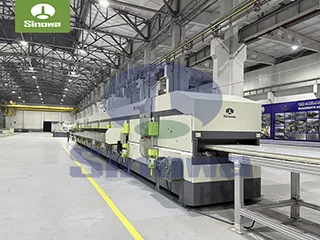
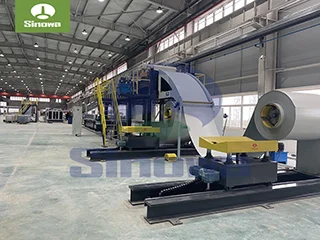
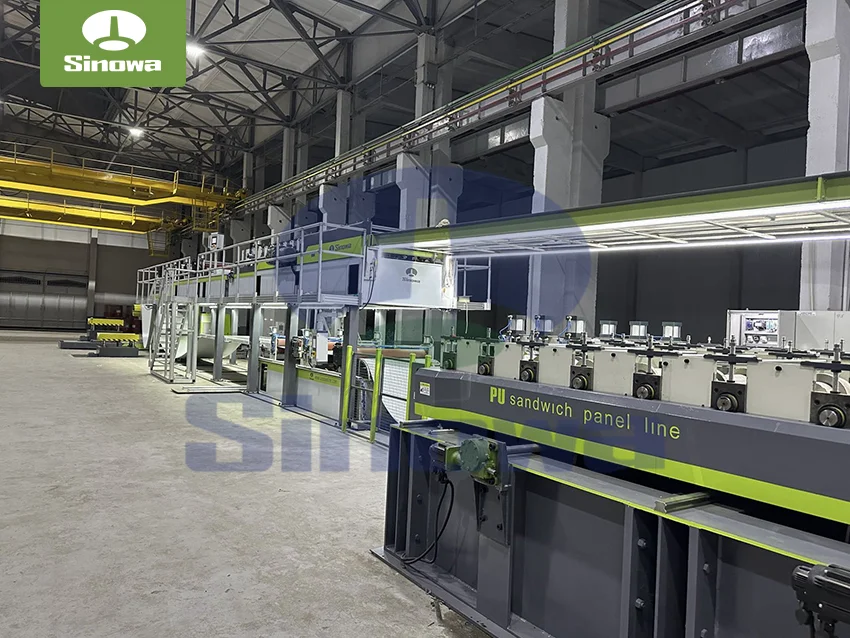
 sandwich panel machine
Once the pre-operation debugging is completed, the sandwich panel line enters the raw material feeding and conveying stage, which serves as the starting point of formal panel production. The surface layer coiled substrates are installed on the dedicated unwinding supports of the machine, and the unwinding system operates stably under the drive of servo transmission motors, realizing uniform and linear release of coiled materials. Equipped with automatic deviation correction structures, the feeding system can dynamically adjust the material transmission track during operation to prevent lateral deviation of the substrates, ensuring consistent feeding accuracy throughout the production process. The released flat substrates are continuously conveyed to the surface pretreatment unit through the transmission roller groups. This pretreatment process is critical for improving the bonding performance between surface substrates and core materials, as it thoroughly removes dust, oil stains, oxide layers, and other attachments on the inner surface of the substrates. These surface impurities would otherwise form isolation layers between the substrate and adhesive, reducing bonding strength and causing delamination or cracking of the finished panels in subsequent use. After pretreatment, the substrates maintain a clean and rough surface state, which significantly enhances the adhesion of coating materials and creates optimal conditions for subsequent composite processing. The whole feeding and pretreatment process operates in a fully continuous manner, with the transmission speed matched with the operating rhythm of subsequent processing modules to avoid material accumulation or supply interruption, ensuring the continuity and fluency of the entire production line.
Following surface pretreatment, the substrates enter the automatic gluing and material distribution stage, a core link that determines the composite firmness of sandwich panels. The sandwich panel machinery precision gluing system evenly coats qualified adhesive materials on the inner surface of the upper and lower substrates, with the coating thickness and range automatically adjusted according to the preset production standards. The equipment adopts a uniform spraying and scraping integrated structure, which can spread the adhesive layer flat while avoiding excessive glue accumulation or local missing coating, ensuring the consistency of the adhesive layer across the entire substrate surface. For production processes requiring foaming core materials, the high-precision batching and mixing system of the machine will fully blend multi-component foaming raw materials in a fixed proportion. The mixed foaming materials are evenly distributed on the surface of the lower substrate through the automatic discharging device, with the discharging speed and dosage precisely synchronized with the substrate transmission speed. This synchronous matching ensures that the foaming materials are uniformly paved on the substrate without accumulation or sparse distribution, laying a foundation for the formation of uniform and dense core structures. During this process, the central control system dynamically monitors the operating state of the gluing and material distribution system, automatically adjusting parameters such as glue output and material distribution volume according to real-time production speed to adapt to continuous changes in the production process and maintain stable coating and distribution quality.
After the completion of gluing and material distribution, the upper and lower substrates with adhesive layers and the middle core materials are synchronously conveyed to the laminating and composite pressing system, which is the key procedure for forming the integral structure of sandwich panels. The laminating unit consists of multiple groups of precision pressing roller sets and constant-temperature heating structures, which can apply stable and uniform pressure and appropriate temperature to the stacked composite layers. Under the dual action of constant pressure and fixed temperature, the adhesive layer undergoes rapid infiltration and curing reaction, and the foaming core materials complete expansion, filling, and solidification processes inside the composite structure. The pressure and temperature parameters in the pressing area are strictly controlled within a stable range to ensure full bonding between layers and complete foaming molding of core materials. Excessively high pressure may cause excessive extrusion of core materials, resulting in uneven panel thickness and structural density defects, while insufficient pressure or temperature will lead to incomplete curing of adhesives and inadequate foaming, causing poor bonding and reduced overall structural stability of the panels. During continuous operation, the equipment maintains constant pressure and temperature output, ensuring that each section of the continuously produced composite panels can obtain consistent pressing and curing effects, thus realizing unified structural performance of finished products. After preliminary composite pressing, the semi-finished continuous panels enter the curing and shaping conveying section, where the slow conveying speed provides sufficient time for the internal adhesive and foaming materials to complete secondary curing, further enhancing the bonding tightness and structural stability of the panel layers.
After curing and preliminary shaping, the continuous long-strip composite panels are transported to the precision cutting and edge trimming module for fixed-length processing and finishing. The sandwich panel making machine automatic flying saw cutting system conducts real-time length measurement and fixed-length cutting according to the preset dimensional standards, achieving high-precision cutting of continuous panels. The cutting system features fast response speed and stable cutting precision, which can complete flat and smooth cutting of panel sections without burrs, collapses, or uneven notches. In addition to fixed-length cutting, the edge trimming device of the equipment can trim the excess edge materials on both sides of the panels, correcting the dimensional deviation generated in the transmission and composite process, and ensuring that the overall width and edge straightness of the panels meet production standards. The edge trimming process also optimizes the flatness of the panel edges, avoiding local bulges or depressions that may affect the assembly and installation effect of finished products. All cutting and trimming actions are automatically completed by the equipment in continuous operation, with no need for manual intervention, which effectively improves production efficiency while ensuring the consistency of panel dimensional accuracy. The waste materials generated during cutting and trimming are automatically collected and sorted by the auxiliary recycling system, realizing standardized waste disposal and maintaining the cleanliness of the production environment.
The cut single panels are then conveyed to the cooling and shaping platform for natural and auxiliary cooling treatment. After high-temperature pressing and curing, the internal temperature of the panels remains relatively high, and the internal structural stress has not been completely released. Timely cooling can accelerate the final shaping of the panel structure, stabilize the internal density and bonding state, and avoid structural deformation, warping, or shrinkage of the panels caused by natural temperature difference changes after stacking. The cooling conveying system adopts a multi-layer circulating transmission structure, which prolongs the cooling stroke of the panels and ensures uniform heat dissipation on the surface and inside of each panel. During the cooling process, the equipment maintains a stable conveying speed to avoid mutual extrusion and friction between panels, protecting the flat and smooth surface of finished panels. After full cooling and stress relief, the structural performance and dimensional stability of the sandwich panels reach the qualified standard, and the panels can enter the final quality inspection and stacking link.
Quality inspection runs through the entire operation process of the sandwich panel production machine, and the final finished product inspection is the last barrier to ensure product quality. The equipment’s real-time monitoring system continuously tracks key production parameters such as substrate transmission speed, gluing thickness, pressing pressure, curing temperature, and cutting accuracy during the whole production process, feeding back abnormal data in real time and triggering automatic parameter adjustment or early warning prompts. In the final inspection stage, operators conduct sampling and comprehensive inspection of the cooled finished panels, focusing on checking surface flatness, coating uniformity, overall dimensional accuracy, internal bonding tightness, and core material compactness. Panels with surface scratches, concave-convex defects, delamination, uneven thickness, or dimensional deviation will be screened out and reprocessed to ensure that all delivered finished products have stable and reliable quality. After passing the quality inspection, the qualified panels are automatically transported to the stacking system, which neatly stacks the panels layer by layer according to the specified quantity and specification standards. The automatic stacking device operates stably and accurately, avoiding collision and extrusion damage between panels during stacking, and ensuring neat and uniform stacking of finished products.
After the completion of stacking, the finished sandwich panel stacks can be sent to the subsequent packaging and storage link. The fully automated sandwich panel production line can complete automatic winding and wrapping of panel stacks through the auxiliary packaging device, which effectively protects the surface of finished panels from dust, scratches, and external extrusion damage during transportation and storage. The entire production process forms a closed-loop operation from raw material feeding, pretreatment, composite pressing, cutting shaping, cooling curing, quality inspection to finished product stacking and packaging. In the continuous production process, the coordinated operation of all functional modules of the machine ensures high production efficiency and stable product quality. Daily standardized operation and maintenance are also crucial to maintain the long-term stable performance of the sandwich panel machine. Operators need to regularly clean the equipment surface and transmission components, lubricate the rotating and moving parts, check the wear degree of roller groups and cutting tools, and calibrate the precision control system regularly. Scientific and standardized operation and maintenance can effectively reduce equipment failure rates, extend the service life of production equipment, and ensure the long-term continuity and stability of sandwich panel production. The mature and standardized operation process of the sandwich panel manufacturing machine not only realizes efficient and automated production of composite panels but also ensures the consistency, stability, and practicability of finished products, providing high-quality basic materials for various construction and industrial engineering applications.
https://www.cnsinowa.com/sandwich-panel-machines/operation-process-of-sandwich-panel-machine.html