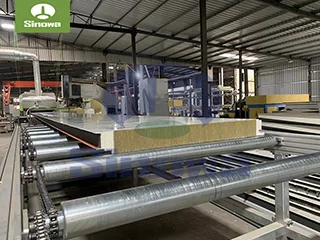
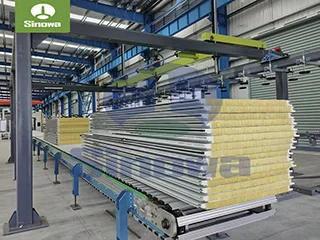
The mineral wool steel sandwich panel production line usually refers to an automated or semi automated assembly line used for producing mineral wool sandwich panels. This production line can efficiently process raw materials such as colored steel plates and mineral wool (such as rock wool or glass wool) into sandwich panels with insulation, heat insulation, fire resistance, and other properties.
The Mineral Wool Steel Sandwich Panel Line mainly consists of the following parts:
Raw material preparation area: used for storing and processing raw materials such as colored steel plates and mineral wool.
Forming equipment: Press colored steel plates into the desired shape and size.
Sandwich material laying equipment: evenly lay mineral wool between two layers of colored steel plates.
Composite equipment: By heating, pressing, and other methods, colored steel plates and mineral wool are firmly composite together.
Cutting and punching equipment: Cut and punch composite sandwich panels according to customer needs.
Finished product inspection and packaging area: Conduct quality inspection on the produced sandwich panels, and package and label them.
Characteristic
High degree of automation: The automatic production line for mineral wool steel sandwich panels usually adopts an automation control system, which can achieve the full process automation production from raw material preparation to finished product packaging.
High production efficiency: Due to the use of advanced production equipment and technology, the production efficiency of the production line has been significantly improved, which can meet the needs of large-scale production.
Stable product quality: Every link in the continuous production line of mineral wool steel sandwich panels undergoes strict quality control to ensure that the produced sandwich panels have stable quality and performance.
Good flexibility: The mineral wool steel sandwich panel production line can adjust production parameters according to customer needs to produce sandwich panels of different specifications and properties.
Mineral wool steel sandwich panels are widely used in various construction fields due to their excellent insulation, thermal insulation, fire resistance and other properties, such as:
Industrial plant: As a wall and roof material for industrial plants, it can provide good insulation and thermal insulation effects.
Cold storage: As an insulation material in cold storage, it can effectively reduce energy consumption and improve the insulation performance of the cold storage.
Public buildings, such as sports halls and exhibition halls, can also use mineral wool steel sandwich panels as insulation materials for their walls and roofs.
With the continuous development of the construction industry and the increasing demand for building quality, the market demand for mineral wool steel sandwich panels, as a high-performance building material, will continue to grow. Meanwhile, with the continuous advancement of technology and the reduction of production costs, the production line of mineral wool steel sandwich panels will also become more intelligent and efficient to meet the constantly changing and upgrading needs of the market.
Mineral wool steel sandwich panels have become an indispensable material in modern construction and industrial fields, thanks to their excellent comprehensive performance, convenient installation and wide range of applications. The production of these high-quality panels relies on a sophisticated and efficient mineral wool steel sandwich panel production line, which integrates mechanical, electrical, hydraulic and chemical technologies to realize continuous and automated production. Understanding the structure, performance, types and applications of this production line is crucial for optimizing production processes, improving product quality and expanding application fields.
The structure of a mineral wool steel sandwich panel production line is a systematic combination of multiple functional units, each of which undertakes a specific production link, and the coordination and cooperation between units ensure the smooth operation of the entire production process. The core structure of the production line mainly includes uncoiling units, roll forming units, mineral wool supply systems, gluing systems, laminating units, cutting units, automatic stacking units and packaging units, as well as supporting control systems and auxiliary equipment. Each unit is designed with high precision and reasonable layout to adapt to the continuous production needs of panels with different specifications and performance requirements. The uncoiling unit is responsible for stably feeding the steel coils into the subsequent process, usually adopting a mandrel-type structure driven by hydraulics, which can realize automatic operation and ensure the stable release of steel coils. For production lines with high capacity requirements, a 2+2 system uncoiling unit is often adopted, which allows loading new coils without stopping the machine, thus ensuring the continuity of production and improving production efficiency. The steel coils used here are usually surface-treated, such as hot-dip galvanized or color-coated steel sheets, which can enhance the corrosion resistance and service life of the final panels.
The roll forming unit is another key part of the production line, which is used to shape the uncoiled steel sheets into the required cross-sectional shape of the panel surface. This unit usually consists of multiple sets of forming rollers, which gradually bend the steel sheets through continuous rolling, and the shape of the rollers can be adjusted according to the design requirements of different panels. The roll forming unit is often designed in cassette type or railway wheel type, which facilitates the replacement of rollers and enables the production of panels with different shapes and specifications, such as wall panels and roof panels with various profiles. The precision of the roll forming unit directly affects the flatness and dimensional accuracy of the panel surface, so the rollers are usually processed with high precision, and the forming process is controlled by a servo system to ensure the consistency of the product shape.
The mineral wool supply system is a unique part of the mineral wool steel sandwich panel production line, which is responsible for cutting and conveying the mineral wool core material to the laminating unit. The mineral wool core is the key component that gives the sandwich panel excellent thermal insulation, fire resistance and sound insulation performance, and its quality and processing accuracy have a direct impact on the final product performance. The mineral wool supply system usually includes a lifting device, a board cutter, a turning conveyor and a side trimming device. The lifting device transports the mineral wool boards to the cutting position, and the board cutter cuts the mineral wool into the required thickness according to the panel specifications. The turning conveyor adjusts the direction of the mineral wool fibers, making the fibers perpendicular to the steel panels, which can effectively improve the bonding strength between the mineral wool and the steel sheets and enhance the structural stability of the panels. The side trimming device trims the edges of the mineral wool to ensure that its width matches the steel panels, avoiding gaps during the laminating process.
The gluing system is responsible for applying adhesive between the steel panels and the mineral wool core to ensure firm bonding between the three layers. The adhesive used needs to have high bonding strength, fire resistance and environmental protection performance, which can adapt to the use environment of the panels and not produce harmful substances. The gluing system usually adopts a high-pressure spraying or roller coating method, which can evenly apply the adhesive on the surface of the steel panels and the mineral wool core. The amount of adhesive applied is precisely controlled by the control system to avoid excessive or insufficient gluing, which may affect the bonding effect and product quality. Some advanced gluing systems are also equipped with automatic temperature control functions to ensure the stability of the adhesive performance under different environmental temperatures.
The laminating unit is where the steel panels and the mineral wool core are combined into a whole. This unit usually consists of a double-belt conveyor and a pressing device. The upper and lower steel panels with adhesive and the mineral wool core are fed into the laminating unit together, and under the action of constant pressure and appropriate temperature, the three layers are tightly bonded. The double-belt conveyor ensures that the panel surface is flat and the thickness is uniform, and the pressing device adjusts the pressure according to the product requirements to ensure the bonding strength between the layers. The temperature control of the laminating unit is particularly important for the curing of the adhesive; too high or too low temperature will affect the bonding effect and the structural stability of the panels. After laminating, the continuous panel blank is formed, which is then sent to the cutting unit for further processing.
The cutting unit is used to cut the continuous panel blank into panels of the required length. This unit usually adopts a flying saw cutting system, which can cut the panel without stopping the machine, ensuring the continuity of production and improving production efficiency. The cutting precision is controlled by a digital servo system, which can accurately cut according to the set length, and the cutting surface is flat and smooth, avoiding burrs or uneven cuts. After cutting, the panels are sent to the automatic stacking unit, which arranges the panels neatly according to the specifications, reducing manual operation and improving stacking efficiency. The stacking unit is usually equipped with a lifting and conveying device, which can automatically adjust the stacking height and spacing to avoid damage to the panel surface. Finally, the stacked panels are sent to the packaging unit, which uses plastic film or other packaging materials to wrap the panels, protecting them from moisture, dust and damage during transportation and storage.
In addition to the above core units, the mineral wool steel sandwich panel production line is also equipped with a complete control system and auxiliary equipment. The control system adopts computer integrated control technology, integrating digital servo technology, frequency conversion vector technology and hydraulic control technology, which can realize the centralized control and management of the entire production line. Operators can set production parameters, monitor production status and adjust production processes through the man-machine interface, which is easy to operate and reduces the difficulty of operation. The auxiliary equipment includes dust removal systems, cooling systems and waste recycling systems. The dust removal system collects the dust generated during the production process, protecting the working environment and the health of operators; the cooling system cools the panels after laminating and cutting to ensure the stability of the product performance; the waste recycling system recycles the leftover materials generated during the cutting process, reducing material waste and improving resource utilization.
The performance of the mineral wool steel sandwich panel production line is reflected in multiple aspects, including production efficiency, product precision, stability, adaptability and environmental protection, which are important indicators to measure the quality of the production line. Production efficiency is one of the core performance indicators of the production line. Modern mineral wool steel sandwich panel production lines usually adopt continuous automatic production mode, with a production speed of 3 to 8 meters per minute, which can be adjusted according to the forming requirements of different products. Based on 250 working days per year and 10 working hours per day, the annual production capacity of a single production line can reach hundreds of thousands of square meters, which can meet the large-scale production needs of enterprises. The high production efficiency is mainly due to the continuous operation design of each unit, the automatic control of the control system and the optimization of the production process, which reduces the manual intervention and the time of machine shutdown.
Product precision is another important performance indicator of the production line, which directly affects the quality and installation effect of the panels. The production line adopts high-precision processing equipment and advanced control technology, which can ensure the dimensional accuracy of the panels. The thickness tolerance of the panels is usually within ±2mm, the effective width tolerance is within ±2mm, and the length tolerance is within ±5mm, which meets the requirements of different construction scenarios. The flatness of the panel surface is also strictly controlled, and the surface of the produced panels is smooth and free of wrinkles, which can ensure the tightness of the connection between the panels during installation. In addition, the production line can also ensure the uniformity of the mineral wool core distribution and the uniformity of the adhesive coating, avoiding the problems of uneven thickness of the core material and insufficient bonding, which ensures the stability of the product performance.
Stability is an important guarantee for the long-term operation of the production line. The production line is made of high-quality materials and components, with high durability and wear resistance, which can adapt to long-term continuous production. The control system adopts mature and reliable technology, which can stably operate for a long time without frequent failures. The hydraulic system and electrical system are equipped with overload protection and fault alarm functions, which can timely find and handle potential faults, ensuring the safe and stable operation of the production line. In addition, the production line also has good maintainability, and the design of each unit is easy to disassemble and maintain, which reduces the maintenance time and cost and improves the utilization rate of the production line.
Adaptability is another important performance of the production line, which refers to the ability of the production line to produce panels of different specifications, types and performance requirements. Modern mineral wool steel sandwich panel production lines have strong adaptability, and can adjust production parameters according to customer needs, producing panels with different thicknesses, widths, lengths and surface shapes. The thickness of the panels can be adjusted between 50mm and 300mm, including common specifications such as 100mm, 125mm, 150mm, 175mm, 200mm and 230mm; the effective width of the panels is usually 1200mm or other customized widths; the length can be customized according to customer requirements, generally up to 13.5 meters. In addition, the production line can also produce panels with different core material densities and different surface materials, such as food-safe laminated steel, stainless steel and acid-proof steel, to meet the needs of different application scenarios. The strong adaptability of the production line enables enterprises to flexibly respond to market changes and expand product categories.
Environmental protection is an increasingly important performance requirement of modern production lines. The mineral wool steel sandwich panel production line adopts a series of environmental protection measures to reduce the impact on the environment. The dust removal system collects the dust generated during the cutting and processing of mineral wool, avoiding dust pollution to the air; the adhesive used in the production process is environmentally friendly, non-toxic and harmless, and does not release harmful substances during use; the waste recycling system recycles the leftover materials, reducing resource waste; some production lines also adopt environment-friendly foaming agents instead of traditional harmful foaming agents, further improving the environmental protection performance of the production process. These environmental protection measures not only meet the requirements of environmental protection policies, but also protect the health of operators and the ecological environment.
The types of mineral wool steel sandwich panel production lines can be divided into different categories according to different classification standards, and each type has its own characteristics and applicable scenarios. According to the production mode, the production line can be divided into continuous production lines and intermittent production lines. Continuous production lines are the most common type in modern industrial production, which can realize 24-hour continuous production, with high production efficiency, stable product quality and low labor intensity. This type of production line is suitable for large-scale production enterprises with large production volume and high product quality requirements. Intermittent production lines, on the other hand, produce panels in batches, with relatively low production efficiency, but simple structure, low investment cost and flexible operation. This type of production line is suitable for small and medium-sized enterprises with small production volume and diverse product specifications.
According to the type of mineral wool core material, the production line can be divided into rock wool steel sandwich panel production lines and glass wool steel sandwich panel production lines. Rock wool has excellent fire resistance, high temperature resistance and sound insulation performance, and the panels produced by the rock wool steel sandwich panel production line are suitable for scenarios with high fire protection requirements, such as industrial workshops, power plants and high-rise buildings. Glass wool has good thermal insulation performance and light weight, and the panels produced by the glass wool steel sandwich panel production line are suitable for general thermal insulation scenarios, such as residential buildings, commercial buildings and agricultural facilities. In addition, according to the surface treatment of steel panels, the production line can also be divided into color-coated steel sandwich panel production lines and hot-dip galvanized steel sandwich panel production lines. Color-coated steel panels have beautiful appearance and good corrosion resistance, and are suitable for scenarios with high aesthetic requirements; hot-dip galvanized steel panels have strong corrosion resistance and long service life, and are suitable for harsh environments such as outdoor and industrial workshops.
According to the functional characteristics of the panels produced, the production line can be divided into ordinary type, fire-resistant type, energy-saving type and special strength type. The ordinary type production line produces panels with basic thermal insulation, sound insulation and structural performance, which are suitable for general construction and industrial scenarios. The fire-resistant type production line is optimized in the gluing system and mineral wool core material, and the produced panels have a high fire-resistant limit, which can reach 30 minutes to 240 minutes according to the panel structure and thickness, and are suitable for fire-resistant structures such as fire partitions and firewalls. The energy-saving type production line adopts high-density mineral wool core material and high-performance adhesive, which can effectively reduce the thermal conductivity of the panels, improve the thermal insulation effect, and meet the requirements of energy-saving construction. The special strength type production line is designed to produce panels with high load-bearing capacity, which are suitable for scenarios such as compartment ceilings and external walls with long spans and high wind loads.
The applications of the mineral wool steel sandwich panel production line are closely related to the performance of the panels produced, and cover a wide range of fields such as construction, industry, agriculture, logistics and public facilities. In the construction field, the panels produced by the production line are widely used in external walls, internal partitions, roofs, ceilings and other parts of buildings. Due to their excellent thermal insulation and energy-saving performance, they can reduce the energy consumption of buildings, meet the requirements of energy-saving construction, and are suitable for residential buildings, commercial buildings, office buildings, schools, hospitals and other public buildings. In addition, the panels have beautiful appearance and diverse colors, which can be matched with different architectural styles, improving the aesthetic effect of buildings. The fire-resistant panels produced by the production line are also widely used in fire partitions and firewalls of buildings, which can effectively prevent the spread of fire and ensure the safety of buildings.
In the industrial field, the mineral wool steel sandwich panel production line plays an important role, and the produced panels are widely used in industrial workshops, factories, power plants, chemical plants and other facilities. Industrial workshops usually have high requirements for thermal insulation, fire protection and sound insulation, and the panels produced by the production line can meet these requirements. For example, in high-temperature industrial processes, the panels with high-temperature resistance can effectively insulate heat, protect the workshop environment and equipment; in chemical plants, the corrosion-resistant panels can adapt to the harsh working environment and extend the service life of the facilities. In addition, the panels are light in weight and easy to install, which can shorten the construction period of industrial facilities and reduce the construction cost. The special strength panels are also used in the compartment ceilings and external walls of industrial workshops, which can bear large loads and meet the structural requirements of the workshops.
In the agricultural field, the panels produced by the mineral wool steel sandwich panel production line are widely used in agricultural greenhouses, livestock and poultry houses, grain storage warehouses and other facilities. Agricultural greenhouses need good thermal insulation performance to maintain a stable internal temperature, which is conducive to the growth of crops. The panels produced by the production line have excellent thermal insulation performance, which can effectively reduce the heat loss in the greenhouse and save energy consumption. Livestock and poultry houses need good ventilation, moisture-proof and sound insulation performance, and the panels can meet these requirements, providing a comfortable living environment for livestock and poultry. Grain storage warehouses need good moisture-proof and insect-proof performance, and the panels can effectively prevent moisture and insects, ensuring the quality of grain storage.
In the logistics field, the mineral wool steel sandwich panel production line is mainly used to produce panels for logistics and distribution centers, cold storage and refrigeration units. Logistics and distribution centers usually have large space and high requirements for thermal insulation and fire protection, and the panels produced by the production line can meet these requirements, ensuring the safety and stability of the goods stored. Cold storage and refrigeration units have strict requirements for thermal insulation performance, and the panels with low thermal conductivity can effectively reduce the heat exchange between the inside and outside of the cold storage, reduce the energy consumption of refrigeration equipment, and maintain a stable low temperature environment. The panels are also moisture-proof and corrosion-resistant, which can adapt to the low-temperature and high-humidity environment of the cold storage and extend the service life of the cold storage.
In addition to the above fields, the mineral wool steel sandwich panel production line also has applications in public facilities such as airports, railway stations, bus stations and stadiums. These public facilities have large flow of people and high requirements for safety, fire protection and comfort. The panels produced by the production line have excellent fire resistance, sound insulation and thermal insulation performance, which can ensure the safety and comfort of the facilities. For example, in airports and railway stations, the panels are used in the walls and ceilings of waiting halls, which can effectively reduce noise and maintain a comfortable temperature; in stadiums, the panels are used in the external walls and roofs, which can withstand wind loads and meet the structural requirements of large-span buildings.
With the continuous development of construction and industrial technologies, the mineral wool steel sandwich panel production line is also constantly upgrading and improving. In the future, the production line will be more intelligent, adopting more advanced control technologies and automation equipment to further improve production efficiency and product quality, and reduce labor intensity. At the same time, the environmental protection performance of the production line will be further enhanced, adopting more environmentally friendly materials and processes to meet the increasingly strict environmental protection requirements. In addition, the production line will be more personalized, able to meet the customized needs of different customers, and expand the application fields of mineral wool steel sandwich panels. The development of the mineral wool steel sandwich panel production line will also promote the development of the entire industry, providing more high-quality and efficient building materials for the construction and industrial fields, and making positive contributions to the sustainable development of the society.


Any Questins About Continuous Sandwich Panel Production Lines or Other Products
Email us with inquiries or use our contact infomations