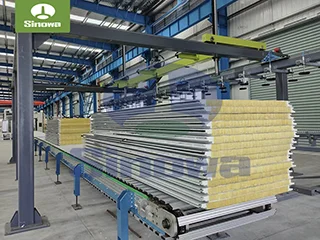
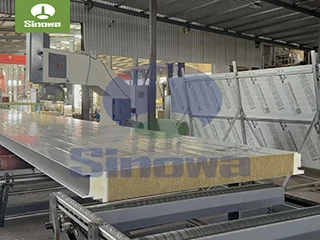
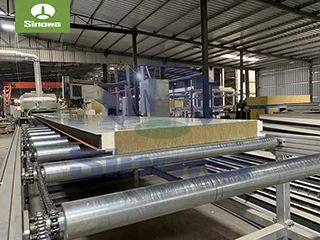
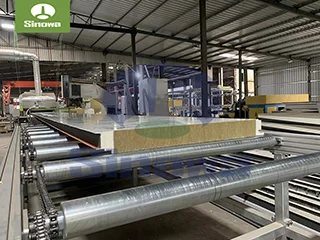
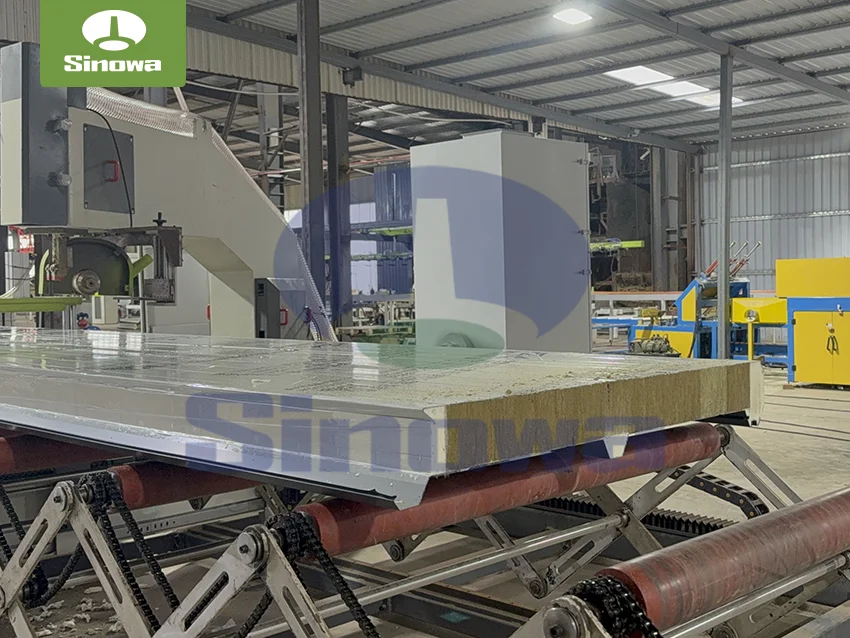
 sandwich panel line
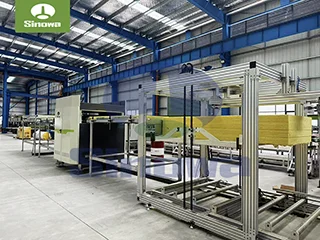
The overall operation logic of a mineral wool sandwich panel production line follows a sequential processing flow, covering raw material preparation, melting and fiberization, wool collection and molding, dehydration and drying, surface finishing, cutting and shaping, as well as final inspection and packaging. Every processing section is closely connected through conveying equipment, forming an uninterrupted production chain that minimizes manual intervention and maintains stable production rhythm. Raw materials constitute the fundamental basis for product quality, and the production line is equipped with professional raw material pretreatment modules to screen, crush, and proportion various mineral raw materials. Common raw materials for mineral wool panels include natural mineral stones and industrial mineral by-products, which need to be processed into uniform particle sizes before entering the melting stage. In the pretreatment area, specialized crushing equipment breaks down bulk raw materials into fine particles, while screening devices separate impurities and unqualified particles to ensure the purity of subsequent melting materials. Meanwhile, automated batching systems accurately mix different raw materials according to fixed ratios, adjusting the material composition to change the density, toughness, and thermal stability of finished panels, which enables the production line to manufacture mineral wool panels suitable for diverse application scenarios.
After completing raw material pretreatment, the qualified mixed materials are transported to the high-temperature melting system, which serves as the core thermal processing unit of the entire sandwich panel production line. The melting equipment heats the mineral mixtures to an extremely high temperature until the raw materials are completely converted into homogeneous molten liquid. During the melting process, the internal temperature and combustion state are stably controlled to avoid uneven melting caused by temperature fluctuations, which could affect the fineness and uniformity of subsequent fibers. Auxiliary air supply systems distribute preheated air evenly around the melting furnace to optimize combustion efficiency and ensure sufficient and stable heat supply inside the furnace. Once the molten liquid reaches the required fluidity, it flows out through adjustable flow grooves and is evenly delivered to the fiberization equipment. The fiberization process determines the basic structural characteristics of mineral wool; high-speed rotating rollers and high-pressure airflow work together to stretch and disperse the molten liquid into slender mineral fibers. In this stage, impurity removal devices eliminate residual slag balls and coarse particles from the fibers, effectively improving the softness and uniformity of the fiber raw materials and laying a solid foundation for the production of high-quality panels.
The dispersed mineral fibers are then transported to the wool collection and molding section, where the loose fibers are gathered to form continuous fiber blankets. This section is equipped with negative pressure collection devices, which use airflow control to evenly distribute fibers on the conveying mesh belt, avoiding fiber accumulation or sparse distribution. During the fiber laying process, adjustable vibration platforms assist in leveling the fiber layers, making the internal structure of the fiber blankets compact and uniform. To enhance the structural stability of mineral wool panels, a certain proportion of adhesive additives are evenly sprayed on the surface and inside of the fiber blankets. The spraying system precisely controls the dosage and spraying range of adhesives to prevent excessive adhesive from increasing material hardness or insufficient adhesive from causing fiber detachment. After adhesive spraying, the preliminary molded fiber blankets undergo preliminary pressing treatment to squeeze out excess gaps between fibers, shaping the loose fiber clusters into continuous board blanks with fixed thickness and flatness. The pressure of the pressing equipment can be adjusted according to production requirements to produce panel blanks with different density specifications, meeting the usage demands of different industrial and construction environments.
Dehydration and drying are essential processing stages to remove internal moisture and stabilize the physical structure of panel blanks. The initially molded board blanks contain a large amount of free moisture introduced during fiber mixing and adhesive spraying, which must be eliminated to prevent panel deformation, mildew, or performance degradation in subsequent use. The mineral wool sandwich panel machine is equipped with segmented drying furnaces, which are divided into multiple temperature control areas to implement gradient drying treatment. In the low-temperature pre-drying area, most of the surface moisture of the board blanks is evaporated to avoid structural damage caused by rapid heating. In the high-temperature constant-temperature drying area, the internal residual moisture is thoroughly removed, and the adhesives inside the panels are completely cured to strengthen the bonding force between fibers. The drying furnace is equipped with circulating air supply systems to ensure uniform heat distribution in the furnace body, preventing local overheating or incomplete drying. Meanwhile, waste gas generated during the drying process is collected and guided into the environmental treatment system to realize harmless purification and reduce the impact on the surrounding production environment. After drying, the board blanks have stable hardness, fixed thickness, and intact fiber structures, completing the transition from semi-finished products to primary finished boards.
The surface finishing section further optimizes the appearance and surface performance of dried mineral wool boards. This processing link includes surface smoothing, coating treatment, and texture modification. Polishing equipment gently grinds the board surface to remove protruding fibers and uneven bulges, making the surface smooth and flat. For panels requiring decorative and protective functions, automatic coating devices spray uniform protective coatings on the board surface. These coatings can enhance the moisture resistance, abrasion resistance, and anti-aging ability of the panels while optimizing the surface texture for better decorative effects. Some production lines are also equipped with embossing and pattern rolling components, which can press different texture patterns on the panel surface according to production requirements, enriching the product types and expanding the application scope of mineral wool panels. All surface treatment processes are completed on the continuous conveying line, realizing seamless connection between processes and avoiding secondary damage to the panels caused by manual handling.
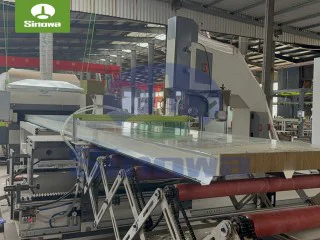
Precision cutting and shaping processes follow surface finishing to divide continuous long boards into standard-sized finished panels. The cutting system of the mineral wool sandwich panel line adopts automated positioning and trimming equipment, which first cuts off irregular edges on both sides of the boards to ensure straight and neat edges. Then, according to preset size parameters, transverse cutting is carried out to obtain mineral wool panels of specified length and width. The cutting equipment is equipped with high-precision sensing components to automatically correct positioning deviations, ensuring that the size error of each finished panel is controlled within a tiny range. After cutting, edge trimming and chamfering processes are performed to polish sharp edges and corners, preventing edge cracking during transportation and installation. In addition, sorting devices screen the cut panels, initially eliminating products with obvious surface defects, uneven thickness, or edge damage to ensure that qualified products enter the subsequent inspection link.
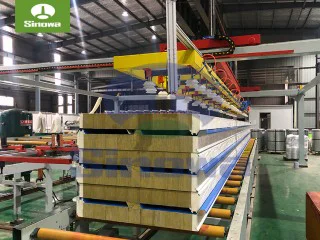
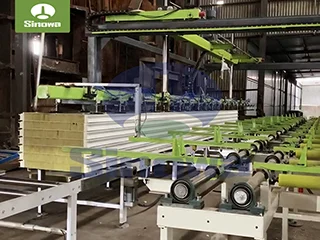
Quality inspection is an indispensable final control link in the production line, covering appearance inspection, dimensional detection, and physical performance sampling inspection. Automated visual inspection equipment scans the panel surface to identify tiny defects such as cracks, pits, and uneven coatings that are difficult to distinguish by human eyes. High-precision measuring instruments detect the thickness, length, and flatness of the panels one by one to ensure that all dimensional indicators meet production standards. For physical performance testing, sampling is carried out at fixed time intervals to detect the thermal insulation, sound absorption, and compression resistance of finished panels. Panels that pass all inspection items are transported to the packaging area, while unqualified products are marked and sent to the reprocessing area for crushing and secondary utilization, realizing resource recycling. The packaging process adopts automatic wrapping and stacking equipment; panels are wrapped with protective materials to prevent dust contamination and surface scratches during storage and transportation, and then stacked neatly on trays for centralized storage and delivery.
In addition to the main processing equipment, a complete mineral wool sandwich panel line is equipped with supporting auxiliary systems to ensure long-term stable operation of the entire line. The automated control system serves as the intelligent core of the production line, monitoring and adjusting the operating parameters of each equipment module in real time, including melting temperature, conveying speed, pressing pressure, and drying time. The system can record production data throughout the process, facilitating production personnel to track production status and optimize process parameters. The waste treatment system collects and purifies waste gas, waste residue, and wastewater generated during production; waste residue is recycled into raw materials for secondary processing, and waste gas is purified through filtration and adsorption processes to meet emission requirements. The cooling circulation system maintains the normal operating temperature of high-temperature equipment, avoiding equipment aging and damage caused by long-term high-temperature operation. These auxiliary systems coordinate with the main processing equipment to form a complete and environmentally friendly closed-loop production system.
The operational characteristics of mineral wool sandwich panel making machine determine the production quality and application advantages of finished products. The highly automated processing mode reduces human error in manual operation, ensuring stable and consistent product quality in mass production. The reasonable process sequence shortens the material circulation cycle, improves daily production capacity, and effectively reduces comprehensive production costs. Moreover, the adjustable production parameters enable the line to produce mineral wool panels with different densities, thicknesses, and surface styles, which can adapt to diversified market demands ranging from indoor decoration to industrial thermal insulation. With the continuous progress of manufacturing technology, modern production lines are gradually developing towards energy conservation, low consumption, and intelligent optimization. Optimized furnace structures reduce energy consumption in the melting stage, and upgraded fiberization equipment improves fiber utilization, minimizing raw material waste. The intelligent monitoring system realizes early warning of equipment faults, reducing downtime and maintenance costs.
Looking at the industrial development trend, mineral wool panels will maintain stable market demand relying on their excellent fire resistance, thermal insulation, and sound absorption properties, which further promotes the technological upgrading of production lines. Future mineral wool panel production lines will integrate more intelligent sensing and digital control technologies to realize fully unmanned automated production. The environmental protection treatment system will be further optimized to improve the recycling rate of production waste and reduce resource consumption. In addition, the production line will strengthen the research and development of composite processing technology to produce multifunctional composite mineral wool panels with higher strength and better durability, adapting to the increasingly stringent material requirements in the construction industry. As an important carrier of mineral wool panel manufacturing, the mineral wool board production line will continuously iterate and upgrade in technology and structure, providing reliable technical support for the sustainable development of the mineral wool material industry and creating higher application value for the global construction and industrial fields.
https://www.cnsinowa.com/sandwich-panel-machines/mineral-wool-panel-production-line.html