sandwich panel line
The overall operation logic of the composite sandwich panel line follows a closed-loop continuous processing mode, with all functional modules closely linked and collaboratively operated to avoid performance fluctuations caused by discontinuous production processes. The entire production process starts with scientific raw material selection and pretreatment, which lays a fundamental foundation for the excellent comprehensive performance of finished marine rock wool boards. The main raw materials adopted by the composite sandwich panel production line are high-quality natural mineral raw materials with stable chemical properties and strong high-temperature resistance, which are screened and proportioned according to the performance standards of marine special materials. These raw materials need to undergo strict physical pretreatment before entering the melting link, including crushing, screening, drying and impurity removal. Professional crushing equipment processes bulk mineral raw materials into uniform fine particles, and multi-layer vibrating screening devices filter out oversized particles and impurity components that affect melting uniformity and fiber quality. Meanwhile, the supporting drying system precisely controls the moisture content of raw materials to eliminate the adverse effects of moisture on high-temperature melting efficiency and fiber forming stability. The fully automatic batching and conveying system realizes quantitative and uniform feeding, maintaining a stable raw material ratio throughout the production process and effectively avoiding structural defects and performance inconsistencies of finished products caused by raw material proportion deviation.
High-temperature melting is the core thermal processing link of the rock wool sandwich panel production line and a key step to determine the basic fiber structure of rock wool. The production line is equipped with a high-efficiency sealed melting furnace with a heavy-duty refractory lining structure, which can withstand long-term extreme high-temperature operation and maintain stable internal temperature field distribution. The pretreated mineral mixed materials are continuously and evenly sent into the melting furnace through an automatic feeding system, and the internal temperature of the furnace is stably controlled within the professional high-temperature range required for marine rock wool production. Under the action of high-temperature heat energy, solid mineral particles are completely melted into uniform and smooth viscous magma, with no unmelted particles or heterogeneous components remaining. The sealed furnace body design effectively isolates external air and dust interference, reduces heat loss, and ensures the purity and uniformity of the molten magma. Equipped with a professional circulating cooling system for the furnace body, the equipment can realize balanced temperature regulation of key components during long-term high-load operation, avoiding equipment aging and performance attenuation caused by local overheating, and greatly improving the continuous operation stability and service life of the production line.
After the high-temperature melting process is completed, the homogeneous magma is transported to the high-speed centrifugal fiber forming system, which is the key equipment to convert molten magma into ultra-fine rock wool fibers. The rockwool sandwich panel production line adopts a multi-roller high-speed centrifugal structure, which drives the centrifugal rollers to rotate at a constant high speed through a precision transmission system. When the high-temperature magma flows evenly onto the surface of the centrifugal rollers, it is instantly thrown out under the action of strong centrifugal force, and rapidly stretched and split into countless ultra-fine inorganic fibers. The fiber fineness and length are automatically adjusted and controlled through the linkage of centrifugal speed and magma flow rate, ensuring that the fiber structure meets the toughness and density requirements of marine composite boards. In the fiber forming area, a precise atomization spraying system is arranged to uniformly spray specially formulated inorganic binder and water-repellent auxiliary agents on the surface of newly formed fibers. These auxiliary agents can make the loose fibers bond closely with each other, and endow the fiber finished products with excellent water resistance and anti-aging performance, adapting to the high-humidity and salt-spray marine working environment. The whole fiber forming process is carried out in a closed space, which not only ensures the uniformity of agent attachment but also avoids fiber floating and environmental pollution, realizing clean and efficient production.
The fiber materials with uniform binder attachment are continuously collected and conveyed to the wool laying and pre-pressing system through the negative pressure wool collecting equipment of the rock wool sandwich panel line. The intelligent pendulum wool laying device can realize reciprocating uniform wool laying in the horizontal direction, making the fiber layers stacked evenly in all directions and effectively avoiding local density differences of the board. The stacked loose fiber wool layers are initially shaped by the pre-pressing equipment, which preliminarily compacts the loose fibers to form continuous and uniform wool slabs with stable thickness and flat surface. The pre-pressing process accurately controls the compression ratio according to the preset product specification parameters, laying a foundation for subsequent formal curing and composite molding. The sandwich panel production line is equipped with a real-time thickness detection and deviation correction device in the pre-pressing link, which can automatically monitor the thickness uniformity of wool slabs during operation, and adjust the pressing parameters in real time once slight deviation is found, ensuring the consistency of semi-finished product specifications.
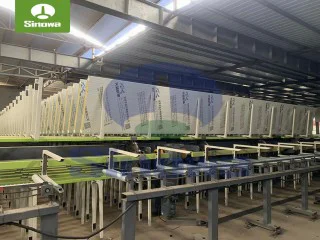
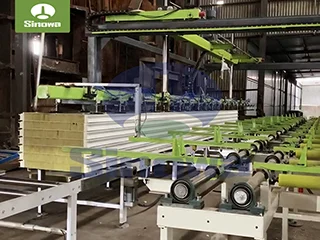
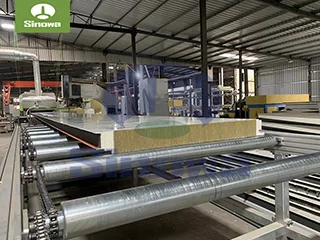
Curing and hot pressing molding is a decisive link to finalize the structural performance and dimensional stability of marine composite rock wool boards. The pre-pressed wool slabs are continuously sent into the constant-temperature curing furnace, where the internal stable high-temperature environment promotes the full reaction and curing of the binder among fibers. During the curing process, the loose fiber structure is firmly bonded into an integral dense plate structure, and the internal stress of the fibers is fully released, effectively improving the structural toughness, compression resistance and deformation resistance of the board. After curing, the rock wool base plate enters the composite hot pressing system. Different from ordinary single-layer rock wool boards, marine composite rock wool boards need to complete the composite lamination of functional auxiliary layers in this link. The sandwich panel line is equipped with an integrated composite lamination structure, which can evenly coat high-performance adhesive on the surface of the rock wool base plate, and compound with protective auxiliary layers that adapt to marine environmental characteristics. The constant-temperature and constant-pressure hot pressing mode ensures that the composite layers are closely bonded without gaps or delamination, and the overall structural tightness and integrity of the composite board are significantly enhanced. The whole curing and composite process realizes assembly line continuous operation, with adjustable curing time and hot pressing parameters, which can adapt to the production requirements of composite boards with different thicknesses and functional configurations.
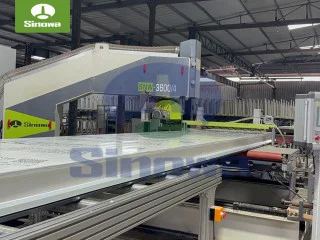
After the composite molding is completed, the continuous plate body enters the precise finishing and cutting system of the rockwool board production line to complete the final shaping and sizing processing. The production line is equipped with an automatic follow-up slitting and cross-cutting integrated device, which can set accurate dimensional parameters according to the actual application requirements of marine engineering. The high-precision cutting equipment adopts stable mechanical transmission and intelligent positioning technology, which can complete fixed-length cutting and edge trimming of continuous plate bodies efficiently. The cutting section is flat and smooth without burrs, cracks or fiber peeling, ensuring the assembly accuracy of finished products in ship cabin decoration and marine facility construction. In the cutting process, the intelligent waste recycling system automatically collects leftover materials and defective materials generated in the production process, which are crushed and re-entered the raw material pretreatment link for secondary utilization, realizing resource recycling and reducing production waste. After cutting and shaping, the finished products pass through the constant-temperature cooling conveying system to complete natural and balanced cooling, which avoids product deformation and performance changes caused by rapid temperature difference, and further stabilizes the internal structural stress of the composite board.
The rock wool insulation board production line is equipped with a full-process intelligent control system, which realizes centralized monitoring and automatic regulation of all links from raw material feeding to finished product output. The system can automatically collect and analyze operating data such as furnace temperature, centrifugal speed, pressing pressure, curing time and running speed in real time, and dynamically adjust various process parameters according to the production status, ensuring that each production link is always in the optimal operating state. The modular structural design of the production line makes each functional unit relatively independent and collaboratively matched, which not only facilitates daily equipment maintenance and fault inspection but also supports flexible adjustment of production processes. According to the different performance requirements of marine rock wool boards for fire resistance grade, insulation density and structural strength in different ship positions and offshore facilities, the production line can quickly switch process parameters to realize flexible production of diversified products.
In terms of production performance and product advantages, the marine composite rock wool board produced by this professional production line has far superior comprehensive performance to ordinary rock wool products. The precise raw material proportioning and high-temperature melting process ensure the high purity and structural uniformity of rock wool fibers, making the product have excellent high-temperature fire resistance and non-combustibility, which can effectively block flame spread and heat transfer in case of fire, meeting the high-standard fire protection requirements of closed marine spaces. The compact composite structure and stable fiber bonding state endow the product with outstanding thermal insulation and sound absorption performance, which can effectively isolate external high and low temperature changes and reduce equipment and environmental noise in ships, improving the comfort and safety of marine working environments. At the same time, through the optimized formula of water-repellent agents and closed composite structure design, the finished product has excellent moisture resistance and salt spray corrosion resistance, which can maintain stable physical and chemical properties for a long time in humid and high-salinity marine environments, without deformation, mildew or performance attenuation.
In actual industrial production applications, the stable operation of the marine composite rockwool board production line provides reliable material support for the upgrading and standardized development of the marine supporting material industry. The automated continuous production mode greatly improves production efficiency, realizes large-scale batch manufacturing of high-standard marine rock wool composite boards, and maintains extremely low product performance fluctuation rate. The strict process control system of the rock wool sandwich panel machine eliminates unstable factors in manual operation, ensures that the density, thickness, bonding strength, fire resistance and insulation performance of each batch of finished products remain consistent, and meets the strict quality requirements of shipbuilding and marine engineering for supporting materials. In addition, the energy-saving and environmentally friendly design of the production line optimizes the heat energy utilization structure of the melting furnace and curing equipment, reduces heat energy loss and power consumption in the production process, and the closed production space effectively controls dust and fiber emission, meeting the green production standards of modern industrial manufacturing.
With the continuous development of the global shipbuilding industry and offshore engineering construction, the market demand for high-performance marine special insulation and fireproof materials is constantly upgrading, and the technical requirements for production equipment are also increasingly stringent. The marine composite rock wool board production line, with its integrated, intelligent and high-precision production characteristics, breaks through the limitations of traditional rock wool production equipment in marine product customization and performance control. Its flexible process adjustment capability and stable production quality can continuously adapt to the iterative upgrading of marine engineering standards, providing efficient and reliable production solutions for the manufacturing of core auxiliary materials in the marine field. In the future, with the further optimization of automated control technology and material formula technology, such sandwich panel machinery will continue to improve in production efficiency, product performance customization and energy-saving environmental protection level, and become an important technical equipment support for the high-quality development of the marine supporting material industry.
https://www.cnsinowa.com/sandwich-panel-machines/marine-composite-rock-wool-board-production-line.html