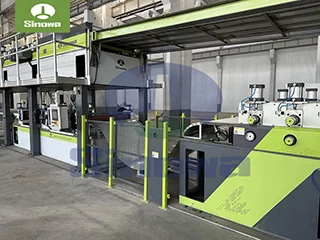
sandwich panel machine
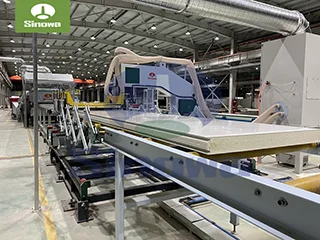
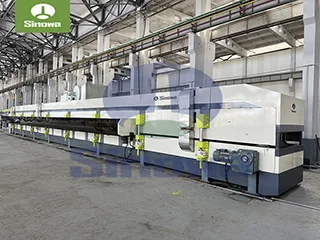
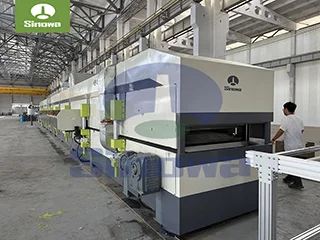
The color steel sandwich panel production machine adopts a linear modular integrated layout, with all functional units arranged sequentially following the logical order of panel manufacturing. Every independent functional module maintains relatively independent mechanical operation logic while achieving seamless linkage and synchronous speed matching through a unified central control system, eliminating material stagnation, process gaps and manual repeated handling during production. The complete production system can be divided into seven interlinked core functional sections without independent operating barriers: raw material unwinding and leveling unit, continuous roll forming unit, core material automatic feeding and arrangement unit, precision gluing and surface treatment unit, constant temperature composite pressing and curing unit, fixed-length flying cutting and edge trimming unit, and automatic finished product conveying and stacking unit. Each section undertakes irreplaceable processing tasks, and subtle parameter changes in any single module will affect the overall flatness, bonding firmness, dimensional accuracy and structural stability of final sandwich panels. Different from scattered single-function processing machines used in traditional building material workshops, this integrated production line realizes one-time feeding and full-process finished product output, fundamentally optimizing production rhythm and reducing human interference in the whole manufacturing process.
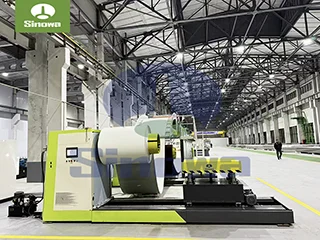
The frontmost unwinding and leveling unit acts as the material supply entrance of the entire production line, responsible for stable output and stress elimination of raw color steel coils. Color coated steel coils used for panel surface layers are rolled and stored for a long time after production, which inevitably generates internal mechanical stress and slight arc-shaped bending deformation on the plate surface. If these hidden quality problems are not eliminated in advance, the finished panels will suffer from warping, edge curling and uneven assembly gaps during later construction. The unwinding structure is equipped with adaptive tension adjustment components, which can automatically sense the tightness change of steel coils during continuous discharging and adjust discharge resistance in real time. This design ensures constant linear feeding speed of steel plates throughout long-hour continuous operation, effectively preventing common defects such as plate surface wrinkling, unilateral material deviation and steel plate stretching thinning. The follow-up multi-roller precision leveling structure uses multiple groups of upper and lower staggered pressure rollers to perform gradual repeated extrusion on flat steel plates, releasing internal winding stress completely and restoring the steel plate to an absolutely flat state before entering the forming process. Besides surface steel plate processing, this unit also reserves matched feeding ports for different insulation core materials, realizing synchronous feeding of upper steel plates, lower steel plates and intermediate core materials from three directions to lay a foundation for subsequent composite bonding work.
Following the pretreatment section, the continuous roll forming unit reshapes flat color steel plates into standardized structural profiles matching actual building usage needs. Most building scenarios require color steel panels with specific groove structures or corrugated surfaces to enhance overall bending resistance and on-site splicing convenience, and roll forming technology completes this profile processing task without damaging the anti-corrosion color coating on steel plate surfaces. The sandwich panel machine adopts segmented gradual rolling molding instead of one-time impact stamping, which disperses plate deformation pressure evenly and avoids local coating peeling, metal plate cracking and stress concentration caused by instantaneous strong extrusion. Operators can adjust the gap between roller sets and replace matched forming molds according to actual production demands, enabling the same production machine to manufacture flat sandwich panels, trapezoidal corrugated panels, concealed plug-in panels and other diversified profile products. All forming rollers keep synchronous linkage with front-end feeding rollers, ensuring no relative sliding between steel plates and rollers during high-speed operation, and controlling the section size error of formed plates within an extremely small range. High-precision forming processing guarantees seamless splicing of panels during on-site building enclosure construction, improving overall airtightness and structural integrity of building walls and roofs.
The core material feeding and precision gluing unit is the key link determining the long-term service life and layered bonding stability of finished sandwich panels. Common core materials matched with this sandwich panel production machine cover two mainstream categories: porous foam insulation materials and fibrous fireproof insulation materials, each requiring targeted feeding and gluing strategies. For lightweight foam core materials, the automatic feeding system realizes continuous horizontal cutting and fixed-thickness paving, ensuring uniform core material thickness across the whole panel without local hollow areas. For rock wool and other fibrous core materials with irregular fiber structures, the equipment is equipped with uniform carding devices to avoid fiber agglomeration and uneven density inside core layers. The automated quantitative gluing system abandons manual gluing operation with unstable dosage, adopting closed-loop intelligent flow control to adjust adhesive output in real time according to production speed and panel specifications. The system distributes adhesives evenly on the inner bonding surfaces of upper and lower color steel plates, forming a complete and dense adhesive layer without missing coating or excessive glue accumulation. For porous fibrous core materials, the gluing depth is slightly increased to realize mechanical occlusion bonding between adhesives and internal fibers; for compact foam core materials, surface uniform coating is adopted to balance bonding strength and raw material consumption, effectively avoiding later panel quality hazards such as interlayer delamination, bulging and peeling.
As the heart of the whole production line, the constant temperature composite pressing and curing unit completes the integral compounding of steel surface layers and intermediate insulation core materials, turning three independent raw materials into an integrated sandwich structure. This unit combines constant circulating heating and steady pressure mechanical pressing to create a stable curing environment for adhesives. The internal heating system forms an even temperature field inside the pressing cavity, accelerating molecular curing reaction of adhesives while avoiding local overheating that leads to adhesive aging and bonding failure. The pressure applying structure adopts flexible integral pressing instead of segmented local pressure, applying uniform vertical pressure on the entire width of composite plates. This process thoroughly discharges residual air bubbles between steel plates and core materials, eliminates tiny gaps between layers, and enables adhesives to form high-strength connecting layers after complete curing. The sandwich panel machinery supports stepless adjustment of pressing pressure and heating temperature to adapt to panels with different total thicknesses and different core material characteristics. After passing through the pressing and curing area, the composite panel obtains integral structural rigidity, and the bonding strength between layers can meet long-term outdoor wind load, temperature difference deformation and mechanical extrusion requirements without layered separation.
The post-processing section includes flying cutting, edge trimming and automatic stacking functions, realizing finished product shaping and orderly output without halting the whole production line. Different from traditional static cutting equipment that needs to stop feeding for sizing cutting, the high-speed flying saw cutting system completes fixed-length cutting synchronously during continuous plate movement. The cutting tool follows the same linear speed as the running panel temporarily during cutting, ensuring ultra-smooth cutting sections without burrs, plate deformation or edge extrusion damage. Operators only need to input target panel length parameters on the interactive interface, and the system can realize automatic cyclic cutting with consistent sizing accuracy for each finished panel. The follow-up edge trimming device fine-tunes panel edge width to eliminate tiny dimensional deviations generated in the forming and pressing processes, ensuring unified overall specifications of all finished products. Finally, the automatic conveying platform sends qualified panels to the stacking area, and the mechanical stacking mechanism completes layer-by-layer orderly arrangement instead of manual carrying. This full-automatic post-processing design reduces labor demand for finished product sorting, avoids surface scratch damage caused by manual contact, and improves overall production line circulation efficiency.
Running through all production links, the centralized intelligent control system acts as the brain of the entire color steel sandwich panel making machine. It integrates real-time data monitoring, synchronous parameter matching, abnormal fault early warning and automatic protection functions, covering all operating parameters including feeding speed, forming roller pressure, gluing flow, heating temperature, pressing force and cutting length. The human-machine interactive interface simplifies complex mechanical parameter settings into visual one-click operations, allowing ordinary operators to switch production modes and adjust panel specifications quickly without professional mechanical programming knowledge. During 24-hour continuous industrial operation, the system monitors the operating state of every module in real time. Once abnormal conditions such as material jamming, temperature fluctuation, motor overload and glue supply interruption occur, the control system will immediately trigger sound and light early warnings and start targeted automatic protection programs, slowing down or stopping corresponding modules accurately to prevent equipment damage and defective product batch output. Meanwhile, the system records full-process production data automatically, providing reliable data support for daily production output statistics, process optimization and equipment routine maintenance arrangement.
Compared with traditional segmented semi-automatic production equipment, modern integrated color steel sandwich panel manufacturing machine has comprehensive competitive advantages in production efficiency, product quality consistency, labor cost control and material utilization rate. In terms of production efficiency, continuous non-stop production eliminates waiting time and transfer links between independent processing devices, greatly shortening the overall production cycle of single panels and adapting to large-scale batch order demands of building material manufacturers. In terms of quality control, all production parameters are locked by intelligent programs, avoiding unstable product quality caused by manual operation differences; the thickness, flatness, bonding strength and dimensional tolerance of each batch of panels remain highly consistent. In terms of raw material utilization, precise quantitative gluing and fixed-length cutting technologies cut down redundant waste of adhesives and color steel plates effectively, reducing overall production material loss. Additionally, the compact modular overall structure reduces floor occupation of production workshops, simplifies on-site circuit and mechanical pipeline layout, and facilitates standardized workshop management and daily equipment maintenance.
Panels produced by this professional production machine fit perfectly with the performance demands of modern green prefabricated buildings. The composite structure of metal surface layer and lightweight insulation core material endows finished panels with low overall self-weight, which can reduce dead load of building enclosure structures and lower foundation engineering construction costs accordingly. The internal porous or fibrous core materials block indoor and outdoor heat conduction and sound wave transmission efficiently, cutting building air conditioning energy consumption significantly and improving indoor environmental comfort. The integrated composite structure also delivers excellent water resistance, weather aging resistance and mechanical impact resistance, maintaining stable structural performance and complete appearance under long-term exposure to high temperature, low temperature, rain and wind in different climatic zones. Relying on these stable performance advantages, color steel sandwich panels manufactured by this equipment are widely applied in industrial production workshops, logistics storage warehouses, dust-free clean workshops, temporary construction facilities, large venue roof enclosures and rural prefabricated residential buildings, covering mainstream low-carbon building scenarios across the whole industry.
Driven by global building energy-saving policies and upgrading demands of prefabricated construction industry, color steel sandwich panel production line is evolving toward higher intelligence, lower energy consumption, stronger compatibility and modular maintainability in recent years. New-generation equipment optimizes internal transmission mechanical structures to reduce operating noise and kinetic energy loss during long-term operation, realizing energy-saving production without reducing operating speed. The upgraded intelligent control system adds automatic parameter self-adaptation function, which can independently match optimal gluing amount, temperature and pressure parameters according to automatically identified core material types, further reducing manual intervention frequency. In terms of production compatibility, updated equipment supports mixed production of multiple core materials on the same line, realizing flexible switching between fireproof core materials and high-insulation core materials to meet diversified customized needs of construction projects. Moreover, the split modular mechanical design makes regular maintenance and vulnerable part replacement more convenient, shortening equipment downtime and improving overall operational rate of production lines.
From the perspective of the entire lightweight building material industrial chain, color steel sandwich panel production machinery occupy an indispensable upstream core equipment position. They promote the transformation of sandwich panel manufacturing from extensive manual production to refined intelligent industrial production, standardizing the quality system of mainstream lightweight enclosure materials in the construction industry. Stable and high-quality panel products supported by this equipment further accelerate the popularization speed of prefabricated buildings, shorten overall construction cycles of engineering projects, and reduce construction site construction waste and on-site construction pollution. Looking ahead, as global building energy-saving standards become stricter and modular building design becomes more popular, color steel sandwich panel production machines will further integrate digital twin monitoring technology and remote intelligent debugging functions. Future equipment will realize remote real-time fault diagnosis and online parameter adjustment, helping building material manufacturers achieve unmanned workshop production gradually. Continuous technological iteration of such sandwich panel line will continue to empower the high-quality, low-carbon and intelligent upgrading of the global construction industry, creating long-term economic and environmental benefits for the whole infrastructure construction field.
https://www.cnsinowa.com/sandwich-panel-machines/color-steel-sandwich-panel-production-machine.html