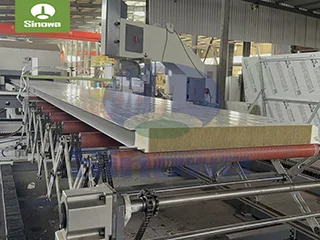
sandwich panel machine
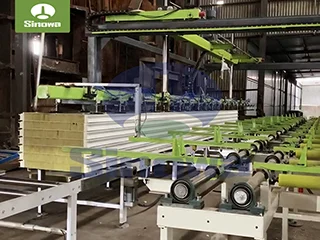
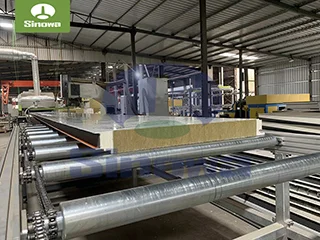
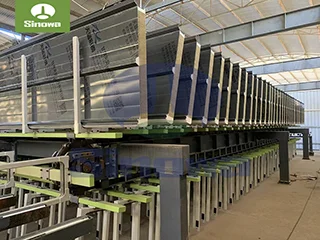
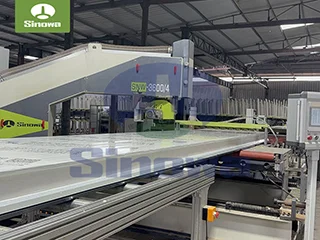
The overall structural design of rockwool sandwich panel machine follows the integrated production concept of streamlined assembly line, and the whole equipment is composed of multiple interconnected functional modules, each of which undertakes independent processing tasks and realizes synchronous coordination through the central control system. The basic composition of the equipment includes raw material unwinding mechanism, surface plate leveling and forming mechanism, automatic gluing system, rockwool core material conveying and arranging mechanism, composite pressing mechanism, constant temperature curing system, fixed-length cutting mechanism, finished product conveying and stacking mechanism, as well as intelligent electrical control system. Every structural part is designed based on mechanical ergonomics and production continuity principles, and the connection between modules adopts optimized transmission structures to reduce mechanical vibration and transmission resistance during long-term operation. The main frame of the machine is made of high-strength metal materials with thickened welding structure, which can bear continuous mechanical pressure and material impact in the production process, effectively avoiding structural deformation and equipment loosening caused by long-time high-load operation. The surface of the frame is treated with anti-corrosion and wear-resistant coating to adapt to complex production environments such as high humidity and dust accumulation in industrial workshops, extending the overall service life of the equipment. In terms of transmission components, the equipment is equipped with precision transmission parts to ensure synchronous operation of each processing link, and the running speed of each module can be independently adjusted according to production requirements, realizing flexible matching of different production rhythms.
The raw material unwinding module is the starting unit of the entire production line, which is mainly responsible for placing and releasing metal coil raw materials used for the surface layer of sandwich panels. This module is equipped with a stable bearing and rotating structure, which can fix large metal coils and realize uniform and slow unwinding under mechanical traction. To avoid material deviation and tension fluctuation during unwinding, the module is embedded with tension sensing and automatic correction components. When the metal coil has lateral displacement in the conveying process, the correction device can dynamically adjust the feeding position to ensure that the metal plate is always conveyed along the set track. Meanwhile, the tension control system can sense the tightness of the coil in real time, automatically adjust the rotating speed of the unwinding shaft, maintain constant material tension, and prevent the metal plate from wrinkling, stretching or breaking due to excessive tension fluctuation. The structure of the unwinding module is reasonably compact, which saves the floor space of the production line, and the disassembling and replacing process of raw material coils is simple and labor-saving, reducing the time cost of material replacement in continuous production.
After the metal plate is unwound, it enters the leveling and forming mechanism for surface pretreatment and shape processing. The initial metal coil has certain internal stress and surface curvature, so the leveling process is essential to eliminate material deformation. This mechanism is composed of multiple groups of upper and lower parallel pressing rollers, which use the gradual pressure difference to flatten the curved metal plate, remove surface wrinkles and uneven depressions, and ensure the flatness of the subsequent composite processing surface. The number and arrangement density of pressing rollers are optimized according to the thickness and hardness of common metal plates, which can complete high-precision leveling without damaging the metal surface coating. After leveling, the metal plate will go through the rolling forming process. Through customized forming dies, the edge of the metal plate is pressed into specific grooves and connecting structures. These structural grooves can enhance the splicing tightness between adjacent finished panels in the later construction and installation process, improving the overall sealing performance and structural stability of the building enclosure. All forming dies are made of high-hardness alloy materials, with strong wear resistance and deformation resistance, which can maintain long-term processing accuracy after repeated extrusion.
The automatic gluing system is a key functional module to ensure the bonding strength between the metal surface plate and the rockwool core material, and its working accuracy directly determines the service life and structural stability of finished sandwich panels. This system consists of glue storage container, filtering device, quantitative conveying pump, circulating heating pipeline and uniform gluing nozzle. Before gluing, the adhesive is stored in a sealed container, and the internal filtering device can filter out impurities and precipitates in the adhesive to avoid nozzle blockage and uneven glue coating. The quantitative conveying pump accurately controls the output of adhesive according to the set parameters, realizing constant and uniform glue supply. Considering the fluidity characteristics of the adhesive, the circulating heating pipeline is designed to maintain the adhesive within the optimal temperature range, reducing the viscosity of the adhesive and improving the diffusion and penetration effect on the surface of rockwool and metal plates. The gluing nozzle adopts a streamlined dispersion structure, which can evenly spray the adhesive on the inner surface of the metal plate in a planar distribution state. There is no missing coating or excessive glue accumulation in the gluing area, which not only ensures the bonding firmness of the composite interface, but also avoids the waste of adhesive raw materials. In addition, the gluing system is equipped with an automatic cleaning pipeline. After the equipment stops running, the residual adhesive in the pipeline can be cleaned to prevent the adhesive from solidifying and blocking the pipeline.
The rockwool core material conveying and arranging mechanism is specially designed for the physical characteristics of rockwool materials. Rockwool is an inorganic fibrous material with loose internal structure, certain compressibility and fragility, so the conveying process needs to avoid excessive extrusion and fiber scattering. This mechanism is equipped with a flexible conveying mesh belt with anti-slip texture, which can stably transport bulk rockwool raw materials without damaging the internal fiber structure of rockwool. In the arranging link, the equipment adopts layered stacking and uniform spreading technology. The loose rockwool raw materials are evenly paved into continuous core material layers with fixed thickness through mechanical oscillation and leveling components. The thickness of the rockwool layer can be adjusted by changing the operating parameters of the leveling components to meet the production requirements of panels with different thermal insulation specifications. Meanwhile, the mechanism is equipped with a dust removal device, which can collect floating fiber dust generated during rockwool conveying and spreading, reduce dust accumulation in the production workshop, and optimize the internal production environment of the equipment. The arranged rockwool core material will be transported to the composite station at a constant speed, realizing precise docking with the glued metal surface plate.
The composite pressing mechanism is the core molding unit of the entire production line, undertaking the task of laminating the upper and lower metal plates with the rockwool core material into an integrated structure. This mechanism is composed of multiple groups of composite pressing rollers, which are arranged in an upper and lower symmetrical structure. The distance between the pressing rollers is adjusted according to the preset thickness of the finished panel, and stable mechanical pressure is applied to the composite material layer in the conveying process. The pressure value is controlled within a reasonable range through a hydraulic sensing system. Excessively high pressure will cause irreversible compression deformation of the rockwool core material and damage the internal fiber structure, while excessively low pressure will lead to insufficient bonding tightness and easy delamination of the finished panel. In the pressing process, the synchronous vibration assistance technology is adopted to make the adhesive fully infiltrate into the gap between rockwool fibers and the metal surface, enhance the adhesion effect of the composite interface, and eliminate tiny bubbles inside the composite layer. The surface of the pressing roller is covered with a wear-resistant and anti-sticking coating to prevent the adhesive from adhering to the roller body and affecting the surface flatness of the finished panel. After composite pressing, the preliminary integrated rockwool sandwich panel forms a stable overall structure, and the bonding interface presents a compact and seamless state.
The constant temperature curing system is an indispensable part to accelerate the solidification of the adhesive and strengthen the composite strength of the panel. After preliminary pressing and molding, the adhesive has not yet completed the curing reaction, and the overall structural strength of the panel is low. The curing system builds a closed constant temperature space through thermal insulation plates and heating components. The internal temperature is evenly distributed through hot air circulation technology to avoid local overheating or low temperature. According to the chemical characteristics of different adhesives, the system can adjust the curing temperature and heating time to create the optimal curing reaction environment. In the constant temperature environment, the molecular reaction speed of the adhesive is accelerated, which shortens the curing cycle and enables the composite panel to rapidly form stable bonding strength. At the same time, the hot air circulation can take away the moisture and volatile substances generated during the adhesive curing process, reducing internal voids of the panel and improving the compactness of the finished product. The thermal insulation structure of the curing box can reduce internal heat loss, improve energy utilization efficiency, and avoid excessive energy consumption caused by long-term heating.
The fixed-length cutting mechanism realizes precise segmentation of continuous long plates to obtain finished panels that meet the size specifications. This mechanism is equipped with high-precision sensing and positioning components. When the composite panel is conveyed to the set length, the sensing device sends a cutting signal, and the cutting tool performs rapid vertical cutting. The cutting tool is made of high-speed wear-resistant alloy materials, with sharp cutting edges, which can complete smooth cutting of metal plates and rockwool core materials at one time without burrs, fractures and fiber scattering at the cutting section. The cutting speed is matched with the conveying speed of the production line to realize non-stop dynamic cutting, avoiding production interruption caused by static cutting and improving continuous production efficiency. In addition, the cutting mechanism is embedded with a dust collection and scrap recovery device, which can collect rockwool fiber debris and metal scraps generated during cutting, realizing centralized processing of production waste and reducing material waste. The cutting size parameters can be modified through the control terminal to adapt to the production requirements of panels with different lengths, realizing flexible switching of product specifications.
The finished product conveying and stacking mechanism is the terminal link of the production line, responsible for transporting the cut qualified panels to the designated area and completing automatic stacking. This mechanism adopts a flat conveying platform with stable operating speed, which can avoid sliding and collision of panels during transportation. The stacking part is equipped with a servo driving structure and automatic alignment components. According to the set stacking quantity and arrangement mode, the mechanical arm or stacking baffle is used to adjust the position of the panels, so that each layer of panels is neatly stacked without offset. The servo control technology ensures accurate positioning during stacking, and the gap between stacked panels is uniform, which meets the direct packaging standard of subsequent packaging equipment without manual secondary sorting and arrangement. For production scenarios requiring different panel placement directions, the mechanism can adjust the flipping and placing angle of the panels to meet diversified packaging and storage requirements. The whole stacking process is automated, which greatly reduces manual handling work, lowers labor intensity, and avoids surface scratches and structural damage to panels caused by manual contact.
The intelligent electrical control system is the brain of the entire rock wool sandwich panel machine, realizing centralized management and synchronous control of all functional modules. The system is equipped with a human-computer interaction touch screen, which displays the operating parameters of each unit in real time, including conveying speed, gluing volume, pressing pressure, curing temperature, cutting length and stacking quantity. Operators can modify production parameters through the touch screen according to product specifications, and the system can automatically store parameter data to facilitate rapid calling in subsequent repeated production. The internal circuit of the control system adopts modular wiring design, with independent protection components for each circuit. When a single module fails, it can automatically cut off the power supply of the corresponding circuit to avoid the fault from spreading to the whole equipment. In addition, the system has built-in fault diagnosis and early warning functions. It can monitor the operating state of mechanical parts and electrical components in real time. Once abnormal vibration, temperature rise or current fluctuation is detected, it will send out prompt signals and record fault data, providing accurate reference for later maintenance and troubleshooting. The simple and intuitive operation logic reduces the difficulty of equipment operation, and operators can master the basic operation procedures after simple training.
Compared with other types of composite board production equipment, rockwool sandwich panel machine has prominent technical advantages in structural design, production performance and product adaptability. In terms of production continuity, the equipment realizes fully automated assembly line operation from raw material feeding to finished product stacking, with few manual intervention links, effectively reducing human error in the production process and improving product consistency. In terms of molding accuracy, the equipment adopts multi-point correction and precise transmission technology. The flatness error of the surface of the finished panel is controlled within a tiny range, and the thickness uniformity of the rockwool core material is excellent, which ensures the stable physical properties of each batch of products. In terms of material adaptability, the equipment can match rockwool raw materials with different densities and metal plates with different thicknesses. By adjusting operating parameters, it can produce panels for different usage scenarios, covering lightweight decorative panels and heavy-duty load-bearing thermal insulation panels. In terms of operational stability, the equipment is equipped with multiple shock absorption and noise reduction structures. The vibration amplitude during high-speed operation is small, and the mechanical noise is controlled within a low range, which improves the working environment of the production workshop. Meanwhile, the optimized mechanical transmission structure reduces the friction loss between parts, lowers the failure rate of the equipment, and extends the continuous operating time.
The finished rockwool sandwich panels produced by this equipment inherit the excellent performance characteristics of raw materials, and the reasonable processing technology further amplifies the comprehensive advantages of the products. In terms of fire resistance, the inorganic rockwool core material does not burn or release toxic smoke when encountering high temperature, and the composite compact structure can prevent the spread of flame, meeting the fire protection requirements of public buildings and industrial plants. In terms of thermal insulation, the porous fibrous structure of rockwool can lock static air, effectively block heat conduction and heat radiation, and reduce the internal and external heat exchange of buildings, which is suitable for constant temperature storage buildings and temperature-controlled industrial workshops. In terms of sound insulation and noise reduction, the internal staggered fiber structure of rockwool can absorb and weaken sound waves, reducing noise transmission, so the panels can be used for sound insulation decoration of factory workshops and public entertainment spaces. In terms of structural performance, the composite structure of metal plate and rockwool has good compression resistance and bending resistance. The surface metal plate can resist external impact and atmospheric erosion, and the service life of the panel is significantly prolonged. In addition, the finished panel has the characteristics of light weight and easy installation. The standardized size design simplifies the on-site splicing process, shortens the construction cycle, and reduces the comprehensive construction cost.
In the daily production and application process, standardized maintenance and maintenance work is crucial to maintain the long-term stable operation of rockwool sandwich panel machine. The daily maintenance work includes surface cleaning, component inspection and lubrication maintenance. After the equipment stops running every day, the floating dust, residual adhesive and fiber debris on the surface of each module need to be cleaned to prevent impurities from accumulating and affecting the transmission accuracy and heat dissipation performance of the equipment. The staff should regularly check the tightness of connecting bolts, the wear degree of transmission belts and the sensitivity of sensing components, and replace severely worn parts in a timely manner to avoid mechanical failure during operation. For rotating and friction parts such as pressing rollers and transmission shafts, high-performance lubricating oil should be regularly injected to reduce friction loss between metal parts and prevent rust and jamming of parts. In terms of regular maintenance, the internal pipeline of the gluing system should be disassembled and cleaned regularly to remove solidified adhesive residues; the heating components and air circulation pipelines of the curing system should be inspected to ensure uniform internal temperature; the cutting tool should be polished regularly to maintain cutting sharpness. In addition, the electrical control box should be kept dry and ventilated to avoid short circuit failure caused by moisture and dust accumulation in the circuit. Scientific maintenance can effectively reduce the failure rate of the equipment, prolong the service life of mechanical parts, and ensure the long-term stable output of high-quality finished panels.
With the continuous progress of industrial manufacturing technology and the improvement of building environmental protection standards, the development direction of rockwool sandwich panel machine is gradually moving towards higher intelligence, energy saving and environmental protection, and multi-functional integration. In terms of intelligent upgrading, the equipment will be combined with data monitoring and remote control technology to realize real-time uploading of production data, remote parameter adjustment and remote fault diagnosis. The automatic identification system can judge the raw material state and automatically match the optimal production parameters, further reducing manual operation intervention. In terms of energy saving optimization, the heating structure and transmission system of the equipment will be further optimized. The waste heat generated by the curing system can be recycled, and the energy consumption of mechanical transmission can be reduced through lightweight structural design, so as to realize energy conservation and emission reduction in the production process. In terms of environmental protection improvement, the dust removal and waste recovery system will be upgraded to realize full closed collection of fiber dust and processing scraps, reduce workshop dust concentration, and improve the green production level of the equipment. In terms of functional expansion, the equipment will realize the compatible production of various composite panels. On the premise of maintaining the production capacity of rockwool panels, it can adapt to the processing requirements of different core materials, improve the utilization rate of production lines, and meet the diversified production needs of processing enterprises.
From the perspective of industrial development, rockwool sandwich panel machine occupies an important position in the field of building material processing and manufacturing. With the acceleration of infrastructure construction in various regions, the market demand for energy-saving, fire-resistant and environmentally friendly building enclosure materials continues to rise. Rockwool sandwich panels, as a typical high-performance environmental protection building material, have irreplaceable application advantages in many special construction scenarios, which provides a broad market space for the development of supporting production equipment. At the same time, the updating and iteration of rockwool sandwich panel machine also promotes the technological progress of the building material industry. The optimized production process not only improves the production efficiency of panels, but also optimizes the internal structure and performance of finished products, making building materials more in line with modern building safety, environmental protection and energy-saving standards. For processing enterprises, selecting high-performance rockwool sandwich panel machine and formulating standardized production and maintenance management systems can effectively reduce production costs, stabilize product quality, and enhance market competitiveness in the fierce building material market competition.
In conclusion, rockwool sandwich panel machine is a comprehensive and intelligent automated production equipment integrating mechanical transmission, electrical control, chemical curing and material molding technology. Its scientific and reasonable structural design, perfect production process and excellent operational performance meet the mass production requirements of high-quality rockwool sandwich panels. Each functional module of the equipment cooperates closely to complete the whole process from raw material processing to finished product output, and the produced panels have multiple excellent physical properties, which are widely applicable to various industrial and civil construction fields. With the continuous innovation of mechanical manufacturing technology and the continuous improvement of building industry standards, rockwool sandwich panel machine will continue to carry out technological upgrading in intelligence, energy saving and environmental protection. In the future, this type of equipment will play a more important role in the lightweight, green and standardized development of the construction industry, providing reliable equipment guarantee for the production of high-performance building materials and promoting the sustainable development of the whole building material manufacturing industry. In the actual production application, only by deeply understanding the operating principle of the equipment, standardizing the production operation process and doing a good job in daily maintenance can the maximum production efficiency of the equipment be exerted, the production cost be optimized, and stable and high-quality product supply be realized for the construction market.
https://www.cnsinowa.com/sandwich-panel-machines/rockwool-sandwich-panel-machine.html