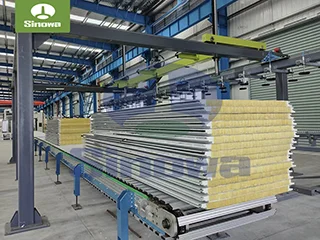
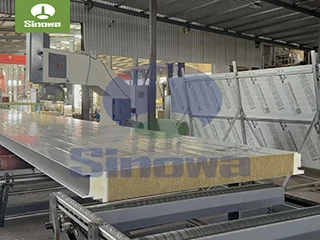
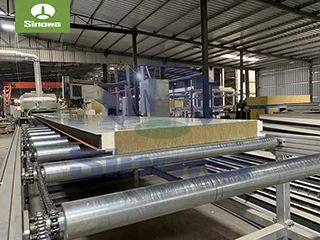
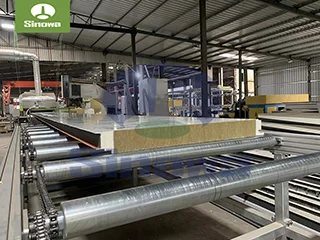
 sandwich panel line
A complete fireproof rock wool sandwich panel production system consists of multiple interconnected and coordinated functional modules, each undertaking independent production tasks while forming a seamless production chain to ensure the continuity and stability of the entire production process. The overall structural design of the rockwool sandwich panel production line follows the principles of streamlined operation and modular configuration, covering raw material pretreatment, core material processing, metal plate forming, composite bonding, integral curing, fixed-size cutting and finished product sorting. Every functional unit is precisely calibrated in mechanical operation and process matching, which can effectively avoid production errors caused by manual intervention and greatly improve the consistency and uniformity of finished panel products. The reasonable layout of the production line also optimizes the production space, reduces the transfer distance of semi-finished products in the production process, and further enhances the overall production efficiency while lowering operational energy consumption.
Raw material pretreatment is the initial and foundational link of the entire production process, which directly determines the basic performance and molding effect of subsequent finished products. The main raw materials involved include metal coil materials for outer protection and rock wool raw materials for internal thermal insulation and fire prevention. For metal coil materials, the rock wool sandwich panel production line is equipped with automatic unwinding and leveling devices, which can smoothly release coiled metal materials and eliminate the bending and deformation stress generated during coil storage. After leveling, the metal sheets will go through surface cleaning and fine flattening processes to remove dust, oil stains and other impurities on the surface, ensuring a clean and flat base for subsequent composite bonding. Meanwhile, the rock wool raw materials used in the production line are processed through high-temperature melting and centrifugal fiber forming in the early stage. Natural mineral raw materials are melted at ultra-high temperature and centrifuged into fine inorganic fibers, which are then stacked into uniform rock wool wool layers through three-dimensional swinging and lapping technologies. This fiber stacking mode forms a dense three-dimensional intertwined structure, laying a solid foundation for the excellent fire resistance, thermal insulation and sound insulation performance of the final panels.
The core material shaping and laying process is a key step to endow the sandwich panels with stable fireproof and thermal insulation functions. In this link, the rock wool board production line adopts precise pendulum laying and wool homogenizing technologies to arrange rock wool fibers in a uniform and orderly manner, avoiding hollowing, uneven density and local thinning of the core material. The equipment is equipped with an automatic slag removal structure, which can effectively filter out unreacted slag balls and impurity particles in rock wool fibers, ensuring the purity and compactness of the core material. After homogenization and impurity removal, the rock wool wool layer will be pre-compressed and shaped to form a continuous and flat core material belt with uniform thickness and density. The density of the rock wool core layer can be adjusted according to different usage scenarios and performance requirements, forming countless tiny fixed air chambers inside the fiber structure. These air chambers can effectively block heat conduction and sound wave transmission, enabling the panel products to obtain low thermal conductivity and good sound absorption and noise reduction effects. In addition, the continuous laying structure avoids gap breakage of the core material, ensuring the overall fireproof integrity of the sandwich panels and preventing fire spread through material gaps.
Metal plate rolling and forming is an important process to shape the outer protective structure of sandwich panels. After pretreatment, the flat metal sheets are sent to the continuous rolling forming unit of the rock wool sandwich panel line, through multiple groups of precision roller sets for gradual bending and rolling. The rolling process adopts segmented pressure regulation and speed matching technology, which can avoid metal plate cracking and surface scratch damage caused by excessive force or uneven rolling speed. Through the set roller profile parameters, the metal sheets can form standard corrugated or flat plate structures with stable mechanical strength, effectively improving the overall rigidity and load-bearing capacity of the panels. The formed metal outer plates have good weather resistance and structural stability, which can protect the internal rock wool core material from external environmental erosion such as wind, rain and ultraviolet radiation, and extend the service life of the panels in complex application environments. Before composite molding, the metal plates will also undergo preheating treatment, which can activate the surface molecular activity, enhance the bonding force between the metal plate and the rock wool core material and adhesive, and avoid degumming and layering of the panels in long-term use.
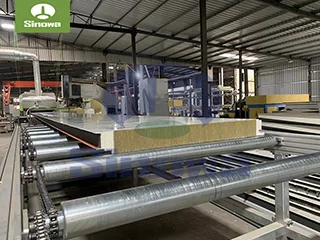
Composite bonding and integral curing are the core molding links of the rock wool sandwich panel machine, determining the structural firmness and comprehensive performance stability of finished sandwich panels. The production line adopts automatic gluing and composite pressing technology, with a precise quantitative gluing system that can evenly coat high-performance adhesive on the bonding surfaces of metal plates and rock wool core materials. The quantitative gluing mode effectively avoids quality problems such as insufficient bonding strength caused by insufficient glue amount and panel bulging caused by excessive glue accumulation. After gluing, the upper and lower metal plates and the middle rock wool core layer are accurately aligned and sent to the composite pressing unit for continuous flat pressing. The pressing process maintains constant pressure and uniform speed, so that the adhesive can fully infiltrate the fiber gaps of the rock wool core material and fit closely with the metal plate surface to form an integrated composite structure. Subsequently, the initially composited semi-finished panels enter the constant-temperature curing system for fixed-time curing treatment. The stable curing temperature and air circulation environment promote the full curing and cross-linking of the adhesive, forming a high-strength bonding layer, which makes the metal plates and rock wool core material integrated permanently, effectively resisting structural separation and deformation caused by external force extrusion and temperature changes.
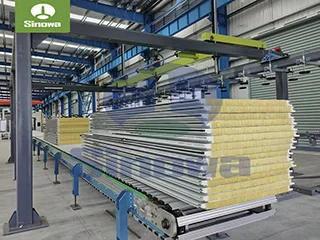
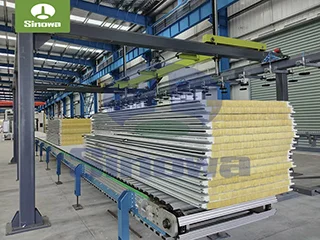
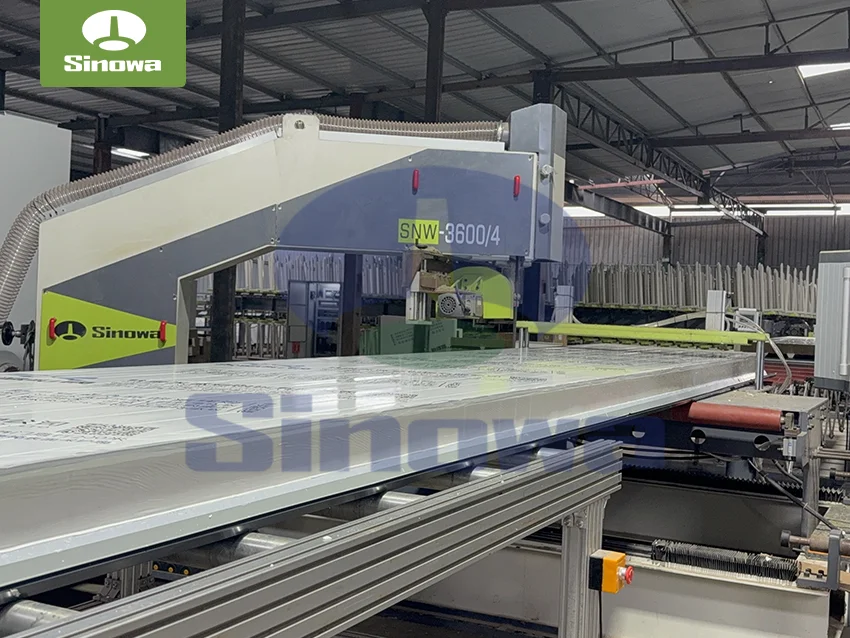
Fixed-size cutting and post-processing are the final finishing processes of the rockwool sandwich panel machine, realizing the standardized sizing and quality optimization of finished products. The continuous composite plates output from the curing unit are transported to the automatic cutting unit through the conveying system. The high-precision cutting system can set arbitrary length and width parameters according to production requirements, and complete fast and smooth cutting through high-speed cutting tools. The cutting process has the characteristics of flat incision, no burr and no fiber scattering, which ensures the neatness and assembly accuracy of the panel ends. After cutting, the finished panels will go through surface inspection, edge trimming and flatness correction processes to remove minor defects generated in the production process. The entire cutting and post-processing process is automatically controlled by the system, which not only ensures the uniform size specification of each batch of products, but also greatly improves the production efficiency and reduces the loss of raw materials. Finally, the qualified finished panels are automatically sorted and stacked by the stacking device, which is convenient for subsequent transportation and storage.
The advanced process configuration of the fireproof rock wool sandwich panel manufacturing line endows the produced panels with outstanding comprehensive performance, especially prominent fireproof safety performance. The rock wool core material is an inorganic non-combustible material with stable high-temperature resistance, which will not burn or support combustion in high-temperature fire environments, nor will it release toxic and harmful gases. The dense fiber structure can effectively isolate high-temperature heat flow and prevent rapid heat transfer, which can delay the spread of fire and reduce the loss of building structures and personnel safety risks in case of fire. In addition to excellent fire resistance, the products also have excellent thermal insulation and energy-saving effects. The intertwined fiber structure and internal closed air chambers can greatly reduce heat conduction efficiency, effectively isolate indoor and outdoor heat exchange, reduce the energy consumption of building heating and cooling, and meet the energy-saving and environmental protection requirements of modern green buildings.
In terms of structural performance, the sandwich panels produced by this production line have the dual advantages of light weight and high strength. The overall composite structure combines the high toughness of metal plates and the stable filling performance of rock wool core materials, which can bear certain external loads and resist bending and deformation. The light weight of the panels reduces the self-weight of building structures, lowers the load-bearing requirements of building foundations, and effectively saves construction costs and structural materials. At the same time, the product also has good sound insulation and noise reduction performance. The porous fiber structure of rock wool can absorb and weaken sound wave energy, reduce indoor and outdoor sound transmission, and create a quiet and comfortable indoor environment for industrial plants, public buildings and civil buildings. In addition, the integrated composite structure has good waterproof, moisture-proof and corrosion resistance, which can adapt to different climatic environments and maintain stable performance in long-term use.
In terms of production operation advantages, the fireproof rock wool sandwich panel machinery realizes highly automated integrated production, covering the whole process from raw material input to finished product output with minimal manual operation participation. The centralized control system can realize unified regulation of production speed, process parameters and equipment operation status, with real-time monitoring of equipment operating parameters and automatic early warning of abnormal conditions, which effectively reduces equipment failure rates and production safety risks. The modular design of the production line also brings strong production flexibility. By adjusting process parameters and replacing simple auxiliary components, the line can produce sandwich panels with different thicknesses, densities and appearance specifications, meeting the diversified product needs of different application scenarios. The continuous production mode greatly improves production efficiency, realizes large-scale and batch standardized production, and shortens the production cycle of building materials.
With the rapid development of the construction industry towards safety, greening and high efficiency, the market demand for high-performance fireproof insulation building materials is constantly increasing, and the application value of fireproof rock wool sandwich panel production machine is becoming increasingly prominent. The panel products produced by this equipment are widely applicable to the exterior and interior wall insulation, roof protection, partition structure setting of various industrial plants, logistics warehouses, public facilities and civil residential buildings. In special industrial places with high fire protection requirements, such as chemical workshops, power equipment rooms and storage places for flammable materials, these sandwich panels can provide reliable fire safety protection for building structures. In green building construction and energy-saving renovation projects, the excellent thermal insulation performance of the products can effectively improve the thermal performance of buildings and reduce building energy consumption, which is in line with the current development trend of energy conservation and emission reduction in the construction industry.
In the long-term industrial development perspective, the continuous optimization and upgrading of fireproof rock wool sandwich panel line technology is promoting the iterative upgrading of the entire building insulation material industry. The efficient and standardized production mode eliminates the performance differences of traditional handmade products, improves the overall quality level of fireproof insulation panels in the market, and provides more reliable material choices for building safety construction. At the same time, the rockwool sandwich panel making machine adopts energy-saving and low-consumption process design in the production process, which reduces energy waste and material loss in the production process, realizes green and low-carbon production, and conforms to the sustainable development concept of modern manufacturing industry. With the continuous improvement of building safety standards and energy-saving requirements, this type of intelligent production line will continue to play an important role in the field of building material manufacturing, and continuously promote the high-quality development of the construction and supporting building material industries.
https://www.cnsinowa.com/sandwich-panel-machines/fireproof-rock-wool-sandwich-panel-line.html