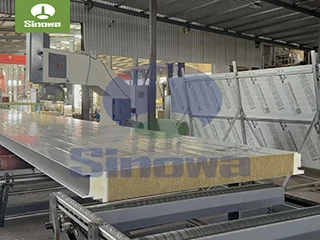
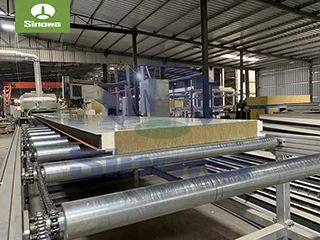
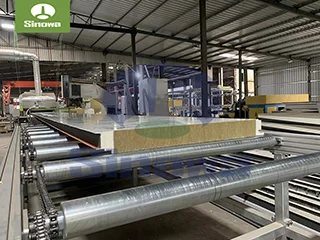
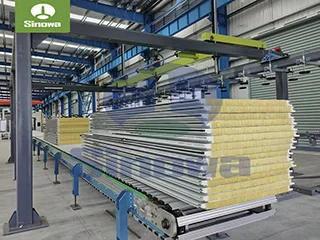
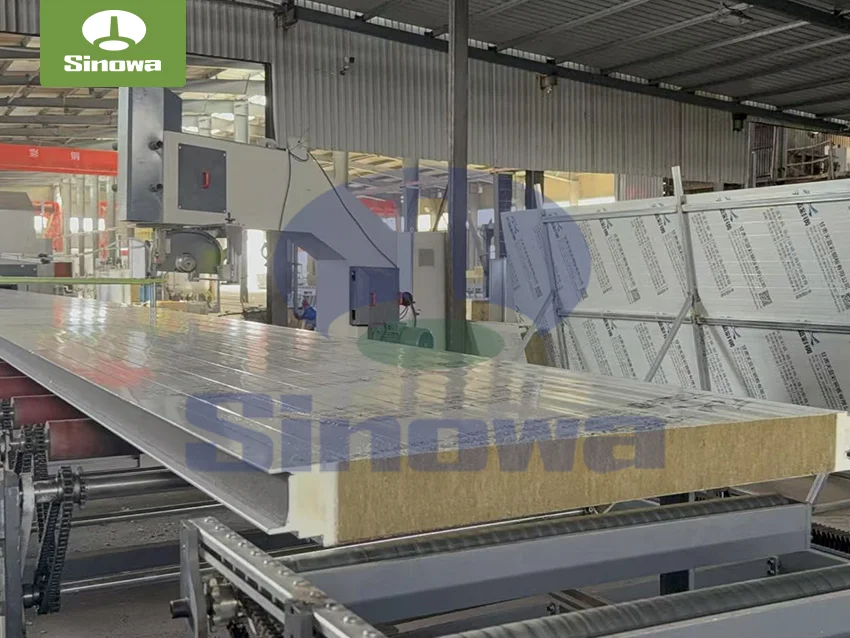
 sandwich panel line
The overall operational logic of the double track rock wool sandwich panel line follows a continuous and streamlined production mode, covering the whole process from raw material pretreatment to finished product shaping and sorting. The entire production flow starts with the unwinding and pretreatment of metal surface materials. Metal coils, serving as the outer protective layers of sandwich panels, are stably released through hydraulic unwinding devices, ensuring consistent tension and flatness of the sheet materials during feeding. This step eliminates the dimensional deviation and surface wrinkles caused by uneven material feeding, which is a key prerequisite for ensuring the surface flatness and structural accuracy of finished panels. After unwinding, the metal sheets go through multi-stage leveling and trimming processes to remove edge burrs and irregular parts, unify the width specification of the sheets, and create optimal surface conditions for subsequent adhesive coating and composite bonding. Meanwhile, the surface filming treatment is carried out to protect the metal surface from scratches and contamination during the subsequent high-temperature processing and mechanical extrusion processes, maintaining the finish and flatness of the panel surface.
While the metal surface materials are undergoing pretreatment, the independent rock wool core material processing system operates synchronously, realizing parallel production and greatly improving overall operational efficiency. Rock wool raw materials, known for their excellent thermal insulation, sound absorption, and fire resistance, are first screened and sorted to remove impurity-containing and unqualified raw materials, then cut and sized according to the preset production specifications. The core materials are arranged in a cross-layered and uniform stacking manner during processing, which effectively optimizes the internal density uniformity of the rock wool core layer and avoids local hollowing or uneven density that may affect the thermal insulation and structural stability of the panels. After precise cutting and shaping, the rock wool cores are transported to the composite docking station through a special conveying mechanism, achieving precise alignment with the upper and lower metal surface sheets. The dual-track structure plays a core role in this link: one track is responsible for the conveying and positioning of the upper metal sheet and rock wool core material, while the other track undertakes the conveying and calibration of the lower metal sheet, realizing synchronous docking and zero-error alignment of the upper and lower layers, and fundamentally improving the composite precision of the sandwich structure.
Adhesive coating treatment is an indispensable key process in the entire production flow, which directly determines the bonding strength and structural durability between the rock wool core and metal surface layers. The rock wool sandwich panel production line is equipped with an automatic uniform gluing system, which can quantitatively and evenly spray special structural adhesives on the inner surfaces of the upper and lower metal sheets and the upper and lower contact surfaces of the rock wool core material. The intelligent gluing control mode can adjust the glue application amount and coating range according to different panel thicknesses and usage environments, ensuring that the adhesive layer is thin and uniform without overflow or missing coating. This precise gluing process not only enhances the bonding compactness between layers but also avoids performance degradation caused by excessive adhesive accumulation or insufficient bonding gaps. Before formal composite pressing, the glued materials will go through a short preheating treatment, which activates the adhesive activity, accelerates the initial bonding reaction, and prepares for the subsequent high-pressure thermal curing process, making the interlayer bonding more firm and lasting.
Composite pressing and thermal curing constitute the core functional stage of the double track rock wool sandwich panel machine, and also the key link that distinguishes dual-track equipment from traditional single-track production lines. The aligned three-layer composite structure of metal sheet, rock wool core, and metal sheet is sent into the double-belt constant-temperature pressing equipment through the dual-track synchronous conveying system. The dual-track design enables the composite board to maintain a completely horizontal and stable conveying state during the whole pressing and curing process, avoiding the lateral offset, warping deformation, and thickness deviation that are prone to occur in single-track transmission. The pressing system provides continuous and uniform static pressure, which acts on the entire surface of the composite panel, ensuring that each area of the rock wool core and the adhesive layer is evenly stressed. Cooperated with the constant-temperature heating system inside the equipment, the adhesive undergoes a complete curing reaction under the dual effect of constant pressure and fixed temperature, forming a high-strength integrated bonding structure. The heating temperature and pressing time can be dynamically adjusted according to the material characteristics and panel specifications, ensuring that the adhesive is fully cured while preventing high-temperature damage to the physical properties of the rock wool core material such as fiber structure and porosity.
After completing thermal curing and preliminary shaping, the panels enter the cooling and shaping area for structural stabilization treatment. The high-temperature cured panels have a certain degree of thermal expansion stress internally, and rapid or uneven cooling will easily cause structural deformation and internal stress concentration. The rockwool sandwich panel production line adopts a gradual cooling mode combining forced air cooling and natural heat dissipation, which slowly reduces the panel temperature and releases internal stress evenly. This process further stabilizes the overall shape, interlayer bonding strength, and dimensional accuracy of the panels, effectively improving the flatness and structural stability of finished products. After cooling and shaping, the panels maintain consistent thickness and flatness in the whole section, and the interlayer bonding gap is completely eliminated, achieving integrated structural forming.
The post-processing stage of the rock wool board production line includes edge sealing, trimming, fixed-length cutting, and surface cleaning, which further optimizes the product quality and practical performance. Edge sealing treatment is carried out on the four sides of the initially formed panels, using flexible filling materials to seal the gaps at the edges of the rock wool core layer, which effectively prevents external moisture, dust, and air from penetrating into the core layer, and enhances the weather resistance and structural durability of the panels. For panels used in special building scenarios, edge reinforcement treatment can be completed through the reserved processing mechanism to meet higher structural stability requirements. Subsequently, the continuous long-size panels are accurately cut into standard fixed-length panels by the automatic tracking cutting device. The cutting system has high dimensional precision, ensuring that the incision is flat and free of burrs, and the length error of finished products is controlled within a tiny range. Finally, the residual adhesive and surface stains on the panel surface are cleaned automatically, and unqualified products generated in the production process are screened out through real-time quality detection.
The outstanding advantages of the double track rockwool sandwich panel line are fully reflected in production efficiency, product stability, and operational flexibility. Compared with single-track production equipment, the dual-track synchronous operation mode realizes the parallel progress of material pretreatment, core material processing, and composite molding, greatly shortening the single-cycle production time and significantly improving continuous production capacity. The dual-track synchronous positioning and conveying system completely solve the problem of asynchronous material transmission in traditional equipment, ensuring the consistency of the relative positions of each layer of materials in the high-speed production state, and making the dimensional accuracy and structural uniformity of batch-produced products far higher than those of single-track production lines. In terms of product performance, the uniform pressure and constant temperature curing environment provided by the double-track pressing system make the interlayer bonding strength of finished panels more stable, and the overall structural compactness is better, which can effectively avoid common quality problems such as interlayer delamination, core material displacement, and panel warping in long-term use.
In terms of production adaptability, this rockwool board production line has strong flexible production capacity and can meet the manufacturing requirements of rock wool sandwich panels with different thicknesses, widths, and structural types. By simply adjusting the track spacing, pressing pressure, heating temperature, and cutting parameters, the equipment can switch production specifications quickly, covering the production of thin-type light-duty panels for interior partition walls and thick-type high-strength panels for exterior wall enclosure and roof thermal insulation. The whole production process realizes mechanical and automatic continuous operation, reducing manual intervention links, not only lowering the labor cost and operational error rate in the production process but also improving the continuity and stability of batch production. The intelligent linkage control system realizes the synchronous operation of each functional unit of the production line, and the equipment can automatically adjust the operating parameters according to the production load, ensuring the optimal operating state of each process link at all times.
In practical industrial production applications, the double track rock wool sandwich panel manufacturing line has become the mainstream equipment for the mass production of high-quality building energy-saving and fireproof panels. The finished rock wool sandwich panels produced by this line integrate excellent thermal insulation, fire resistance, sound insulation, and structural stability, and can adapt to various complex building environments. The standardized and high-precision production mode of the equipment ensures that the physical properties of each batch of products are consistent, providing reliable basic materials for the construction of industrial plants, logistics warehouses, clean workshops, and public building enclosure structures. In addition, the streamlined production process of the equipment effectively reduces material waste in the production link, improves the utilization rate of rock wool core materials and metal raw materials, and realizes energy-saving and efficient production while ensuring product quality.
With the continuous upgrading of modern building energy-saving standards and building safety requirements, the market demand for high-performance rock wool sandwich panels is constantly improving, which also puts forward higher requirements for the precision, efficiency, and stability of supporting production equipment. The structural design and process layout of the double track rock wool sandwich panel line fully conform to the development trend of the building material manufacturing industry. Its dual-track collaborative operation mode, precise intelligent control system, and complete continuous production process can continuously output high-quality composite panels that meet modern building application needs. In the future, with the further optimization of automated control technology and processing technology, this rockwool sandwich panel machienry will further improve production intelligence and operational efficiency, expand the scope of adaptable product specifications, and provide more reliable and efficient technical support for the green and high-quality development of the modern construction industry.
https://www.cnsinowa.com/sandwich-panel-machines/double-track-rock-wool-sandwich-panel-line.html