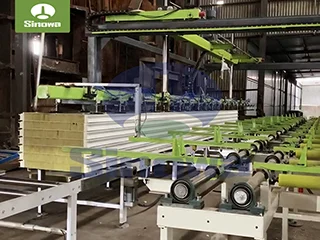
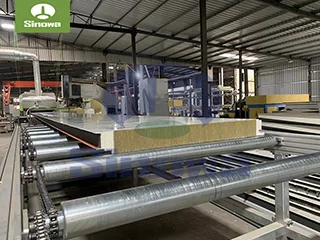
sandwich panel line
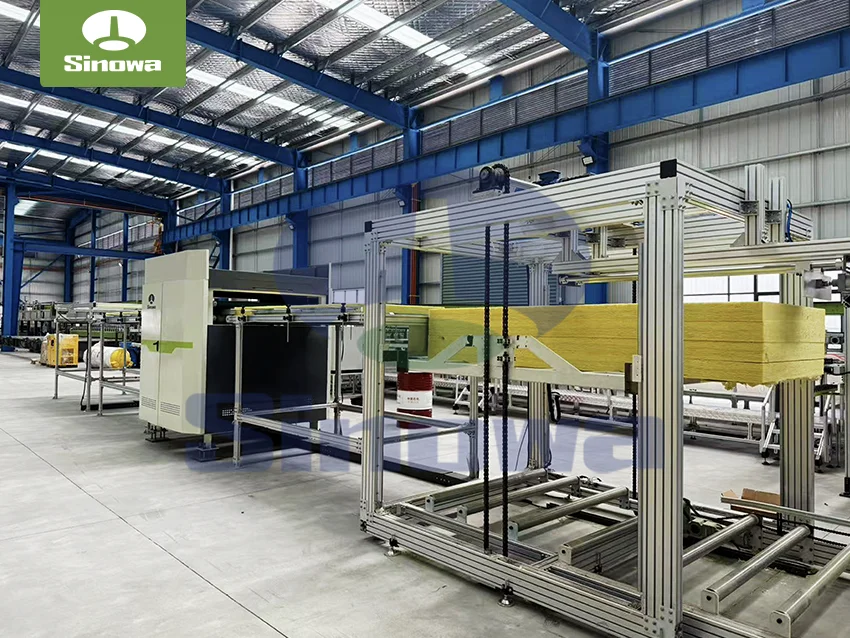
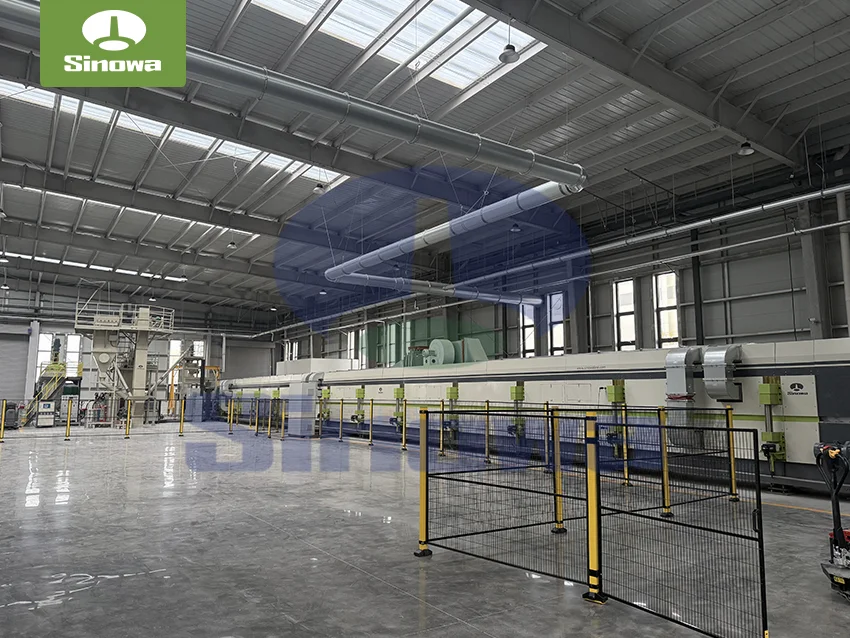
The overall structural design of a rockwool sandwich panel line follows the logic of continuous streamlined production, covering multiple functional units that operate in a coordinated and interconnected manner. Each functional module is precisely positioned and scientifically arranged to ensure the smooth flow of raw materials from the feeding link to the final finished product stacking link, minimizing material transfer dead zones and production time consumption. The basic composition of the production line includes raw material unwinding units, surface plate forming mechanisms, core material processing and laying systems, adhesive coating devices, high-pressure composite molding units, constant-temperature curing tunnels, precision cutting mechanisms, post-processing trimming equipment, and automatic stacking systems. In addition, auxiliary supporting systems such as electrical intelligent control modules, dust removal devices, and constant-temperature circulation systems are equipped to maintain the stable operation of the entire production process. All mechanical components are made of high-strength alloy materials with anti-corrosion and wear-resistant treatments, which can adapt to long-term continuous industrial production conditions and reduce equipment aging and failure rates caused by frequent mechanical friction and environmental humidity changes.
Raw material preparation is the initial and fundamental link in the entire production workflow, determining the basic performance and appearance quality of finished rockwool sandwich panels. The surface layer of the sandwich panel usually adopts metal sheets with excellent surface flatness and mechanical toughness, which are stored in the unwinding unit in a rolled state. The unwinding mechanism is equipped with a hydraulic automatic tension control system, which can maintain constant tension during the slow release of metal coils to avoid sheet wrinkling, stretching, or offset deviation caused by uneven stress. Before entering the forming process, the surface of the metal sheet will undergo preliminary cleaning and surface activation treatment to remove surface dust, oil stains, and oxide layers. This treatment enhances the bonding affinity between the metal sheet and the adhesive, effectively preventing the delamination phenomenon of the composite panel during long-term use. The core material of the panel is inorganic rockwool fiber with porous microstructures, which is processed into uniform strip-shaped raw materials in advance. The rockwool raw materials need to undergo density screening and fiber arrangement sorting to ensure that the internal fiber structure is dense and evenly distributed, eliminating hollow gaps and loose fiber areas that may affect thermal insulation and mechanical strength.
Surface plate cold roll forming is a key processing procedure that shapes the outer contour of the sandwich panel. After being unwound and pretreated, the metal sheet is transported to the cold roll forming unit through a servo-driven conveyor belt. This unit consists of dozens of groups of precision rolling rollers arranged in an orderly manner, and each group of rollers has an independent pressure adjustment structure. Through gradual rolling and bending, the flat metal sheet is processed into a fixed wave-shaped or flat plate structure with standardized edge folds. The whole forming process adopts a low-speed and stable rolling mode to avoid metal fatigue and surface coating damage caused by instantaneous strong extrusion. The forming accuracy of the metal sheet is strictly controlled within a tiny error range, ensuring that the upper and lower surface plates can be perfectly aligned with the rockwool core material in the subsequent composite process. Meanwhile, the edge sealing structure of the metal sheet is synchronously processed in this link, which enhances the overall airtightness and structural stability of the finished panel and prevents external moisture from penetrating into the internal fiber structure of the rockwool.
Core material arrangement and laying directly affect the internal uniformity and comprehensive performance of rockwool sandwich panels, and advanced pendulum cotton laying technology is widely adopted in modern production lines to complete this process. The sorted rockwool strips are transported to the cotton laying system through a sealed conveying pipeline, and the mechanical pendulum structure continuously and evenly spreads the rockwool materials between the upper and lower metal plates. Different from the traditional flat laying method, the pendulum laying technology can realize the vertical directional arrangement of rockwool fibers, making the fiber structure perpendicular to the surface of the metal plate. This special fiber arrangement mode significantly improves the compression resistance, shear resistance, and internal bonding strength of the core material. During the laying process, the intelligent detection sensor real-timely monitors the thickness and density of the rockwool layer. Once local uneven accumulation or material shortage is detected, the system will automatically adjust the operating frequency of the pendulum mechanism and the conveying speed of raw materials to ensure that the overall density of the rockwool core material remains consistent, avoiding performance differences in different areas of the same panel.
Adhesive coating and interfacial composite treatment are critical procedures to integrate metal plates and rockwool core materials into an organic whole. Environmentally friendly high-strength polymer adhesives are selected for production, which have excellent weather resistance, aging resistance, and bonding activity. The automatic gluing device evenly sprays the adhesive on the inner surfaces of the upper and lower metal plates in a quantitative and fixed-point manner. The gluing amount is accurately controlled by a microcomputer program according to the thickness and specification of the panel, so as to avoid bonding failure caused by insufficient glue amount or panel bulging caused by excessive glue accumulation. After the gluing operation is completed, the metal plates and rockwool core materials are sent to the high-pressure composite unit together. The composite unit adopts an up-down symmetrical pressing structure, and the hydraulic pressure system provides stable and uniform pressing force. Under the action of constant pressure, the adhesive fully infiltrates the tiny gaps between metal surfaces and rockwool fibers, forming a dense bonding interface. The low-temperature pre-pressing mode is adopted in the composite process to prevent the adhesive from undergoing premature chemical curing due to excessive temperature, which would lead to insufficient bonding compactness.
Constant-temperature curing treatment is an indispensable process to stabilize the bonding structure and enhance the overall rigidity of the composite panel. The initially composited semi-finished panels are continuously transported into an insulated curing tunnel with adjustable internal temperature. The interior of the curing tunnel is divided into multiple temperature gradient areas, realizing staged heating and constant-temperature maintenance. In the early stage of curing, the medium and low temperature environment promotes the slow flow and uniform diffusion of the adhesive to fill the microscopic gaps of the bonding interface completely. In the middle stage, the temperature is appropriately increased to accelerate the cross-linking chemical reaction of the adhesive molecules, forming a high-strength solid bonding layer. In the later stage, gradual cooling treatment is carried out to eliminate the internal stress generated by thermal expansion of the metal plate and rockwool materials during the heating process. The whole curing process is automatically controlled by an intelligent system, with real-time monitoring of temperature, humidity, and material transportation speed inside the tunnel. The closed tunnel structure effectively reduces heat loss, improves energy utilization efficiency, and avoids environmental pollution caused by volatile substances generated during adhesive curing.
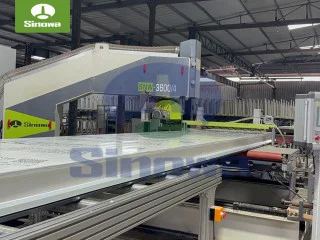
Precision cutting and edge trimming processes determine the dimensional accuracy and appearance smoothness of finished rockwool sandwich panels. After curing and shaping, the continuous long-strip composite panels are transported to the cutting area, where two sets of high-speed cutting equipment are configured for longitudinal slitting and transverse fixed-length cutting respectively. The longitudinal cutting mechanism trims the redundant edge materials on both sides of the panel to ensure that the width of the panel meets the preset production standard. The transverse cutting system uses digital positioning technology to complete fixed-length cutting according to customized dimensional requirements, and the cutting section is flat and smooth without burrs, cracks, or fiber falling off. All cutting tools are made of high-hardness alloy materials, with wear resistance and high-temperature resistance, which can maintain long-term cutting accuracy. After cutting, the edge trimming equipment performs fine polishing and sealing treatment on the cutting section to seal the exposed rockwool fiber section, preventing moisture absorption and fiber scattering of the core material, and further improving the durability of the panel in humid and complex environments.
The automatic stacking and temporary storage system is the final link of the production line, realizing the orderly collection and preliminary protection of finished panels. The cut qualified panels are transported to the stacking station through a flexible conveyor belt, and the mechanical gripper with anti-slip protection function automatically grabs and stacks the panels according to the set arrangement mode. The stacking height and spacing are intelligently adjusted to avoid surface extrusion scratches and structural deformation between panels. Meanwhile, the system is equipped with a counting and sorting module, which can classify and store panels of different specifications separately to facilitate subsequent centralized packaging and transportation. The closed temporary storage area is equipped with moisture-proof and dust-proof facilities to isolate external moisture, dust, and temperature changes, ensuring that the surface coating and internal structure of the finished panels remain stable before leaving the factory. The whole stacking process realizes unmanned automatic operation, which greatly improves production efficiency and reduces labor costs caused by manual handling.
The intelligent control system runs through the entire operation process of the rockwool sandwich panel line, serving as the intelligent brain to coordinate the operation of all functional modules. The system adopts a centralized integrated control mode, with a human-computer interaction touch screen set in the control room. Operators can input production parameters such as panel thickness, width, length, and production speed through the touch screen. The background program automatically adjusts the operating parameters of each mechanical unit to realize one-click switching of different production specifications. A large number of high-precision sensors are installed inside each processing unit to real-timely collect data such as mechanical operating speed, pressure, temperature, and material thickness. Once abnormal conditions such as equipment jamming, parameter deviation, and material shortage occur, the system will automatically trigger an alarm prompt and execute emergency shutdown protection to avoid equipment damage and unqualified product production. In addition, the system has a data storage and statistical function, which can record daily production output, product qualification rate, and equipment operation status, providing accurate data support for production management and process optimization.
In terms of production performance advantages, the modern rockwool sandwich panel line has obvious characteristics of high efficiency, stability, and flexibility. The continuous streamlined production mode breaks the limitation of intermittent processing in traditional single machines, realizing uninterrupted feeding, processing, and forming, and the production speed can be dynamically adjusted according to production demands. The integrated mechanical structure reduces intermediate material transfer links, effectively lowers the risk of panel surface damage and structural deviation during transportation. The production line has strong production flexibility, which can quickly adapt to the production requirements of panels with different thicknesses, surface shapes, and structural specifications. The replacement of production molds and parameter adjustment can be completed in a short time, meeting the diversified customized production needs of the market. At the same time, the production line is designed with energy-saving optimization structures, such as heat circulation recovery devices in the curing tunnel and low-energy consumption servo motors, which effectively reduce energy consumption per unit product and realize energy-saving and environmentally friendly production.
The product quality control capability of the production line runs through the whole production cycle from raw material input to finished product output. In the raw material inspection link, the system is equipped with an automatic material quality detection device to screen unqualified metal coils and rockwool raw materials to prevent inferior raw materials from entering the production process. In the intermediate processing link, real-time monitoring is carried out on key indicators such as sheet forming flatness, adhesive coating uniformity, and composite pressure stability to eliminate defective products in the bud. After the panels are formed, the online nondestructive testing technology is used to detect the internal bonding compactness and structural uniformity of the panels. The unqualified products with delamination, hollowing, and uneven thickness are automatically screened out and sent to the reprocessing area. The standardized and systematic quality control mode ensures that the batch-produced rockwool sandwich panels have stable mechanical properties, consistent appearance quality, and low product defect rate.
From the perspective of product application performance, the rockwool sandwich panels produced by the advanced production line have multiple excellent functional characteristics. Relying on the porous fiber structure of rockwool core material and the dense composite structure, the panels have outstanding thermal insulation performance, which can effectively block the heat transfer between spaces and reduce the energy consumption of building temperature regulation. The inorganic rockwool fiber has non-combustible characteristics, giving the panel good fire resistance, which can delay the spread of flames and meet the safety requirements of high-fire-risk buildings. In terms of sound insulation, the internal staggered fiber structure can absorb and weaken sound waves, reducing noise transmission between adjacent spaces. In addition, the metal surface layer has high structural strength and weather resistance, which can resist external wind pressure, rain erosion, and ultraviolet aging, adapting to long-term use in high-temperature, low-temperature, humid, and other harsh environments. The integrated integral structure formed by high-pressure composite avoids the problem of easy separation of traditional assembled plates, improving the overall structural stability and service life of the panels.
In the industrial application field, rockwool sandwich panels manufactured by professional production lines are widely used in various construction scenarios. In industrial factory buildings, the panels are used for factory wall enclosures, roof structures, and partition walls, meeting the requirements of industrial buildings for fire prevention, heat preservation, and rapid construction. In public buildings such as shopping malls, exhibition halls, and office buildings, the lightweight and easy-to-install characteristics of the panels simplify the building enclosure structure and shorten the construction cycle. In special industries such as chemical engineering, pharmaceuticals, and food processing, the panels with corrosion resistance and clean surface are adopted to build closed production workshops, meeting the industry's requirements for environmental hygiene and safety. In temporary engineering facilities such as mobile isolation rooms and construction temporary houses, the convenient assembly and disassembly performance of the panels improves the reuse rate of building materials and reduces engineering construction costs.
Daily maintenance and scientific management are important guarantees to prolong the service life of the rockwool sandwich panel line and maintain stable production efficiency. The daily maintenance work includes regular cleaning of mechanical surfaces, removal of surface dust and adhesive residues, and lubrication treatment of rotating parts such as rolling rollers and transmission gears to reduce mechanical friction loss. The sealing performance of the curing tunnel and conveying pipeline is inspected regularly to prevent heat loss and material leakage. The electrical control components and sensor devices are calibrated and maintained periodically to ensure the accuracy of parameter detection and instruction execution. In terms of production management, enterprises need to formulate standardized operation procedures to regulate the operating steps of staff, avoid equipment failure caused by misoperation. Meanwhile, the wearing parts such as cutting tools and sealing gaskets are regularly checked and replaced to ensure the continuous and stable operation of the production line.
With the continuous progress of industrial manufacturing technology and the upgrading of building material industry standards, the rockwool sandwich panel line is developing in the direction of higher automation, intelligent integration, and green environmental protection. In terms of technological upgrading, more advanced intelligent sensing technology and digital twin technology will be applied to the production line to realize real-time simulation and visual monitoring of the production process, further improving production accuracy and product consistency. In terms of structural optimization, the production line will adopt a more compact integrated design to reduce floor space occupancy and improve the utilization rate of factory space. In terms of environmental protection optimization, the waste gas and dust generated in the production process will be recycled and purified in a closed cycle, and the excess edge materials will be automatically crushed and recycled to realize resource regeneration. In addition, the production line will strengthen the compatibility of diversified raw materials, which can adapt to the processing requirements of new environmentally friendly core materials and high-performance surface plates, and continuously expand the application scope of finished panels.
In conclusion, the rockwool sandwich panel production line is a highly integrated and systematic industrial production system, which integrates multiple advanced mechanical manufacturing and material processing technologies. From raw material pretreatment to finished product stacking, each production link has precise mechanical logic and technological principles, and the coordinated operation of multiple functional modules realizes efficient and standardized production of composite panels. The excellent production performance and perfect quality control system of the production line endow rockwool sandwich panels with stable and diverse application characteristics, making them occupy an important position in the modern building material market. With the continuous improvement of social requirements for building safety, energy conservation, and environmental protection, the market demand for high-quality rockwool sandwich panels will continue to rise, which will further promote the technological innovation and iterative upgrading of the production line. In the future, the continuous optimization of production line technology will not only improve the production efficiency and product quality of sandwich panels but also make greater contributions to the high-quality development of the global construction industry and the realization of green and energy-saving building goals.
https://www.cnsinowa.com/sandwich-panel-machines/rockwool-sandwich-panel-line.html