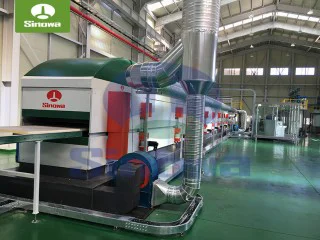
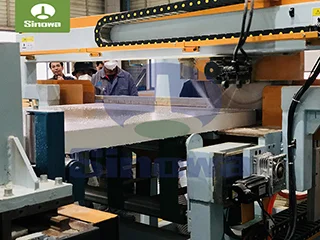
sandwich panel line
Raw material preparation constitutes the initial and foundational stage of the entire phenolic resin panel production line, and the rational selection and precise proportioning of raw materials directly determine the fundamental performance of finished panels. The core raw materials of phenolic resin mainly include phenolic compounds and aldehyde compounds, among which common phenolic raw materials cover phenol, resorcinol, and xylenol, while aldehyde raw materials are primarily composed of formaldehyde and furfural. These chemical raw materials need to meet strict purity standards to avoid the interference of impurity components on the polycondensation reaction and the long-term stability of the final panels. In addition to the main resin synthesis raw materials, various auxiliary materials are indispensable in the production process. Catalysts are added to regulate the rate and degree of the polycondensation reaction, with acidic substances such as hydrochloric acid, phosphoric acid, and oxalic acid, as well as alkaline substances including sodium hydroxide and ammonia water, serving as commonly used catalytic components. Reinforcing substrates are key carriers for shaping the mechanical structure of phenolic panels, and fibrous or sheet materials such as kraft paper, glass fiber cloth, and wood veneer are widely adopted to enhance the tensile strength, bending resistance, and overall structural toughness of composite panels. Meanwhile, a small amount of functional additives including flame retardants, thermal stabilizers, and corrosion inhibitors are incorporated to further optimize the environmental adaptability of the panels, enabling them to maintain stable performance under extreme temperature and chemical erosion conditions. Before feeding into the production line, all raw materials need to undergo preprocessing procedures: solid raw materials are crushed and screened to ensure uniform particle size, liquid raw materials are filtered to remove suspended impurities, and reinforcing substrates are dried to control internal moisture content, eliminating the adverse impact of excess moisture on resin bonding and panel molding.
The resin synthesis unit acts as the core reaction module of the phenolic resin panel line, undertaking the task of converting mixed chemical raw materials into qualified phenolic resin adhesives. This unit is mainly equipped with sealed reaction kettles, constant temperature heating systems, circulating stirring devices, and distillation condensation components. The pre-proportioned raw materials are quantitatively transported into the reaction kettle through automatic feeding pipelines, and the internal stirring blades operate at a stable rotation speed to achieve uniform mixing of raw material components. In the reaction stage, the temperature inside the kettle is gradually raised to the preset reaction temperature range, and the exothermic characteristics of the polycondensation reaction will further increase the material temperature. The staff precisely control the reaction duration and temperature changes according to the expected resin polymerization degree, ensuring that the molecular structure of the phenolic resin reaches a stable cross-linking state. During the reaction process, small molecular by-products such as water will be continuously generated. The distillation and condensation system separates these by-products from the mixed materials through distillation columns and horizontal condensers, realizing the recovery and reuse of useful raw material components while reducing the discharge of industrial waste. The heating and cooling system of the reaction kettle adopts an intelligent temperature control mode, which can accurately adjust the internal temperature within a narrow fluctuation range, effectively avoiding product quality defects caused by excessive temperature difference. After the completion of the polycondensation reaction, the preliminary synthesized resin is slowly cooled to room temperature to reduce molecular activity, and then filtered and purified to remove unreacted raw material residues and macromolecular agglomerates, obtaining high-purity phenolic resin adhesives that meet the coating and bonding requirements of subsequent production processes.
Impregnation and coating procedures serve as the intermediate link connecting resin synthesis and panel molding, determining the uniformity of resin distribution on the surface and inside of reinforcing substrates. The processed sheet or fibrous substrates are continuously transported to the automatic impregnation tank through transmission rollers, where the liquid phenolic resin fully infiltrates the gaps of the substrate fibers under constant temperature and pressure conditions. To avoid uneven resin penetration caused by air accumulation inside the substrate, the impregnation unit is equipped with a vacuum exhaust structure, which extracts internal air in advance to ensure that the resin can completely fill the fiber gaps. The impregnation time and resin viscosity are strictly controlled during production: excessively high viscosity will lead to poor fluidity and incomplete infiltration, while overly low viscosity will cause excessive resin loss and reduced bonding strength. After completing the impregnation process, the excess resin on the substrate surface is scraped off by adjustable sizing scrapers to maintain a consistent resin attachment amount on each substrate. Subsequently, the resin-containing substrates are sent to the drying tunnel through a conveying system, where graded temperature drying is adopted to gradually evaporate volatile substances such as residual moisture and trace solvents. The drying temperature increases from low to high, and the internal hot air circulates evenly to prevent local overheating from causing resin premature curing and substrate deformation. The drying process not only optimizes the adhesion state between the resin and the substrate but also improves the flatness and rigidity of the semi-finished substrates, laying a solid foundation for subsequent lamination and hot pressing molding.
Lamination and hot pressing molding are the key molding stages of phenolic resin panels, which realize the permanent bonding of multiple layers of impregnated substrates and shape the overall structural specifications of the panels. According to the thickness and performance requirements of finished products, workers stack dried impregnated substrates in a fixed order, and the number of stacked layers is adjusted dynamically to meet different thickness standards. The stacked plate blanks are smoothly transported to the interior of the multi-layer hot press through an automatic feeding mechanism. Before formal pressing, the leveling system of the hot press finely adjusts the horizontal position of the plate blanks to avoid offset and wrinkling during the pressing process. The hot pressing process adopts a composite control mode of temperature, pressure, and time. The internal heating plate of the press continuously transfers heat to the plate blanks to promote the secondary cross-linking curing of the phenolic resin molecular structure. The mechanical pressure acts evenly on the surface of the plate blanks to eliminate internal gaps and squeeze out residual tiny bubbles, making the internal structure of the panels dense and uniform. In actual production, low-temperature long-time pressing and slow pressure relief strategies are commonly adopted to prevent quality defects such as surface bulges and internal cracks caused by rapid temperature and pressure changes. For panels with different thicknesses and density requirements, the production line can dynamically match pressing pressure and holding time through an adaptive control system. Thick and structurally complex panels require higher pressure and longer holding time, while thin and simple-shaped panels can complete curing molding within a shorter process cycle. The stable operation of the hot pressing unit directly affects the dimensional accuracy and structural stability of finished panels, and all process parameters are recorded in real time to provide data support for subsequent quality traceability and process optimization.
The cooling and shaping module is an indispensable post-molding processing unit in the phenolic resin panel line, which eliminates internal stress generated during hot pressing and stabilizes the physical shape of panels. The high-temperature panels discharged from the hot press have unbalanced internal molecular stress, and direct stacking and storage will lead to irreversible deformation such as warping and bending. Therefore, the hot-pressed semi-finished panels are first sent to the circulating cooling rack, where natural air cooling or circulating water cooling is used to reduce the panel temperature to room temperature at a uniform cooling rate. The cooling rack is equipped with a layered fixing structure to ensure that each panel is placed horizontally without mutual extrusion, maintaining excellent flatness during the cooling process. During the cooling period, the residual stress inside the panels is gradually released, and the cross-linked structure of the phenolic resin tends to be more stable, further improving the hardness and compression resistance of the panels. After cooling, the panels are transported to the trimming and cutting unit. Precision cutting equipment is used to trim the irregular edges of the panels, removing redundant edge materials generated during stacking and pressing. The cutting tool maintains a high rotating speed and sharp blade state to ensure smooth and burr-free cutting sections, avoiding micro-cracks on the panel edges. For panels requiring special shapes and hole positions, the production line is equipped with flexible drilling and grooving components to complete customized shaping processing, meeting the diversified size and shape requirements of different application scenarios.
Surface treatment and quality inspection procedures endow phenolic resin panels with excellent surface performance and qualified quality standards, completing the final processing link of the production line. The surface treatment process includes polishing, cleaning, and anti-aging coating. The polished panels are processed by fine abrasive belts to remove surface uneven textures and tiny scratches, presenting a smooth and flat surface state. High-pressure clean gas is used to blow away surface dust and residual debris to keep the panel surface clean. For panels used in outdoor and corrosive environments, a layer of transparent protective coating is evenly coated on the surface, which can isolate ultraviolet radiation, humid air, and chemical corrosives, effectively delaying the aging rate of the resin material and extending the service life of the panels. The quality inspection work runs through the entire production process, and the finished product inspection link conducts comprehensive performance testing from multiple dimensions. Staff use professional testing instruments to detect the dimensional tolerance, surface flatness, and structural density of panels, and sample panels are selected regularly to test mechanical properties such as tensile strength, bending strength, and impact resistance. Meanwhile, the internal compactness and bonding uniformity of panels are checked by non-destructive testing technology to eliminate hidden quality dangers such as internal gaps and poor bonding. Panels that meet all performance indicators are classified and stacked, while unqualified products are marked and sent to the reprocessing area for raw material recovery and secondary processing, strictly controlling the product qualification rate of the production line.
The mechanical structure and control system of the phenolic resin panel line determine the overall production efficiency and operation stability of the equipment. The entire production line adopts a modular integrated design, and each functional unit including raw material feeding, resin synthesis, impregnation drying, hot pressing molding, and finished product processing is closely connected through automated transmission devices. The transmission system adopts synchronous speed control technology to ensure the consistency of the operating speed of each link and avoid production stagnation and material damage caused by speed mismatch. In terms of material selection, the key equipment in contact with chemical raw materials is made of corrosion-resistant metal materials, which can resist the erosion of acidic and alkaline substances in the resin raw materials and prolong the service life of mechanical components. The temperature control system of the entire line realizes precise temperature monitoring and adjustment, and the temperature error of key reaction and processing links is controlled within a tiny fluctuation range, providing a stable temperature environment for resin reaction and panel molding. The intelligent control center integrates data collection, parameter adjustment, and fault alarm functions. It can monitor the operating status of each equipment component in real time, record key production parameters such as raw material ratio, reaction temperature, pressing pressure, and processing time, and automatically adjust the operating parameters according to the production requirements of different panels. When abnormal conditions such as equipment blockage and temperature fluctuation occur, the system will automatically trigger an alarm signal and execute emergency protection actions to ensure the safety and stability of the production process.
Production optimization and energy-saving improvement are important development directions of modern phenolic resin panel lines, aiming to balance production efficiency, resource utilization, and environmental protection performance. In terms of process optimization, manufacturers continuously adjust the raw material proportioning scheme to reduce the consumption of high-purity chemical raw materials while maintaining the inherent performance of panels. By optimizing the stirring mode and heating sequence of the reaction kettle, the reaction efficiency of phenolic resin is improved, and the reaction cycle is shortened. The hot pressing process is further optimized by adopting segmented pressure maintaining technology to make the internal pressure distribution of panels more uniform and reduce the generation of defective products. In terms of energy saving and consumption reduction, the production line is equipped with waste heat recovery devices, which collect and reuse the waste heat generated by drying tunnels and hot presses to preheat raw materials and transmission pipelines, effectively reducing energy consumption. The circulating water system realizes the closed-loop reuse of cooling water, minimizing water resource waste. For industrial waste generated during production, including unqualified semi-finished products, trimmed edge materials, and reaction by-products, professional recovery and regeneration technologies are adopted to realize secondary utilization of raw materials, reducing industrial waste discharge. In addition, the production line optimizes the sealing structure of each processing unit to prevent volatile chemical substances from escaping into the external environment, improving the cleanliness and safety of the production workshop and realizing green and low-carbon production.
The application fields of panels produced by phenolic resin panel lines are constantly expanding, covering multiple industries such as industrial manufacturing, architectural decoration, electronic electrical, and chemical engineering. In the industrial manufacturing field, these panels are used to produce anti-corrosion workbenches, mechanical insulation baffles, and wear-resistant backing plates, relying on their excellent mechanical strength and chemical corrosion resistance to adapt to long-term high-intensity working conditions. In the architectural decoration industry, the panels serve as partition boards, fireproof decorative boards, and outdoor wall protection boards, with outstanding fire resistance and weather resistance to maintain stable performance in complex building environments. The electronic and electrical industry applies phenolic resin panels to insulating structural parts and circuit support components, utilizing their good insulation performance to avoid current leakage and electrical short-circuit failures. In the chemical industry, the panels are used for anti-corrosion lining of storage tanks and reaction equipment, resisting the erosion of acidic, alkaline, and organic chemical reagents. With the continuous upgrading of industrial manufacturing standards, the market demand for customized phenolic panels is gradually increasing, which also promotes the continuous iterative upgrading of phenolic resin panel lines, requiring production lines to have more flexible production adjustment capabilities to meet the personalized production needs of different industries.
Looking at the long-term development trend, phenolic resin panel lines will develop in the directions of higher automation intelligence, more refined process control, and more environmentally friendly production modes. With the continuous integration of digital technology and industrial production equipment, the future production line will realize fully unmanned automatic operation from raw material feeding to finished product warehousing. Artificial intelligence algorithms will be used to predict and adjust production parameters, automatically identify potential quality hazards in the production process, and further improve product consistency and qualification rate. In terms of material innovation, the production line will be compatible with more new modified phenolic raw materials and composite reinforcing substrates, developing lightweight, high-strength, and multi-functional composite panels to expand the application boundary of phenolic resin materials. In terms of environmental protection upgrading, the waste gas and wastewater treatment system of the production line will be further optimized to realize zero discharge of harmful pollutants in the production process. Meanwhile, the production line will strengthen the research and development of renewable raw materials, reducing the dependence on non-renewable chemical resources. Driven by technological progress and market demand, the phenolic resin panel line will continue to mature and improve, providing more reliable and high-quality composite material products for various industries and making important contributions to the development of the modern composite material manufacturing industry.
https://www.cnsinowa.com/sandwich-panel-machines/phenolic-resin-panel-line.html