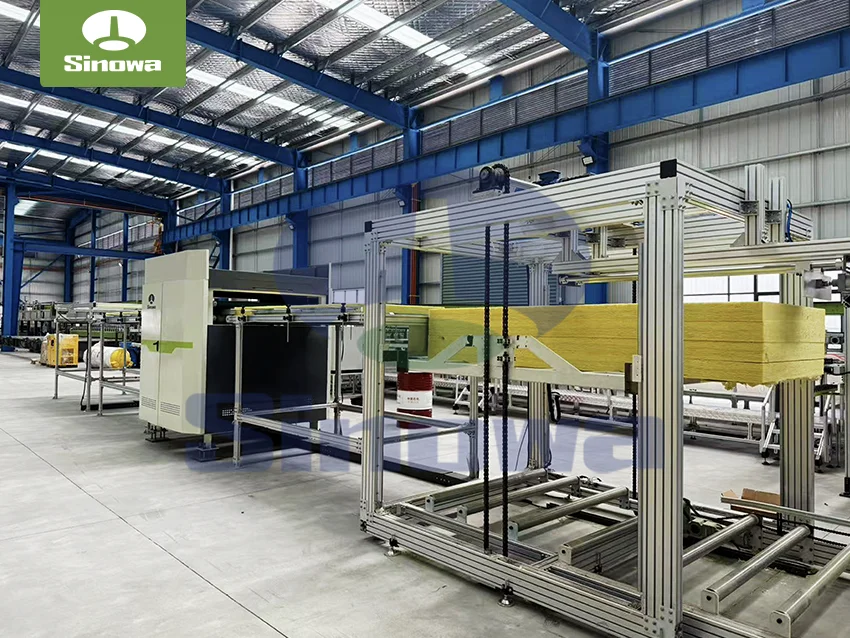
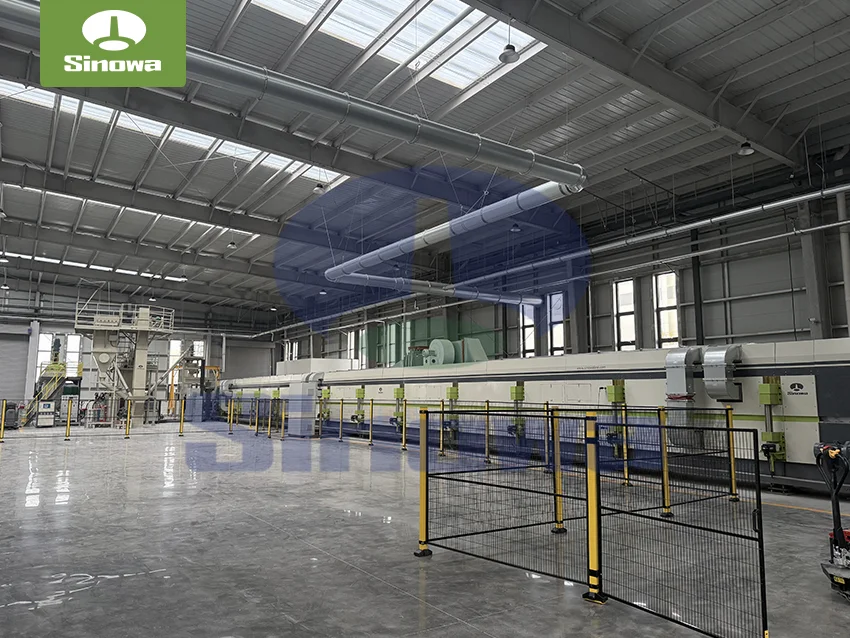
sandwich panel line
Raw material preparation constitutes the initial fundamental stage of the entire production process, laying a solid foundation for the quality stability of finished panels. The core raw materials mainly include phenolic resin monomers, reinforcing base materials, catalytic additives, and auxiliary modifiers. Phenol and formaldehyde serve as the primary synthetic monomers for resin preparation, and their purity and proportion directly affect the curing degree, bonding strength, and corrosion resistance of the final resin. Reinforcing base materials commonly adopt porous fiber substrates such as kraft paper, glass fiber cloth, and woven asbestos cloth. These substrates possess excellent tensile resistance and structural permeability, which can fully absorb resin liquid and form a compact composite structure after curing. Catalytic additives are divided into acidic and alkaline types, which are used to adjust the polymerization rate of raw monomers during the resin synthesis reaction, controlling the molecular weight distribution and viscosity of the resin liquid. Auxiliary modifiers are added in appropriate amounts to optimize the high-temperature resistance, waterproof performance, and toughness of the panels, reducing the brittleness defects inherent in traditional phenolic materials. Before formal processing, all raw materials need to undergo strict impurity removal and screening treatment. Solid raw materials are crushed and filtered to remove granular impurities, while liquid raw materials are kept at a constant temperature to maintain uniform fluidity, avoiding raw material agglomeration or component stratification that may affect subsequent processing effects.
Resin synthesis is a key chemical processing link in the phenolic insulation board production line, completed in sealed reaction vessels with precise temperature and pressure control systems. After proportioning according to the production formula, the measured raw materials are transported into the reaction vessel through closed conveying pipelines. The internal stirring device operates at a constant speed to mix all components evenly, eliminating local concentration differences of raw materials. In the early stage of the reaction, the heating system raises the internal temperature of the vessel to a stable reaction range, triggering the polycondensation reaction between phenol and formaldehyde. This chemical reaction is exothermic, so the production line is equipped with an intelligent temperature regulation module. When the internal temperature rises excessively due to reaction heat, the circulating cooling device automatically starts to dissipate heat, preventing resin molecular chain breakage or performance degradation caused by overheating. During the reaction process, volatile by-products generated by chemical decomposition are collected and processed through distillation and condensation systems. The condensed recyclable raw materials are reintroduced into the production cycle, while harmless waste gas is discharged after purification treatment to reduce resource loss and environmental impact. After reaching the preset reaction time and molecular polymerization degree, the resin liquid is cooled down to room temperature at a slow and uniform rate to complete the preparation of phenolic resin liquid with stable viscosity and good permeability.
Impregnation treatment determines the bonding uniformity and structural compactness between the resin and the reinforcing substrate, acting as an indispensable intermediate processing step in the phenolic panel production line. The qualified fiber substrates are continuously transported to the impregnation tank through an automatic feeding mechanism. The tank is filled with uniformly mixed phenolic resin liquid, and the internal liquid level is kept constant by an automatic liquid supply system to ensure consistent impregnation depth for each batch of substrates. As the substrates pass through the resin liquid at a stable transmission speed, the porous fiber structure fully absorbs the resin liquid under the action of natural penetration and slight mechanical pressure. To avoid incomplete impregnation or resin accumulation on the material surface, auxiliary pressing rollers are installed inside the impregnation tank. These rollers evenly press the substrates to discharge the air trapped in the fiber gaps, enabling the resin liquid to fill every tiny pore of the substrates. After impregnation, the excess resin liquid attached to the material surface is scraped off by adjustable scraper devices to control the resin content within a reasonable range. The resin content of different types of panels is adjusted according to usage requirements, balancing the hardness, toughness, and production cost of the finished products. The scraped redundant resin liquid flows back to the circulation tank for filtration and reuse, realizing cyclic utilization of raw materials.
Drying and curing pretreatment is designed to remove volatile substances from the impregnated substrates and complete the preliminary curing of the resin, preparing for subsequent hot pressing forming. The wet substrates after impregnation are transported into a sealed drying oven through a continuous conveying track. The interior of the oven adopts a segmented temperature control design, with the temperature gradually rising from the feeding end to the discharging end. The low-temperature area at the front evaporates free moisture and residual volatile solvents in the substrates to prevent bubble defects inside the panels during high-temperature hot pressing. The high-temperature area at the rear promotes the preliminary cross-linking reaction of resin molecules, enhancing the bonding fastness between the resin and the fiber substrates. The drying oven is equipped with a hot air circulation system to keep the internal temperature and humidity evenly distributed, avoiding local over-drying or insufficient drying of the materials. During the drying process, the transmission speed of the materials is synchronized with the temperature adjustment system. Thick substrates with high resin content require a slower transmission speed and longer drying time, while thin substrates adopt a faster transmission rhythm to improve production efficiency. After drying, the semi-finished materials have stable surface dryness and moderate toughness, which is convenient for subsequent stacking and pressing processing without adhesion or brittle fracture.
Hot pressing forming is the core molding process of phenolic resin panels, which converts loose semi-finished materials into compact integrated plate structures. The dried single-layer materials are stacked manually or by an automatic stacking machine according to the preset thickness specifications. The number of stacked layers determines the final thickness of the panel, and the stacking sequence is strictly standardized to ensure uniform stress distribution of the finished product. The stacked plate blanks are sent into a hydraulic hot press through an automatic feeding platform. The hot press is equipped with a high-precision pressure control system and an intelligent temperature sensing module. During the pressing process, the internal temperature of the mold is raised to the resin curing temperature, and stable hydraulic pressure is applied to the plate blanks. Under the dual action of high temperature and high pressure, the phenolic resin undergoes thorough cross-linking and curing reactions. The molecular chains are tightly intertwined to form a stable three-dimensional network structure, permanently bonding the fiber substrates into an integral plate. The pressure, temperature, and holding time in the hot pressing stage are dynamically adjusted according to the plate thickness and raw material formula. Excessively high parameters will cause material carbonization and surface cracking, while insufficient parameters will lead to loose internal structure and poor compression resistance of the panels. After the completion of hot pressing and heat preservation, the plate blanks enter the slow cooling and pressure maintaining stage to avoid plate deformation caused by rapid temperature difference.
Post-processing and finishing procedures optimize the appearance quality and dimensional accuracy of the finished panels, completing the final processing of production products. The cooled raw panels are transported out of the hot press and sent to the trimming workshop. The trimming equipment cuts off the irregular rough edges on all sides of the panels according to the preset dimensional standards, eliminating irregular burrs and warped edges generated during the pressing process. For panels requiring smooth surfaces, polishing and sanding devices are used to grind the surface repeatedly to remove residual resin particles and uneven protrusions, forming a flat and smooth surface texture. In addition to surface treatment, flaw detection is carried out for each finished panel. Professional detection equipment identifies internal bubbles, delamination, cracks, and other potential defects through non-destructive testing technology. Panels with unqualified quality are screened out and sent to the recycling processing area for secondary crushing and raw material recovery. Qualified panels undergo surface cleaning and dust removal treatment to keep the surface clean and free of impurities. Some panels for special usage scenarios are additionally coated with weather-resistant and anti-corrosion protective layers to extend their service life in harsh application environments.
Automation and intelligent control systems run through the entire phenolic resin panel production line, realizing refined management of the production process. The central control platform uniformly monitors the operating parameters of all processing units, including reaction temperature, transmission speed, pressing pressure, and drying humidity. Real-time data collected by various sensors is transmitted to the control terminal, and the system automatically adjusts operating parameters according to material changes and production requirements. When abnormal conditions such as temperature overload and material blockage occur in a single processing unit, the intelligent system will trigger an early warning mechanism and perform automatic shutdown protection to avoid equipment damage and material waste. The closed conveying design is adopted between all processing links to reduce manual intervention, not only improving production continuity and output efficiency but also reducing the safety risks caused by manual contact with chemical raw materials and high-temperature equipment. In addition, the production line is equipped with an independent waste treatment system. Waste gas, waste liquid, and solid residues generated during the production process are classified and processed. Recyclable waste materials are reused in the production cycle, while non-recyclable waste is discharged after reaching environmental protection standards, realizing green and sustainable production.
The reasonable structural design of the insulation board production line endows phenolic resin panels with unique comprehensive performance advantages. The finished products have excellent mechanical strength, with stable compression resistance and tensile resistance, and are not easy to deform under long-term external force extrusion. The cured phenolic resin has stable chemical properties, showing good resistance to acid, alkali, and organic solvent corrosion, adapting to complex industrial use environments. In terms of temperature adaptability, the panels maintain stable structural performance in both high-temperature and low-temperature environments, with outstanding flame retardant and heat insulation effects. Meanwhile, the compact internal structure makes the panels have low water absorption, effectively avoiding mildew, expansion, and structural aging caused by moisture erosion. These performance advantages are closely related to the standardized control of each link in the production line. Precise raw material proportioning ensures chemical stability, uniform impregnation ensures structural consistency, and graded hot pressing ensures internal compactness, jointly shaping the high-quality characteristics of phenolic resin panels.
With the continuous upgrading of industrial manufacturing technology, phenolic resin panel production lines are constantly optimized in structural layout and processing technology. Modern production lines tend to adopt modular design, and each functional processing unit can be independently adjusted and maintained according to production demands, improving the flexibility of production line operation. The optimized resin synthesis formula and low-energy consumption temperature control modules effectively reduce energy consumption in the production process and improve raw material utilization efficiency. At the same time, the production line continuously strengthens the research and development of modified materials, adjusting the material formula and processing technology to develop lightweight, high-toughness, and environmentally friendly new phenolic panels to meet the diversified market demand. In the future, with the further integration of intelligent manufacturing technology, the production line will realize more precise automatic parameter matching and intelligent quality screening, further reduce the defective rate of finished products, and promote the high-quality development of the phenolic resin panel manufacturing industry. Relying on mature and optimized production processes, phenolic resin panels will continue to expand their application scope and become an indispensable composite material in multiple industrial fields.
https://www.cnsinowa.com/sandwich-panel-machines/phenolic-resin-panel-production-line.html