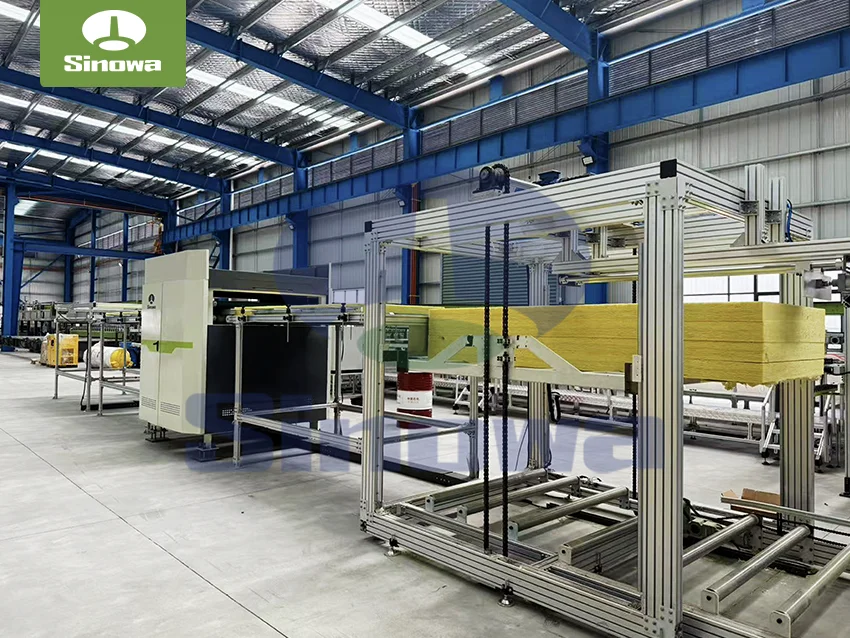
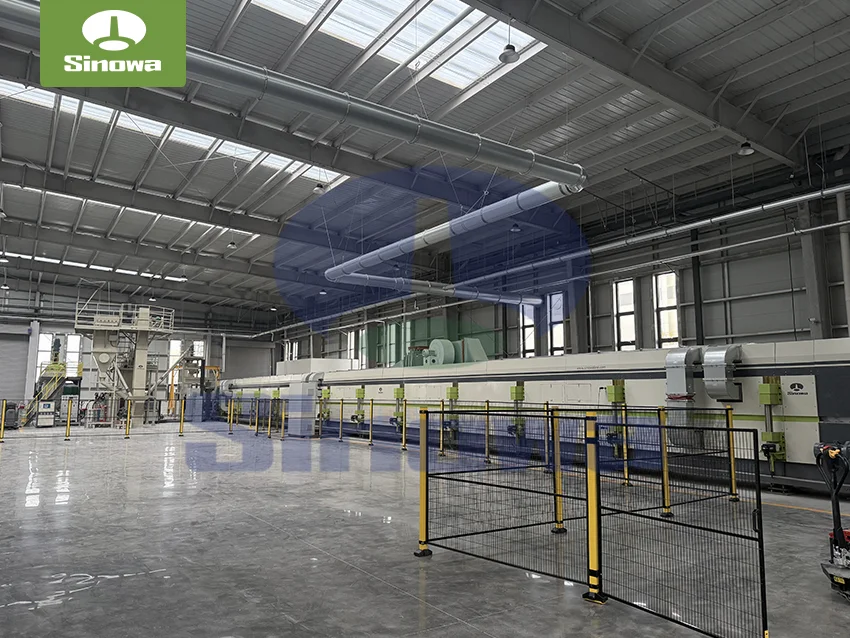
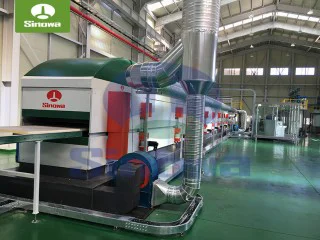
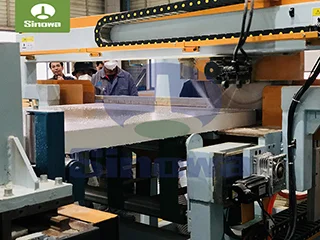
sandwich panel line
Raw material preparation constitutes the initial and foundational stage of the entire production workflow, where the accurate selection and proportioning of chemical components lay the premise for qualified phenolic insulation boards. The core raw materials primarily consist of phenolic resin base materials, foaming agents, curing agents, flame retardant additives, smoke inhibition components, and auxiliary modifiers that regulate fluidity and reaction activity. Phenolic compounds and aldehyde substances serve as the fundamental precursors for resin synthesis, undergoing polycondensation reactions under controlled catalytic conditions to form thermosetting phenolic resin with stable molecular chains. Auxiliary chemical additives are incorporated to adjust the viscosity, curing speed, and foaming uniformity of the resin mixture, eliminating structural defects such as irregular pores and uneven density in the final foam products. In modern production lines, raw material storage units are independently arranged with sealed container structures to prevent volatile chemical components from evaporating and avoid external dust and moisture from contaminating raw materials. Each storage container is equipped with temperature and humidity sensing modules to maintain raw materials within a stable storage environment, preventing chemical component deterioration caused by extreme ambient conditions. The automated batching system undertakes the precise weighing and quantitative extraction of various raw materials, adopting closed pipeline transportation to transfer proportioned raw materials to the mixing unit. This enclosed material transmission mode effectively reduces raw material waste and minimizes the emission of harmful volatile substances during material handling, achieving both production cost control and basic environmental protection requirements.
The raw material mixing unit acts as the core pretreatment facility for chemical raw materials, responsible for realizing homogeneous blending and preliminary activation of multi-component raw materials. After entering the mixing equipment, raw materials are subjected to high-speed cyclic stirring under constant temperature conditions, with the stirring speed and internal temperature dynamically adjusted according to the preset material reaction characteristics. In the early stirring stage, low-speed rotation is adopted to fully infiltrate different liquid raw materials and avoid local concentration accumulation of single chemical components. As the mixing process progresses, the stirring speed is gradually increased to break up tiny agglomerated particles in the mixed solution, ensuring uniform distribution of functional additives in the resin matrix. Meanwhile, the internal pressure of the mixing chamber is moderately regulated to complete vacuum degassing treatment, removing tiny dissolved air bubbles inside the mixed solution. These air bubbles, if not eliminated in advance, would form irregular hollow structures inside the foam substrate, reducing the overall structural compactness and mechanical strength of the insulation board. The mixed raw materials form a homogeneous colloidal solution with stable fluidity after completing stirring, constant-temperature maintenance, and degassing procedures. The viscosity and activity of the colloidal solution are strictly detected by online monitoring sensors, and only materials that meet the preset physical parameter standards can be transported to the subsequent foaming and molding units, forming a rigorous raw material quality screening mechanism at the front end of the production line.
Foaming and curing molding represents the key intermediate processing stage of the production line, directly determining the internal pore structure and macroscopic morphological characteristics of phenolic insulation boards. The uniformly mixed colloidal raw materials are continuously injected into the mold cavity or continuous molding equipment through quantitative feeding pipelines. In the early foaming stage, the internal temperature of the molding equipment is raised steadily to activate the foaming agent inside the mixed materials. The foaming agent undergoes physical gasification or chemical decomposition to generate stable gas components, which are wrapped by the viscous resin matrix to form uniformly distributed tiny closed pores. During this process, the internal pressure of the molding chamber is maintained within a fixed range to constrain the free expansion speed of foam materials, preventing excessive pore volume or pore rupture caused by rapid expansion. With the gradual progress of the polycondensation reaction, the phenolic resin molecular chains undergo cross-linking and solidification, transforming from viscous colloid into a rigid porous solid structure. The curing temperature and curing time are core control parameters in this stage; excessively high temperature leads to rapid local curing and uneven internal stress of the board, while excessively low temperature extends the curing cycle and reduces production efficiency. Modern production lines adopt segmented temperature control technology, setting gradient temperature intervals for the preheating zone, foaming expansion zone, and constant-temperature curing zone inside the molding equipment. This temperature control mode ensures synchronous progress of foam expansion and resin curing, forming a dense and uniform closed-cell structure inside the insulation board. After the primary curing process is completed, the semi-finished boards maintain a stable macroscopic shape and are transported to the constant-temperature aging unit through an automated conveying mechanism to eliminate residual internal stress generated during the molding reaction.
Surface composite and flattening processing are essential procedures to optimize the surface flatness and structural integrity of phenolic insulation boards. Semi-finished foam boards discharged from the molding unit have slightly uneven surface structures and tiny burrs on the edges due to the natural expansion characteristics of foam materials. The continuous flattening machine in the production line adopts symmetrically arranged compression roller sets to perform constant-pressure calibration on the upper and lower surfaces of the boards. The compression spacing of the roller sets is precisely adjusted according to the preset board thickness parameters, and the surface smoothness of the boards is improved through gentle physical pressing without damaging the internal closed-cell structure. For composite phenolic insulation boards used in complex application scenarios, surface lining materials are bonded to the single side or double sides of the foam substrate in this processing link. Common lining auxiliary materials include lightweight fiber fabrics and inorganic protective layers, which enhance the surface tensile resistance, wear resistance, and external corrosion resistance of the boards. The bonding process adopts environmentally friendly adhesive components compatible with phenolic resin materials. Before bonding, the board surface is subjected to electrostatic dust removal and micro-roughness treatment to increase the contact friction between the lining material and the substrate, improving the bonding firmness. After composite bonding, the boards pass through a low-temperature drying and bonding curing channel to accelerate adhesive solidification, ensuring no degumming or warping during long-term use of composite boards. The entire composite processing procedure operates in a fully automated assembly line mode, realizing continuous feeding, composite pressing, and curing transmission to maintain high production continuity.
Precision cutting and shaping units undertake the dimensional calibration and edge finishing of semi-finished insulation boards. After completing surface composite and flattening treatment, the continuous long-strip board materials need to be cut into standard specification boards that meet market usage requirements. The cutting system of the production line is equipped with high-precision servo drive modules, which can freely adjust the cutting length and spacing according to different dimensional customization needs. Circular saw blades made of high-hardness alloy materials are adopted for cutting components, with smooth blade surfaces to avoid jagged burrs and fiber tearing on the cutting section of phenolic foam. During the cutting process, an integrated dust removal and adsorption device is installed near the cutting position to collect tiny foam debris generated by cutting, reducing debris accumulation on the production line and maintaining the cleanliness of the processing environment. For boards requiring special edge processing, edge trimming and chamfering mechanisms are configured behind the cutting equipment to polish sharp edges and corners, preventing edge cracking and damage during subsequent transportation and construction. All cutting and shaping parameters are uniformly controlled by the central control system, and the dimensional deviation of finished boards is strictly controlled within a tiny error range to ensure high compatibility of products in assembly and construction applications.
Online quality inspection constitutes the core quality control link of the entire production line, covering multi-dimensional detection of appearance morphology, physical properties, and structural stability of insulation boards. The visual inspection module uses high-resolution industrial cameras to conduct panoramic scanning of the board surface, automatically identifying surface defects such as pits, cracks, color differences, and uneven coating. The thickness detection sensor monitors the thickness data of each section of the board in real time, feeding abnormal thickness signals back to the central control system to adjust the operating parameters of the front-end molding and flattening equipment. In terms of physical performance testing, the production line is equipped with online density detection instruments to measure the bulk density of foam boards, ensuring that the internal pore compactness meets production standards. Random sampling mechanical performance tests are carried out at fixed time intervals, including compression resistance, tensile resistance, and bending resistance tests, to verify the structural stability of finished boards under external force. Thermal conductivity testing equipment is used to regularly detect the thermal insulation capacity of products, ensuring that the low heat transfer characteristics of phenolic foam remain stable in continuous production. All inspection data is automatically recorded and stored in the system database, forming traceable production quality files. Unqualified products screened out during the inspection process are automatically sorted out by the intelligent sorting mechanism and transported to the reprocessing area for crushing and recycling treatment, realizing resource cyclic utilization and reducing raw material waste.
Finished product packaging and automated storage serve as the terminal processing links of the production line, achieving standardized packaging and orderly storage of qualified insulation boards. Qualified boards after quality inspection are neatly stacked by an automated stacking machine, with flexible buffer gaskets placed between adjacent boards to prevent surface friction damage and extrusion deformation during stacking. The packaging process adopts fully enclosed wrapping materials with moisture-proof and dust-proof functions. The packaging equipment automatically completes film wrapping, edge sealing, and binding operations, maintaining the integrity and cleanliness of the board surface during transportation and storage. Basic product marking information is printed on the outer packaging through inkjet printing equipment, recording production batches, processing parameters, and production time to facilitate subsequent product circulation and quality traceability. Packaged finished products are transported to the stereoscopic warehouse through automated conveyor belts. The intelligent warehouse management system automatically classifies and stores products according to specifications and production batches, optimizing the spatial layout of the warehouse. The handling of finished products is completed by automated handling equipment, reducing manual contact links, lowering the risk of artificial collision damage, and improving the overall circulation efficiency of finished products.
The central intelligent control system acts as the brain of the entire phenolic insulation board production line, realizing integrated regulation and collaborative operation of all functional units. This system adopts modular programming logic to connect raw material batching, mixing, molding, composite processing, cutting, inspection, and storage equipment through signal transmission lines. Operators can view the real-time operating status of each equipment module through the human-computer interaction interface, including material temperature, operating pressure, transmission speed, and product detection data. The system has an automatic parameter adjustment function; when minor parameter fluctuations occur in a single processing unit, the control system can complete self-correction without manual intervention to maintain the stability of the production process. In case of abnormal operating conditions such as equipment failure and parameter overload, the system will trigger an early warning mechanism, automatically mark the abnormal position, and cut off the power supply of related equipment to avoid equipment damage and safety accidents. In addition, the data statistics function of the control system can summarize daily output, raw material consumption, product qualification rate, and other production indicators, providing accurate data support for production scheduling optimization and cost accounting of manufacturing enterprises. The highly integrated control mode simplifies the operation logic of the production line and reduces the professional threshold for equipment operation.
Environmental protection and energy-saving design concepts run through the entire construction and operation process of modern phenolic insulation board production lines. In terms of waste gas treatment, closed gas collection pipelines are installed in the raw material mixing, foaming, and curing links to collect volatile organic gas generated during chemical reactions. The collected waste gas is purified through adsorption, filtration, and low-temperature decomposition processes to eliminate harmful components and meet clean emission standards. For solid waste such as defective boards and foam debris generated during production, special crushing and reprocessing equipment is configured to crush waste foam into fine particles, which are added into the raw material proportioning link in an appropriate proportion for secondary utilization. This waste recycling mode effectively reduces solid waste discharge and improves the comprehensive utilization rate of raw materials. In terms of energy consumption optimization, the production line adopts heat preservation structures for high-temperature processing equipment to reduce heat loss during temperature control. Waste heat generated by equipment operation is recycled and transferred to the raw material preheating unit, realizing secondary utilization of heat energy and lowering overall energy consumption. The production workshop is equipped with a circulating ventilation system and dust purification device to maintain clean air quality in the operating space and reduce the impact of production processes on the external production environment.
Daily maintenance and scientific management are crucial guarantees to maintain the long-term stable operation of the phenolic insulation board production line. Mechanical transmission components such as conveyor belts, compression rollers, and cutting blades need regular surface cleaning and lubrication maintenance to eliminate foam debris and residual adhesives attached to the surface, preventing equipment jamming and component wear. Sealing parts of raw material conveying pipelines and mixing containers are inspected regularly to avoid raw material leakage caused by aging and damage of sealing components. Precision sensing instruments and detection equipment need regular calibration and parameter debugging to ensure the accuracy of real-time monitoring data during production. The production line formulates differentiated maintenance plans according to the usage frequency and loss degree of different equipment modules, dividing daily simple maintenance, weekly component inspection, and quarterly comprehensive overhaul. In terms of personnel management, operators need to master standardized operation procedures and basic fault identification methods to avoid operational errors affecting product quality and equipment safety. The establishment of complete equipment maintenance files records the maintenance time, processing content, and component replacement information of each equipment, providing data reference for subsequent equipment upgrading and transformation.
With the continuous progress of material synthesis technology and industrial automation technology, phenolic insulation board production lines are evolving toward high intelligence, low energy consumption, and multi-functional integration. The upgrading direction of raw material processing technology focuses on the development of low-volatile and high-stability composite additives, reducing harmful gas emissions during production while further improving the thermal insulation and flame retardant properties of finished products. In terms of mechanical equipment optimization, the production line will adopt more compact modular structural design to reduce floor space and improve the integration of processing units. The intelligent monitoring technology based on artificial intelligence algorithms will realize predictive judgment of equipment failure and automatic optimization of production parameters, further reducing manual intervention links. In addition, the personalized customization capability of the production line will be continuously enhanced to meet the diversified product demands of different application scenarios such as building exterior wall insulation, industrial pipeline anti-freezing, and indoor enclosure heat insulation. Through continuous technological innovation and process optimization, the comprehensive production performance of phenolic insulation board production lines will be continuously improved, providing more reliable and environmentally friendly thermal insulation material solutions for the modern industrial and construction fields.
https://www.cnsinowa.com/sandwich-panel-machines/phenolic-insulation-board-production-line.html