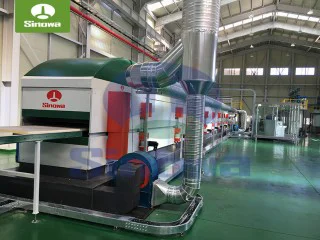
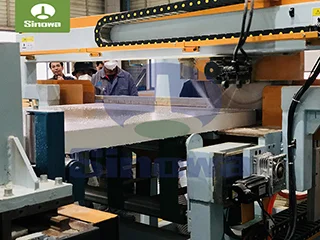
sandwich panel line
The core production principle of phenolic insulation panels is based on the polymerization and foaming reaction of phenolic resin as the base material. Phenolic resin, as a thermosetting polymer material with excellent inherent performance, undergoes cross-linking and curing reactions under the combined action of foaming agents, curing agents, flame retardants, smoke suppressants, and various functional additives, forming a uniform closed-cell foam structure. This unique cellular structure endows the finished panels with outstanding thermal insulation, flame retardancy, low smoke density, corrosion resistance, and dimensional stability, making phenolic insulation materials far superior to many traditional foam insulation materials in extreme temperature environments and fire safety scenarios. The production line is precisely developed and optimized around this reaction mechanism, with each functional unit accurately controlling the reaction conditions of materials to ensure that the foaming density, cell uniformity, curing degree, and overall flatness of each batch of products maintain a stable level.
Raw material pretreatment and accurate proportioning constitute the primary core link of the entire production process, which directly determines the basic performance of finished phenolic insulation panels. The raw materials used in production include liquid phenolic resin matrix, physical foaming agents, acidic curing agents, high-efficiency flame retardant additives, smoke suppression modifiers, and viscosity stabilizers. Each raw material has strict proportional standards and feeding sequence requirements, and any deviation in dosage or feeding order will affect the foaming reaction effect and final product performance. The modern phenolic insulation panel production line is equipped with a fully automatic closed proportioning system, which abandons the traditional manual weighing and feeding mode that relies on human experience. The system adopts high-precision metering components and real-time data sensing modules to quantitatively convey various liquid and powder raw materials according to preset process parameters.
In the proportioning operation, the phenolic resin matrix is transported from the raw material storage tank to the metering unit through a constant-pressure delivery pump, maintaining a stable flow rate and pressure to ensure the continuity of subsequent mixing operations. Functional additives such as flame retardants and smoke suppressants are automatically screened and metered through a special powder feeding device, avoiding material agglomeration and uneven dispersion caused by manual feeding. The entire proportioning process is completed in a fully enclosed environment, which not only prevents external dust and impurities from mixing into the raw materials to affect product purity but also avoids the volatilization of trace active ingredients in raw materials, ensuring the accuracy of material ratio and the stability of subsequent chemical reactions. Meanwhile, the system has a real-time parameter correction function. When slight fluctuations in raw material viscosity, temperature, and ambient humidity are detected, it will automatically fine-tune the metering proportion and feeding speed to maintain the optimal raw material mixing state.
After the completion of raw material proportioning, the homogeneous mixing process is carried out immediately, which is a key procedure to ensure the uniform distribution of various functional components in the resin matrix. The production line is equipped with a high-speed dynamic mixing device with multi-layer stirring structures. Different from ordinary single-layer stirring equipment, this device adopts combined stirring modes of high-speed shear and low-speed kneading. In the initial stage of mixing, high-speed shear blades break up trace agglomerated particles in additives to realize the microscopic dispersion of functional components in the resin liquid. In the later stage of mixing, low-speed uniform kneading is adopted to eliminate bubbles generated during high-speed stirring, ensuring that the mixed material liquid has uniform viscosity, stable activity, and no local component enrichment or deficiency.
The temperature control system is embedded in the mixing unit to strictly maintain the material liquid within the optimal reaction temperature range. Excessively high temperature will cause premature micro-foaming and local curing of the material liquid, resulting in uneven cell structure of subsequent products; excessively low temperature will lead to insufficient activity of curing agents and foaming agents, reducing the foaming rate and product porosity, and affecting the thermal insulation performance of the panels. The intelligent temperature control module monitors the material liquid temperature in real time through high-sensitivity sensors, and adjusts the heating and heat dissipation power in real time to keep the mixing temperature constant throughout the process, laying a solid foundation for stable subsequent foaming molding.
The continuous foaming and initial curing process is the core molding stage of phenolic foam insulation panels, which determines the basic structural characteristics of the products. The uniformly mixed material liquid is continuously and stably transported to the foaming molding station through a sealed pipeline. Different from the open foaming process of traditional insulation materials, the production line adopts a closed constant-temperature foaming cavity structure, which can accurately control the foaming pressure, temperature, and reaction time. After the material liquid enters the foaming cavity, the foaming agent rapidly undergoes gasification and expansion reactions under preset temperature and pressure conditions. At the same time, the curing agent triggers the cross-linking polymerization reaction of phenolic resin molecules, so that the expanded foam body is rapidly shaped and initially cured, forming a continuous and uniform phenolic foam substrate.
The foaming speed and curing speed are dynamically matched by the continuous sandwich panel production line control system throughout the process. If the foaming speed is too fast and the curing speed lags behind, the foam body will have unstable structure, easy cell rupture, and large dimensional shrinkage after molding; if the curing speed is too fast and the foaming is insufficient, the product will have high density, poor toughness, and increased thermal conductivity, failing to meet the lightweight and thermal insulation requirements. Through years of process optimization, the production line realizes the synchronous progress of foaming expansion and molecular curing, forming a closed-cell structure with uniform cell size, tight arrangement, and high structural stability. The continuous feeding and continuous foaming mode makes the foam substrate form an integral long plate structure without intermediate joints, effectively avoiding the performance defects such as heat leakage and structural cracking caused by plate splicing in segmented production.
Following the initial foaming and curing, the continuous composite pressing process is carried out to complete the integral molding of phenolic insulation panels. Most phenolic insulation panels used in engineering scenarios need to be compounded with protective surface layers on single or double sides to enhance the surface flatness, mechanical strength, weather resistance, and construction convenience of the products. The common surface layer materials include inorganic fiber cloth, polymer waterproof coating layer, and lightweight cement-based protective layer. The production line is equipped with an automatic surface layer unwinding and conveying system, which can synchronously complete the laying and positioning of surface layer materials while the phenolic foam substrate is output at a constant speed.
The composite pressing unit adopts multi-stage constant-pressure and constant-temperature pressing technology. The foam substrate with flexible reaction activity after initial curing is closely bonded to the surface layer material under the action of uniform pressing force. The moderate temperature in the pressing process can promote the secondary micro-curing of the phenolic foam surface and activate the adhesive performance between the foam substrate and the surface layer, realizing integrated composite molding without additional adhesive bonding. This integral composite structure effectively avoids the delamination, bulging, and peeling problems that are prone to occur in traditional post-bonded composite panels. The pressing speed of the equipment is strictly synchronized with the foaming and conveying speed of the front end, ensuring that the thickness of each position of the continuous plate body is consistent, and the bonding strength between the core material and the surface layer is uniform.
In the pressing process, the intelligent pressure regulation system can automatically adjust the pressing force according to the preset product thickness parameters. For thin-type insulation panels used for interior decoration, low-pressure gentle pressing is adopted to prevent the compression deformation of the foam core structure and maintain excellent thermal insulation performance; for thick-type engineering insulation panels used for external wall and industrial equipment insulation, medium and high-pressure uniform pressing is adopted to improve the overall compactness and mechanical strength of the plate body, enhancing its wind pressure resistance and impact resistance in complex application environments. The entire composite pressing process is free of manual intervention, realizing fully automated continuous operation and greatly improving the consistency of product composite quality.
The constant-temperature curing and aging treatment process is an essential link to stabilize the final performance of phenolic insulation panels. The composite plate body output from the pressing unit still has slight residual reaction activity inside, and the molecular cross-linking reaction is not completely finished. Direct cutting and forming at this stage will lead to subsequent dimensional shrinkage, surface warping, and unstable performance of the products. Therefore, the production line is equipped with an independent constant-temperature curing and aging channel, which provides a stable temperature and wind circulation environment for the semi-finished plates.
In the curing channel, the plate body is conveyed forward at a constant low speed through a flat conveying platform. The circulating hot air system in the channel forms a uniform temperature field, which promotes the complete cross-linking and curing of the internal phenolic resin molecules and fully releases the residual stress generated in the foaming and pressing process. The aging treatment eliminates the unstable state of the internal structure of the plate body, so that the thermal conductivity, density, dimensional stability, and mechanical properties of the product reach the optimal stable state. The length and temperature of the curing channel are designed according to different product specifications, which can meet the curing and aging requirements of panels with different thicknesses and densities, ensuring that each batch of products has long-term performance stability in subsequent use.
Fixed-size cutting and edge finishing are the final molding procedures of the production line, realizing the conversion of continuous long plate bodies into standard finished products. The production line is equipped with a high-precision automatic cutting system, which supports flexible setting of product length and width parameters according to market and engineering needs. The cutting unit adopts high-speed rotating special cutting tools, which have smooth cutting surfaces and no burrs, and will not cause edge cracking and cell damage of the phenolic foam plate body during cutting. The servo positioning system ensures that the cutting error of each plate is controlled within a very small range, realizing high-precision fixed-size molding.
After cutting, the edge finishing device automatically polishes and trims the four edges of the plate body to eliminate tiny burrs and uneven edges generated during cutting, making the plate edges flat and neat. This finishing treatment not only improves the appearance quality of the products but also avoids the problems of incomplete fitting and heat leakage caused by uneven plate edges during on-site construction and installation. At the same time, the equipment is equipped with a dust collection and cleaning device, which timely collects the tiny foam debris generated during cutting and finishing, keeping the product surface clean and ensuring the cleanliness of the production environment.
The automatic conveying and stacking system runs through the entire post-processing stage of the continuous sandwich panel line. The finished plates after cutting and finishing are automatically conveyed to the stacking station through the flat conveying line. The intelligent stacking device carries out orderly layered stacking according to the preset stacking height and arrangement mode, realizing automatic collection and arrangement of finished products. This automated operation replaces the traditional manual carrying and stacking mode, not only greatly improving production efficiency and reducing labor intensity but also avoiding plate damage, pollution, and irregular stacking problems caused by manual operation, which is convenient for subsequent centralized storage and transportation of products.
The intelligent control system is the brain core of the entire phenolic insulation board production line, supporting the stable and efficient operation of all functional units. The entire production process is uniformly scheduled and controlled by a centralized control module, which integrates parameter setting, real-time monitoring, data analysis, fault early warning, and automatic adjustment functions. Operators only need to set the product specification parameters such as plate thickness, density, and surface type on the control terminal, and the system will automatically match the corresponding raw material proportioning ratio, mixing speed, foaming temperature, pressing pressure, curing time, and cutting size parameters to realize one-click switching of different product production modes.
During the continuous production process, the system monitors the operating status of all equipment components and the real-time process parameters in real time through a large number of high-precision sensors, including raw material flow rate, mixing temperature, foaming cavity pressure, pressing speed, curing channel temperature, and plate conveying speed. All monitoring data are presented in real time on the control terminal interface. Once individual parameters deviate from the preset standard range, the system will automatically trigger fine-tuning procedures to adjust the operating state of the equipment in time. For abnormal faults that cannot be automatically adjusted, the system will send out early warning prompts and record fault data, facilitating staff to quickly troubleshoot and maintain, effectively reducing the occurrence of defective products and production shutdown losses.
Compared with traditional intermittent production equipment, the modern integrated phenolic insulation board production line has obvious advantages in production stability, product consistency, and production efficiency. In terms of product quality control, the fully enclosed and automated production mode avoids the interference of human factors on the production process. All process parameters are precisely controlled by the system, making the cell structure, density, thermal conductivity, and mechanical strength of each plate highly consistent, effectively solving the common problems of uneven product quality in traditional production. In terms of production efficiency, the continuous assembly line operation realizes uninterrupted feeding, foaming, composite pressing, curing, and cutting, with a far higher continuous output capacity than discrete equipment, which can meet the large-scale order production needs of industrial production and engineering supporting.
In terms of production energy consumption and environmental protection, the optimized structural design and intelligent parameter adjustment function of the production line realize precise energy supply, avoiding the invalid energy consumption caused by long-term high-load operation of traditional equipment. The entire production process is carried out in a closed environment, with no excessive volatile substance emission and no dust overflow. The residual materials and cutting debris generated during production can be uniformly recycled and treated, which conforms to the development requirements of green and low-carbon manufacturing. In addition, the modular design of the production line makes the equipment maintenance and later upgrading more convenient. Each functional unit is relatively independent, which can realize targeted maintenance and parameter optimization without affecting the overall operation of the production line, reducing the operation and maintenance cost of the equipment.
The products manufactured by the phenolic foam production line have excellent comprehensive performance and wide application scenarios, covering building energy conservation, industrial thermal insulation, special fire prevention engineering, and other fields. In the field of building energy conservation, phenolic insulation panels are used for external wall thermal insulation, roof heat insulation, and interior partition thermal insulation of various civil and commercial buildings. Their low thermal conductivity can effectively reduce the heat exchange between the building interior and the external environment, reduce building energy consumption for heating and cooling, and achieve the effect of energy saving and emission reduction. At the same time, the excellent flame retardant and low smoke performance of phenolic materials can improve the fire safety level of buildings and reduce the fire hazard of building insulation systems.
In the field of industrial thermal insulation, phenolic insulation panels are widely used for thermal insulation and anti-corrosion protection of industrial equipment such as power equipment, chemical pipelines, and metallurgical furnaces. They can maintain stable thermal insulation performance in high-temperature and humid industrial environments, effectively reduce the heat loss of industrial equipment, improve industrial energy utilization efficiency, and avoid equipment aging and performance degradation caused by temperature changes and corrosion. In addition, phenolic insulation panels have good weather resistance and dimensional stability, and will not deform, crack, or deteriorate after long-term outdoor and industrial environment use, ensuring long-term stable operation of the thermal insulation system.
With the continuous improvement of global building energy conservation standards and industrial environmental protection requirements, the market demand for high-performance, green, and safe insulation materials is constantly upgrading, which also promotes the continuous technological iteration and performance optimization of phenolic insulation panel production lines. The current production line technology is developing towards higher automation intelligence, more precise process control, more diversified product adaptation, and greener production processes. On the basis of maintaining stable production, the new generation of production lines further optimizes the raw material utilization rate, reduces the generation of waste materials in the production process, and improves the resource utilization efficiency.
At the same time, the automatic sandwich panel production line has realized the flexible production of diversified products. By adjusting process parameters and matching different surface layer composite structures, it can produce phenolic insulation panels with different densities, thicknesses, surface strengths, and functional characteristics, meeting the differentiated application needs of different scenarios such as high-temperature resistance, low-temperature thermal insulation, waterproof and moisture-proof, and high mechanical strength. The flexible production mode enables the production line to adapt to the personalized and diversified market demand, improving the market adaptability and comprehensive service capacity of production equipment.
In the actual production and operation process, the standardized operation and scientific maintenance of the production line are crucial to maintaining long-term stable production efficiency and product quality. Daily equipment maintenance includes regular inspection of raw material metering components, stirring and foaming devices, pressing transmission systems, and intelligent control systems, timely cleaning the residual materials inside the equipment, checking the operating state of transmission parts and sensor components, and ensuring the sensitivity and accuracy of each functional unit. Regular parameter calibration and equipment debugging can eliminate the parameter drift and mechanical wear errors generated by long-term operation of the equipment, ensuring that the production process is always in the optimal state.
In addition, the insulation sandwich panel production line has a good safety operation mechanism. All rotating and pressing parts are equipped with protective structures, and the system has automatic power-off protection and overload protection functions. When abnormal equipment operation, overload operation, or misoperation occurs, the system will automatically cut off the power and stop the operation to avoid production safety accidents. The closed production environment and perfect waste gas and waste residue recovery measures also ensure the safety and environmental protection of the production process, realizing the coordinated development of production efficiency, product quality, and production safety.
In summary, the phenolic insulation panel production line is a highly integrated, intelligent, and efficient professional manufacturing system tailored to the production characteristics of phenolic foam insulation materials. Through precise control of raw material proportioning, homogeneous mixing, controllable foaming, continuous composite pressing, constant-temperature curing, and precision molding processes, it realizes standardized and large-scale production of high-performance phenolic insulation panels. With its stable production performance, excellent product quality consistency, efficient production capacity, and green environmental protection production characteristics, this production line has become the core supporting equipment for the modern insulation material manufacturing industry. As the market's requirements for insulation material performance, safety, and environmental protection continue to improve, the process technology and equipment performance of phenolic insulation panel production lines will continue to be optimized and upgraded, providing more high-quality and reliable insulation material products for building energy conservation, industrial manufacturing, and engineering construction fields, and making continuous contributions to the development of green and low-carbon industries.
https://www.cnsinowa.com/sandwich-panel-machines/phenolic-insulation-panel-production-line.html