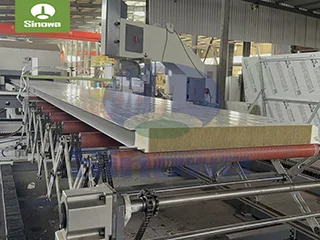
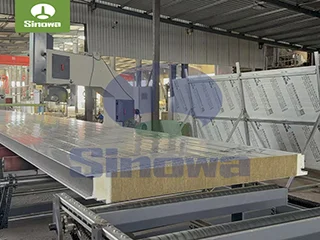
sandwich panel line
Different from segmented semi-automatic production equipment for traditional sandwich panels, the edge sealing rock wool sandwich panel line adopts an integrated full-link continuous production design, which integrates raw material unwinding, metal sheet leveling and forming, rock wool core material precision processing, automatic glue spraying, synchronous edge sealing foaming, double-belt constant temperature pressing and curing, fixed-length cutting, surface finishing and finished product stacking into one uninterrupted production flow. The whole production process realizes unified linkage and synchronous speed matching through a centralized digital control system, which eliminates frequent start-stop actions in segmented production, avoids manual intervention errors in intermediate processes, and ensures consistent panel appearance, dimensional accuracy and internal bonding strength for each batch of finished products. The core technological difference between this production line and ordinary rock wool panel production lines lies in the embedded synchronous edge sealing module, which can complete seamless closed sealing for the two longitudinal side gaps of the composite panel in real time before the upper and lower metal sheets are completely bonded with the rock wool core, forming an integral closed protective structure on both sides of the panel. This innovative process completely isolates the internal porous rock wool fiber layer from external air, moisture and dust, and comprehensively improves the long-term service stability and comprehensive performance of rock wool sandwich panels in complex outdoor and industrial environments.
The overall mechanical structure of the rock wool sandwich panel production line is divided into six interlocking functional sections with smooth process connection without independent process interruption, and each functional section operates in precise speed synchronization to adapt to continuous high-speed production. The first section is the raw material feeding and pretreatment section, which undertakes the preliminary processing of metal surface sheets and rock wool core materials respectively. For metal coil raw materials, the line is equipped with automatic double-station unwinding units with online deviation correction functions. After large-format metal coils are loaded onto unwinding supports, the deviation correction system monitors the conveying track of metal sheets in real time through infrared sensing modules, and automatically fine-tunes the horizontal position of sheet materials to prevent lateral deviation during long-distance conveying, which effectively avoids uneven panel edges and material waste caused by sheet dislocation. After unwinding, the metal sheets pass through multi-group leveling roller sets to eliminate internal stress generated during coil storage and transportation, removing surface wrinkles and uneven radian, so as to ensure flat and smooth surface of finished panels. Subsequently, continuous roll forming units carry out customized edge pressing and groove processing on both sides of metal sheets, reserving matched installation grooves for subsequent edge sealing materials, which can enhance the mechanical occlusion force between edge sealing layers and metal sheets and prevent delamination of edge structures in long-term use.
In terms of rock wool core material pretreatment, this insulation board production line is equipped with intelligent core material slitting and flipping systems exclusive to edge sealing panel production. Bulk integral rock wool raw slabs are conveyed to precision slitting equipment through chain plate conveying devices with vibration reduction design, and high-precision rotary cutting blades cut complete rock wool slabs into uniform strip core materials matching panel width. The slitting gap is precisely controlled to realize smooth and burr-free cutting sections, reducing unnecessary raw material loss. More importantly, the sandwich panel production line is equipped with automatic 90-degree flipping devices after slitting units, which adjust the internal fiber arrangement direction of rock wool strips from horizontal to vertical. This optimized fiber layout greatly improves the compression resistance, bending resistance and overall structural stability of rock wool core materials. Compared with horizontally arranged rock wool fibers in ordinary panels, vertically oriented fibers can disperse external impact pressure and building structural stress more evenly, effectively preventing core material collapse and panel deformation under long-term external load. After flipping and alignment treatment, rock wool strips are arranged closely without gaps in the set conveying track, laying a solid foundation for subsequent composite pressing and edge sealing processing.
The second core functional section is the automatic adhesive coating and pre-compounding section, which determines the initial bonding firmness between metal sheets and rock wool core materials. The rockwool board production line adopts closed automatic glue spraying systems instead of traditional manual glue spreading or roller gluing modes. The spraying modules are arranged symmetrically above and below the rock wool core material, which can evenly atomize and spray environmental-friendly structural adhesives on the upper and lower contact surfaces of rock wool strips. The digital control system can automatically adjust glue spraying flow, spraying range and spraying density according to real-time production speed and panel thickness parameters, realizing quantitative and uniform glue application without glue deficiency, glue accumulation or missing spraying. Reasonable adhesive dosage not only ensures reliable bonding performance between metal sheets and rock wool core layers, but also avoids excessive adhesive filling rock wool internal pores which would damage original thermal insulation and sound absorption performance of rock wool. After glue spraying, upper and lower formed metal sheets are automatically closed and covered on both sides of rock wool core materials through synchronous conveying rollers to form a preliminary three-layer composite structure, and the pre-compression roller set carries out slight pre-pressing to discharge residual air between layers, preventing bubble generation inside finished panels that may affect bonding strength.
The synchronous edge sealing section is the most critical technological module of the rock wool sandwich panel machine and the core difference from conventional rock wool panel manufacturing equipment. This module is installed right before the constant temperature curing pressing section, realizing real-time synchronous edge sealing while the panel composite structure keeps moving forward without stopping production. Two sets of high-precision foaming and pouring devices are arranged on the left and right sides of the panel conveying track, which automatically inject liquid edge sealing raw materials into reserved side grooves of metal sheets on both sides of the composite panel. After injection, the liquid materials undergo rapid low-pressure foaming reaction under constant temperature environment set by the production line, and fully fill the tiny gaps between metal sheet edges and rock wool core sections. After complete foaming and initial curing, the edge sealing layer forms an integrated compact protective strip seamlessly connected with both metal surface sheets. Unlike post-edge-sealing processes that process finished panels separately, inline synchronous edge sealing achieves integral molding of panel main body and edge sealing structure in one continuous process. There is no splicing gap between edge sealing strips and panel main body, fundamentally blocking the capillary water absorption channel of exposed rock wool sections. Meanwhile, the integral edge sealing structure also improves the overall torsion resistance of the panel, solving the problem of easy edge cracking of rock wool panels during cutting, transportation and on-site installation.
Subsequently, the initially compounded panel with complete edge sealing enters the constant temperature double-belt pressing and curing section, which undertakes final integral bonding and adhesive curing. The long tunnel-type double-belt pressing machine adopts upper and lower synchronous circulating steel belt structure, which can provide stable and uniform linear pressure covering the whole panel surface, avoiding local depressions or uneven bonding caused by point pressure of traditional roller pressing equipment. The interior of the pressing tunnel is divided into multiple independent temperature control zones with gradient temperature setting, which matches the curing reaction curve of structural adhesive and edge sealing foaming materials. Low-temperature pre-curing zone stabilizes the initial shape of edge sealing layers to prevent foaming deformation under pressure; medium-temperature main curing zone accelerates cross-linking reaction of internal adhesive to strengthen bonding force between metal layers and rock wool core; high-temperature final shaping zone eliminates internal residual stress of composite panels. The whole curing process is completed in continuous moving state without static placement, which greatly shortens production cycle and maintains continuous production rhythm. After gradient constant temperature pressing and curing, the upper metal sheet, lower metal sheet, middle rock wool core and bilateral edge sealing layers are integrated into an inseparable integral composite panel structure with excellent overall structural tightness.
After high-temperature curing, the continuous long panel enters the air cooling and fixed-length cutting section. High-speed circulating air cooling devices are arranged along the conveying track to rapidly reduce the surface and internal temperature of panels to ambient temperature, which locks the bonding state of internal materials and avoids thermal deformation or edge warping caused by rapid natural temperature drop. After cooling, the panels enter the synchronous tracking cutting unit. The cutting saw follows the forward moving speed of panels synchronously during cutting, realizing dynamic fixed-length cutting without sandwich panel line shutdown. The cutting system supports free switching of arbitrary cutting lengths according to actual order demands, and the cutting section is smooth and flat without edge burrs or core material shedding. After cutting, edge trimming modules carry out fine polishing on panel cutting ends to remove tiny residual burrs, further optimizing panel appearance quality.
The final process link is finished product conveying, surface inspection and automatic stacking. Qualified panels after cutting and trimming are transported to the inspection station through roller conveyors, where visual inspection sensors automatically detect surface scratches, edge sealing defects and dimensional errors. Unqualified products are automatically screened out and transported to the recovery area separately, while qualified finished panels are sent to automatic stacking equipment. The stacking machine realizes layered and orderly stacking of panels according to set height specifications, avoiding surface friction damage between panels during stacking. The whole process from raw material feeding to finished product warehouse entry is completed automatically, requiring only a small number of on-site operators to monitor the operation status of the central control system, which greatly reduces labor input and reduces unstable factors caused by manual operation.
Compared with ordinary rockwool sandwich panel production line, the edge sealing integrated production line brings comprehensive performance upgrades to finished panels from multiple dimensions, covering structural durability, environmental adaptability and functional stability. In terms of moisture resistance and waterproof performance, the fully enclosed bilateral edge sealing structure completely cuts off the contact channel between internal rock wool fibers and external humid air. Traditional rock wool panels without edge sealing will gradually absorb moisture when used in outdoor wall enclosure, cold storage exterior walls and coastal high-humidity environments, leading to increased thermal conductivity of rock wool core, reduced insulation effect, and even mildew and corrosion inside panels after long-term use. Edge-sealed rock wool panels maintain stable hydrophobic performance for a long time, and their thermal insulation parameters will not attenuate with the change of external humidity throughout the service life. In terms of fire safety performance, the compact edge sealing layer cooperates with inorganic rock wool core materials to form an overall fire barrier structure. The edge sealing materials selected for matching production have good flame retardant properties, which can prevent flame and high-temperature smoke from penetrating into the panel interior from side gaps in case of building fire, improving the overall fire resistance limit of enclosure panels and enhancing passive fire protection capability of building envelope systems.
In terms of mechanical properties, integral edge sealing structure optimizes the overall stress distribution of sandwich panels. When panels bear external wind pressure, building vibration and mechanical impact during transportation and installation, bilateral edge sealing strips share partial edge stress, effectively inhibiting panel edge delamination, core material shedding and edge cracking. This makes edge-sealed rock wool panels more suitable for large-span roof enclosure, high-rise building exterior walls and long-distance logistics transportation scenarios. In addition, the rockwool insulation panel production line also has outstanding production flexibility and compatibility advantages. The central control system can realize one-click adjustment of core production parameters including panel thickness, overall width, edge sealing width and production running speed, and can switch production specifications quickly without mechanical debugging shutdown. The line is compatible with multiple types of metal surface sheets including galvanized sheets, color-coated sheets and aluminum sheets, and can match rock wool core materials with different densities to produce customized panels meeting different load-bearing and insulation demands, adapting to diversified market demands of construction engineering, industrial factory buildings, clean workshops, cold storage facilities and municipal enclosure projects.
From the perspective of production operation and energy-saving benefits, the integrated continuous process design of edge sealing rockwool sandwich panel making machine effectively reduces comprehensive production costs and energy consumption. The full-link synchronous operation eliminates repeated heating and start-stop energy consumption caused by segmented intermittent production, and the gradient circulating heating system in the curing section recycles waste heat generated in the curing process, reducing overall power consumption of equipment operation. Meanwhile, intelligent sensing and automatic adjustment systems minimize material waste in glue spraying, edge sealing foaming and slitting processes, improving the utilization rate of metal sheets and rock wool raw materials. The high degree of automation reduces manual operation posts on site, lowers long-term labor management costs for manufacturers, and unified digital parameter control ensures that the performance difference between different batches of panels is controlled within an extremely small range, stabilizing overall product quality and reducing after-sales quality maintenance costs brought by inconsistent products.
Against the background of global dual-carbon goals and the vigorous development of green buildings, the market demand for high-performance, long-life and low-energy-consumption building enclosure materials keeps rising continuously. Traditional ordinary rock wool panels can no longer meet the stringent durability and energy-saving requirements of modern high-standard buildings, especially building projects in coastal humid areas, severe cold regions and industrial corrosive environments, which have put forward higher requirements for the waterproof, anti-aging and stable thermal insulation performance of insulation panels. The edge sealing rock wool sandwich panel manufacturing line precisely responds to this market demand upgrade. It not only retains the original advantages of rock wool materials such as incombustibility, excellent sound absorption and environmental friendliness, but also makes up for all structural defects of open-edge rock wool panels through inline synchronous edge sealing technology. The panels produced by this line can maintain stable comprehensive performance throughout the whole service cycle of buildings, reduce later maintenance and replacement frequency of building enclosure structures, and help reduce the whole-life cycle carbon emission of construction projects.
Looking forward to the future technological evolution direction of composite panel production equipment, edge sealing rock wool sandwich panel line will further develop toward higher intelligent integration, lower energy consumption and stronger multi-process compatibility. Upgraded sensing and artificial intelligence monitoring systems will realize real-time automatic early warning and self-adjustment of equipment operation faults, further reducing manual intervention; optimized heating and foaming processes will continue to reduce production energy consumption and improve environmental production performance; and multi-functional composite module expansion will enable the same production line to complete edge sealing, surface anti-fouling coating and reinforced rib processing synchronously in one pass, realizing multi-functional integrated molding of panels. As one of the most practical technological upgrades in the field of rock wool sandwich panel equipment, edge sealing production technology will continue to promote the iterative upgrade of building insulation composite materials, provide more reliable, durable and energy-saving material solutions for global green construction, and play an important supporting role in promoting the high-quality and sustainable development of the modern construction industry.
https://www.cnsinowa.com/sandwich-panel-machines/edge-sealing-rock-wool-sandwich-panel-line.html