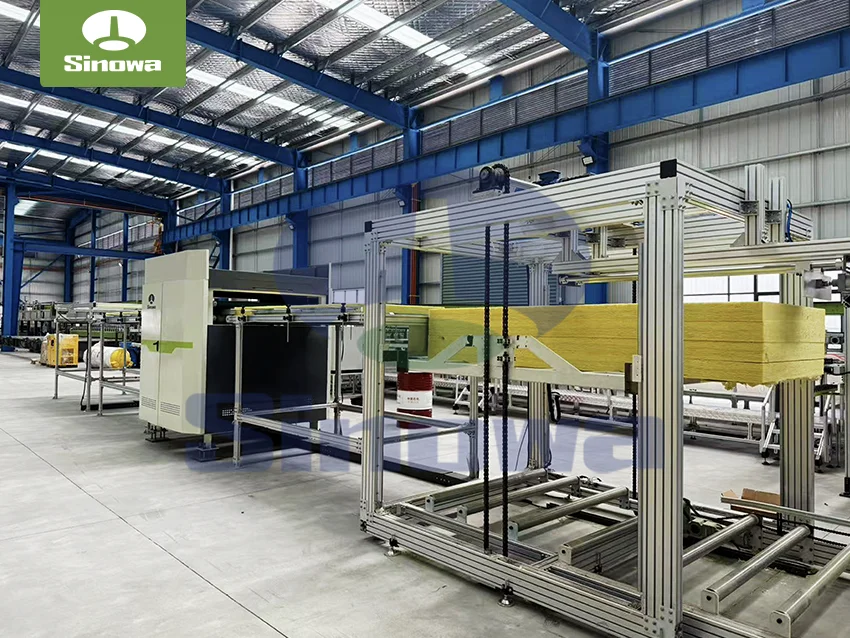
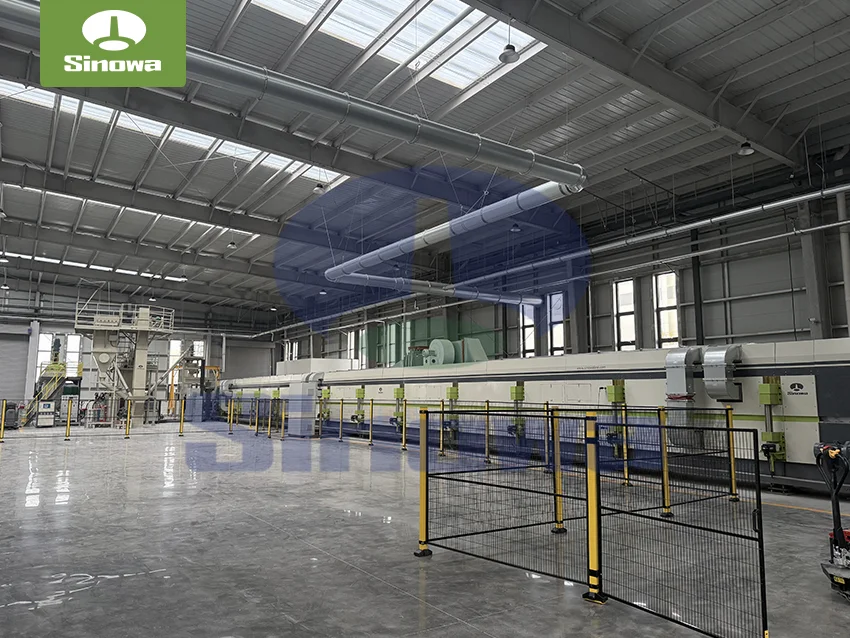
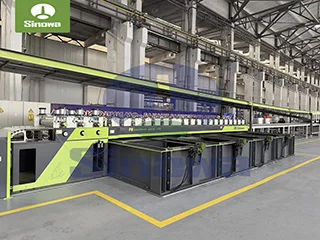
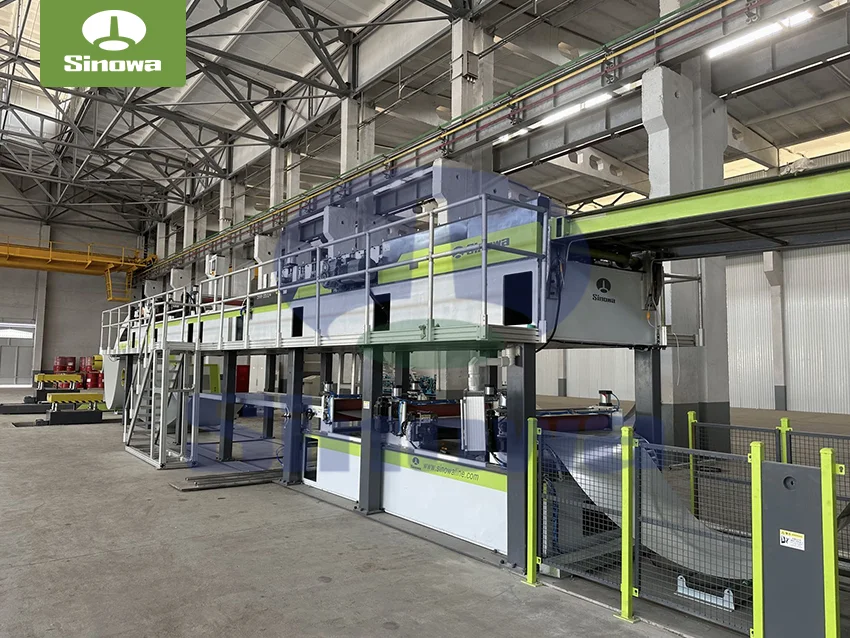
 sandwich panel line
The overall structural design of the corrugated sandwich panel production line follows modular industrial manufacturing logic, with each functional unit closely connected and operationally synchronized to form a complete closed-loop production system. The whole line abandons scattered manual and semi-mechanical production modes, and realizes unified scheduling and precise control of all production links through an integrated control system. Each functional module is optimized according to the mechanical characteristics and bonding principles of corrugated sandwich panels, ensuring that the structural stability, surface flatness and internal bonding firmness of each produced panel maintain a consistent high standard. This integrated design not only simplifies the production workflow but also greatly reduces the interference of human factors on product quality, laying a solid foundation for standardized batch production.
The front-end raw material processing module is the starting point of the entire production process, undertaking the pretreatment and stable feeding of surface layer and core layer raw materials. For the surface metal materials commonly used for corrugated sandwich panels, the system is equipped with automatic unwinding and leveling devices. The unwinding structure can stably support coiled metal raw materials and achieve uniform speed unwinding, while the supporting correction device can dynamically adjust the material conveying track in real time to avoid material deviation and wrinkling during the conveying process. The leveling unit adopts multi-group roller structural design, which can eliminate the internal stress and surface unevenness of metal coiled materials after long-term winding, ensuring that the surface materials entering the subsequent forming process are flat and smooth with uniform thickness. In addition to metal surface materials, the corrugated sandwich panel line is compatible with a variety of non-metallic surface materials, and can complete adaptive feeding and pretreatment according to the hardness and toughness characteristics of different materials, with strong production compatibility.
The corrugated forming unit is the core functional component that endows the panel with unique structural performance, and its operating precision directly determines the mechanical strength and structural stability of the final product. Different from the flat panel forming process, this unit adopts precision profiled roller sets with customized groove structures. When the pretreated flat surface material passes through the gap between the upper and lower roller sets, it is gradually pressed into a continuous and regular corrugated structure through multi-stage gradual compression molding. The layered rolling design avoids one-time strong extrusion causing material deformation and structural damage, and ensures uniform stress on each wave crest and wave trough of the corrugated structure. The spacing and depth of the corrugated structure can be adjusted by changing the roller gap and operating parameters, enabling the corrugated sandwich panel machine to process panels with different structural specifications to adapt to different load-bearing and usage scenario requirements. The corrugated structure formed by this process can effectively disperse external pressure and impact force, significantly improving the overall bending resistance and compression resistance of the sandwich panel.
The core material laying and gluing composite system is a key link to realize the layered composite structure of sandwich panels and ensure the bonding stability between layers. After the surface material completes corrugated forming, the system will automatically and quantitatively convey the core material to the composite bonding area. Common core materials include lightweight thermal insulation and sound insulation materials with good filling performance, which can provide excellent auxiliary performance for the panel. Before lamination, the high-precision automatic gluing device will evenly coat the bonding surfaces between the upper and lower surface layers and the core layer with adhesive. The gluing system adopts atomized uniform coating technology, which can control the glue coating amount and coating range accurately, avoiding local glue shortage, glue accumulation and uneven coating problems. Uniform adhesive distribution ensures that every contact area between the core material and the surface layer can form a tight bonding interface, preventing layer separation and degumming in the later use of the panel. The entire gluing process is completed automatically, with stable gluing quality and high efficiency, which effectively avoids the uneven bonding quality caused by manual gluing.
The constant-pressure curing and composite pressing unit is an important guarantee for the integration and molding of sandwich panels. After the completion of gluing and material laying, the multi-layer composite structure enters the double-belt pressing system for integrated pressing and curing. The circulating belt structure made of high wear-resistant and heat-conductive materials can provide continuous and uniform pressure for the composite panel, and the adjustable gap between the upper and lower belts can adapt to the production of panels with different thickness specifications. While applying stable mechanical pressure, the system is equipped with a constant temperature curing device, which creates a stable temperature environment for the curing reaction of the adhesive. Moderate and constant temperature can accelerate the molecular bonding reaction of the adhesive, improve the bonding strength between layers, and avoid the quality problems of insufficient bonding force or excessive adhesive aging caused by temperature fluctuation. Through the coordination of constant pressure and constant temperature, the core material and the surface corrugated layer are closely integrated into an integral structure, eliminating internal gaps and loose structures, and greatly improving the overall compactness and structural durability of the panel.
The precision cutting and shaping module undertakes the final sizing and finishing of the continuously formed integrated panel. After curing and molding, the long-strip continuous panel is conveyed stably to the cutting station through the conveying system. The high-precision cutting device adopts fixed-length automatic cutting technology, which can set different cutting lengths according to actual production and use requirements. The cutting tool is made of high-hardness wear-resistant materials, which can complete smooth cutting of composite structures with metal surface layers and lightweight core layers at one time, without burrs, cracks and edge collapses on the cutting section. After cutting, the edge trimming device will finely process the edge of the panel to ensure the flatness and regularity of the panel edge, which facilitates subsequent installation and assembly. The entire cutting process is completed automatically with high dimensional accuracy, which can effectively meet the dimensional standard requirements of engineering construction for finished panels.
The final cooling and automatic stacking system realizes the finishing and storage of finished products. The newly cut panels still retain residual temperature after curing and pressing, and the natural cooling conveying platform can gradually dissipate the internal and surface heat of the panels to ensure that the internal adhesive structure is completely stabilized and the panel shape is fixed. After cooling and shaping, the automatic stacking device neatly stacks the qualified finished panels according to fixed specifications, realizing orderly collection of finished products. This automatic stacking method replaces manual carrying and stacking, reduces surface scratches and structural damage to the panel caused by manual operation, and improves the neatness and uniformity of finished product storage. The stacked finished panels have stable structures and uniform specifications, which are convenient for subsequent transportation, storage and on-site construction and installation.
The intelligent control system runs through all links of the corrugated sandwich panel production machine and is the core brain to ensure the stable and efficient operation of the equipment. The system adopts integrated programming control, which can uniformly adjust and monitor the operating speed, feeding volume, gluing parameters, pressing pressure, curing temperature and cutting size of each functional unit. During the production process, the system can automatically sense the operating state of each module, identify abnormal conditions such as material blockage, parameter deviation and equipment jitter, and realize real-time parameter adjustment and fault early warning. The centralized control mode simplifies the equipment operation process, reduces the technical threshold of equipment operation, and enables production personnel to complete the overall scheduling and parameter adjustment of the sandwich panel production line through simple operation settings. At the same time, the system has stable parameter memory function, which can accurately reproduce the production parameters of different specification panels, ensuring the consistency of batch production quality.
The corrugated sandwich panel produced by this professional production line has outstanding comprehensive performance advantages, which stem from the precise control and scientific molding process of each production link. The unique corrugated surface structure greatly enhances the mechanical performance of the panel compared with ordinary flat sandwich panels. The alternating wave structure can disperse external loads in multiple directions, making the panel have excellent bending resistance, compression resistance and impact resistance, and not easy to deform under long-term load and external force impact. The internal sandwich structure gives the panel lightweight characteristics while ensuring structural strength, effectively reducing the self-weight of building enclosure structures, reducing the load-bearing pressure of building main structures, and saving overall construction costs.
In terms of functional performance, the tightly composite layered structure effectively blocks the transmission of heat and sound. The internal porous core material and closed composite gap structure can form an effective thermal insulation and sound insulation barrier, which can reduce indoor and outdoor heat exchange and weaken sound wave transmission. This enables the panel to maintain stable indoor temperature in building applications, reduce energy consumption for temperature regulation, and create a quiet indoor environment. In addition, through optimized surface treatment and internal composite process, the finished panel has good weather resistance, corrosion resistance and water resistance, can adapt to complex and harsh external environments such as high temperature, low temperature, humidity and salt erosion, and has a long service life, reducing the frequency of later maintenance and replacement of building enclosure materials.
In terms of production application value, the automated continuous operation mode of the corrugated sandwich panel manufacturing line greatly improves manufacturing efficiency. The streamlined production from raw material feeding to finished product stacking realizes uninterrupted operation, effectively shortens the single-panel production cycle and improves unit-time output. The high-precision automatic control effectively controls the error rate of product specifications and performance, reduces defective products and material waste, and improves the overall utilization rate of raw materials. The production line has strong production flexibility, can quickly switch production specifications according to market demand and engineering requirements, and produce panels of different thicknesses, sizes and structural strengths, meeting the diverse application needs of different scenarios.
This type of sandwich panel line and its finished panels are widely used in multiple fields of modern construction and industrial manufacturing. In industrial plant construction, the panels are used for wall and roof enclosure of factory buildings, which can meet the lightweight, thermal insulation and anti-corrosion needs of industrial buildings and adapt to the long-term operation environment of factories. In logistics and warehousing facilities, the excellent thermal insulation performance of the panels can maintain stable internal temperature, protect stored goods from temperature changes, and reduce warehouse operation energy consumption. In temporary construction facilities, municipal engineering enclosure and building interior partition projects, the lightweight and easy-to-install characteristics of corrugated sandwich panels can shorten construction cycles and improve construction efficiency. At the same time, in special environment construction such as coastal humid areas and chemical industrial zones, the weather-resistant and corrosion-resistant advantages of the panels can ensure the long-term stable operation of building structures.
With the continuous upgrading of modern building energy-saving standards and industrial manufacturing technology, the corrugated sandwich panel production machinery is also constantly evolving towards higher automation, higher precision and more energy-saving operation. The optimized mechanical structure and intelligent control technology further improve production stability and product consistency, while reducing equipment energy consumption and production noise. The diversified material adaptation capability enables the production line to match more new environmental-friendly core materials and surface materials, helping the building material industry develop towards energy conservation, environmental protection and sustainable development. As an efficient and reliable professional manufacturing equipment, the corrugated sandwich panel production line will continue to play an important role in modern building enclosure material production, providing stable and high-quality basic material support for the development of construction industrialization.
https://www.cnsinowa.com/sandwich-panel-machines/corrugated-sandwich-panel-production-line.html