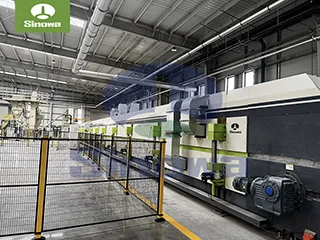
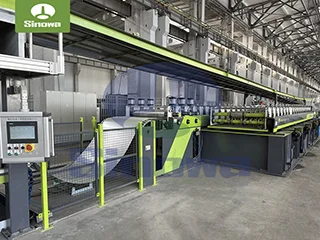
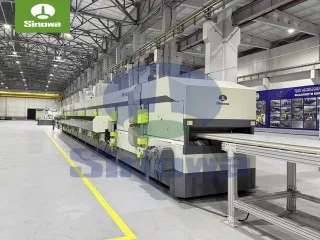
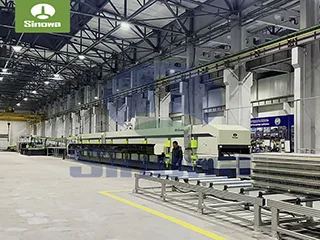
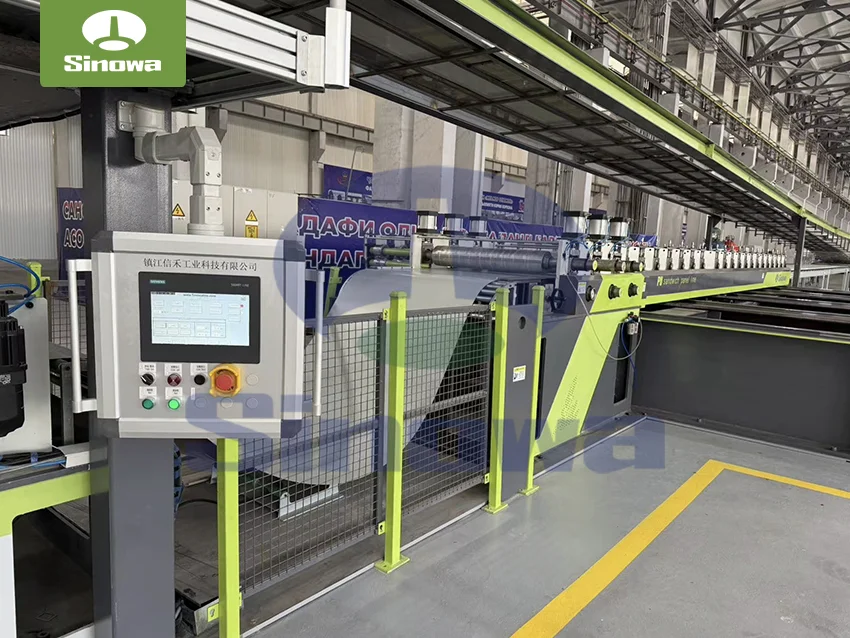
 sandwich panel line
The overall operational logic of the continuous sandwich panel production line centers on the perfect combination of glass wool core substrate and surface facing materials through professional PU adhesive composite technology. Glass wool, as a porous fibrous core material formed by melting and spinning raw silica-based materials, features intricate interlaced fiber structures and abundant internal tiny pores, endowing the finished panels with outstanding thermal insulation, sound absorption and heat preservation capabilities. However, the loose fibrous structure of glass wool also brings higher requirements for the bonding process, as inappropriate adhesive application or compounding pressure may lead to fiber collapse, uneven bonding or reduced core material porosity, which would weaken the comprehensive performance of composite panels. The PU sandwich panel production line is precisely optimized for the physical characteristics of glass wool materials, adopting targeted material conveying, precise adhesive spraying, graded pressure compounding and constant-temperature curing processes to fully retain the inherent performance advantages of glass wool while forming a stable integrated composite structure.
The entire production process starts with the automatic feeding and pretreatment of surface facing materials, which is the foundation for ensuring the flatness and bonding effect of finished panels. The system is equipped with automatic unwinding and leveling units that steadily release coiled facing materials, including metal sheets and other decorative protective materials. Multiple groups of precision leveling rollers eliminate the internal stress and surface wrinkles of the coiled materials, ensuring the flatness of the facing materials throughout the subsequent compounding process. Meanwhile, the integrated surface cleaning and pretreatment device removes floating dust, oil stains and oxide layers on the material surface, creating a clean and dry bonding interface. This pretreatment link is crucial for PU adhesive bonding, as it effectively improves the contact tightness between the adhesive layer and the facing material, avoiding hollowing or peeling caused by surface impurities and significantly enhancing the long-term bonding stability of the composite structure.
Synchronized with the facing material pretreatment process is the automatic processing and conveying of glass wool core materials. Different from rigid foam core materials, glass wool belongs to flexible fibrous materials, so the production line adopts a special flexible feeding and shaping system to avoid fiber damage and density deviation during transportation. The core material conveying unit can automatically adjust feeding speed and laying thickness according to production specifications, realizing uniform and flat laying of glass wool layers. The built-in fine compaction mechanism performs graded micro-compression on the loose glass wool fibers, moderately adjusting the core material porosity to match the bonding requirements without crushing the fine fiber structures or blocking the internal porous channels. This precise control ensures that the glass wool core can maintain excellent thermal and acoustic performance after compounding, while providing a stable structural foundation for subsequent PU adhesive penetration and bonding.
The PU adhesive spraying and composite bonding system serves as the core functional module of the composite sandwich panel line, determining the structural strength and service life of glass wool composite panels. The system adopts a high-precision quantitative spraying mode, which can evenly distribute the prepared polyurethane adhesive on the inner surfaces of upper and lower facing materials and the upper and lower surfaces of the glass wool core layer. Compared with traditional manual gluing or roller coating processes, the atomized spraying technology realizes ultra-thin and uniform adhesive layer coverage, effectively avoiding excessive adhesive accumulation that may block glass wool pores or insufficient local gluing that causes weak bonding. The polyurethane adhesive used in the production process has excellent fluidity and permeability, which can slightly penetrate into the surface fiber gaps of glass wool after spraying, forming a mechanical embedding bonding structure after curing. This bonding method not only improves the bonding strength between the core material and the facing materials, but also enhances the overall integrity of the panel, preventing layer separation and deformation during long-term use.
After the completion of adhesive spraying and core material laying, the semi-finished panels enter the continuous rolling compounding unit for integrated shaping. The PU sandwich panel production line is equipped with multi-stage adjustable pressing rollers, which implement graded pressurization according to the thickness and density characteristics of glass wool core materials. The low-pressure primary pressing stage preliminarily fits the facing materials and the core layer to discharge residual air between layers and avoid bubble generation. The constant-pressure secondary pressing stage completes the stable compounding of the overall structure, ensuring consistent panel thickness and uniform internal stress. The whole pressing process adopts flexible pressure control, which fully adapts to the compressible characteristics of glass wool fibers, avoiding permanent fiber deformation and performance degradation caused by excessive pressure. At the same time, the synchronous speed control system ensures that the feeding, spraying and pressing processes operate in perfect synchronization, eliminating the dislocation and deviation of each structural layer and guaranteeing the overall flatness and structural uniformity of the composite panels.
The constant-temperature thermal curing system is a key link to realize rapid molding and performance stabilization of PU glass wool composite panels. After rolling compounding, the semi-finished products are sent to the segmented curing channel, which adopts circulating hot air heating to create a uniform and stable temperature environment inside the channel. The segmented temperature control mode meets the curing requirements of PU adhesives at different reaction stages: the low-temperature preheating stage promotes the preliminary spreading and infiltration of the adhesive, the medium-temperature curing stage accelerates the cross-linking reaction of polyurethane molecular chains, and the constant-temperature shaping stage completes the final structural stabilization. This gradual curing process enables the PU adhesive to form a high-strength elastic bonding layer, which tightly combines the glass wool core and surface facing materials into an integrated structure. Reasonable temperature control can effectively avoid the problems of incomplete adhesive curing caused by low temperature or brittle adhesive layer caused by excessive temperature, ensuring that the composite panels have both high bonding strength and good toughness, and can adapt to different environmental temperature changes without cracking or delaminating.
Following the curing and shaping process, the polyurethane sandwich panel production line carries out automatic fixed-length cutting and edge finishing of the composite panels. The high-precision tracking cutting system can set arbitrary panel dimensions according to production demands, realizing stable and fast cutting of continuous long-strip panels. The cutting tool adopts special wear-resistant structural design, which can complete smooth cutting of composite structures composed of metal facing and fibrous core materials, without burrs, collapses or fiber scattering at the cutting edge. The subsequent edge trimming and sealing unit carries out fine finishing on the panel edges, optimizing the edge flatness and tightness, which effectively prevents external moisture and dust from entering the core layer through the gaps, improves the moisture resistance and corrosion resistance of the panels, and further extends the service life of the finished products. The entire cutting and finishing process is automatically controlled, with high dimensional accuracy and good consistency of finished product specifications, reducing the error rate caused by manual operation.
The intelligent control system runs through the whole production process of the sandwich panel equipment, realizing integrated management of all functional units. The centralized control platform unifies the parameter setting and operation monitoring of unwinding, leveling, feeding, spraying, compounding, curing and cutting modules, and can automatically adjust operating parameters such as feeding speed, adhesive spraying volume, pressing pressure and curing temperature according to different panel thicknesses and core material densities. The real-time monitoring function can track the operating status of each link in real time, identify abnormal fluctuations in parameters, and realize automatic early warning and parameter correction, effectively reducing the occurrence of defective products. The highly automated operation mode minimizes manual intervention in the production process, not only greatly improves production efficiency and continuous production capacity, but also ensures the stability and consistency of batch product quality, avoiding performance differences between individual products caused by human factors.
This PU sandwich panel line has significant technical advantages in product performance optimization compared with traditional panel production equipment. By virtue of the efficient bonding performance of polyurethane materials and the precise process control of the production line, the finished composite panels achieve excellent structural integrity. The elastic bonding layer formed after PU adhesive curing can buffer the structural stress caused by external temperature changes and mechanical vibration, effectively improving the seismic resistance and deformation resistance of the panels. The fully retained porous fiber structure of glass wool endows the panels with superior thermal insulation performance, which can effectively block heat transfer and reduce building energy consumption. At the same time, the dense fiber layout and integrated composite structure also greatly improve the sound absorption and noise reduction effect of the panels, which can effectively isolate external noise and create a quiet indoor environment.
In terms of production adaptability, the equipment has strong flexible production capacity and can meet the manufacturing requirements of composite panels with different thicknesses, densities and surface specifications. By simply adjusting the operating parameters of each module, the production line can switch between different product specifications, covering the production needs of wall panels, roof panels and partition panels used in different building scenarios. The optimized material utilization system effectively controls the waste of facing materials and core materials in the production process, and the precise quantitative spraying technology avoids the waste of adhesive raw materials, realizing efficient and economical production. In addition, the closed production structure reduces the overflow of dust and fine fibers during the processing of glass wool materials, improving the cleanliness of the production environment and meeting the environmental protection requirements of modern industrial production.
The finished glass wool composite panels produced by this professional sandwich panel production line have broad application prospects in the field of modern construction and industrial facilities. Relying on the excellent fire resistance, thermal insulation and sound insulation properties of glass wool core materials, combined with the stable structural performance brought by PU integrated bonding, the panels are widely used in the enclosure structures of industrial plants, logistics warehouses, public buildings and temporary construction facilities. The lightweight structural characteristics of the composite panels reduce the overall load of the building, while the convenient installation and splicing performance greatly shorten the construction cycle. At the same time, the good weather resistance and corrosion resistance of the panels enable them to maintain stable performance in different climatic environments, realizing long-term safe use and providing reliable material support for energy-saving and green building construction.
With the continuous development of green building and energy-saving building concepts, the market demand for high-performance thermal insulation composite panels is constantly upgrading, which also promotes the continuous technological optimization of PU glass wool composite sandwich panel production line. The future development direction of the equipment focuses on higher automation intelligence, more precise process control and more diversified product adaptation. Through continuous upgrading of transmission systems, sensing systems and control algorithms, the equipment can realize more accurate control of material processing and composite molding, further improve product quality stability and production efficiency, and meet the increasingly stringent performance requirements of the construction industry for energy-saving, environmental protection, safety and durability of building enclosure materials. As a key equipment in the field of new building materials manufacturing, this sandwich panel machinery will continue to play an important role in promoting the industrial upgrading of composite insulation panels and the development of green construction industry.
https://www.cnsinowa.com/sandwich-panel-machines/pu-sandwich-panel-line-for-glass-wool-composite-panels.html