sandwich panel line
Different from discrete processing equipment that relies heavily on manual operation and segmented processing, the automatic sandwich panel production line adopts a streamlined integrated layout, arranging all functional processing units in a sequential production structure. This overall design enables seamless connection from raw material input, surface material forming, core material laying, adhesive compounding, constant-temperature curing, fixed-size cutting to finished product stacking, eliminating intermediate manual handling and repeated positioning links. The entire production process is coordinated and controlled by an intelligent central control system, which can automatically adjust operating parameters according to different production requirements, ensuring that each production link maintains stable operating states and consistent processing standards. This highly integrated production mode not only simplifies the production flow of sandwich panels but also effectively avoids product quality fluctuations caused by human operation errors, laying a solid foundation for large-scale standardized production.
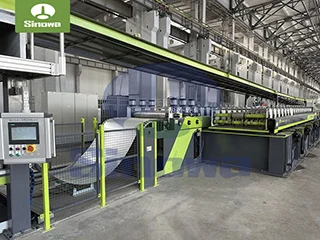
The operational logic of the automatic sandwich panel line is based on continuous roll forming and integrated composite lamination technology, with the whole production process divided into multiple interconnected and coordinated functional stages. The initial stage of production focuses on raw material pretreatment and feeding, which is the basic link to ensure the uniformity of finished products. The surface layer materials of sandwich panels are usually metal coiled materials with good flatness and ductility, which are loaded on automatic uncoiling equipment. Driven by hydraulic and servo transmission systems, the uncoiling device realizes stable and uniform discharging of coiled materials, avoiding tension fluctuation and material deviation during feeding. After uncoiling, the metal sheets will pass through a multi-group leveling system, which eliminates the internal stress and surface wrinkles of the coiled materials through precise mechanical pressing, ensuring that the surface sheets maintain absolute flatness before forming. This pretreatment process is crucial for the subsequent lamination and bonding effect, as uneven surface materials will directly lead to inconsistent bonding gaps and affect the overall structural compactness of finished panels.
Following the pretreatment of surface materials is the roll forming process, which shapes flat metal sheets into various standardized profile structures. The continuous sandwich panel production line is equipped with multi-stage rolling groups with precise spacing and pressure control, and each group of rolling rollers corresponds to different forming procedures. Through gradual rolling and extrusion, flat metal sheets are processed into corrugated, flat or special-shaped structures that meet different engineering design requirements. The whole forming process adopts servo synchronous control technology, which can precisely control the feeding speed and forming precision of metal sheets, ensuring that the size, radian and structure of each formed sheet remain highly consistent. Meanwhile, the production line supports flexible adjustment of forming parameters, which can quickly adapt to the production requirements of panels with different specifications and profile types, realizing flexible switching of multiple production modes on a single device and greatly improving the versatility of production equipment.
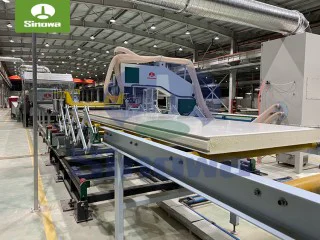
While the surface materials are undergoing forming processing, the core material conveying and arrangement system operates synchronously to realize the precise docking of multi-channel processes. Common core materials for sandwich panels include lightweight thermal insulation and filling materials with excellent thermal insulation and shock resistance, which are automatically transported to the laminating station through a special conveying mechanism. The conveying system is equipped with automatic sorting and leveling devices, which can arrange the bulk or strip core materials neatly and uniformly, eliminate material accumulation and sparse gaps, and ensure that the core material layer maintains consistent thickness and density in the whole panel area. The synchronous operation of the surface material forming system and core material conveying system realizes the parallel progress of multiple processes, effectively shortening the production cycle and improving the overall continuity of production. In addition, the production line is equipped with a precise glue coating system, which can evenly coat high-performance adhesive on the bonding surfaces of surface materials and core materials through quantitative spraying and rolling coating technologies. The intelligent glue supply system can automatically adjust the glue application amount and coating uniformity according to the production speed and panel specifications, ensuring that the adhesive forms a uniform and stable bonding layer without excess glue overflow or local glue shortage, which greatly enhances the bonding firmness between the surface layer and the core layer.
The composite pressing and constant-temperature curing stage is the core link to determine the structural stability and service performance of sandwich panels. After the surface materials and core materials are initially compounded through glue coating, the semi-finished panels enter the integrated pressing and curing system. The pressing device adopts multi-group balanced pressure structure, which can apply uniform and stable pressure on the whole panel surface, making the surface layer and core layer closely bonded without local hollowing or deviation. The internal temperature of the curing system is intelligently controlled in real time, maintaining a constant and reasonable curing temperature environment. Under the dual action of stable pressure and constant temperature, the adhesive undergoes sufficient chemical reaction and curing molding, and the core material completes stable foaming and structural shaping, forming an integrated composite structure with high bonding strength and overall uniformity. The closed-loop temperature and pressure control system can monitor the operating state in real time and automatically correct parameter deviations, ensuring that the curing effect of each batch of panels is consistent, and effectively improving the structural stability, compression resistance and durability of finished products.
After curing and molding, the continuous integrated panel will enter the fixed-length cutting and finishing stage. The continuous sandwich panel line is equipped with high-precision automatic cutting equipment, which can complete fixed-size cutting according to preset parameter instructions. The servo positioning system realizes accurate positioning of the cutting position, and the high-speed cutting mechanism ensures smooth and neat cutting sections without burrs, deformation or edge warping. The intelligent cutting system supports flexible setting of different panel lengths, realizing arbitrary switching of product specifications and meeting the diversified size requirements of different engineering projects. After cutting, the finished panels will pass through the post-processing trimming system, which automatically completes edge trimming, surface cleaning and defect inspection of the panels. The automatic detection device can identify tiny surface defects, bonding gaps and size deviations, and screen out unqualified products in real time, ensuring that all products entering the finished product area meet standardized quality requirements.
The final stage of the production process is automatic stacking and output. The qualified finished sandwich panels are automatically transported to the stacking station through the conveying system, and the intelligent stacking device realizes orderly stacking and arrangement of panels according to the set stacking mode and quantity. The automatic stacking operation replaces traditional manual carrying and stacking, avoiding surface scratches, panel deformation and stacking irregularities caused by manual operation, while greatly reducing labor investment. The stacked finished products have neat overall structure and uniform placement, which is convenient for subsequent transportation, storage and construction application, and improves the overall standardization of product delivery.
The core advantage of the automatic sandwich panel machine lies in its high degree of automation and intelligent control capability, which realizes the whole-process unmanned operation from raw material feeding to finished product output. The entire production system is centrally controlled by a programmable intelligent control terminal, which integrates all process parameters, operating procedures and fault detection functions. Operators only need to set the panel specification, production speed and process parameters through the human-computer interaction interface at the initial stage of production, and the equipment can operate continuously and automatically. The control system has real-time data monitoring and self-adjustment functions, which can dynamically optimize operating parameters according to the operating state of each unit, maintain the synchronous coordination of all links, and ensure the stability and efficiency of long-term continuous production. In addition, the system is equipped with a complete fault self-diagnosis and early warning mechanism, which can timely identify abnormal operating states such as equipment jitter, parameter deviation and material blockage, and trigger early warning prompts and automatic protection procedures, effectively reducing equipment failure rate and production loss caused by faults.
In terms of production quality control, the automatic sandwich panel production machine achieves precise control of the whole production process, completely different from the quality instability of traditional manual production. Each processing link has standardized parameter thresholds and real-time detection feedback mechanisms, and key indicators such as panel thickness, flatness, bonding strength and overall dimensional accuracy are always maintained within a stable range. The continuous production mode avoids batch quality differences caused by segmented processing, making the performance and appearance of each finished panel highly consistent. At the same time, the precise glue coating, constant-temperature curing and balanced pressing processes effectively optimize the internal structure of the panels, improving the overall compression resistance, bending resistance, thermal insulation performance and weather resistance of the products. The finished sandwich panels produced by the automatic line have compact internal structure, no hollow gaps, stable overall performance, and can maintain good structural stability and functional performance in complex application environments for a long time.
In terms of production efficiency and cost control, the automatic sandwich panel manufacturing line shows obvious advantages in large-scale industrial production. The integrated continuous production mode greatly shortens the production cycle of a single panel, and the synchronous operation of multiple processes multiplies the production capacity of the production line. The long-term stable continuous operation capability enables the equipment to maintain efficient production status for a long time, effectively meeting the large-order and batch production needs of the construction and manufacturing industries. At the same time, the high degree of automation greatly reduces the demand for manual operation, realizing the optimization of human resource allocation and significantly reducing labor costs in the production process. In addition, the precise quantitative control of raw materials by the production line avoids raw material waste caused by manual operation errors, improves the utilization rate of raw materials, and further reduces the comprehensive production cost of products. The efficient and cost-saving production mode makes the automatic production line the mainstream choice for large and medium-sized sandwich panel manufacturing enterprises.
With the continuous upgrading of industrial manufacturing concepts and the increasing improvement of building energy-saving standards, the functional requirements for sandwich panels in the market are becoming more diversified, which also promotes the continuous technological optimization and functional upgrading of automatic production lines. Modern automatic sandwich panel production line has broken through the limitations of single-process production, and can adapt to the production of multiple types of core materials and composite structures. By adjusting process parameters and matching functional components, the equipment can produce thermal insulation panels, fire-resistant panels, sound-insulating panels and other functional products with different performance characteristics, meeting the application needs of different scenarios such as high-temperature resistance, low-temperature thermal insulation and sound absorption and noise reduction. At the same time, the production line has realized the optimization of energy-saving structure, adopting energy-efficient transmission components and intelligent temperature control systems, which effectively reduce energy consumption in the production process, realize green and low-carbon production, and conform to the development trend of modern industrial energy conservation and environmental protection.
In practical industrial application, the stable operation performance and flexible production capacity of automatic sandwich panel machinery provide strong support for the standardized development of the building composite material industry. The highly standardized finished products produced by the equipment have good interchangeability and adaptability, which can be perfectly matched with various building enclosure structures and industrial supporting facilities, improving the construction efficiency and engineering quality of downstream projects. Whether it is the rapid construction of large industrial plants, the thermal insulation and sealing of cold storage and fresh-keeping facilities, or the structural assembly of modern light steel buildings, high-quality sandwich panels produced by automatic production lines can provide reliable material support. With the continuous expansion of the application scope of sandwich panels in new energy buildings, prefabricated buildings and special industrial facilities, the market demand for high-efficiency and intelligent automatic production lines will continue to grow.
Looking at the development trend of the industry, the automatic sandwich panel production line will further develop in the direction of higher intelligence, stronger flexibility and better environmental performance. The deep integration of intelligent sensing technology, big data analysis technology and production equipment will realize the full digital monitoring and intelligent management of the production process, further improve the precision of production control and product quality stability. The modular design of production equipment will enhance the flexibility of production line transformation and upgrading, and can quickly adapt to the iterative upgrading of product specifications and functional requirements. At the same time, with the continuous improvement of industrial environmental protection standards, the production line will further optimize the production process, reduce the generation of waste materials and pollutants in the production process, and realize a more efficient, environmentally friendly and sustainable production mode. As the core equipment of the sandwich panel manufacturing industry, the automatic production line will continue to drive the technological progress and industrial upgrading of the composite building material industry, and provide more high-quality and reliable basic materials for the development of modern construction and industrial manufacturing fields.
https://www.cnsinowa.com/sandwich-panel-machines/automatic-production-line-for-sandwich-panels.html