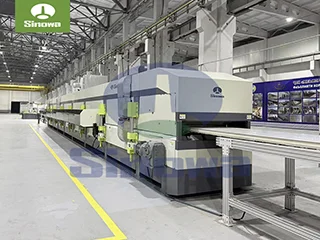
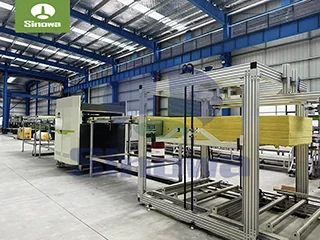
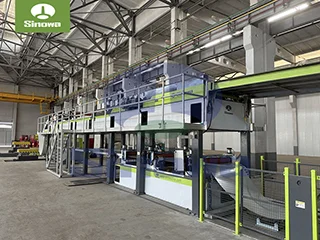
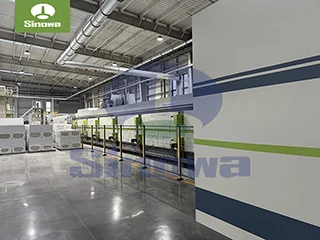
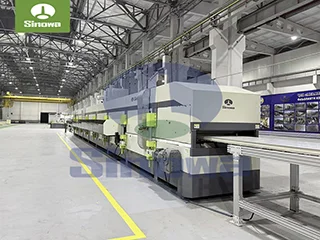
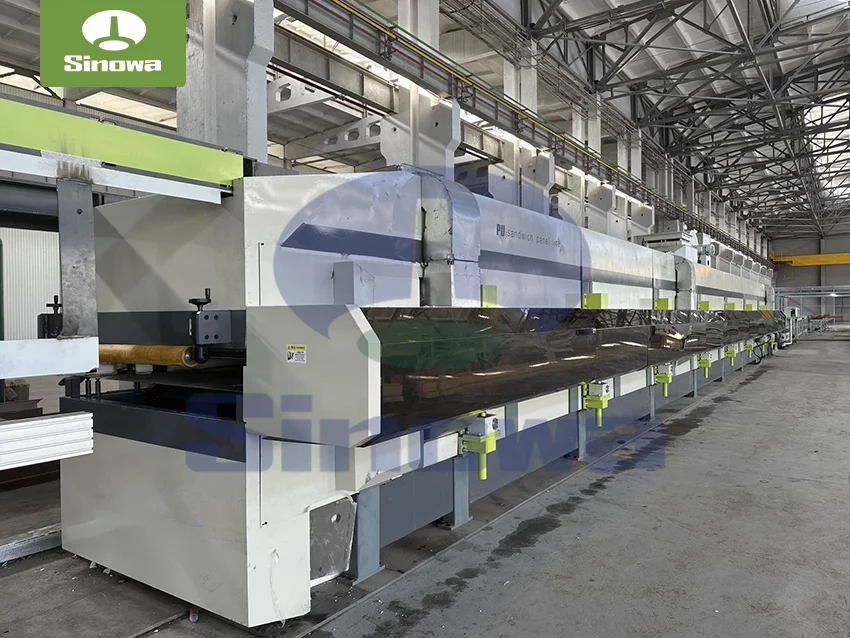
 sandwich panel line
The entire production workflow starts with the orderly unwinding and pretreatment of raw materials, which lays a foundational guarantee for the subsequent composite molding process. Aluminum foil, as the key surface material of the finished panels, is delivered to the production station in coil form. The unwinding unit of the PU sandwich panel production line is equipped with intelligent tension adjustment structures, which can stably release the aluminum foil material at a constant speed during operation. This design effectively avoids common defects such as material wrinkling, stretching deformation, and offset deviation that easily occur in the unwinding process of thin flexible materials. While unwinding, the auxiliary leveling and surface cleaning structures of the production line will remove tiny dust, oil stains, and impurities on the surface of the aluminum foil, ensuring that the bonding interface between the aluminum foil and polyurethane foam is clean and flat. A clean and dry bonding surface is essential for enhancing the composite fastness of the panel, as any residual impurities will weaken the adhesion between the surface layer and the core material, leading to delamination or cracking of the panel during long-term use. Meanwhile, the production line completes the unwinding and preliminary arrangement of the auxiliary base materials matching the panel structure, ensuring that all raw materials enter the subsequent processing link in a synchronized and orderly state.
After the raw material pretreatment is completed, the PU sandwich panel line enters the core foaming and pouring stage, which directly determines the thermal insulation performance and structural uniformity of the PU sandwich panel. The polyurethane foaming system of the production line adopts precise proportional metering and high-speed mixing technology. The two-component polyurethane raw materials are accurately transported to the high-pressure mixing head through independent metering units, where the materials undergo full and uniform mixing at a stable state. The whole mixing process is completed in a closed environment, which ensures the stability of the chemical reaction of the polyurethane raw materials and avoids uneven foaming caused by insufficient mixing or proportion deviation. The well-mixed polyurethane material is continuously and evenly poured on the inner side of the flattened aluminum foil base material through the automatic pouring device of the production line. The pouring range, thickness, and flow rate are precisely controlled by the system to ensure that the polyurethane raw materials can cover the aluminum foil surface completely and uniformly without local accumulation or missing areas. This accurate pouring mode is the key to forming a dense and consistent foam core layer, avoiding hollowing, uneven thickness, and inconsistent density inside the panel.
Subsequently, the PU sandwich panel machine completes the lamination and composite molding of the panel through the double-track laminating system, which is the key link to realize the integration of aluminum foil surface layer and PU foam core layer. After the polyurethane material is poured, the upper aluminum foil surface material and the lower base material are accurately butted and conveyed into the constant-temperature lamination curing channel along with the unfoamed polyurethane raw materials. The double-track laminating structure maintains stable and uniform pressure in the whole lamination section, which can effectively limit the free expansion range of the polyurethane foam and force the foam to expand and fill the preset space in an orderly manner. At the same time, the temperature control system of the lamination channel provides a constant and appropriate reaction temperature for the polyurethane foaming and curing process. Under the dual action of constant pressure and constant temperature, the polyurethane raw materials undergo steady chemical foaming, gelation, and solidification reactions. The foam gradually forms a fine and closed-cell structure, and closely bonds with the inner surface of the aluminum foil, forming an integrated composite structure with no gap between the surface layer and the core layer.
The length and temperature gradient design of the lamination curing section of the polyurethane sandwich panel production line are scientifically optimized according to the foaming characteristics of polyurethane materials. The front section of the curing channel adopts a slightly higher temperature to accelerate the initiation and expansion of the foaming reaction, ensuring that the foam can fully fill the composite space in a short time. The middle section maintains a constant temperature to promote the complete gelation of the foam and enhance the bonding strength between the foam and aluminum foil. The rear section adopts a gradual cooling design to stabilize the internal structure of the cured panel, eliminate the internal stress generated during the foaming and molding process, and prevent the finished panel from warping, deforming or rebounding after leaving the production line. This segmented temperature control mode ensures that each batch of panels can complete the foaming curing process in the most appropriate reaction environment, greatly improving the structural stability and dimensional accuracy of the finished products. Compared with manual or semi-automatic intermittent production methods, the continuous lamination curing process of the production line makes the foaming reaction state of each panel completely consistent, realizing zero difference in core density and bonding strength of mass-produced products.
After completing lamination and primary curing, the semi-finished panels enter the trimming and finishing stage of the polyurethane sandwich panel line to achieve standardized dimensional specifications. The continuous conveying structure of the production line stably transports the cured composite panels to the trimming unit, where the edge trimming device accurately cuts off the irregular excess materials on both sides of the panels. The edge trimming process can remove the unqualified foam and aluminum foil edge materials generated in the molding process, making the two sides of the panels flat and neat, and facilitating the seamless assembly and splicing of the panels in subsequent engineering applications. After edge trimming, the panels are sent to the fixed-length cutting station. The intelligent tracking and cutting system of the production line can automatically identify and set the cutting length according to the production requirements, and complete the fixed-length cutting of the panels through high-precision cutting components. The cutting process is stable and efficient, with smooth and burr-free cutting sections, which effectively avoids material waste and dimensional errors caused by manual cutting. All trimming and cutting processes are completed in a fully automated continuous state, which not only improves production efficiency but also ensures the unified dimensional tolerance of each finished panel.
The final stage of the production process is cooling shaping and finished product sorting and conveying. The cut fixed-length panels are transported to the cooling flatting area of the polyurethane sandwich panel machine, where the natural air cooling and auxiliary air cooling structures quickly reduce the surface and internal temperature of the panels to room temperature. The cooling process can further stabilize the internal closed-cell structure of the polyurethane foam, completely eliminate the residual molding stress, and ensure that the panels will not have dimensional changes or structural deformation during storage and use. After full cooling and shaping, the qualified finished panels are automatically conveyed to the finished product stacking area through the conveying system. The whole process from raw material feeding to finished product output is completed in a fully continuous and automated cycle, with no need for intermediate manual transfer and intervention, which greatly reduces the labor cost and human error in the production process.
The unique structural design and process configuration of the aluminum foil faced continuous PU sandwich panel production line endow the finished panels with excellent comprehensive performance and wide application adaptability. First of all, the precise foaming and lamination process of the production line enables the polyurethane core layer to form a uniform closed-cell structure with high density stability, which gives the panel extremely low thermal conductivity and excellent thermal insulation performance. This structural feature can effectively block heat transfer, making the panel an ideal energy-saving insulation material for building envelopes and cold storage spaces. Secondly, the aluminum foil surface layer formed by composite molding through the production line has good weather resistance, moisture resistance, and anti-corrosion ability. The aluminum foil layer can effectively isolate external moisture, air, and corrosive media, protect the internal polyurethane foam core layer from damp aging and corrosion, and greatly extend the service life of the panel. In addition, the integrated composite structure formed by one-time continuous molding of the production line has high overall structural strength, with good compression resistance, bending resistance, and shock resistance, which can adapt to various complex installation and use environments.
In terms of production stability and operational advantages, this professional production line has obvious advantages over general panel production equipment. The whole production system adopts synchronous linkage control of multiple units, and the operating speed, process temperature, molding pressure, and material proportion parameters of each link are uniformly regulated by the central control system. This highly integrated control mode ensures that all production parameters are kept within the optimal range during the continuous operation process, avoiding product quality fluctuations caused by parameter adjustment errors and equipment asynchronous operation. The production line is also equipped with multiple anti-deviation and anti-wear structures for material conveying, which can keep the thin aluminum foil material in a flat and stable conveying state for a long time, effectively reducing the defect rate of surface material damage and composite deviation. At the same time, the closed foaming and molding environment of the production line reduces the overflow of raw materials and the generation of waste materials in the production process, realizing efficient utilization of raw materials and environmentally friendly production operation.
In practical industrial production applications, the aluminum foil faced continuous PU sandwich panel line shows strong production flexibility and market adaptability. By adjusting the operating parameters of the system, the production line can manufacture panels with different core thicknesses, surface specifications, and structural strengths to meet the differentiated needs of different application scenarios. Whether it is thin lightweight panels for interior building insulation or thick high-strength panels for exterior wall thermal insulation and cold chain warehouse enclosure, the production line can complete efficient and standardized production through simple parameter adjustment. The continuous production mode of the equipment can realize uninterrupted large-scale production, greatly shorten the production cycle of a single panel, and meet the large-volume order demand of engineering construction and industrial supporting projects. In addition, the fully automated production process reduces the dependence on skilled operators, simplifies the production management process, and makes the whole production process more standardized and controllable.
With the continuous improvement of energy-saving and environmental protection requirements in the modern construction and industrial fields, the market demand for high-efficiency insulation and durable composite panels is increasing day by day, which also promotes the continuous optimization and upgrading of aluminum foil faced PU sandwich panel production line. The upgraded production equipment pays more attention to the refinement of process control and the stability of long-term operation. The optimized metering and mixing system can realize more accurate proportioning of polyurethane raw materials, further improving the uniformity and fineness of the foam structure. The upgraded temperature and pressure control system can realize more precise segmented regulation, making the panel bonding strength and structural stability reach a higher level. At the same time, the optimized conveying and trimming structure further reduces the loss of raw materials in the production process, improves the yield of finished products, and realizes more economical and efficient production.
In summary, the professional production line for aluminum foil faced PU sandwich panels is a highly efficient, stable, and intelligent integrated production system tailored for composite insulation panel manufacturing. Through standardized and streamlined processes such as precise raw material pretreatment, uniform foaming and pouring, constant-temperature pressure lamination curing, and precise trimming and molding, the sandwich panel equipment stably produces high-performance aluminum foil faced PU sandwich panels with uniform structure, reliable performance, and strong durability. The excellent production characteristics of the equipment not only ensure the consistent quality of mass-produced products but also improve the overall production efficiency and economic benefits of the production process. As a key core equipment in the field of energy-saving insulation material manufacturing, this production line provides solid technical and equipment support for the popularization and application of high-quality insulation composite panels in modern construction, cold chain logistics, industrial manufacturing, and other fields, and also promotes the standardized and high-quality development of the whole insulation panel industry.
https://www.cnsinowa.com/sandwich-panel-machines/pu-sandwich-panel-line-for-aluminum-foil-faced-panels.html