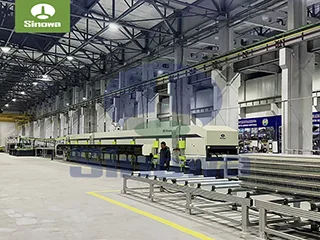
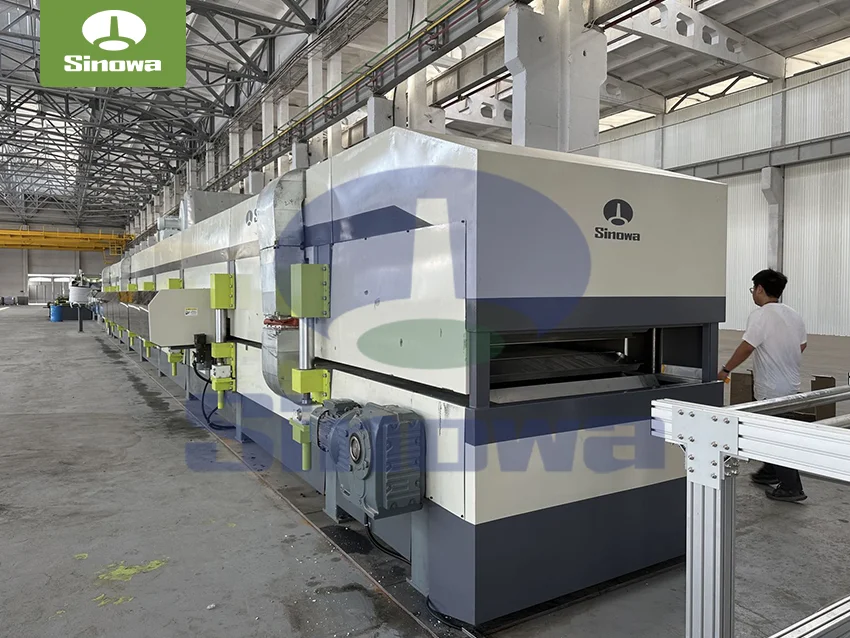
 sandwich panel line
To fully understand the operational value of the double belt conveyor in PU sandwich panel production, it is essential to break down the complete production logic of the entire line and the unique functional advantages brought by the dual-belt structure. The full production workflow of the PU sandwich panel line starts with the automatic feeding and preprocessing of surface materials. Common surface substrates include metal sheets with anti-corrosion and decorative treatments, as well as other lightweight rigid plate materials, all of which are released from coil stocks and conveyed into the pre-forming unit through automatic feeding mechanisms. Before entering the core composite molding stage, the surface materials undergo continuous leveling, trimming, and preheating treatment. Preheating is a critical preparatory step that eliminates surface temperature differences of the substrates, optimizes the adhesion condition between the substrate and PU foam materials, and avoids quality defects such as incomplete foaming and local delamination caused by low or uneven substrate temperature during subsequent composite molding.
After surface material preprocessing, the production process enters the batching and foaming injection stage of PU core materials. Polyurethane composite materials are composed of two-component foam raw materials, which are accurately proportioned and transported to the high-pressure mixing unit through precision metering systems. The raw materials undergo full homogeneous mixing under high-pressure conditions to form a uniform liquid foaming mixture, which is then evenly sprayed and distributed on the surface of the lower substrate material that is steadily advancing along the conveyor track. The uniformity of mixing and spraying directly determines the compactness and thermal insulation performance of the subsequent PU foam core layer, laying a foundation for the overall quality of the sandwich panel. Unlike manual or semi-automatic intermittent foaming methods, the continuous feeding and spraying mode matched with the double belt conveyor realizes uninterrupted material supply, ensuring the consistency of foam raw material dosage and distribution state in each production section.
The double belt conveyor system undertakes the most critical molding and curing process in the entire production sequence, serving as the core equipment that determines the dimensional accuracy and structural stability of finished panels. The system consists of upper and lower parallel endless conveyor belts, supporting transmission components, precision height adjustment structures, constant temperature heating modules, and lateral guiding devices. The upper and lower belts operate at completely synchronous speeds to clamp and wrap the upper and lower surface substrates and the middle PU foaming layer in a closed and stable conveying space. This synchronous operation mode fundamentally eliminates the relative displacement and sliding deviation between the upper and lower plates during the foaming and curing process, effectively preventing panel surface scratches, dislocation deformation, and uneven edge trimming that often occur in single-belt or asynchronous conveying equipment.
A key functional feature of the double belt conveyor is its stable constant-pressure lamination capability during the PU foam expansion and curing cycle. After the liquid PU mixture is sprayed between the upper and lower substrates, it begins to expand rapidly and fill the interlayer space. The dual-belt structure maintains continuous and uniform vertical pressure on the composite structure throughout the foaming process, restricting the free expansion of the foam and guiding it to form a dense, uniform, and flat core layer structure. This constant-pressure constraint effectively improves the closed-cell rate of the PU foam core, enhancing the thermal insulation, sound insulation, and water resistance of the finished panel. Without the precise pressure control of the double belt system, the foam would expand randomly, resulting in inconsistent core density, irregular panel thickness, and loose bonding between the core layer and surface substrates, which greatly reduces the structural strength and service life of the sandwich panel.
In addition to constant-pressure lamination, the double belt conveyor is equipped with a precise constant-temperature heating system that creates a stable thermal environment for PU foam curing. The heating zone of the conveyor maintains a controllable and uniform temperature range, which accelerates the chemical reaction of PU foaming and solidification, ensuring that the foam completes full expansion, curing, and adhesion in the limited conveying stroke. The length of the double belt conveying and heating section is scientifically designed to provide sufficient reaction time for the PU material, avoiding incomplete curing caused by insufficient reaction time or material performance degradation caused by excessive high-temperature baking. The internal circulating heating structure ensures uniform temperature distribution in the entire lamination cavity, eliminating local overheating or underheating problems, so that every section of the panel maintains consistent curing quality and performance indicators.
The lateral guiding and width adjustment mechanism of the double belt conveyor further improves the production flexibility and dimensional accuracy of the equipment. The side guiding devices arranged on both sides of the belt can effectively limit the horizontal expansion range of the PU foam, accurately defining the width of the finished panel and preventing edge deformation, warping, and irregular burrs. The spacing between the upper and lower belts and the width of the guiding structure can be adjusted precisely according to production demands, adapting to the manufacturing of sandwich panels with different thicknesses and widths. This adjustable design enables a single production line to meet the diversified product specifications required by different application scenarios, greatly improving the equipment utilization rate and production flexibility compared with traditional fixed-size molding equipment.
The structural stability and material selection of the double belt conveyor determine its long-term operational reliability in continuous industrial production. The conveyor belts adopt high-strength, wear-resistant, and high-temperature-resistant materials, which can withstand long-term constant-pressure operation and cyclic temperature changes without deformation, aging, or surface damage. The overall frame of the equipment is equipped with a high-precision calibration structure to ensure the horizontal parallelism of the upper and lower belts during long-term operation, avoiding thickness deviation of panels caused by belt inclination or jitter. The matching transmission system adopts stable frequency conversion speed regulation technology, which can adjust the conveying speed steplessly according to the production rhythm and curing requirements, realizing the coordinated matching of foaming reaction speed, curing time, and conveying efficiency, and achieving the optimal balance between production efficiency and product quality.
After completing the foaming, curing, and composite molding in the double belt conveyor system, the integrally formed continuous sandwich panel is sent to the subsequent post-processing unit. The continuous panel is cut into standard fixed-length finished products through a high-precision flying saw cutting device, with smooth and flat cutting sections without burrs or collapse edges. Subsequent processes include edge trimming, surface finishing, and automatic stacking, all of which form a fully automated closed-loop production process. The stable output of high-quality semi-finished products from the double belt conveyor lays a solid foundation for the consistency of finished product quality in post-processing, reducing the defective rate caused by front-end molding defects and lowering subsequent processing costs.
Compared with traditional intermittent PU sandwich panel production equipment and single-belt production lines, the polyurethane sandwich panel production line equipped with double belt conveyor shows comprehensive advantages in product quality, production efficiency, and operational stability. In terms of product performance, the constant-pressure and constant-temperature molding environment ensures that the bonding strength between the PU core layer and the surface substrate is significantly improved, effectively avoiding interlayer delamination and peeling problems that are prone to occur in long-term use. The uniform foam cell structure makes the panel have stable thermal insulation performance, low thermal conductivity, and excellent weather resistance, which can adapt to complex outdoor and industrial environment conditions for a long time. In terms of dimensional accuracy, the dual-belt synchronous clamping and guiding control make the thickness error and flatness deviation of the finished panel controlled within a very small range, meeting the high-precision installation and assembly requirements of modern building engineering and industrial facilities.
In terms of production efficiency, the continuous uninterrupted conveying and molding mode of the double belt conveyor completely breaks the efficiency bottleneck of intermittent production. The polyurethane sandwich panel line can realize long-term stable continuous operation, with a greatly improved single-line output capacity, and the unit production energy consumption is effectively reduced due to the optimized thermal cycle and material utilization mode. The precise metering and uniform molding control reduce the waste of PU foam raw materials, improving the overall material utilization rate of the production line. In addition, the highly automated operation mode reduces manual intervention links in the production process, lowers the impact of human operation errors on product quality, and realizes standardized and standardized production of sandwich panels.
The technological advantages of the double belt conveyor-based PU sandwich panel machine also support the diversified application expansion of PU sandwich panels. The finished panels produced by this equipment have lightweight, high strength, excellent thermal and sound insulation, fire retardancy, and convenient construction characteristics, and are widely used in prefabricated building envelopes, cold storage and refrigeration facility insulation layers, industrial factory wall and roof systems, clean workshop enclosure structures, and modular building components. In cold chain logistics facilities, the high closed-cell PU core layer ensures low heat transfer efficiency, reducing the long-term energy consumption of refrigeration equipment. In industrial building applications, the integrated composite structure has good wind resistance, pressure resistance, and structural stability, adapting to different climatic and environmental conditions.
From the perspective of production process upgrading, the double belt conveyor system represents the advanced development direction of continuous intelligent manufacturing of PU sandwich panels. With the continuous improvement of building energy-saving standards and industrial material performance requirements, the market demand for high-precision, high-stability, and high-performance sandwich panels continues to rise. The traditional production process is difficult to meet the stringent requirements of modern engineering for panel consistency, durability, and dimensional accuracy, while the double belt conveyor production line, through synchronous transmission, constant pressure molding, precise temperature control, and flexible adjustment functions, realizes the overall upgrading of production technology. It not only improves the intrinsic quality of products but also promotes the standardized and large-scale development of the PU sandwich panel industry.
In actual production operation, the double belt conveyor system also has excellent maintainability and operational stability. The modular structural design facilitates daily inspection, maintenance, and partial replacement of wearing parts, reducing equipment downtime and maintenance costs. The intelligent speed regulation and pressure self-calibration function can automatically adjust the operating parameters according to different raw material characteristics and production specifications, ensuring the stability of the production process in different working conditions. The optimized mechanical structure design reduces vibration and jitter during high-speed operation, further improving the surface flatness and overall uniformity of the molded panels.
In conclusion, the double belt conveyor is the core technological support for high-quality continuous production of PU sandwich panels. It integrates precise conveying, constant-pressure lamination, constant-temperature curing, and flexible adjustment functions, solving multiple quality and efficiency problems in traditional production processes. By realizing synchronous and stable molding of surface substrates and PU foam core materials, the equipment ensures the structural integrity, performance stability, and dimensional accuracy of finished sandwich panels. With the continuous development of prefabricated construction, energy-saving building materials, and industrial insulation industries, the PU sandwich panel production line equipped with double belt conveyor will continue to play an irreplaceable role, providing efficient, stable, and high-quality manufacturing solutions for the production of lightweight energy-saving composite panels, and continuously driving the technological progress and industrial upgrading of the building material manufacturing field.
https://www.cnsinowa.com/sandwich-panel-machines/pu-sandwich-panel-line-with-double-belt-conveyor.html